AI + Blockchain: How Chainbase Builds a New Ecosystem for Data Value?
TechFlow Selected TechFlow Selected
AI + Blockchain: How Chainbase Builds a New Ecosystem for Data Value?
Chainbase aims to democratize on-chain data access and has, to date, processed over 500 billion data queries, supporting more than 20,000 developers and 8,000 projects.
 Navigating Web3 tides with focused insights
Data, as a core element of blockchain technology, is becoming increasingly significant. It is not only a key resource driving the development of the entire ecosystem but also a continuous source of vitality. However, behind the rapid growth of Web3, we face numerous challenges:
An overabundance of public blockchains has led to data being scattered across isolated networks, hindering efficient data circulation and value extraction. Low-quality data fails to meet the demands of complex applications, restricting the development and deployment of innovative use cases. Existing centralized platforms struggle to integrate global data and developer communities, impeding Web3’s true realization of decentralization and collaborative progress.
In response to these data challenges, Chainbase—leveraging sharp market insight—has pivoted into the data domain, reshaping Web3's data infrastructure in a blockchain-native way and laying a solid foundation for the convergence of AI and blockchain. It aims to build an open, transparent, and crypto-native data interoperability layer, enabling developers worldwide to easily access, process, and utilize data resources.
Chainbase has successfully closed a $15 million Series A funding round, attracting participation from Tencent Investment Group, Matrix Partners, Hash Global, Folius Ventures, JSquare, DFG, Mask Network, Bodl Ventures, and Bonfire Union Ventures. This capital will be used to build the most comprehensive on-chain data infrastructure for the Web3 ecosystem.
Chainbase is committed to democratizing access to on-chain data. To date, it has processed over 500 billion data calls and supported more than 20,000 developers and 8,000 projects.
Chainbase: Building a Crypto-Native Data Infrastructure
Chainbase focuses on the crypto-native data infrastructure space. Compared to traditional data infrastructures like The Graph and Dune, Chainbase places blockchain at its core and builds a next-generation AI stack from the chain outward. Using a blockchain-native approach, it has developed a decentralized architecture with four layers and dual consensus mechanisms to achieve high accessibility across thousands of chains, ensure data integrity within decentralized networks, and standardize data formats—enabling broader adoption by large-scale, complex applications and AI-driven use cases. Furthermore, Chainbase introduces on-chain native AI, unlocking new possibilities for data analysis and application development.
Chainbase’s technical architecture consists of four key layers: the Data Access Layer, Data Integrity Layer, Data Format Standardization Layer, and On-Chain Native AI Layer. Specifically:
Data Access Layer: Provides efficient and user-friendly data access interfaces, supporting data queries across multiple blockchain networks while ensuring real-time performance and accuracy.
Data Integrity Layer: Leverages distributed ledger technology and cryptographic algorithms to guarantee data integrity and immutability, thereby safeguarding user data security.
Data Format Standardization Layer: Unifies data format standards to eliminate data silos and enable cross-chain data interoperability.
On-Chain Native AI Layer: Integrates AI capabilities directly into the blockchain network, offering smart contract and data analytics services that enhance data processing and application efficiency.
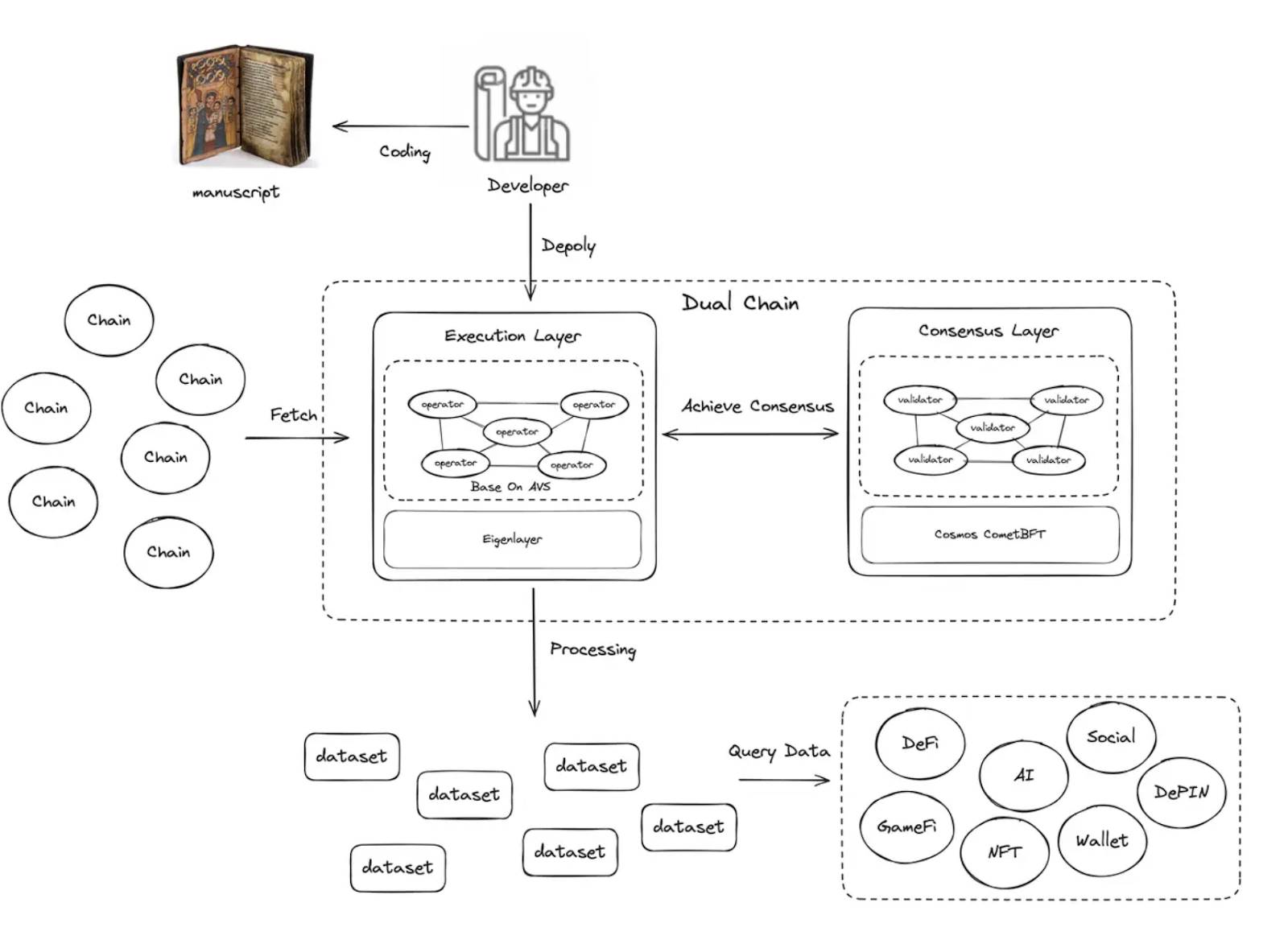
This novel architecture ensures efficient data processing and access while introducing on-chain native AI to empower advanced data analytics and applications. It adapts well to the fast-evolving and diverse needs of Web3 and provides developers with more flexible and efficient data services. Moreover, its decentralized design maintains high levels of security and stability even when handling complex data queries and analytical tasks.
As Chris Feng, Co-Founder and COO of Chainbase, noted in an interview, with the flourishing of Web3, “on-chain data is no longer limited to simple transaction records—it is gradually evolving into a new asset class.” These data sets are not just used for transaction validation but have become valuable resources that provide insights and drive innovation. Chris emphasized, “Robust data infrastructure is key to realizing this vision.”
Understanding the importance of data transparency and fairness, Chainbase is dedicated to building an ecosystem that breaks the monopoly held by a few centralized entities. It offers a unified, modular, and interoperable on-chain data layer accessible to a broad audience, allowing developers to easily leverage high-quality data to build more precise and efficient applications within the Web3 environment.
The $C Token Economy and Incentive Mechanism
The $C token is Chainbase’s native utility token and a core component of its ecosystem. Its tokenomics are designed to precisely align incentives among all participants, supporting a sustainable and secure network environment. This model ensures seamless coordination between the execution and consensus layers while continuously driving network development and widespread adoption. As a utility token, $C also effectively coordinates data supply and demand within the network and incentivizes protocol participants to efficiently organize and manage data.
The $C token’s incentive mechanism is allocated across several dimensions:
Data Query Fees: Data developers create scripts that process blockchain data into queryable datasets. Each time these datasets are accessed, users must pay a fee in $C tokens to cover retrieval costs and reward network resource providers (e.g., operators and validators) for their ongoing service. Distribution is as follows: 80% goes to operators and their delegators to incentivize them to maintain and optimize computing resources for efficient query processing; 15% is awarded to data developers to encourage high-quality data processing logic; the remaining 5% is burned to help maintain the token’s economic value.
Operator Incentive Pool: Over a six-year period, 15% of the total $C token supply will unlock annually at a rate of 2%, aimed at incentivizing operators to provide reliable and diverse computational resources to support large-scale data processing. Allocation principle: 100% distributed fairly to operators and their delegators based on the quality and volume of data processing services provided to blockchain projects.
Block Rewards: Designed to bootstrap the network and maintain a -2% annual inflation rate, block rewards are distributed as follows: 100% to validators and their delegators in recognition of their contributions to network security, stability, and smooth blockchain operations.
To ensure the long-term value and stability of the $C token, Chainbase implements multiple deflationary and value-preserving mechanisms, including setting an annual cap on token issuance, carefully controlling new token distribution, maintaining broad utility across the platform, dynamically adjusting query fees based on network activity, and requiring validators and delegators to stake tokens.
Why Should You Pay Attention to the $C Token?
First, the $C token is backed by real-world use cases that anchor its value.
As the native token of Chainbase’s data network, $C facilitates and incentivizes various ecosystem activities, serving as both a medium of exchange and an incentive engine within the platform. It enables diverse ecosystem activities and allows users to pay for data queries and earn rewards through practical utility. Additionally, the $C tokenomics model ensures efficient collaboration between execution and consensus layers, providing strong momentum for continuous network development and broad adoption.
Second, the $C token’s incentive structure demonstrates deep respect for the community.
Through its well-balanced reward system, $C distributes data query fees, operator incentives, and block rewards in a fair manner, ensuring all contributors receive appropriate returns. For example, 80% of query fees go to operators and delegators, 15% to data developers, and 5% are burned to preserve token value.
More importantly, the $C incentive model encourages active user participation—whether by contributing computing resources, validating transactions, or submitting data transformation code—in exchange for rewards. At the same time, multiple anti-inflationary measures are in place to maintain token utility and protect long-term user value.
How Can Users Participate More Effectively?
Currently, users can participate in the Chainbase Genesis campaign and the first phase of Chainbase EcoBoost to earn $C token rewards by verifying addresses, referring friends, and completing tasks. Additionally, Chainbase has partnered with TrustaLabs to launch the first phase of Chainbase EcoBoost, where participants stand a chance to win generous $C token and eTrusta point rewards.
Beyond campaigns, there are many ways to contribute to the Chainbase network: developers can contribute by writing documentation or developing code; users can support the network by using Chainbase products and services; investors can back the network by investing in $C tokens. Moreover, actively engaging in Chainbase’s community governance and decision-making processes is another vital way to support the project’s long-term success.
Empowering Diverse Scenarios Through a Decentralized Data Network
In reality, Chainbase is emerging as a leader in the decentralized data network space. To ensure high data security and trustworthiness while empowering application development through data intelligence, Chainbase relies on three core components to drive a virtuous cycle of data and applications: distributed ledger technology, a dual-chain technical architecture, and a dual-staking model. These enable end-to-end processes including data verification, storage, processing, analysis, and value distribution, forming the foundational backbone of the entire Chainbase ecosystem.
Specifically, the decentralized architecture is the cornerstone of the Chainbase protocol, ensuring data security and trust. By leveraging distributed ledger technology, Chainbase prevents data tampering or deletion, guaranteeing integrity and reliability. The dual-chain architecture enables high throughput and low latency, meeting the demands of large-scale data processing. Meanwhile, the dual-staking model further enhances network security, ensuring data stability and availability.
In terms of data processing, Chainbase achieves high data accessibility across thousands of chains and standardizes data formats to facilitate interoperability. By integrating on-chain native AI, Chainbase unlocks entirely new possibilities for data analytics and applications, significantly expanding the scope and value of data utilization.
The Chainbase protocol aims to promote data exchange and value distribution across decentralized data networks, wallets, security, AI, and other domains. Currently, Chainbase has extensive applications across multiple sectors. In DeFi, for instance, Chainbase provides comprehensive data support and analytical services. DeFi applications can leverage Chainbase to access real-time transaction and market data from blockchains, enabling better-informed decisions. Additionally, Chainbase offers secure and efficient data storage and access solutions, protecting user assets and data privacy.
Fusing AI and Blockchain: Pioneering a New Cryptoeconomic Model
AI is transforming the world, and Chainbase deeply understands that the integration of AI and blockchain will be a pivotal force in advancing Web3. While AI is reshaping business operations, blockchain brings unique advantages in data transparency and trust, making it an ideal partner for AI applications. Through its innovative network, Chainbase transforms raw blockchain data into actionable insights for AI models, enabling them to understand and process on-chain data more accurately and build smarter, more efficient application platforms.
In innovating cryptoeconomic models, Chainbase is working to develop the first comprehensive intelligent model dedicated to the crypto domain, significantly enhancing AI capabilities and setting a new benchmark for on-chain intelligence. Chainbase believes this breakthrough will attract millions of developers and users, standardize on-chain data interfaces, and deliver unprecedented value to data creators and consumers alike.
Conclusion
In today’s digital era, data has become an invaluable strategic resource. Yet, the privacy crises and monopolistic dominance seen in the Web2 era are pushing the industry toward new solutions. Chainbase, an ambitious project, is striving to build the world’s largest omnichain data network—consolidating fragmented blockchain data into a unified ecosystem and establishing an open, transparent foundation for data interaction in the coming AI age.
Chainbase’s core mission is to return data sovereignty to users, ensure privacy protection, and promote fairer distribution of data value. With the gradual maturation of its token economy and the rollout of community incentive programs, Chainbase is beginning to trigger a powerful flywheel effect, accelerating breakthroughs in product iteration, ecosystem expansion, and user growth.
Chainbase is not only redefining the value dimensions of data but also opening boundless possibilities for the deep integration of AI and blockchain. Its pioneering cryptoeconomic framework is steadily becoming a reality, signaling that Chainbase is entering a brilliant new chapter of development.
Join TechFlow official community to stay tuned
Telegram:https://t.me/TechFlowDaily
X (Twitter):https://x.com/TechFlowPost
X (Twitter) EN:https://x.com/BlockFlow_News
 @ChainbaseHQ