Mapping the Bitcoin Layer 2 Landscape: Sidechains and Rollups Emerge as Mainstream Paths, Top Projects Raising Tens of Millions of Dollars
TechFlow Selected TechFlow Selected
Mapping the Bitcoin Layer 2 Landscape: Sidechains and Rollups Emerge as Mainstream Paths, Top Projects Raising Tens of Millions of Dollars
According to statistics from l2.watch, there are currently over 80 Layer2 projects focused on Bitcoin scaling.
 Navigating Web3 tides with focused insights
Author: Weilin, PANews
Bitcoin Layer2 refers to a second-layer blockchain network built outside the main Bitcoin chain to enhance scalability, functionality, and transaction efficiency of the Bitcoin blockchain. Although often compared with Ethereum Layer2, it wasn't until May 2023—when the experimental BRC20 token standard based on the Ordinals protocol went viral—that more people began believing Bitcoin could not only issue tokens but also support more complex and sustainable applications.
Currently, according to l2.watch, there are over 80 projects focused on Bitcoin scaling via Layer2 solutions. This article by PANews reviews major Layer2 projects following different technical approaches and introduces the latest developments and funding activities within the Bitcoin Layer2 ecosystem.
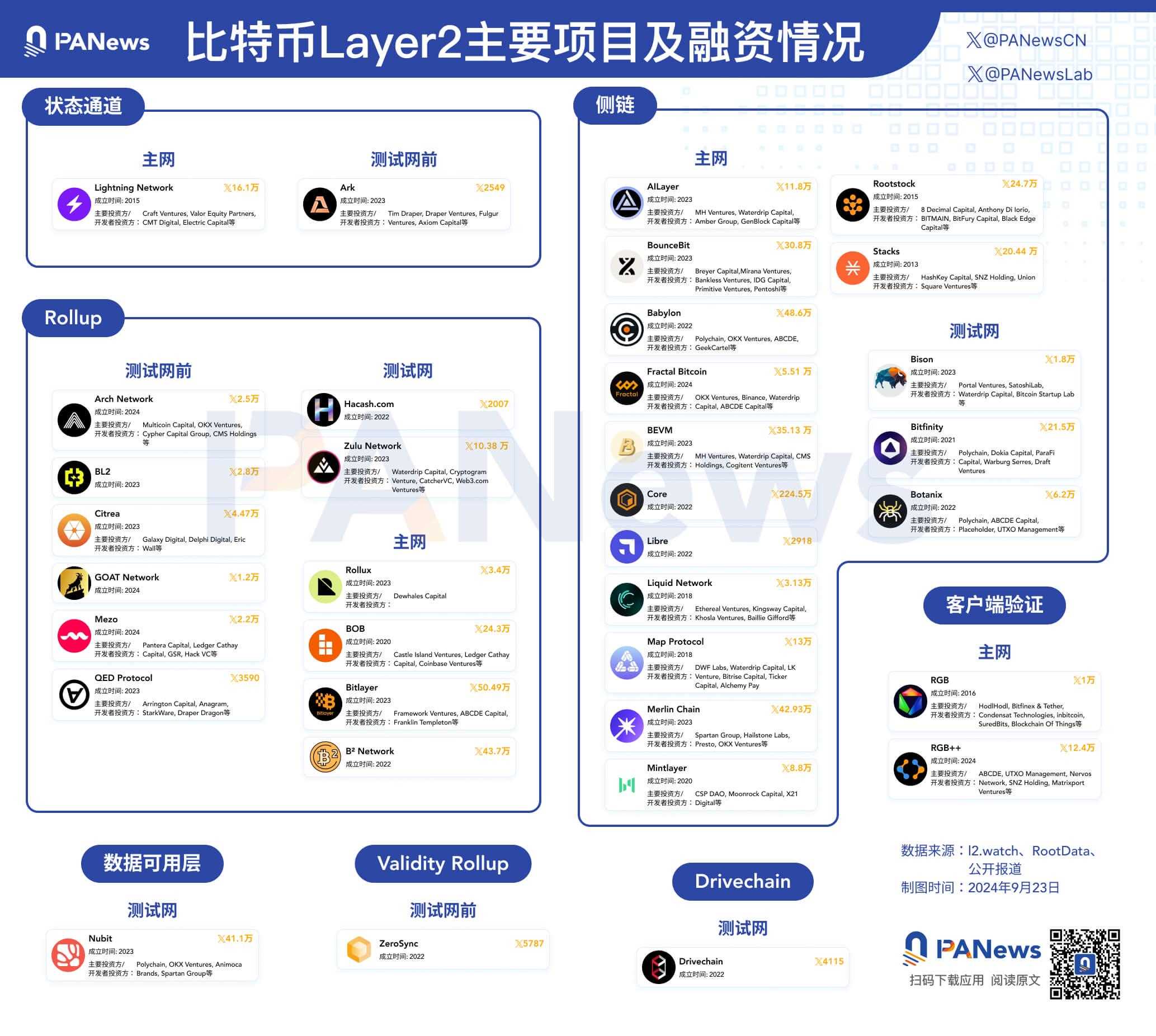
Main Technical Approaches in Current Bitcoin Layer2 Projects
State Channels
State channels allow users to establish end-to-end encrypted channels enabling multiple off-chain transactions between two or more parties, ensuring only the first and final transactions are recorded on the Bitcoin blockchain—without broadcasting every single transaction to the main chain. Thus, state channels support higher transaction throughput at minimal gas fees.
Representative project: Lightning Network
Sidechains
Sidechains are independent blockchains that run parallel to but separate from the main chain, allowing users to transfer assets (such as Bitcoin) from the main blockchain to the sidechain. Once transferred, these assets can be used for smart contracts, token issuance, or new consensus mechanisms. Sidechains verify information from the Bitcoin main chain and execute subsequent operations. A two-way peg mechanism connects the sidechain with the Bitcoin blockchain.
Representative projects: Established ones include Rootstock and Stacks; newer projects include BEVM, Merlin Chain, Fractal Bitcoin, Liquid Network, Mint layer, Babylon, Bison, Botanix, Core, BounceBit, AILayer, etc.
Rollups
Rollups move multiple off-chain transactions from the main Bitcoin blockchain to an independent network for processing, then submit a compressed batched transaction back on-chain. Unlike sidechains, rollups periodically commit blocks to the main chain, inheriting its security and decentralization, though average transaction capacity is generally lower than sidechains. Common types of rollups include optimistic rollups, ZK-Rollups, and sovereign rollups.
Representative projects: B² Network, Bitlayer, BOB, Citrea, QED Protocol, Zulu Network, GOAT Network, Mezo, Bitfinity Network, Arch Network, etc.
UTXO+ Client-Side Validation
UTXO+ client-side validation is a scaling solution based on Bitcoin’s UTXO (Unspent Transaction Output) accounting model, aiming to perform off-chain ledger computation atop Bitcoin UTXOs and ensure ledger authenticity through client-side validation.
In 2016, Peter Todd proposed the concepts of "Single-use Seals" and "Client-Side Validation," which led to the creation of the RGB protocol.
The RGB++ approach is similar to RGB, conducting computation, execution, and validation off-chain before settling on the Bitcoin chain. Nervos leverages the same PoW+UTXO structure as Bitcoin and combines it with innovative "isomorphic mapping" technology to successfully migrate RGB's client-side validation onto CKB. In doing so, Nervos maintains security equivalent to Bitcoin while extending the functionality and flexibility of the RGB protocol.
Representative projects: RGB, RGB++ (UTXO Stack)
Note: Besides the above categories, some classification methods mention BitVM as a Layer2 technical path. Representative projects include Bitlayer and Citrea, both classified under Rollup in this article. Simply put, BitVM is a computational model allowing developers to run complex contracts on Bitcoin without altering its base rules. Since its proposal and whitepaper release in October 2023, BitVM has drawn significant attention from the Bitcoin community. Under BitVM, computations occur off-chain with on-chain verification—similar to optimistic rollups on Ethereum.
Recent Developments in Major Bitcoin Layer2 Projects
Lightning Network
First introduced in 2015 and fully implemented starting in 2018, the Lightning Network enables more transactions via smart contract applications. It uses Revocable Sequence Maturity Contracts (RSMC) and Hash Time-Locked Contracts (HTLC) to address confirmation and payment channel issues in off-chain transactions.
The Lightning Network has gained widespread attention and adoption but primarily focuses on Bitcoin payments. On July 23 this year, Lightning Labs, the developer behind the network, announced a major update launching Taproot Assets on Lightning, enabling multi-asset transfers beyond BTC. Lightning Labs considers this update highly significant, potentially bringing the multi-trillion-dollar stablecoin market into Bitcoin and facilitating the Bitcoinization of USD and global financial assets.
Stacks
Originally known as Blockstack, Stacks was first proposed in 2013 and conducted its initial coin offering (ICO) in 2017. The Stacks Network employs the Proof-of-Transfer (PoX) consensus mechanism—an adaptation of proof-of-burn—where miners transfer Bitcoin to secure the Stacks blockchain and earn rewards.
On August 28, after months of delay, Stacks launched its long-awaited Nakamoto upgrade. This upgrade increases block production speed by 120x, reducing Bitcoin confirmation times from an average of 10 minutes to just seconds. The upgrade also prepares the network for sBTC, a "programmable Bitcoin asset" that allows users to bridge their BTC to the Stacks network in a relatively decentralized manner. sBTC code is expected to be completed in September.
Rootstock
Rootstock (RSK) was first proposed in 2015 and officially launched in 2018. Beyond RSK itself, the team has developed various products including DEXs, wallets, domain services, and other dApps built upon universal protocols covering payments, storage, computing, communication, and gateways/bridges. Their goal is to build a comprehensive RIF ecosystem (RSK Infrastructure Framework), unified under RIF OS technology.
The Rootstock team closely monitors developments in the Bitcoin ecosystem, especially BitVM technology, which forms the foundation of their upcoming BitVMX initiative. Additionally, from 2024 to 2025, the team will focus on developing RBTC super apps, consolidating recent advances in DeFi tools on the Rootstock network.
Merlin Chain
Launched in February by Bitmap Tech, Merlin Chain is a Bitcoin Layer2 solution integrating a ZK-Rollup network, decentralized oracle, and on-chain BTC fraud-proof module. Bitmap Tech’s metaverse platform Bitmap.Game and the BRC-420 asset protocol have both performed well in the market this year.
At the end of August, ZK interoperability infrastructure Polyhedra Network announced integration of its Decentralized Verification Network (DVN) with Merlin Chain via LayerZero. After integration, over 100 applications in Merlin’s ecosystem benefit from ZK-secured interoperability.
On September 9, Merlin Chain released its semiannual report reviewing its growth trajectory in H1 2024: $1.2B TVL, $16B bridged volume, 1.9M on-chain addresses, 12.7M transactions; reached $3.9B TVL within 50 days of mainnet launch (88% BTC, Ordinals, and other native assets); M-BTC achieved a $1.2B market cap in H1; asset trading volume exceeded $3B; DEX liquidity surpassed $78M. Merlin Chain plans to continue advancing in technology, ecosystem, and community during H2 to drive sustained development of the Bitcoin ecosystem.
Fractal Bitcoin
Fractal Bitcoin improves transaction processing speed and capacity by recursively creating infinite expansion layers using BTC core code on the main Bitcoin chain, while maintaining full compatibility with existing Bitcoin ecosystems. According to available data, Fractal Network achieves approximately 30-second block confirmations and claims up to 20x the transaction capacity of the Bitcoin main chain.
The underlying development team, Unisat, continues to attract market attention. Comprised of developers proficient in Bitcoin technologies such as SegWit, Lightning Network, and Taproot, the team previously achieved strong performance in the BRC20 trading market. Its issued token $PIZZA performed well in the market and attracted investments from Binance and OKX.
On September 9, Fractal Bitcoin officially launched its mainnet, reigniting interest in the Bitcoin ecosystem. As of 5 PM on September 12, total FB holding addresses reached 200,165, increasing by 79,484 in the past 24 hours, with 118,454 active addresses.
RGB++
Recently, Stable++, the first protocol based on RGB++, launched an over-collateralized stablecoin system issuing RUSD—a USD-pegged stablecoin backed by BTC and CKB. By leveraging RGB++'s advanced Leap feature, Stable++ enables seamless asset transfers within the Bitcoin ecosystem.
Additionally, on August 23, Fiber Network—the next-generation public Lightning Network built on Nervos CKB and off-chain channels—was launched, providing fast, low-cost, decentralized multi-currency payments and peer-to-peer transactions for RGB++ assets.
Babylon
On August 22, the Bitcoin staking protocol Babylon launched Phase 1 of its staking mainnet, introducing a third native use case for Bitcoin assets beyond store-of-value and simple payments: staking to secure PoS networks and earn rewards. The launch of Babylon’s staking mainnet temporarily spiked gas fees on the Bitcoin network that evening, sparking broader market discussions about returns from Bitcoin staking projects.
B² Network
Founded in 2022, B² Network is a Bitcoin Layer2 built on ZK-Rollup technology, EVM-compatible, enabling seamless deployment of DApps for developers from the EVM ecosystem. On August 28, B² Network formed strategic partnerships with Aptos and Echo Protocol to promote BTCFi expansion into the Move ecosystem—an inaugural attempt for BTCFi in the Move ecosystem.
Bitlayer
On March 29, Bitlayer announced a $50 million ecosystem incentive program to accelerate the development of its mainnet ecosystem.
On September 2, Bitlayer launched its DApp Center—the official application hub designed to provide users with a one-stop platform to explore and experience innovative applications within the Bitlayer ecosystem. The DApp Center serves as a key gateway to the Bitlayer ecosystem, aggregating the latest and most popular apps.
Funding Activity in Bitcoin Layer2 Over the Past 5 Months
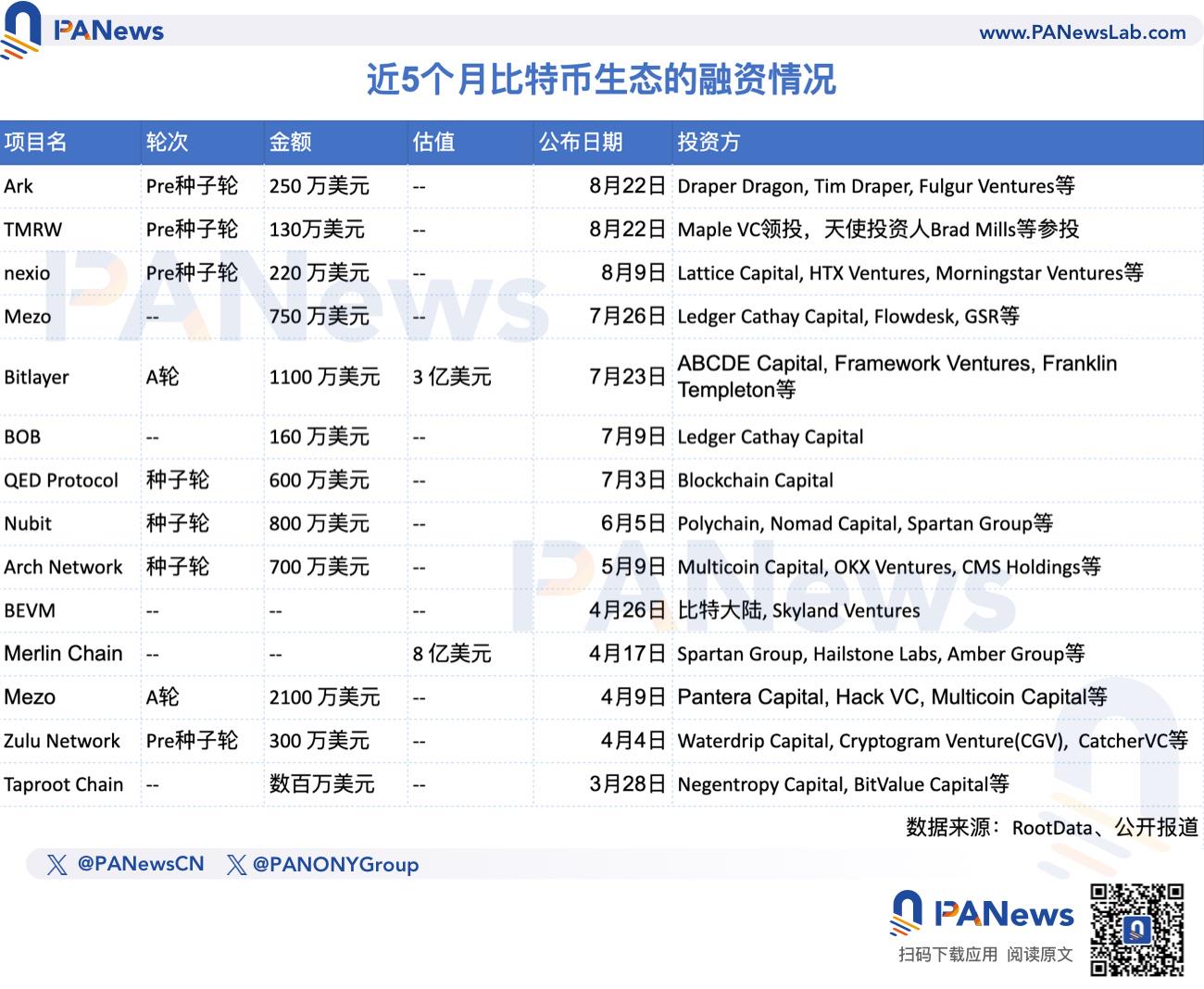
In the past five months, the BTC Layer2 sector has seen frequent investment activity, with 14 public funding rounds totaling over $71.1 million. The largest single raise was Mezo securing $21 million in its Series A round.
On August 22, Bitcoin L2 project Ark Labs raised $2.5 million in a pre-seed round; on the same day, Bitcoin Lightning Network payment startup TMRW announced a $1.3 million pre-seed round; on July 26, Bitcoin scaling network Mezo closed a $7.5 million funding round led by Ledger Cathay Fund. Additionally, Bitlayer, BOB, and QED Protocol have all demonstrated strong fundraising capabilities and received strong investor interest.
Active VCs in the Bitcoin Layer2 space currently include Draper Dragon, ABCDE Capital, Ledger Cathay Capital, Waterdrip Capital, Polychain, among others. Well-known Chinese-investor familiar firms such as Hashkey Capital, OKX Ventures, and Binance Labs also maintain extensive portfolios in this area.
Overall, the current Bitcoin Layer2 landscape features numerous projects, even leading to a sense of "inflation." These projects adopt diverse technical paths. Well-known early movers like Stacks and Rootstock have explored related technologies for years but currently lack standout innovations. With Bitcoin's base protocol maturing, newer projects such as Merlin, RGB++, and Babylon are expanding what’s possible in the Bitcoin ecosystem, opening up greater potential for Layer2 development.
Nonetheless, Bitcoin Layer2 faces certain bottlenecks. According to Haotian, an independent researcher at CryptoInsight, the chaotic competition in the BTC Layer2 market hasn’t truly brought significant incremental value to the BTC ecosystem. During market downturns, debates resurface questioning whether BTC Layer2 is merely a pseudoproblem. While the absence of standards offers BTC Layer2 greater "copy-paste" flexibility, directly grafting mature scaling solutions onto Bitcoin’s inherently constrained main chain may fail to return scalability benefits to the mainnet—and could instead harm BTC users due to security and stability risks. In his view, the era of unstructured prosperity in BTC Layer2 is coming to an end, and future progress will likely shift toward higher technical barriers.
As Haotian suggests, narrowing Layer2 technical standards may become a trend going forward. For now, challenges and opportunities coexist. Looking ahead, we remain hopeful for more breakthrough Layer2 projects that can bring innovation and surprises to crypto users and markets.
Join TechFlow official community to stay tuned
Telegram:https://t.me/TechFlowDaily
X (Twitter):https://x.com/TechFlowPost
X (Twitter) EN:https://x.com/BlockFlow_News
 PANews