How Chainbase Builds the Omnichain Data Interaction Layer with $15 Million in Series A Funding Led by Matrix Partners
TechFlow Selected TechFlow Selected
How Chainbase Builds the Omnichain Data Interaction Layer with $15 Million in Series A Funding Led by Matrix Partners
On-chain data surges; Chainbase keeps users from drowning.
 Navigating Web3 tides with focused insights
Author: Pzai, Foresight News
To date, blockchain-generated data has reached into the hundreds of millions, and processing this data is increasingly becoming a critical issue in the crypto space. As ecosystems evolve, varying degrees of bottlenecks and fragmentation exist in cross-chain data interoperability, forcing related use cases (such as AI, wallets, and on-chain infrastructure) to adopt more complex architectures. Consequently, demand for broader and easier access to omnichain data continues to grow.
Recently, blockchain data network Chainbase announced the completion of a $15 million Series A funding round led by Matrix Partners China, with participation from Folius Ventures, Hash Global, JSquare, Mask Network, and Bodl Ventures. Let’s take a closer look at how Chainbase delivers accurate and usable on-chain data to users.
What is Chainbase?
Chainbase aims to integrate all blockchain data into a unified ecosystem, providing an open and transparent data interoperability layer for the AI era. At the operational level, as a full-chain data layer, organic data integration is essential. The Chainbase network includes operators, validators, developers, and delegators, delivering data to various Web3 applications via APIs and other channels. Currently, the network already supports data from over 20 blockchains, achieving sub-three-second real-time synchronization across multiple chains.
Within the network, data circulates through a structure called "manuscripts," which consist of two components: Schema and Operators. The schema defines the data types and corresponding parameters of on-chain transactions, while operators serve as tools for data extraction and analysis. After developers compile a manuscript, operators (who must register with EigenLayer) index these manuscripts and confirm them with validators. Validators ensure data security and integrity, while delegators stake native ETH or the protocol token CBT to economically secure the network.
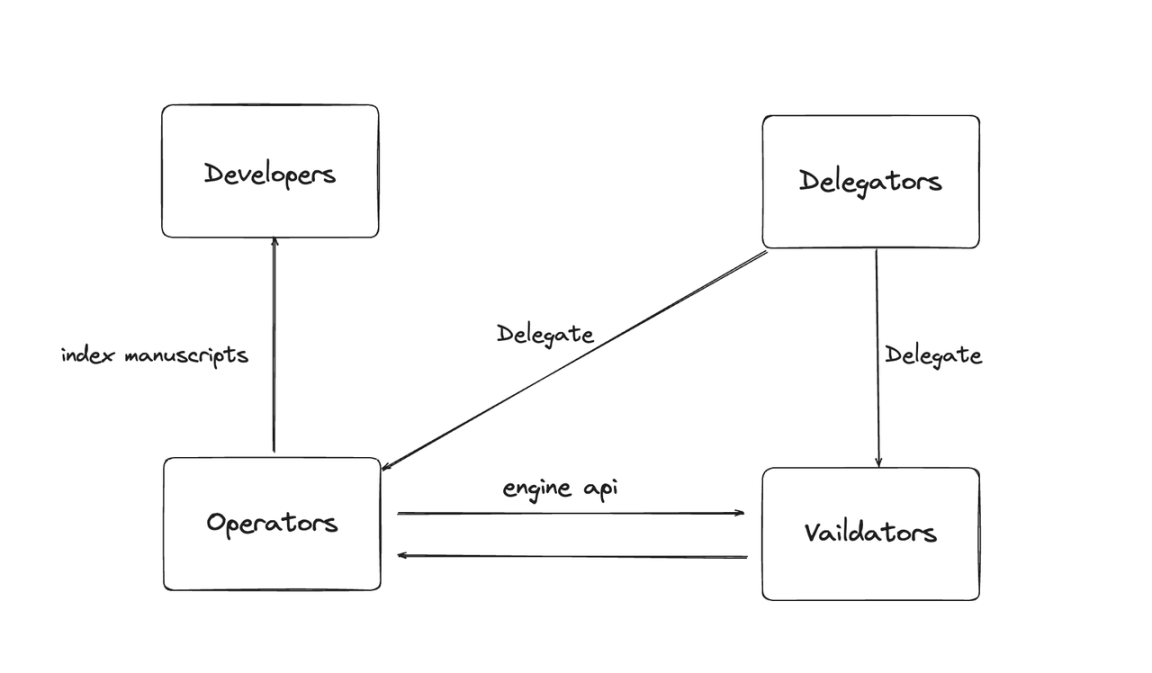
Figure 1: Network Operation Model
At the foundational level, Chainbase employs a novel dual-chain technical architecture that supports cross-chain data interoperability and programmability, achieving high throughput, low latency, finality, and enhanced network security. Specifically, the execution layer and consensus layer are decoupled. The execution layer leverages AVS supported by EigenLayer to establish economic security and uses the Chainbase Virtual Machine (CVM) to deliver parallel computing capabilities, enabling high-throughput data processing within a programmable runtime environment for handling complex data tasks. The consensus layer, built on the Cosmos CometBFT architecture, achieves instant finality without requiring additional confirmations or reorganizations. Furthermore, by integrating Cosmos and EigenLayer, the protocol implements a dual-staking model.
Token Economics
Within the protocol, CBT serves as a utility token to coordinate data providers and consumers, incentivizing participants to efficiently organize data and ensuring the network's sustainability and organic ecosystem growth.
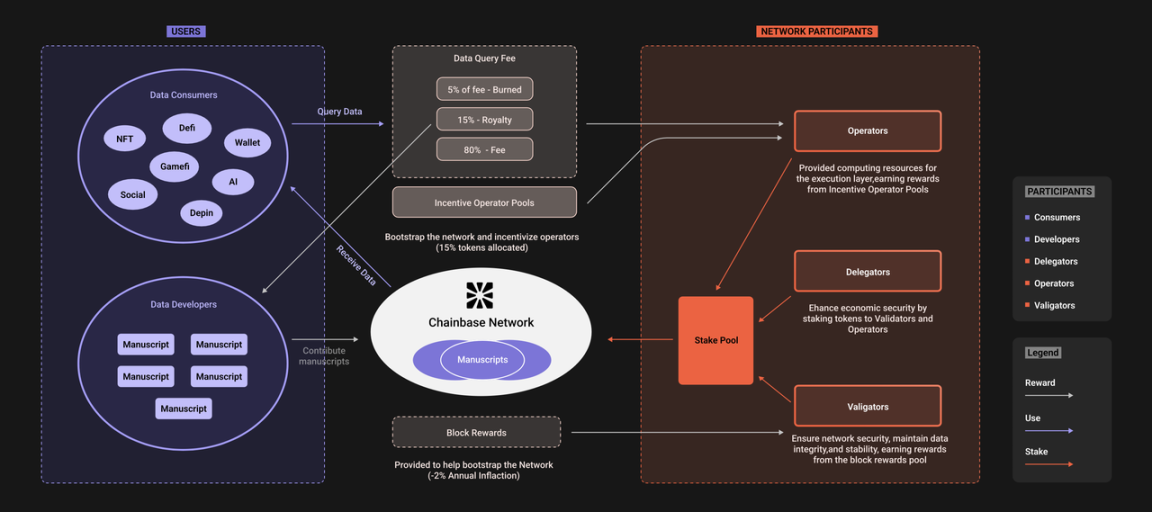 Figure 2: Token Economics
After developers create a manuscript, queries to the associated dataset require payment in CBT. These fees cover data retrieval costs, with 80% distributed as rewards to network resource providers (such as operators and validators), 15% allocated to the developers, and the remaining 5% burned to ensure long-term sustainability. Additionally, 15% of the total token supply will be linearly distributed over six years to operators and delegators based entirely on the quality and volume of data processing. An annual inflation rate of 2% is allocated to validators and their delegators, ensuring ongoing network sustainability and long-term incentives.
AI Models for the Crypto World
The crypto world has always been built upon vast and rapidly growing blockchain data, rich with knowledge and latent opportunities. While continuously extracting and organizing this data, much of the so-called "dark knowledge" within crypto data cannot be efficiently structured using traditional databases and limited human effort alone, creating accessibility barriers for average crypto users.
Chainbase has developed Theia, a large-scale model for the crypto world based on blockchain data. This model aims to learn from blockchain data and simulate and reason about native blockchain environments. In the future, AI agents built on Theia will be able to effectively understand, predict, and interact with blockchains. Technically, the model decomposes large models into magnitude vectors and directional vectors; the resulting matrix captures extensive on-chain knowledge. Moreover, the complete reasoning chain built into the model provides users with highly interpretable results. Being decentralized by design, the data model inherently offers high performance, crypto-native capabilities, and high transparency.
Conclusion
Existing data-focused projects face certain limitations in decentralization, performance, versatility, and economic design. Chainbase aims to break through these constraints. As mass adoption draws nearer, we are facing an ever-growing data tsunami—and robust defenses are being built. In the future, atop decentralized, high-performance architectures, we can look forward to navigating this wave with greater confidence.
Join TechFlow official community to stay tuned
Telegram:https://t.me/TechFlowDaily
X (Twitter):https://x.com/TechFlowPost
X (Twitter) EN:https://x.com/BlockFlow_News
 Foresight News





![In-depth Analysis of Trade[XYZ]: How Were 92 Markets and 98% HIP-3 Trading Volume Established?](https://upload.techflowpost.com/upload/images/20260716/20260716061117965147.jpeg?x-oss-process=image/resize,p_50/quality,q_80)