Web3 Game Development Insights: Stop Obsessing Over "Fully On-Chain"—Focus on Capturing Attention
TechFlow Selected TechFlow Selected
Web3 Game Development Insights: Stop Obsessing Over "Fully On-Chain"—Focus on Capturing Attention
Fully on-chain games will serve as a medium for novel on-chain use cases and enable creative player behaviors we've never seen before.
 Navigating Web3 tides with focused insights
Author: y77c
Translation: TechFlow
We developed Project Mirage (@mirage_game_), a casual on-chain island-building game. Since launching on testnet in April this year, we’ve been releasing new features, fixes, and experiments every two to three weeks. Although we’re still in the early stages of game development, these iterations have taught us a lot along the way.
(Note: This was my speech at an ETHCC-related event)

I lied. I’m not bearish. Take off your shoes—we’re building on-chain games until mass adoption arrives.
Don’t Be Obsessed with Theory/Philosophy
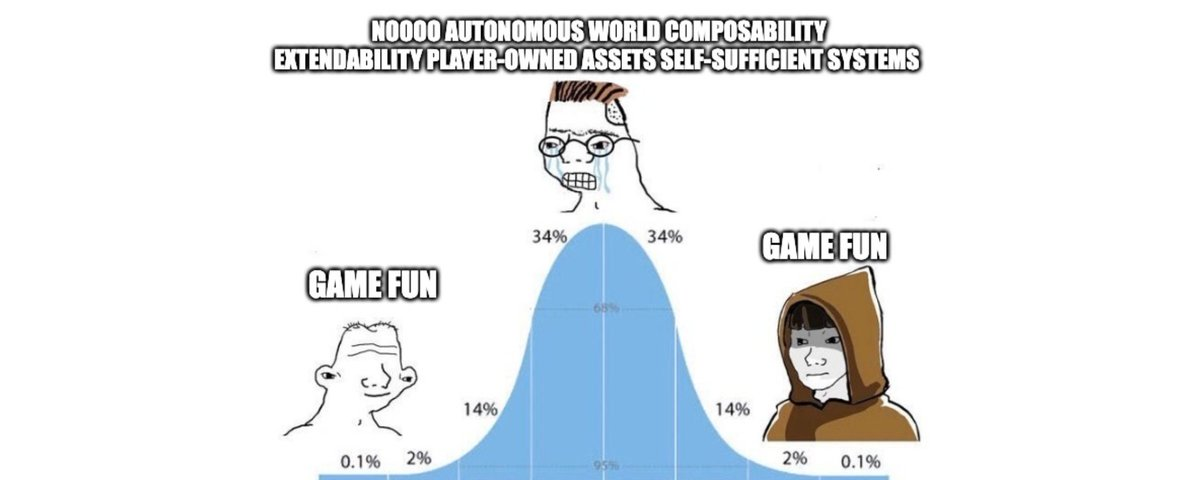
As early developers, what might have drawn us into the on-chain gaming space is the idea of Autonomous Worlds—a world that runs forever, permissionless and composable, where you truly own your assets. The harsh truth is, none of this matters to most players. Players seek fun and engaging experiences. Maybe one in a hundred players (already high-end given the open back-end of on-chain) will be inspired by the game’s extensibility and build upon it. Openness and composability are nice features, but they won’t drive traffic to your game. What drives traffic is fun, unique experiences. If being on-chain doesn’t enhance the gameplay itself, you shouldn’t be building an on-chain game. Instead of asking, “What on-chain game can we build?” a better question is, “For the game I want to build, how does being on-chain make it better?”
In a niche, early-stage, research-driven space, we often convince ourselves that following theory guarantees success. But games are games—games are consumer products, regardless of underlying technology. Delivering fun and unique experiences is the only path to success. The challenges and vision of this space fascinate us, but as game designers, our ultimate goal is creating experiences that bring joy to players.
Study GameFi
GameFi is often criticized as unsustainable, but we must acknowledge that cryptocurrency speculation is an incredibly powerful viral tool. GameFi projects excel at user acquisition and community building—the “Fi” part empowers people and creates a sense of belonging. Even holding underperforming game assets can strengthen player connections through shared experience within a community, offering unique engagement. (In fact, such penalizing behavior may create a near-win effect, making the game more addictive.)
Building on-chain games is extremely challenging. You not only face resource constraints but also deal with the same hurdles as any conventional app—daily active users (DAU) and retention rates. As a tech team, we initially focused on overcoming resource limitations, but later realized the importance of incorporating virality into the game early on. Fortunately, we weren’t too late.
If you're just getting started, it's crucial to think about who you're building for. Are you targeting crypto-native players, mainstream players (currently hard to reach), or venture capitalists (VCs)? If you're building for crypto players, remember they’re overstimulated, have short attention spans, and are constantly lured by new gamified experiences. If you're building for VCs, then treat your game studio like a research lab—experiment with any novel tech, ignore users, and sell vision and imagination. For those of us with simpler ambitions—just wanting to build something fun—financialization is an inevitable part of surviving in this space.
You Don’t Need to Be Fully On-Chain Early On
Now, with many on-chain games launching on testnets and mainnets, and competing for attention in a broader crypto gaming market, no matter your theoretical stance—you need to win the battle for attention. One way to win this battle is rapid testing and iteration to precisely understand what players want. However, building fully on-chain makes fast iteration difficult, as it's constrained by resource limits or complex solutions designed to overcome them.
We found that the best approach for us was placing core game logic on-chain while using off-chain solutions for experimental features or those lacking mature on-chain implementations. In Mirage, randomness and certain experimental features run off-chain, allowing our small team to ship quickly without excessive constraints. Once we confirm a feature is permanent, we move it on-chain for extensibility and permanence.
If we were to start over, the classic GameFi approach—putting only assets on-chain—might be a better way to accelerate iteration speed. However, starting with zero resource constraints could negatively influence design decisions, potentially causing more issues when migrating to a limited on-chain environment later. It’s a trade-off. Both fully on-chain and hybrid approaches are valid—but both can also go wrong. Ultimately, regardless of your chosen tech or method, survival depends on rapid iteration and winning the attention war.
Conclusion
I believe fully on-chain games will become a medium for novel blockchain use cases and enable creative player behaviors we’ve never seen before. There’s no more vision to discuss—now go build a fun game.
Join TechFlow official community to stay tuned
Telegram:https://t.me/TechFlowDaily
X (Twitter):https://x.com/TechFlowPost
X (Twitter) EN:https://x.com/BlockFlow_News
 @y77cao