Reflections on attending Farcon: Why a16z is willing to bet big on the next-gen social network Farcaster
TechFlow Selected TechFlow Selected
Reflections on attending Farcon: Why a16z is willing to bet big on the next-gen social network Farcaster
Looking ahead, Farcaster is committed to decentralization, user sovereignty, and innovative features, positioning itself as a potential leader in the next wave of social media platforms.
 Navigating Web3 tides with focused insights
TL;DR
-
Farcaster is a decentralized social platform that combines on-chain identity creation, storage leasing, and key management with off-chain data storage maintained by a decentralized network of nodes. This architecture enables users to own their data and identities, forming a decentralized social graph.
-
Channels and Frames are key to user engagement. Channels enable focused community discussions through embedded URLs, while Frames turn broadcasts into interactive applications supporting activities like NFT minting, voting, and secure transactions. These features promote diverse and personalized content delivery, enhancing user experience.
-
Farcaster’s open social graph and content algorithms offer unique opportunities for developing diverse clients. Potential clients include AI-, video-, and audio-focused applications. This openness reduces platform risk, fosters innovation, and could create the "magic moment" of a successful social app.
-
Farcaster's ID registry can serve as a foundational identity layer in Web3, addressing authentication and accountability. It provides secure, verifiable identities linked to various Web3 services, enhancing trust and transparency while managing ownership and responsibility in decentralized environments.
-
Key challenges include potential issues importing 1:1 social graphs from existing platforms, resilience during bear markets, managing bots and automated accounts, and achieving mainstream adoption beyond the crypto community. Addressing these is critical for Farcaster’s long-term success.
-
Farcaster’s decentralized and open infrastructure paves the way for innovative applications and a user-controlled social media landscape. By focusing on strategic planning, community engagement, and user-centric features, Farcaster can overcome its challenges and lead the next wave of social media, offering a more secure, dynamic, and user-driven platform.
1. What is Farcaster?
Web3 has seen a wave of new social applications such as Friend.tech, Fantasy top, and Farcaster. While most are consumer-facing apps, Farcaster has built a robust infrastructure layer paving the way for a decentralized social graph that tracks users and their overall social data.
At a high level, Farcaster performs high-priority operations on-chain—such as ID creation, storage leasing, and key maintenance across different apps—while the data storage itself is handled off-chain by a decentralized network of nodes called the “Farcaster Hub.”
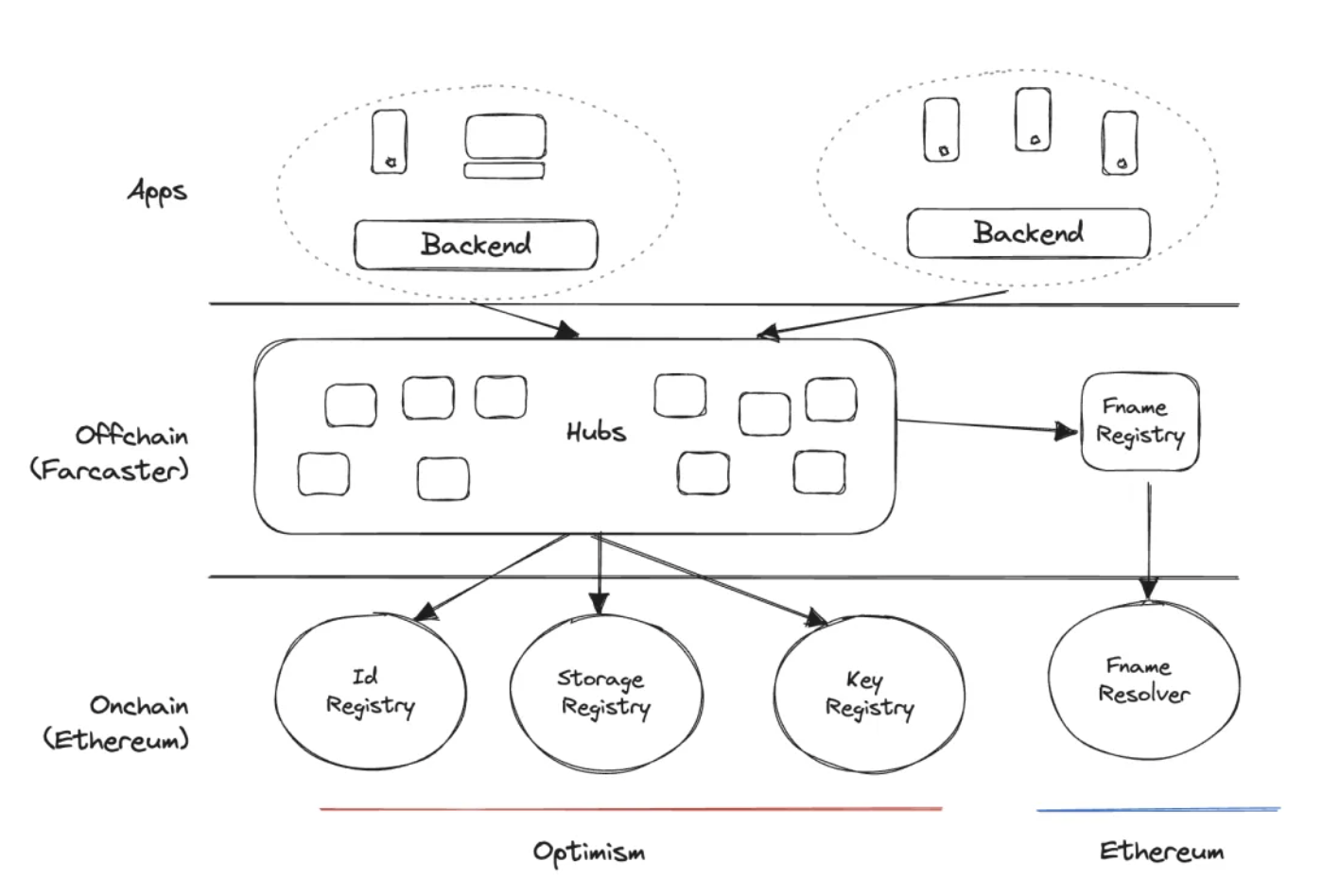
Source: https://docs.farcaster.xyz/learn/architecture/overview
This infrastructure design supports Farcaster’s decentralized social graph, connecting users and their social activities. It could mark the beginning of an identity layer enabling reliable authenticated actions and transactions, reducing fraud risks and ensuring accountability—major barriers to broader blockchain adoption. Users can link their Farcaster identity to various Web3 services, enhancing trust and transparency across the decentralized ecosystem. Additionally, by enabling recovery mechanisms and secure identity transfers, Farcaster offers a practical solution to one of blockchain technology’s most persistent challenges: managing and proving ownership and responsibility within decentralized environments. Core features like Channels and Frames enhance user engagement, while a strong ecosystem supports scalability and adoption.
Channel
A Channel is a public space for community discussions, prototyped in Warpcast. It resembles a hashtag on Twitter but gives communities a more personalized and independent space in the form of embedded URLs.
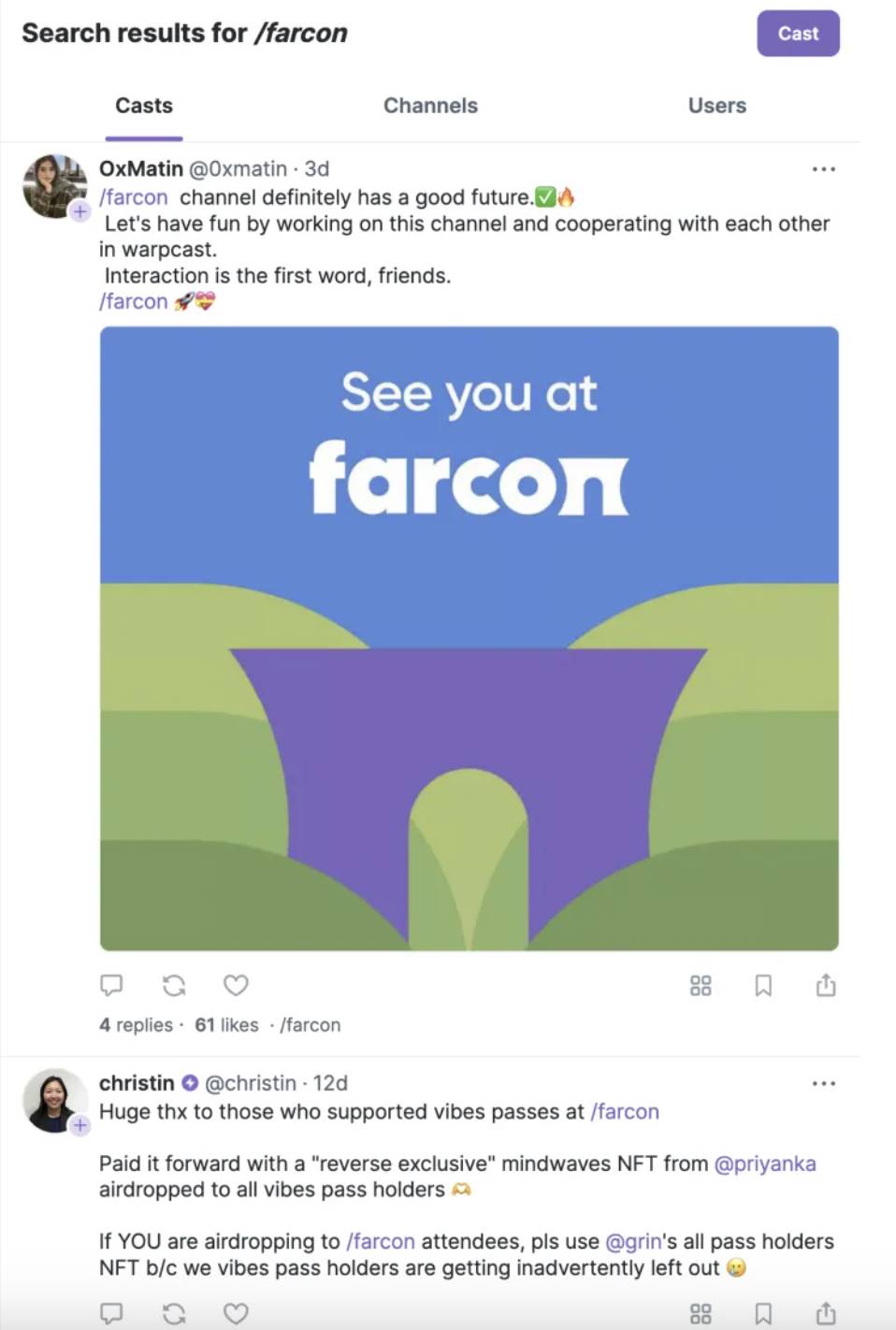
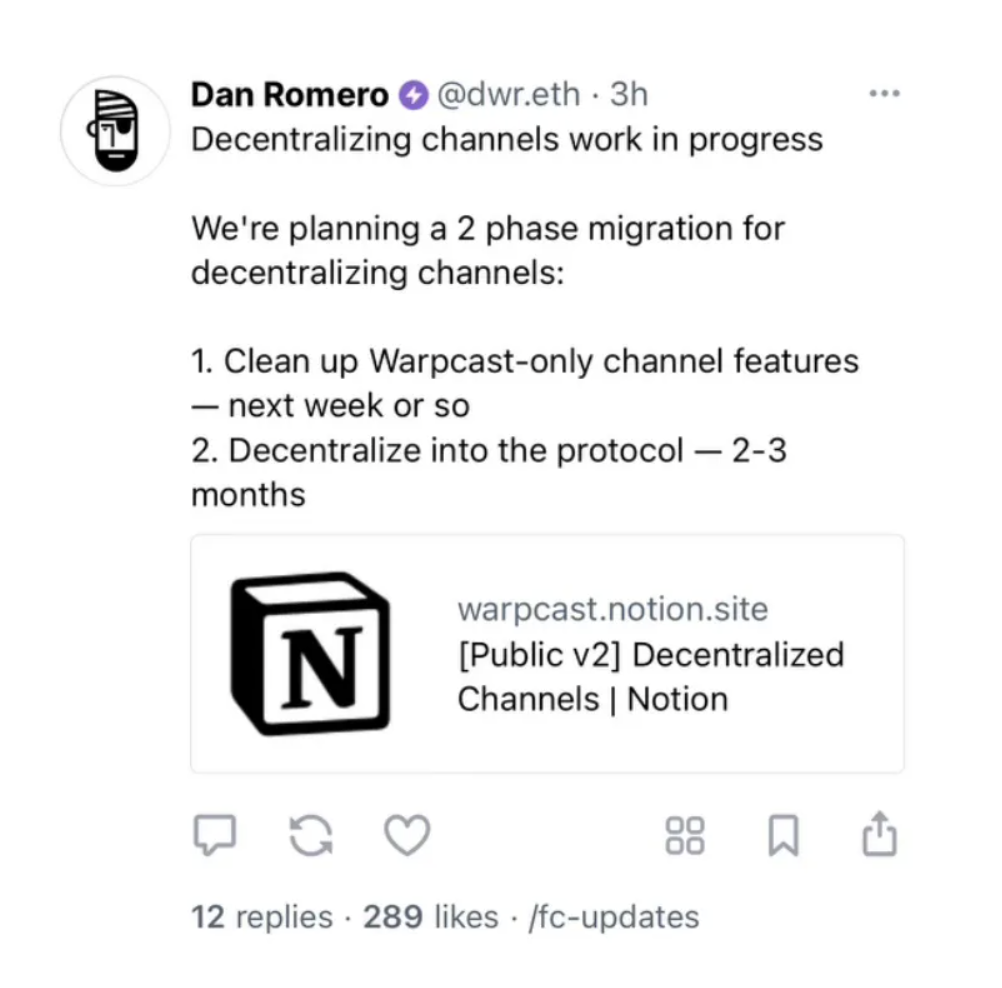
Channels follow Farcaster’s “Cozy Corner” theory, allowing small communities to emerge within the larger social graph. This is a key differentiator—Farcaster’s founders recognized this vision could help the product stand out by building a stronger social graph. Although currently a feature in Warpcast, it is planned to be fully decentralized, as Dan Romero acknowledges its unique value proposition. By nurturing these small, focused communities, Channels enhance user engagement and create more intimate social experiences.
In Farcaster, Casts (similar to tweets) can link to any URL, not just other Casts. This allows new feeds to be created based on the same URL. For example, all Casts in the Degen channel link to the URL corresponding to the Degen token contract.
Leveraging this functionality, Farcaster can develop diverse content feeds. The ability to embed URLs in Casts enables feeds containing various content types. This advances Farcaster’s vision of users owning their data, unlike traditional social media platforms where companies use user data to personalize feeds and content via algorithms.
Frame
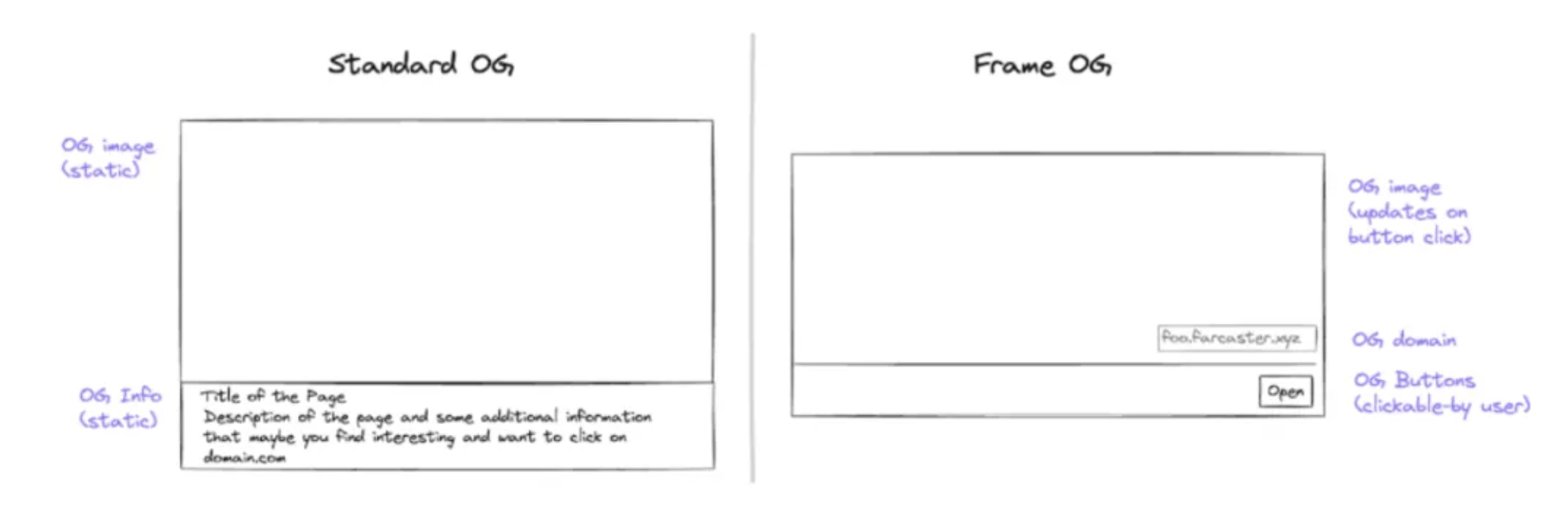
Source: https://docs.farcaster.xyz/learn/what-is-farcaster/frames
Frames turn any broadcast into an interactive application, creating interactive and authenticated experiences on Farcaster through standardized protocols. In practice, it’s a Cast with images and buttons that allows interaction with different servers, making it an app within an app. Use cases include claiming or minting NFTs, conducting votes, and facilitating token airdrops. Within a week of its launch, over 400 apps released nearly 1,000 Frames, directly fueling Farcaster’s growth by providing active users with incentives like airdrops.
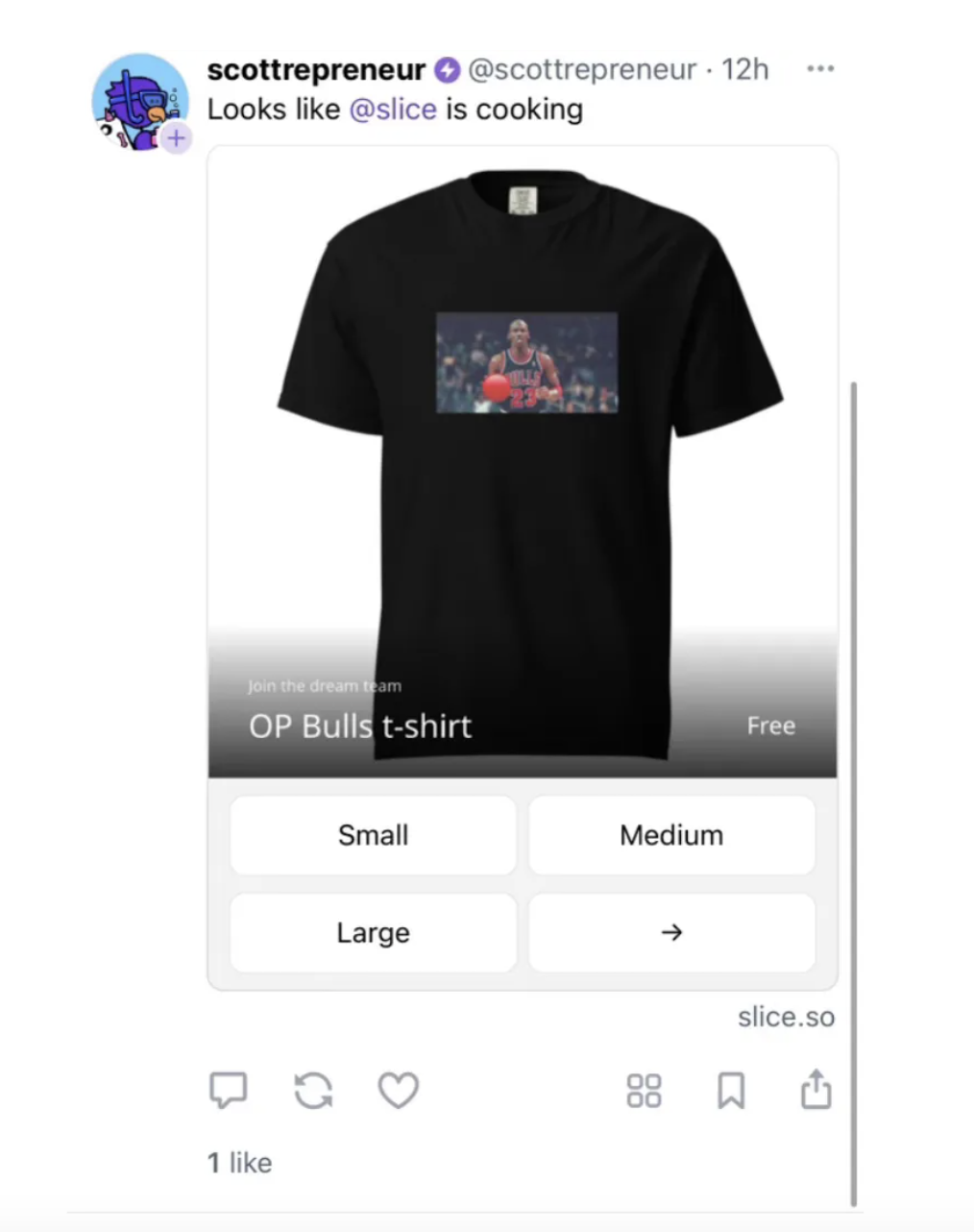
The underlying theory behind Frames is that most social apps are 80–85% similar, but the remaining 15–20% unique value allows different apps to dominate distinct markets. The Frame system enables Farcaster to integrate with more on-chain activities, further creating a positive feedback loop that could expand Farcaster’s user base. At the same time, it positions Farcaster as a more intuitive product, extending social media functionality to deliver richer consumer experiences (like a more integrated Facebook Marketplace or TikTok Shop).
The most powerful aspect of Frames is the seamless integration of Farcaster-authenticated data with Frame servers. When users interact with a Frame, the client transmits authentication data from Farcaster to the Frame server. This process gives the server verified proof of the user’s interaction and confirms the user owns the wallet associated with their Farcaster account.
Since both Farcaster and wallet data are public and transparent, Frame servers can leverage this information to create rich, verified, and personalized interactions. This opens numerous possibilities, such as personalized content delivery, secure transactions, and customized user experiences. For example, servers can authenticate user participation in polls, verify the legitimacy of NFT claims, or facilitate secure token airdrops. This integration of authentication and wallet verification significantly enhances user experience by enabling trusted and interactive applications within the Farcaster ecosystem.
Clients
In the early days of Web2, platforms like Twitter saw a variety of third-party clients offering diverse user experiences. However, as these platforms grew, they often restricted API access to protect their own clients and prepare for IPOs. Building alternative clients for major Web2 platforms became unattractive due to high platform risk.
For Farcaster, this presents a unique and underexplored opportunity: clients are essentially applications hosting parts of the infrastructure to display the social graph in more digestible and interactive ways. In the Web3 paradigm, the most valuable assets of social platforms—their social graphs and content algorithms—are open to everyone. This openness drastically reduces platform risk and may signal a paradigm shift.
Currently, the most widely used Farcaster client is Warpcast, developed by the Farcaster team. But this is just the beginning. The platform has yet to experience the “magic moment” displayed by many successful social apps—a unique combination of user experience and behavior that makes an app stand out. Examples include seeing what friends are doing on Facebook for the first time, finding a match on Tinder, watching TikTok videos, or one-click purchasing on Amazon.
Potential for Diversified Farcaster Clients
-
AI-Focused Client: An AI-powered Farcaster client could summarize social activity—similar to ChatGPT—instead of requiring users to scroll through lengthy feeds. High-quality Farcaster channels could serve as valuable data sources for AI training. Channel owners should be compensated when their data is used for model training.
-
Video-Focused Client: Given the success of video-centric apps in Web2, a video-focused Farcaster client is a promising idea. This client could leverage Farcaster’s decentralized nature to deliver unique video content and interactions.
-
Audio-Focused Client: Despite no dominant social audio app emerging yet, an audio-focused Farcaster client holds potential. It could explore new forms of social interaction through audio, building on the success of apps like Clubhouse.
By exploring these diverse client possibilities, Farcaster can create a vibrant ecosystem where different apps cater to various user needs and preferences. This not only drives user growth and engagement but also fosters innovation within the Farcaster community.
2. Current State of Farcaster
As a basic overview of Farcaster’s current ecosystem, we can examine the following ecosystem forces.
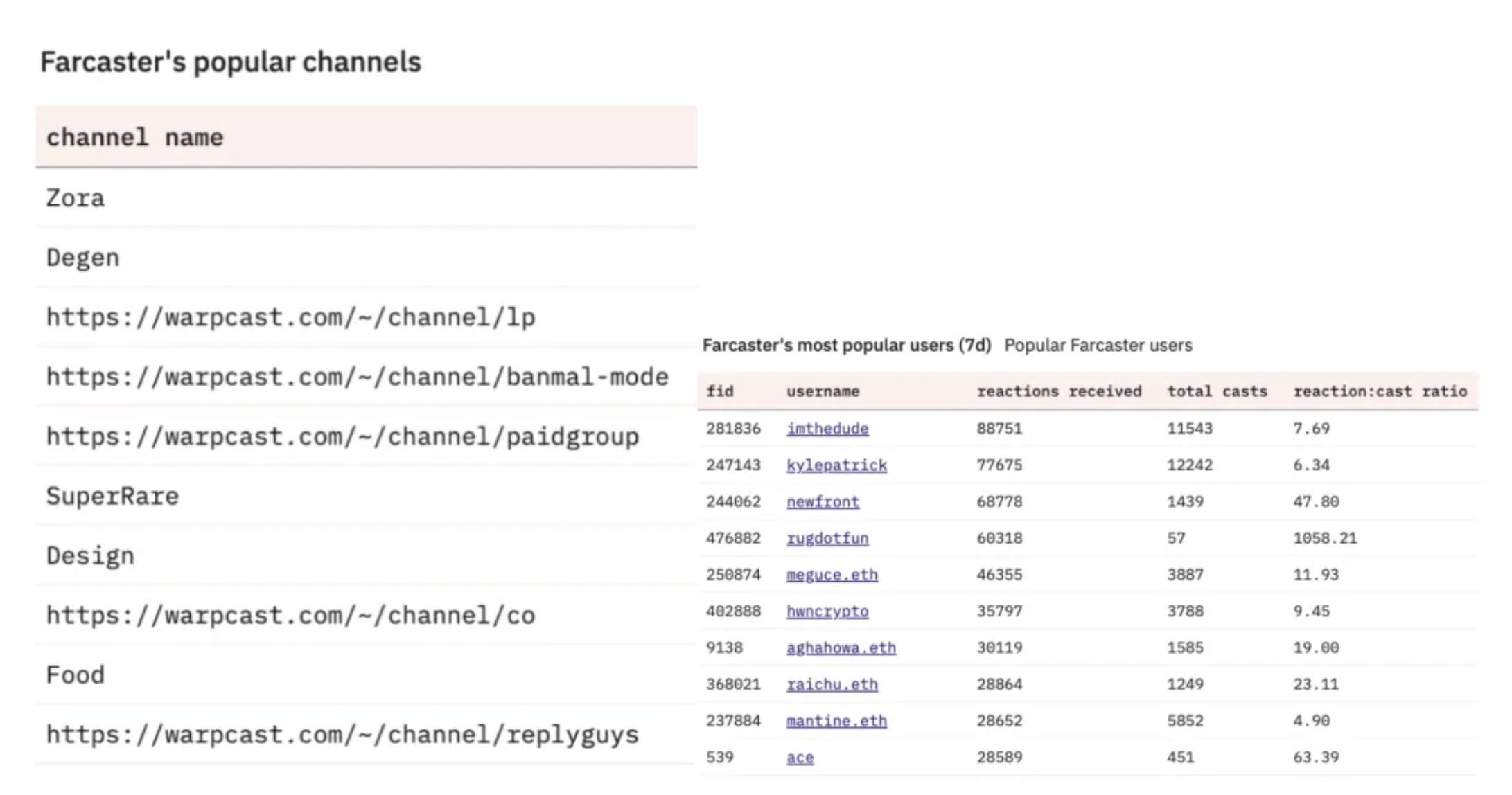
Source: https://dune.com/pixelhack/farcaster
It’s notable that Warpcast currently accounts for 90% of network activity, but other clients can still offer unique propositions on this infrastructure. Moreover, most people currently use it as a pure Web2 social media platform because users haven’t yet been trained to utilize everything it offers. A significant growth signal will be individuals using Farcaster’s native solutions, experiencing the full range of intended functionalities (decentralized social graph, Frames, etc.), which may take time as the graph itself is still in its early stages and not yet mature or robust enough.
Data Performance:
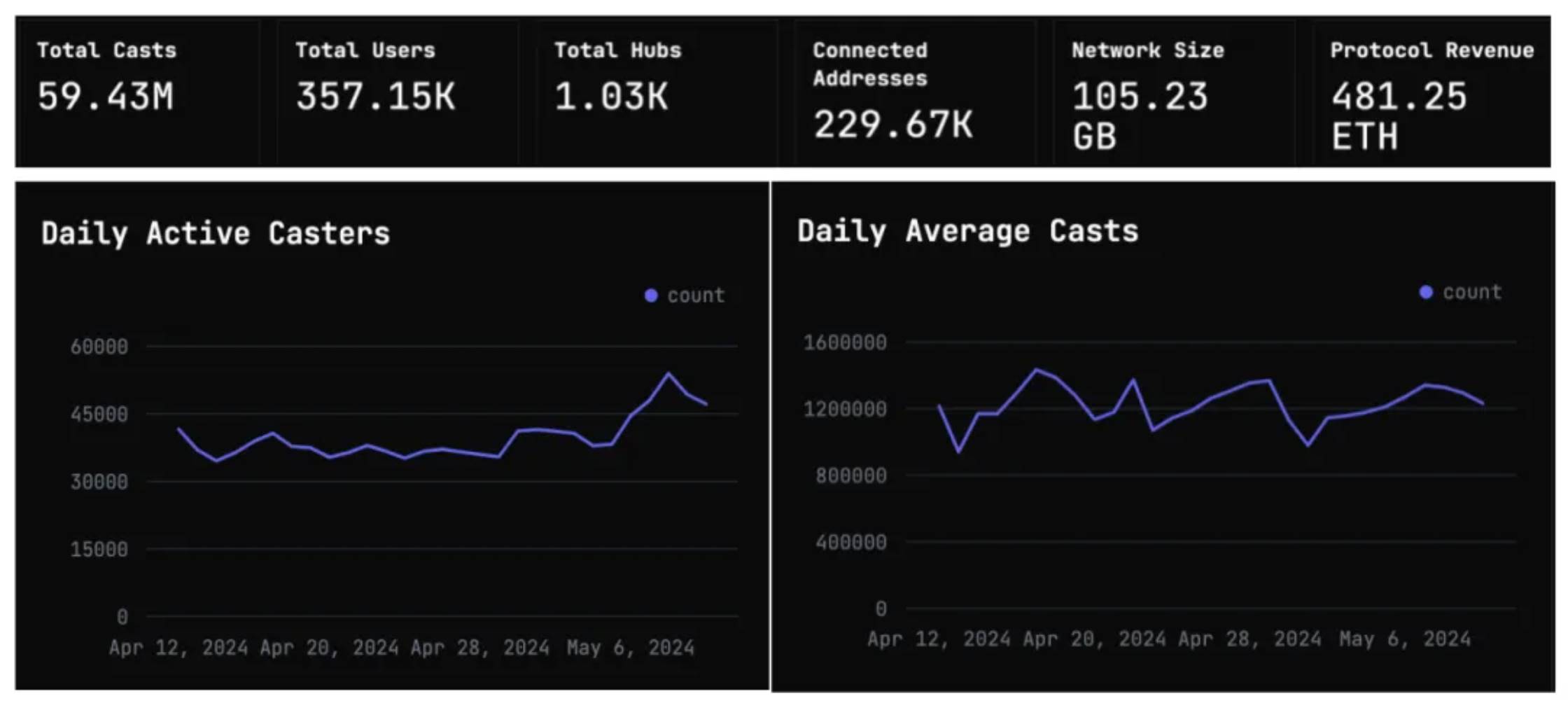
Source: https://farcaster.network (for comparison: Twitter has 245M DAU, 500M Tweets per day)
According to Dan Romero, there is still work to do in scaling—Farcaster’s current architecture can scale to 10 million active users. However, technically, the infrastructure is flexible enough that the team is confident about further scaling if needed.
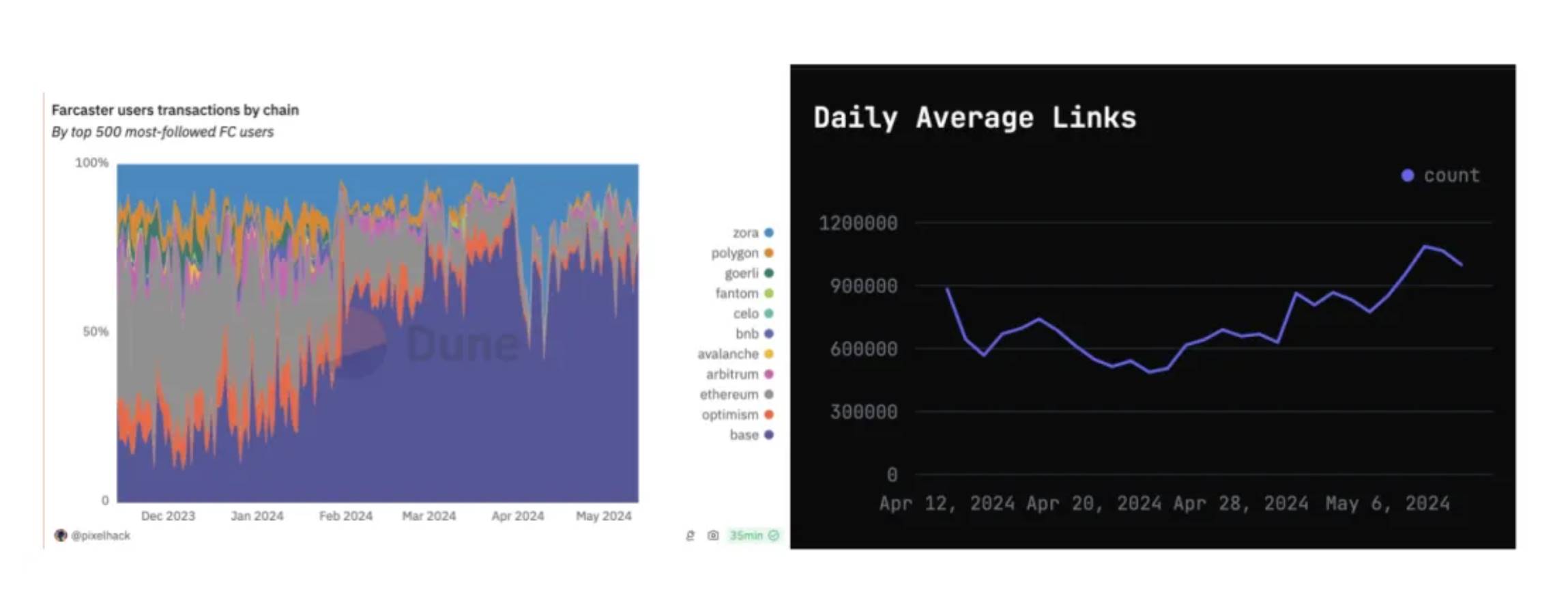
We see increasing foundational adoption, such as the $DEGEN token bootstrapping the network through incentive rewards and community engagement. This alone can be seen as a vertical, with Farcaster playing a secondary role. As consumer attention shifts toward platforms like Base with seamless user experiences, adoption of protocols like Farcaster may see correlated growth.
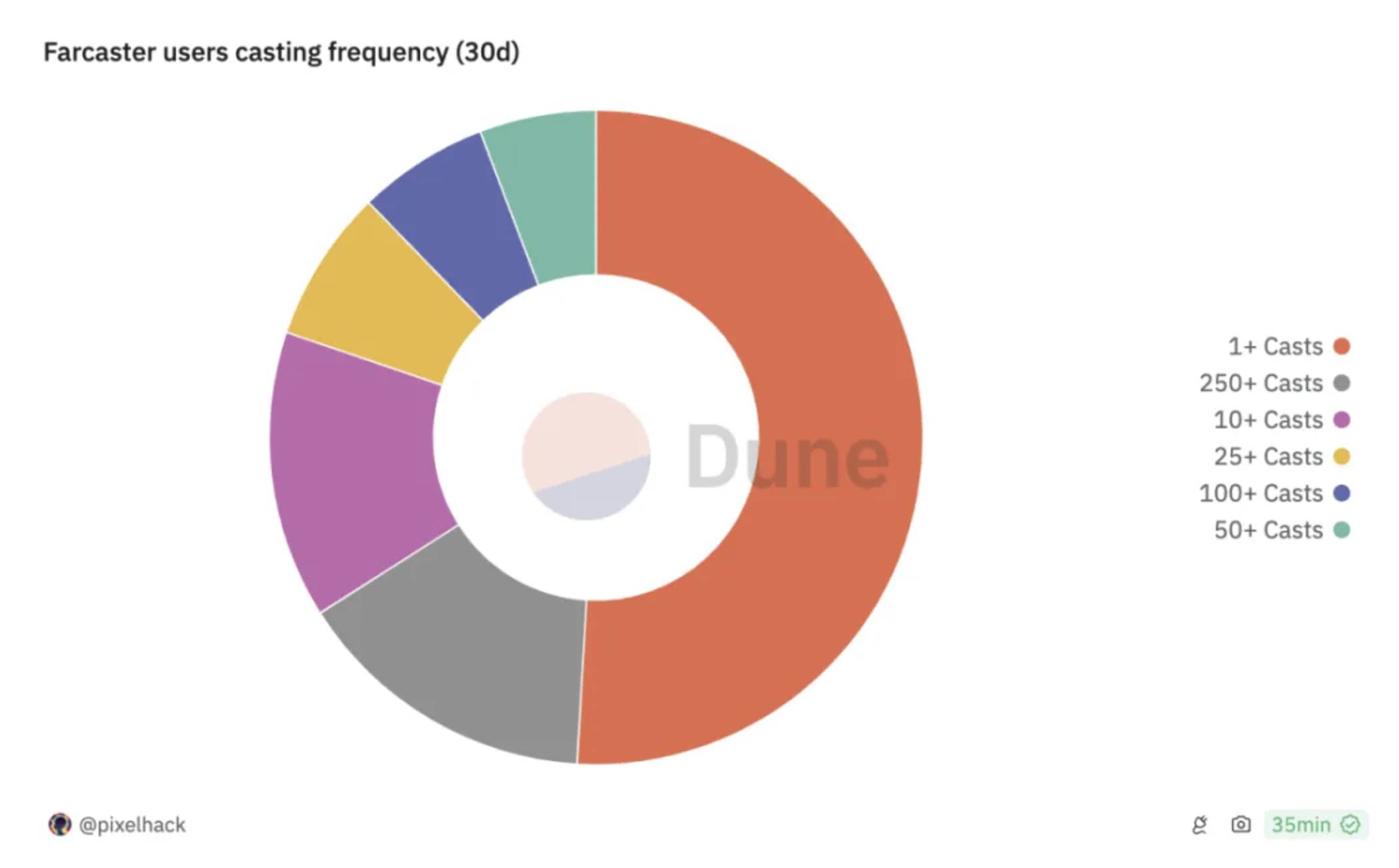
Within the scope of Farcaster and social apps, this is a very interesting data point. About half of users engage once a month, but the other half consists of a highly active user community (the second highest posting over 250 Casts), showing high retention and indicating Farcaster excels at delivering high-value utility to niche communities.
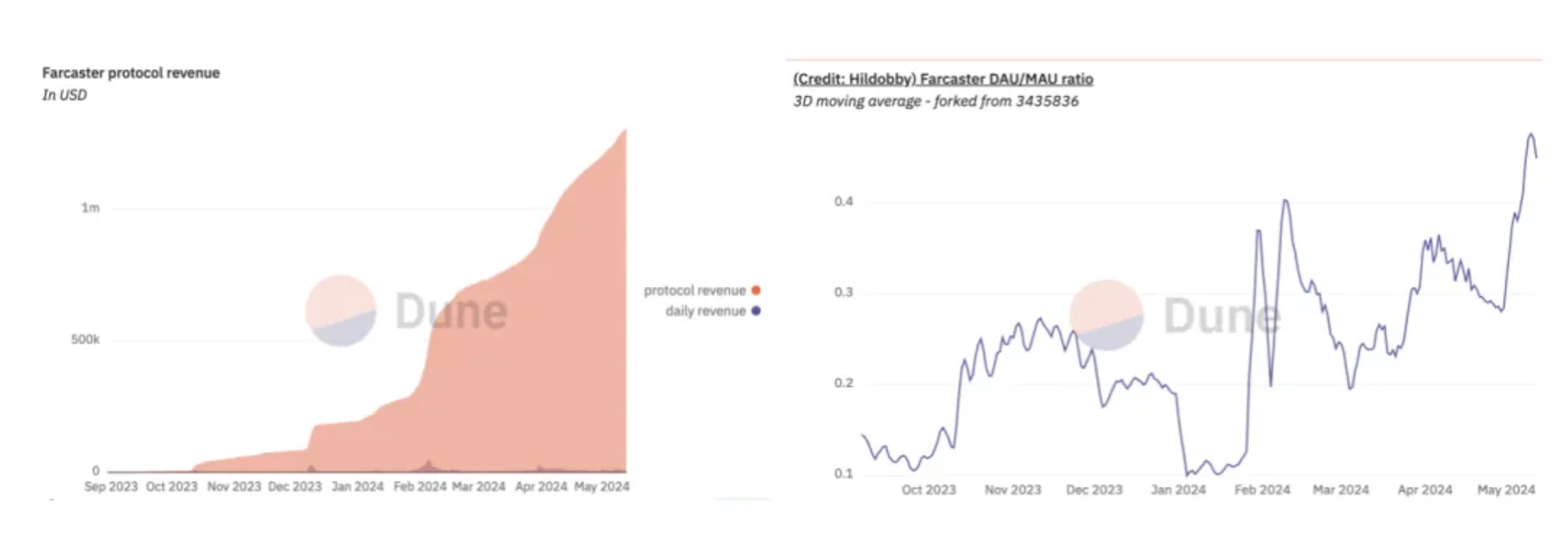
A higher DAU/MAU ratio also suggests Farcaster’s retention is improving, with daily active users approaching monthly active users. This significantly and almost directly contributes to revenue growth for the Farcaster team.
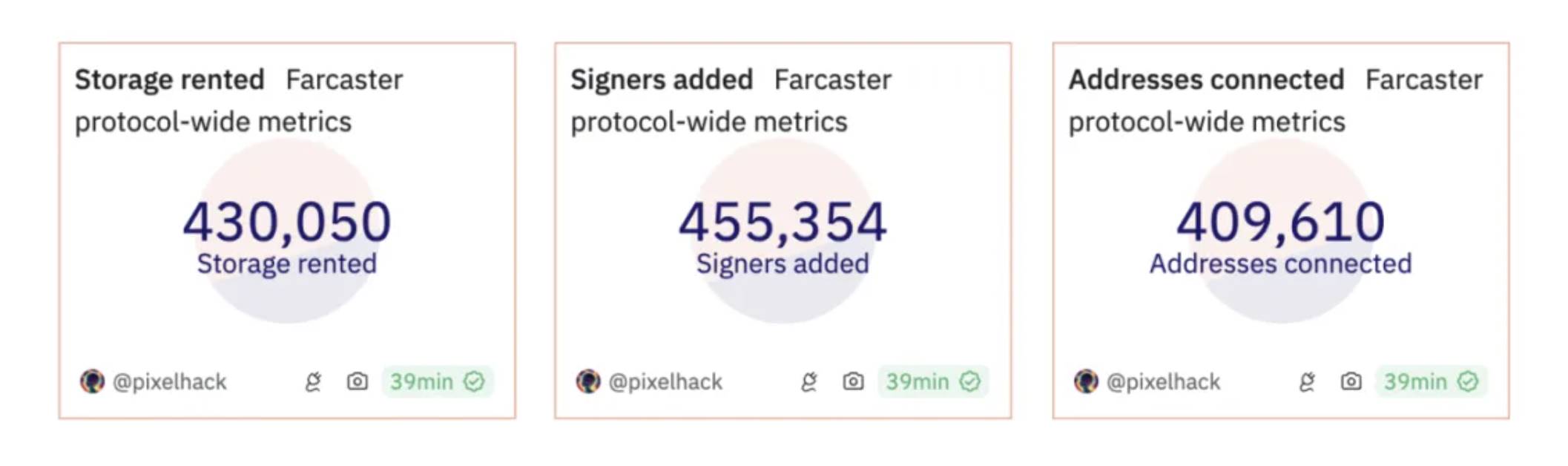
Over several months, a large number of people have paid for services such as storage leasing. Partly due to growing numbers of developers building apps on Farcaster, maintaining a Farcaster account costs $3 annually—a measure to prevent spam and bots. It will be interesting to see how many people actually retain the product and consider its quality high enough to pay for it over free platforms like Twitter or Instagram in the coming year.
3. Three Waves Application Theory
As we navigate the evolving landscape of social media, now is a good time to deconstruct the monolithic stacks of established platforms like Meta, X (formerly Twitter), WeChat, and Weibo. Farcaster offers a unique opportunity to rebuild these layers on a decentralized, open network. Entrepreneurs and startups can seize this chance to own and co-own every layer of this emerging ecosystem, leveraging Farcaster’s open canvas for innovation and creation.
First Wave: Building Infrastructure
The first wave focuses on establishing robust infrastructure. This foundational phase is crucial for enabling developers to build applications on Farcaster quickly and efficiently.
Tools: Development tools are needed to streamline the app-building process. Who will create Farcaster’s “Heroku,” providing developers with resources and support to seamlessly launch apps?
API: The effectiveness of Farcaster’s official API is another key component. Is it user-friendly and powerful enough to support diverse applications? If not, who will build Farcaster’s “Twilio” to simplify API integration and extend functionality?
Data: Just as Etherscan became essential for navigating Ethereum, Farcaster will need robust data tools as it grows. These tools will reorganize and make Farcaster data more accessible, supporting a wide range of use cases as the ecosystem matures.
Second Wave: Driving Network Growth Through Applications
Simultaneously, the second wave involves driving network growth through innovative applications. This growth can be divided into user growth and revenue growth, both vital to Farcaster’s expansion.
User Growth: Viral apps or compelling Farcaster client apps can significantly increase user numbers. By creating engaging user experiences, these apps will attract more people to join the Farcaster network, fostering a vibrant community.
Revenue Growth: Applications leveraging Web3’s financialization and assetization can enhance revenue streams. These apps will enable Farcaster users to earn income, providing monetary incentives for platform engagement. Increased protocol revenue can fund more paid user acquisition, creating a positive feedback loop of growth and investment.
Third Wave: Network Participation – Cautious Growth Guidance
While infrastructure and growth-oriented apps are crucial, caution is advised at this stage regarding applications solely aimed at driving engagement. These apps often heavily depend on an existing user base and may struggle to grow independently. Investing too early in engagement-driven apps could lead to stagnation if they fail to sustain growth through user acquisition.
4. Second Theory: Learning From the Past
A valuable way to unlock Farcaster’s potential is to study Web2 social apps that faced challenges due to restrictions or pressures from major platforms. Many of these apps were banned, acquired, or forced to pivot despite having innovative features and user engagement strategies that posed significant threats to large platforms. In the more open Web3 environment, these ideas could thrive without constraints of centralized control.
Examples from the Twitter ecosystem:
-
Meerkat: A live-streaming app that initially succeeded until Twitter restricted its access to the social graph, hindering its growth.
-
Klout: Known for measuring social media influence, it faced limitations due to API changes and eventually shut down.
-
Favstar: Provided a popular service for tracking favorite tweets and retweets until Twitter’s API changes rendered its functions obsolete.
Examples from the Facebook/Meta ecosystem:
-
tbh: An anonymous social app targeted at teens, acquired and later shut down by Facebook.
-
Poke: A Facebook-owned app similar to Snapchat, eventually discontinued.
Opportunities in the Web3 Paradigm
In Web3’s decentralized and open environment, similar ideas and innovations can find new life. Farcaster’s infrastructure allows for the creation and integration of diverse applications without fear of restrictive API policies or centralized control. This openness could spark a renaissance of innovative social apps, cultivating a rich ecosystem where:
-
User-Driven Innovation: Developers are free to experiment and build on Farcaster, creating unique apps tailored to niche audiences or novel use cases.
-
Decentralized Ownership: By owning their data and interactions, users enjoy greater control and privacy—increasingly important in the digital age.
-
Resilience Against Centralized Control: Without a central authority imposing limits, apps on Farcaster can evolve more naturally based on user needs and feedback.
This approach not only revives the innovative spirit of past social apps but also ensures a more resilient and user-centric social ecosystem. Entrepreneurs have the opportunity to revisit and reimagine these once-promising ideas to better empower users with customizable control.
5. Challenges
Despite Farcaster’s bright potential, several challenges must be addressed to ensure its long-term success and adoption.
1. Reservations About Importing 1:1 Social Graphs
One challenge for Farcaster is the potential issue of importing 1:1 social graphs from existing platforms. While integrating existing social graphs could ease the transition for new users, it may not foster the same community dynamics developed locally. Imported social graphs might not translate well into Farcaster’s decentralized environment, leading to disjointed user experiences. Communities show high receptiveness to social apps that allow customized experiences and status games for new influencers, which could also drive user adoption. Having a strong graph already established with key opinion leaders and major figures might undermine this experience—one that many users seek in social media. However, as demonstrated by products like Instagram Reels, TikTok, and YouTube Shorts, many influencers can repurpose their content across different platforms, potentially offering unique opportunities for them to leverage Farcaster’s graph.
2. Decline of Previous Social Products During Bear Markets
History shows that many Web3 social products struggle during bear markets. Downturns in the crypto market often lead to reduced user engagement and investment, significantly impacting the growth and sustainability of platforms like Farcaster. To build resilience against market volatility, Farcaster needs to ensure its value proposition extends beyond the crypto community to attract a broader audience. Diversifying its user base and creating engaging, market-independent features will be key to weathering market fluctuations.
3. Presence of Bots on Social Media Platforms
The presence of bots and automated accounts is a common problem across social media platforms, and Farcaster is no exception. Bots can distort engagement metrics, spread misinformation and propaganda, and create unwelcoming environments for real users—similar to Sybil attacks. Implementing robust bot detection and prevention measures is highly beneficial for maintaining ecosystem integrity. By prioritizing user verification and developing algorithms/mechanisms to identify and mitigate bot activity (fortunately, many apps on Farcaster like Phaver or Desmos are already working on this), Farcaster can create a safer and more authentic social space while preserving the vision of its uniquely designed identity layer.
Future Mass Adoption
Breaking out of the crypto echo chamber and achieving mass adoption is one of Farcaster’s biggest hurdles. While the platform has gained traction among crypto enthusiasts, attracting the broader public will require overcoming several barriers, including education, ease of use, and perceived value. Simplifying onboarding, providing user-friendly interfaces, and emphasizing Farcaster’s unique advantages over traditional social media platforms will be key strategies. Additionally, promoting Farcaster’s decentralized, user-owned nature can appeal to users concerned about privacy and data ownership. All of this ties closely to Farcaster’s marketing strategy—educating a wider audience about the unique value Farcaster adds for niche communities beyond the crypto space.
6. Conclusion
At its core, Farcaster is a social infrastructure layer that allows communities to vet users and users to vet communities through its key features: authentication, graph, feed, and frames. All of this is enabled by the protocol’s unique design and features that empower developers and entrepreneurs to creatively leverage the platform’s social graph. Farcaster’s greatest value proposition stems primarily from the identity layer it leverages and the ability for users to own their data rather than large corporations—a narrative reinforced as major social companies face scrutiny over data misuse.
Despite challenges such as social graph integration, market volatility, bot management, and achieving mainstream adoption beyond the crypto sphere, these obstacles are not insurmountable. Through strategic planning and innovation, Farcaster can overcome these hurdles and pave the way for a new era of decentralized social networks.
The robust infrastructure, combined with Web3’s open and transparent nature, creates fertile ground for innovative applications and user experiences impossible under the Web2 paradigm. By leveraging the unique strengths of the Farcaster protocol, developers can create diverse and engaging apps that drive user growth and engagement, fostering a vibrant and resilient ecosystem.
Looking ahead, Farcaster’s commitment to decentralization, user autonomy, and innovative features positions it as a potential leader in the next wave of social media platforms. This journey will require continuous improvement, community engagement, and unwavering focus on user needs. Building a more secure, user-controlled, and dynamic social media landscape is a goal worth pursuing. Farcaster isn’t just building a platform—it’s laying the foundation for a new way of social interaction in the digital age.
Join TechFlow official community to stay tuned
Telegram:https://t.me/TechFlowDaily
X (Twitter):https://x.com/TechFlowPost
X (Twitter) EN:https://x.com/BlockFlow_News
 IOSG Ventures