2023 Outlook: Concepts like GameFi Will Recover in the Cycle, Web3 Systematization Emerges as a Trend
TechFlow Selected TechFlow Selected
2023 Outlook: Concepts like GameFi Will Recover in the Cycle, Web3 Systematization Emerges as a Trend
2023 Outlook: Concepts like GameFi Will Recover in the Cycle, Web3 Systematization Emerges as a Trend
 Navigating Web3 tides with focused insights
Author: Harry Liu, CEO of Forj
Translation: Wayne Zhang, Forj Network
Before discussing the cycles and systems of 2023, let's first look at a comparison of investment activity in Q4 2022, hoping to identify new trends for 2023 from VC data.
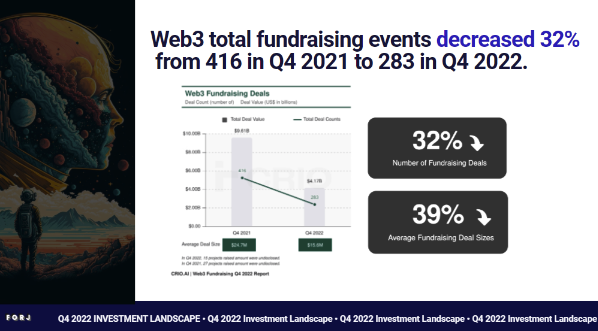
In Q4 2021, Web3 saw 416 funding rounds. In 2022, that number dropped by 32% to 283 deals. The average deal size fell to $15.6 million, down to 61% of last year’s level. This data contradicts reality—compared to last year, Web3 has made significant progress in both adoption and technological innovation, yet the scale and frequency of funding have sharply declined. One reason is the bear market, under which capital has gradually become more conservative.
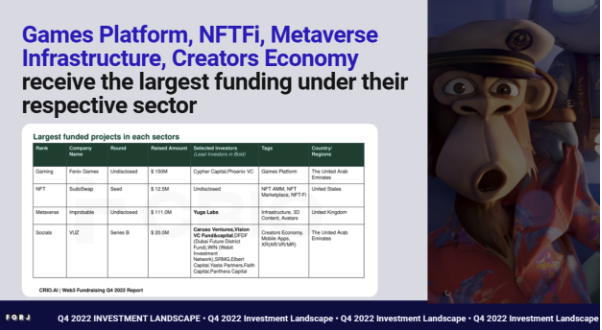
The largest funding rounds occurred in gaming platforms, NFTFi, metaverse infrastructure, and creator economy sectors. Fenix Games raised the largest single round in the quarter within the gaming sector, securing $150 million. Close behind was Improbable with $111 million.
Breaking it down by domain, in Q4, POLYCHAIN Capital invested seven times in infrastructure projects, leading each round. They were particularly aggressive, with an average deal size around $19 million. The chart below also shows other VCs who heavily backed different sectors in Q4 and their respective investment activities.

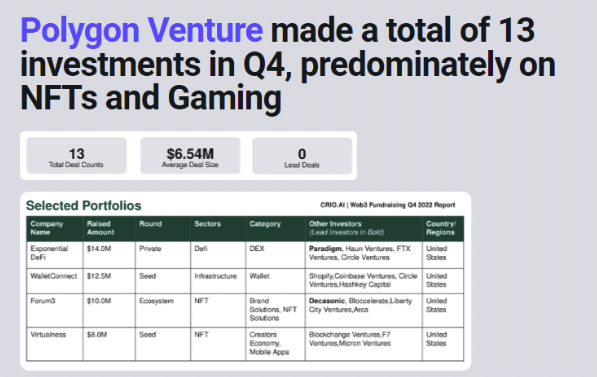
It's worth noting that Polygon, previously mentioned in our earlier reports on large-scale Web3 adoption, has partnered with multiple Web2 brands, using NFTs and the metaverse to drive Web3 adoption. Beyond partnerships, Polygon Ventures invested in 13 projects during Q4, averaging $6.54 million per deal, primarily focused on NFTs and gaming.
Themes of 2023
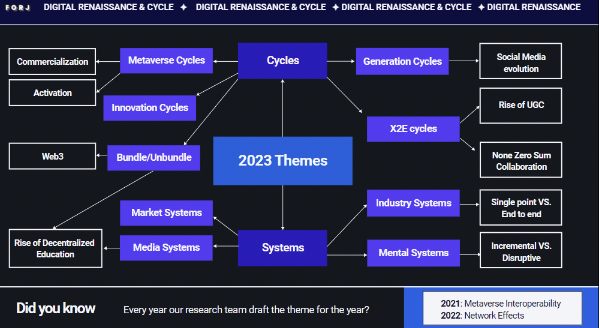
Looking back over the past two years, the theme of 2021 could be summarized as "metaverse interoperability," while 2022 was defined by "network effects." The narrative for 2023 may consist of two sub-themes: "cycles" and "systems." On one hand, concepts like the metaverse, X2E, and GameFi, which debuted during the bull market, will be refined during the bear market and rise again. On the other hand, as infrastructure improves and innovative technologies continue to emerge, systematization will become a trend—leading to the establishment of Web3 market systems, media systems, and more.
Systems & Institutions
From 1880 to 1930, the United States achieved various foundational innovations. With the emergence of critical infrastructure, systems built upon them—such as electricity, highways, and urban planning—began widespread use. From 1930 to 1970, innovation itself became systematized: education continuously improved productivity, and institutions, factories, media, and management systems gradually emerged and matured. Since 1970 until today, we are in an era where systems are being expanded and newly established—monopolies are growing, regulation is tightening, and people have created new systems to limit power. Here, systemic and systematized innovation is driving societal progress.
Let’s consider a question: Can games replace schools? Especially in some Asian schools, which heavily emphasize grades and KPIs. Many students are trained like test-taking robots just to achieve scores. But in fact, you can learn everything from elementary to university-level knowledge via the internet on your computer or phone. Knowledge assessment is constrained by grades, but real-world needs focus on whether knowledge is truly mastered and skillfully applied. Despite its flaws, this remains a mature system. We believe institutional innovation will further boost productivity—for example, optimizing the pathway from data → information → knowledge → wisdom.

For social media, follower counts and views function like scores—a game-like mechanism where higher attention means higher ranking. Forj Research is participating in this game too, gaining trust and visibility through publishing research reports. In this social media game, you can meet more people and generate income by using apps and posting content. If we view the internet as a whole, every service becomes a system—Twitter might not be a game, but it’s a game with 250 million daily active users.
Companies often prioritize their profits over industry innovation. Kodak once had a market cap of $3 billion and ranked among the world’s top 30 companies, specializing in film photography. Ironically, the digital camera—the technology that ultimately dethroned Kodak—was actually first developed in Kodak’s own lab. However, based on the assumption that high-margin film sales would remain sustainable long-term, they didn’t pursue it. The rest is history: the rise of digital devices led to Kodak’s decline.
An overly systematized world may lack intellectual diversity and foster conformity, causing people to prioritize maintaining the status quo and becoming less receptive to new, disruptive ideas—potentially stifling innovation and creativity, hindering entrepreneurship. On the other hand, this environment may motivate some individuals to challenge norms, question assumptions, and discover new opportunities and motivations.
Once a system scales up, it becomes difficult to replace with new institutions or innovations. Startups and venture capital firms play crucial roles in this revolution aimed at displacing entrenched systems. Meanwhile, changing multiple systems simultaneously requires waiting for pivotal moments—various industries are now reaching such turning points, finally beginning to adopt transformative systemic innovations.
Cycles
Systems exist because existing industries, companies, regulations, and institutions have already taken shape and continue evolving, while cycles revolve continuously around innovation. As Mark Twain said: “History doesn’t repeat itself, but it often rhymes.”

We believe Web3 follows the same pattern. When a new innovation emerges, it is usually ignored at first, then met with logical criticism, followed by increasing public discussion, and eventually acceptance and adoption. Today’s Web3, AI, and metaverse face similar trajectories as automobiles, airplanes, and the internet did in the past.

The rise of Gen Z and younger generations will usher in new innovation cycles—as platforms like Snapchat and TikTok grow into mainstream favorites, and smartphones and wearable devices become increasingly popular. New users bring new ways of thinking and new demands, signaling the arrival of a new cycle.

Industry transformation occurs through cycles of fragmentation and consolidation. The internet evolved through layered protocols and diversified into many content forms. DeFi innovations stimulated new liquidity, and minor breakthroughs across areas like cross-chain technology gave rise to multi-functional aggregators and complex, feature-rich DEXs. For entrepreneurs, both horizontal innovation and vertical exploration can drive industry progress, leading to business success and wealth creation.

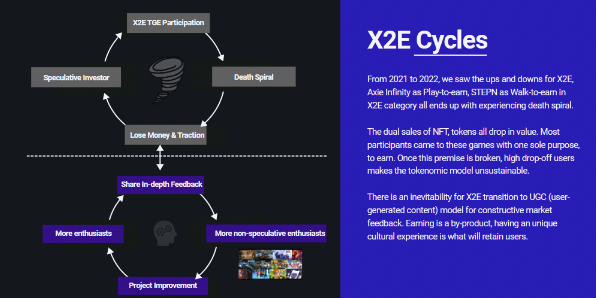
From 2021 to 2022, we witnessed the rise and fall of X2E—whether Axie Infinity’s Play-to-Earn or Stepn’s Walk-to-Earn model. Despite initial popularity, both NFT sales and token prices have significantly contracted. This proves that relying solely on earning mechanisms is unsustainable. UGC (User Generated Content) is an inevitable future trend for gaming—earning will become a byproduct of gameplay. The new growth flywheel for projects will be: fun → deep engagement and feedback sharing → more non-speculative players → project optimization → more fun.
New Systems
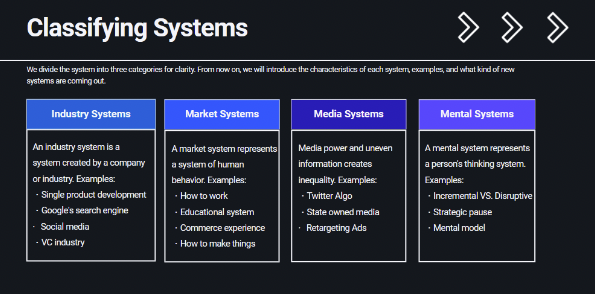
To clarify, we categorize systems into four types and discuss each type’s characteristics, case studies, and emerging systems:
Industrial Systems
Industrial systems are typically established by a single company (industry leader) or an entire industry. A common piece of startup advice is to “focus on one thing,” which is indeed important. However, over the past 10–15 years, things have changed. Slack was sold to Salesforce in 2020 because it couldn't compete against Microsoft’s bundled product ecosystem. To beat Microsoft, you must fundamentally change your approach.
Many companies now launch multiple products from inception or build services upon them. Having multiple products reduces competition, expands market size, enables bundled pricing, supports unified UIs and APIs for customers, and allows deeper integration. As composite product companies, collaboration itself becomes a product, and underlying data and analytics grow in importance. Restructuring organizations requires upfront investment and time—but if the ultimate goal is GAFA (Google, Apple, Facebook, Amazon), it’s worthwhile. Animoca Brands is a prime example, leveraging investments in NFTs, the metaverse, and gaming to gradually build network effects.

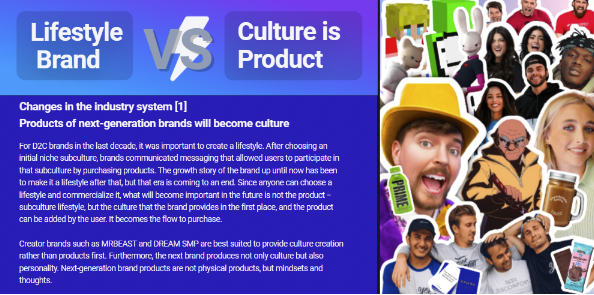
The biggest shift in industrial systems is that culture itself becomes a product. Unlike previous waves of innovation that shaped lifestyles, today’s consumers can choose any lifestyle. In contrast, culture enhances brand recognition and distinctiveness. Products may no longer be physical items—they could represent a mindset or a cultural artifact.
Market Systems
Market systems are also human behavior systems. Take education: universities offer bundled services—education, socializing, dating, status, and creation. People worry online courses can’t fulfill these functions, but next-generation education should focus on learning environments—enhancing curiosity, sparking interest in students’ fields, and exposing them to new domains. This requires a system enabling greater collaboration and personalization. At this point, AI may prove to be a better solution.
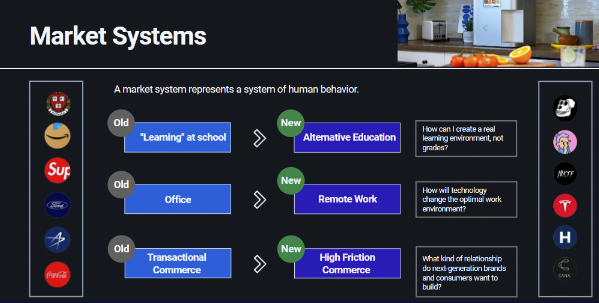
A few years ago, working in fixed office spaces was considered normal. Now, remote work is increasingly accepted. In the U.S. and Japan, companies aiming to improve conversion rates now offer minimal commercial experiences for convenience. As times change, we seek not just convenient shopping experiences, but branded experiences offering gamified interactions to deepen user relationships. Crucially, brands must infuse a sense of “play.” For example, Gucci’s collaboration with 10KTF on an NFT gaming experience attracted over 3,000 collectors with 4,253 collectibles, generating revenue while delivering a novel commercial experience.

Brands used to spread via mass media; now, technology and data enable personalized branding—allowing brands to quickly pinpoint target audiences based on user behavior statistics. However, this raises challenges regarding privacy and cost.
The invention of factories, assembly lines, and global supply chains fundamentally transformed manufacturing. Today, we mostly improve efficiency or scale to reduce costs. The future lies in services that fundamentally change how things are made. As Elon Musk said: “At Tesla, the factory is more of a product than the car.” Factory-as-a-Service (FaaS) may become a sustainable system.
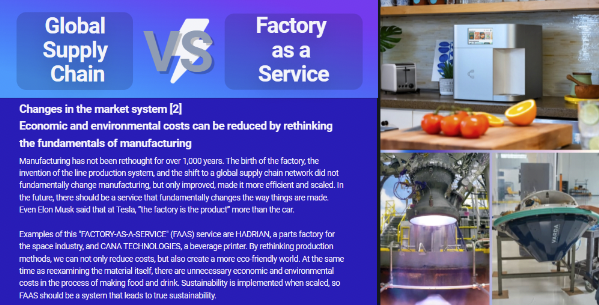
Lastly, media systems and spiritual systems—we’ll share more in future reports. Regarding spiritual systems, a clear trend is that more innovation comes from collective intelligence rather than individual genius. Good ideas are continuously shared, imitated, refined, implemented, and put into practice.

Conclusion
The price cycle is the most visible cycle we’re currently experiencing. Falling prices stimulate the creativity of true believers—during the bear market, we observe:
- Fewer speculators: Declines in NFT and FT trading volume and transaction counts
- Entry of new brands: Nike, Gucci, Reddit, and others testing Web3
- Technological innovation: Cross-chain, L2s, Move language, etc.
- ……
Whether at the level of technology, product, or business model, foundational innovations are continuously driving systemic innovation across Web3. New entrepreneurs and entrants are reshaping the rules of the Web3 system. We can anticipate that X2E, the metaverse, and others will re-emerge in refreshed forms after being refined during the bear market. But even more certain is this prediction: the next wave of innovation will come from Scenius, not Genius.
Appendix:
1. This report was presented on January 19 at Binance Live. Video version:https://www.binance.com/en/live/video?roomId=2119321
3. Report subscription site:https://forjresearch.substack.com/
4. Learn more about Forj:https://twitter.com/ForjOfficia
Join TechFlow official community to stay tuned
Telegram:https://t.me/TechFlowDaily
X (Twitter):https://x.com/TechFlowPost
X (Twitter) EN:https://x.com/BlockFlow_News
 Forj Network