Long awaited, a comprehensive解读 of GMX V2
TechFlow Selected TechFlow Selected
Long awaited, a comprehensive解读 of GMX V2
This article provides a comprehensive解读 of GMX V2, offering a glimpse into the future of this leader in the derivatives sector.
 Navigating Web3 tides with focused insights
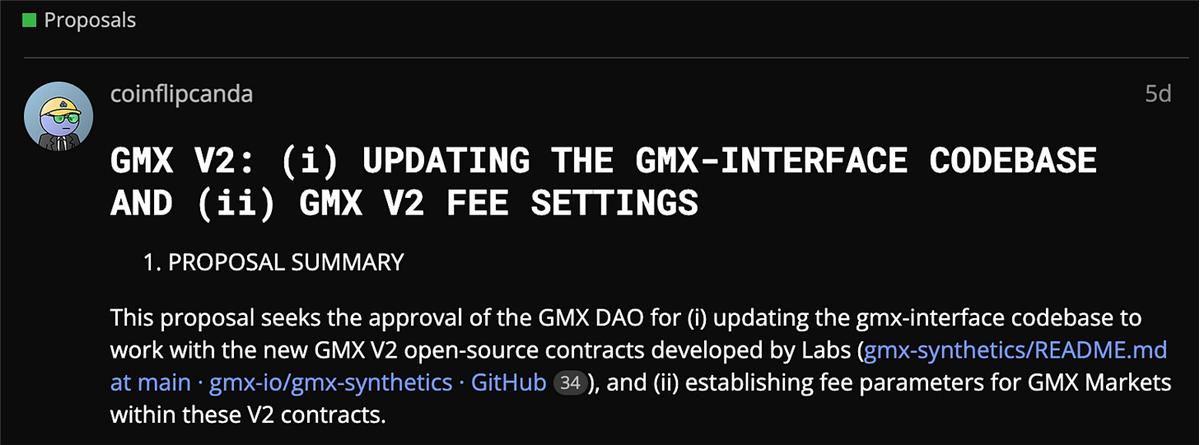
The GMX team has recently released a proposal for V2, signaling that the long-anticipated synthetic asset version of GMX is finally nearing launch. This article provides a comprehensive解读 of GMX V2, offering a glimpse into the future of this leading player in the derivatives space.
Trading Markets
In GMX V2, each trading pair has its corresponding liquidity pool (LP). For example, in ETH/USD trading, the LP consists of ETH/USDs. Here, long positions are collateralized with ETH, short positions with stablecoins, and the index token is ETH.
This setup retains the security benefits of full collateralization while ensuring that each trading pair’s LP only bears risk associated with that specific pair. This facilitates the listing of more assets and opens up possibilities for permissionless listings in the future, since new tokens no longer affect an entire shared pool as was the case with GLP.
Furthermore, the so-called synthetic assets allow trading of assets not natively available on-chain. For instance, in a SOL/USD market, the LP could be ETH/USD, with long positions backed by ETH, short positions by stablecoins, and the index token being SOL—meaning ETH supports long exposure to SOL.
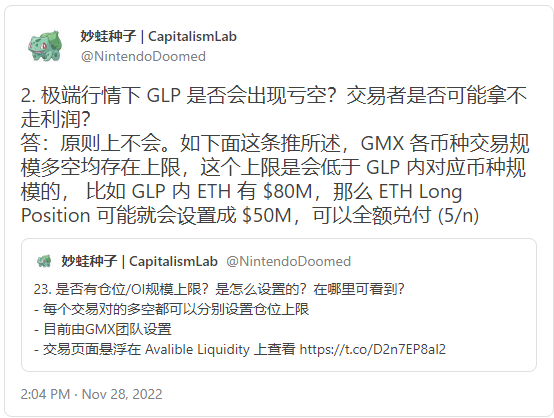
Clearly, the security of SOL/USD cannot match the full protection offered by ETH/USD. However, given the correlation between SOL and ETH, the risk is significantly lower compared to using pure USD as collateral. Additionally, GMX states it will limit open interest (OI) to less than the value of the collateral to further mitigate risks.
Fee Structure
Beyond basic trading fees, GMX V2 introduces three additional fees: Funding Fee, Borrow Fee, and Price Impact. These fees help balance long and short positions in both LPs and OI, prevent inefficient use of capacity, and reduce price manipulation risks—overall reducing risk for GMX LPs and enabling higher trading volume.
The primary purpose of the Funding Fee is to balance long and short positions. The formula is: (X) * (difference in long/short OI) ^ (Y) / (sum of long/short OI). Both X and Y are configurable parameters. If long OI exceeds short OI, longs pay funding to shorts, and vice versa.
The Borrow Fee aims to reduce inefficient usage of trading capacity. Since GMX's trading capacity is limited by pool size—a finite resource—the borrow fee in V2 is determined by the ratio of OI to pool capacity.
Borrowing fees are calculated as borrowing factor * (open interest in usd + pending pnl) ^ (borrowing exponent factor) / (pool usd) for longs and borrowing factor * (open interest in usd) ^ (borrowing exponent factor) / (pool usd) for shorts.
Price Impact serves three key purposes:
-
Incentivizing balanced LP pools;
-
Encouraging balanced long and short positions;
-
Reducing price manipulation risks.
How does this work? Simply put, when depositing or withdrawing from an LP, if your action makes the pool more imbalanced, you pay a fee; if it improves balance, you earn a reward. For opening or closing positions, the impact on long/short balance is considered.
(initial USD difference) ^ (price impact exponent) * (price impact factor / 2) - (next USD difference) ^ (price impact exponent) * (price impact factor / 2)
Other Improvements
Thanks to the more sophisticated Price Impact mechanism, the V2 parameter proposal significantly reduces spot swap fees—base rates for non-stablecoin pairs are now just 0.05%, and as low as 0.01% for stablecoins. This gives GMX a stronger chance to capture greater market share in spot trading.
Additionally, V2 enhances the trading experience by improving limit and stop-loss order mechanisms and adding support for spot limit orders.
Horizontal Comparison with GNS
GNS also employs three fees: Funding Fee, Rollover Fee, and Spread (Price Impact). Aside from the Funding Fee, which functions similarly, the other two differ significantly. For example, GNS determines Price Impact based on CEX depth data and position size, while its Rollover Fee applies only to collateral, unlike GMX’s Borrow Fee, which applies to the entire position. See this tweet thread for details.
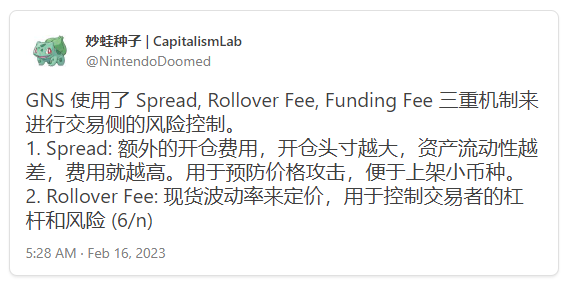
Moreover, GNS uses a single gDAI as its LP, whereas GMX continues with its index asset model and independent liquidity pools. While GNS offers greater capital efficiency and flexibility in listing assets, GMX takes a stronger stance on risk control.
Vertical Comparison with GMX V1
Compared to GLP, isolated liquidity pools better isolate risk—especially important as GMX plans to support many long-tail assets (small-cap tokens) via synthetic assets. These assets carry higher risk; for example, Avax trading previously suffered related attacks. Risk isolation is therefore crucial to prevent a single incident from jeopardizing the entire GMX system. Currently, GLP token allocations are centrally decided by the team or DAO. With isolated pools, allocation decisions shift to the market, increasing efficiency and paving the way for permissionless listings.
The addition of Funding Fee and Price Impact also boosts trading volume. GMX currently operates more like a leveraged trading platform with one-way fees. Perpetual futures markets are clearly much larger, making these upgrades highly beneficial for attracting more users. Price Impact helps balance long/short ratios and reduces price manipulation risks, thereby increasing overall trading capacity—definitely an improvement over the previous single Borrow Fee model.
The synthetic asset model enables trading of off-chain assets such as the earlier example of SOL/USD. However, since long positions still require eligible collateral—and ideally a correlated one—it won’t immediately expand to include all stocks, forex, and similar assets available on GNS. Although theoretically possible—by simply using U as collateral—it remains constrained by practical risk considerations.
Summary
In one sentence: GMX V2 makes GMX safer, increases trading capacity, and enables support for more tradable assets.
Join TechFlow official community to stay tuned
Telegram:https://t.me/TechFlowDaily
X (Twitter):https://x.com/TechFlowPost
X (Twitter) EN:https://x.com/BlockFlow_News
 CapitalismLab