IOSG: HIP-3, 고가의 진입권, 살 수 없는 해자
저자: Mario Chow, IOSG Ventures
Hyperliquid에서 자신의 퍼페추얼 마켓을 등록한 팀은 총 10개였으며, 대부분 이를 위해 약 4,000만 달러의 HYPE를 록킹(locking)했습니다. 이 중 한 곳이 거래량의 97.8%를 차지하고 있으며, 최근 한 달 만에 44% 하락했습니다. 본고가 분석하는 것은 나머지 아홉 곳의 행보이며, 모든 수치는 공시가 아닌 온체인 데이터에서 직접 추출합니다.
본고의 모든 숫자는 Hyperliquid 공개 API에서 직접 추출됩니다: perpDexs, metaAndAssetCtxs, 등록된 모든 519개 자산을 아우르는 일일 candleSnapshot, delegatorSummary, userNonFundingLedgerUpdates 및 clearinghouseState{dex}。
「30일」은 2026년 8월 15일부터 9월 13일까지의 완전한 UTC 자연일을 의미하며, 「전 전월 30일」은 7월 16일부터 8월 14일, 「7일」은 9월 7일부터 13일을 의미합니다. HYPE 가격은 $79.73으로 환산합니다. 제7절의 라우팅 데이터는 flowscan에서 가져왔는데, 이는 공개 API로 builder code의 거래량을 집계할 수 없기 때문입니다.
요약
· HIP-3는 다시 한번 Hyperliquid의 소수파가 되었습니다. 빌더가 배포한 마켓이 30일 간 퍼페추얼 거래량에서 차지한 비율은 25.8%이며, 지난달에는 57.1%였습니다. 이 변화의 주원인은 분모입니다: 코어 오더북(Core Orderbook)의 거래량이 두 배 이상 증가하는 동안 HIP-3 자체는 하락세를 보였습니다.
· 선두 주자가 위축되고 있습니다. Trade[XYZ]의 30일 거래량은 $646억($64.60B), 전월 대비 44.2% 감소했으며, 7일 평균 거래량은 8월 초 하루 $53.6억($5.36B/일)의 정점에서 $20.1억($2.01B/일)으로 떨어졌습니다. 이 하락 폭의 약 절반은 스토리지 및 AI 섹터의 실제 시장(Traditional Market) 거래량 회귀와 일치하며, 나머지 절반은 해당 플랫폼自身的 위축 때문입니다. 8월 18일 이후 단 하루도 코어 오더북의 성과를 추월하지 못했습니다.
· 엔트로피(Entropy/io)는 치열하게 경쟁하는 시장에서 단 한 주간 선두를 점령했다가 다시 자리를 내주었습니다. Nebius 시장에서의 점유율은 연속 세 주 동안 8.7%, 53.1%, 20.4%의 궤적을 그리며 변동했고, 자체 거래량도 세 주간 연속 하락했습니다. 역방향 신호는 포지션에서 비롯됩니다: 미결제약정(Open Interest)은 상승세로 37% 증가해 $5,140만($51.4M)에 도달했습니다.
· 클리어링 자산(Settlement Asset)은 여전히 생사의 갈림길이며, 기록은 여전히 6대 6입니다. USDC 스테이블코인을 제외한 다른 통화로 클리어링하는 플랫폼은 모두 거래를 중단했으며, 현재 살아남은 곳은 모두 USDC를 사용합니다.
· 자산 상장 권한은 유지하기 어렵습니다. 현재 경매 최저가 기준으로 자산 자리(Asset Slot) 하나당 약 $39,900가 필요하며, Paragon의 모든 활성 마켓을 인수하는 데 드는 비용은 약 $104만 정도에 불과합니다. 이는 Trade[XYZ]의 2주 치 수수료 수입과 맞먹는 금액입니다.
· 어느 누구도 가격(수수료 인하) 측면에서 경쟁하지 않습니다. 모든 주식 관련 플랫폼은 deployerFeeScale = 1.0과 Growth Mode를 기반으로 작동하며, 측정된 실제 수수료율은 Trade[XYZ] 기준 0.427bp, Entropy 기준 0.400bp입니다. 선두 제외 나머지 플랫폼들은 생존 여부와 관계없이 통틀어 평생 $747,000의 디플로이어 커미션(운영사 지분수익)만 벌어들이는 데 그쳤습니다.
活跃的 열 개 디플로이어(Deployer)

▲ Trade[XYZ]의 일일 거래량 및 하위 모든 챌린저 플랫폼. 두 차트의 Y축 스케일은 약 100배 차이 납니다.

「체결 건수」는 일봉(K선)의 n 필드를 기간 내에 합산한 값입니다. 공개 API로는 독립적인 거래자 수를 산출할 수 없습니다.
역사적으로 퍼페추얼 DEX를 등록한 곳은 단 열 곳뿐이었으며, 지금까지 열 번째 플랫폼은 등장하지 않았습니다. 현재 네 곳이 운영 중이며, 다섯 곳이 중단되었고 한 곳은 개설조차 하지 않았습니다. Trade[XYZ]는 HIP-3 거래량의 30일간 97.8%, 최근 7일간 97.6%를 차지합니다.
챌린저들의 상황은 짧은 문장으로 요약할 수 있습니다. 엔트로피(Entropy)는 26일간 $10.3억($1.03B)의 거래량을 기록했으며, 자체 구축한 오라클(Oracle)을 활용하여 자산 목록보다는 자체 검증에 의존하는 six 개의 활성 마켓을 운영합니다. 선두 주자가 이미 입찰을 진행 중인 마켓에서 실제로 선두를 차지한 유일한 플랫폼입니다. 파라곤(Paragon)은唯一的 오더북 구조가 전문적인 챌린저로, 26개의 활성 마켓을 보유하며 포지션 분포가 넓게 이루어져 있습니다. Trade[XYZ]가 단시간에 5개 종목으로 공격해 왔음에도 월간 거래량은 49.9% 상승했습니다. Markets by Kinetiq는 23개 종목을 취득했으며, 거래량의 95%가 두 지수 퍼페추얼 상품에 집중되어 있습니다. 하이애나(HyENA)는 이미 종료되었습니다: 모든 마켓이 하향 처리되었으며 미결제약정이 0이 되었고, 평생 벌어들인 수익은 고작 $33,414에 그쳤습니다.
HIP-3의 점유율과 오독되기 쉬운 이유

▲ HIP-3의 Hyperliquid 퍼페추얼 거래량 내 점유율(일별).

7일 이동평균은 7월 중순 50%를 돌파했으며, 8월 초엔 57% 가까이 도달했으나随后 30% 아래로 추락했고 8월 20일 이후로 회복하지 못하고 있습니다. 8월 18일 당시 한 빌더의 거래량이 Hyperliquid의 전체 검증자 노드 집계를 압도한 적이 있었으나, 이후로는 그런 기록을 세우지 못했습니다.
실제로 이 비율은 분모의 변화를 의미합니다. 분자는 traditional 주식 오더북이고 분모는 암호화폐 오더북인데, 변동성을 유발하는 변수는 암호화폐 쪽에 있습니다. 57%라는 수치는 암호화폐 시장이 정체되었을 때 읽은 값이며, 26%는 같은 traditional 주식 오더북이 호황기를 맞이했을 때 읽힌 값입니다. 동기간 코어 퍼페추얼 거래량은 117% 증가했습니다. 최근 7일간 점유율은 오히려 28.6%까지 내려갔고, Trade[XYZ]는 지속적으로 축소 중입니다. HIP-3 점유율을 인용하기 전에는 반드시 해당 기간 중 암호화폐 시장의 흐름을 명시해야 합니다.
진짜로 봐야 할 것은 절대량이며, 절대량은 악화되고 있습니다. Trade[XYZ]의 30일 거래량은 $646억($64.60B)으로 전월 대비 44.2% 감소했으며, 7일 평균 거래량은 8월 초의 하루 $53.6억($5.36B)에서 $20.1억($2.01B)으로 떨어졌습니다. 자체 오더북은 62% 축소되었습니다. 최대 마켓인 SK하이닉스는 $85억($8.50B)까지 하락했습니다. 점유율 하락 요인 둘 다 실증적이지만, 다음 절에서 알 수 있듯 HIP-3 영역의 대부분은 경쟁 문제가 아닙니다.
거래량 하락의 주된 원인은 스토리지 섹터의 침체이지, 점유율 이탈이 아니다
44%의 급락을 단순히 '선두 주자의 패배'로 해석하는 것이 가장 직관적이지만, 데이터는 이를 뒷받침하지 않습니다. 검증 방법은 매우 간단합니다. 경쟁으로 인한 하락이라면 종목 자체가 정상적으로 거래되다가 단지 Trade[XYZ]가 독식하던 비중만 줄어드는 모습이어야 합니다. 그러나 실제 발생したのは 종목 자체의 거래 활동이 둔화되는 것입니다.
패닉 셀링(Panic Selling)이나 거대한 매도 물결은 전혀 없었습니다. 거래량이 정점을 찍었던 8월 초를 기준으로 볼 때, 현재 오더북상의 주요 대형 종목들 가격은 모두 더 높은 상태를 유지하고 있습니다.

진정으로 무너진 것은 이러한 종목들이 하루 종일 움직이는 진폭(Volatility)이며, 플랫폼의 거래량은 거의 연동하여 동반 하락했습니다.

이상은 모두 영업일 기준 데이터입니다. 주말에 traditional 주식 시장이 휴장하는 동안 Trade[XYZ]는 정상 거래를 이어갔기에 주말을 포함하면 양 상관관계가 지나치게 부풀려질 수 있습니다. 영업일만 고려할 경우, 스토리지 섹터의 일평균 변동성과 플랫폼 일일 거래량 간의 상관계수는 +0.47로 나타나며 샘플링 기간은 45일입니다. 금(Gold)은 천연 대조군 역할을 합니다: 이번 달 금은 일중 변동성이 상승한 유일한 대형 마켓이었으며, 거래량 역시 동반 증가했습니다. 은(Silver)은 이러한 패턴에서 벗어난 예외 사례입니다.
다만 변동성은 단순 대리변수에 불과합니다. 보다 직접적인 검증은 동일한 9개 종목의 실제 traditional 주식 거래량과 비교하는 것이며, 그 결과는 traditional 시장이 거래량 감소분의 약 절반만을 설명한다는 것입니다.

스토리지 및 AI 섹터의 actual Traditional 거래량은 실제로 25.7% 하락했으며, 이는 반이 맞는 수치입니다. 그러나 XYZ의 거래량은 49.7% 하락하여 약 두 배 차이가 발생합니다. 추가로 발생한 24%p의 격차는 산업 전반의 요인이 아닙니다.
특히 격차가 가장 큰 곳은 바로 핵심 포트폴리오입니다: 마이크론(Micron) -26.0pp, 인텔(INTEL) -25.4pp, SK하이닉스 -21.5pp. 오히려 엔비디아(NVIDIA, +36.5pp)와 Nebius(+18.6pp)에서는 traditional 시장을 상회했으나, 해당 두 종목의 규모는 작습니다.
경쟁 구도만으로는 이 격차를 설명할 수 없습니다. 엔트로피의 30일간 Micron 거래량은 고작 $5.23억이지만, XYZ 자체 Micron 오더북은 $61.4억이 줄었습니다. 따라서 챌린저 플랫폼이 가져갈 수 있는 최댓값은 겨우 약 8%에 불과합니다.
나머지는 주로 자금의 이동(Rotation)으로 보입니다. 동기간 Hyperliquid 코어 오더북의 퍼페추얼 거래량은 117% 증가했으며, HIP-3는 감소세였음에도 양자를 합친 전체 규모는 26% 성장했습니다. 자금이 Hyperliquid을 떠난 게 아니라, 단순히 traditional 주식 오더북에서 암호화폐 오더북으로 재편성된 것입니다.
규모 측면의 기준으로 보면. 같은 30일 동안 이 9개 종목은 traditional 증권사에서 총 $2,004.7B가 거래되었으며, XYZ에서의 거래량은 $23.5B에 불과해 1.2%를 차지합니다. XYZ의 모든 104개 마켓을 합친 $64.60B도 이들 9개 종목의 Traditional Actual成交额의 3.2% 수준에 그칩니다. 渗透率 최고는 SK하이닉스 9.1%, 최저는 브로드컴 0.1%입니다. 이 데이터 분포曲线 자체가 해당 비즈니스의 속성을 보여줍니다: traditional Traditional시장 일반인에게 접근성이 낮은 Traditional傳統資產ほど渗透率이 높고,누구나 손쉽게 매수할 수 있는 미국 대형주는渗透率이 낮다는 점입니다.
따라서 이번 거래량 감소는 두 가지 요인이 복합적으로 작용했습니다: 약 절반은 섹터 전반의 Beta 요인이고, 나머지 절반은 플랫폼自身의 요인입니다. 제6절의 계산은 traditional來源을不问單純根據Actual Traditional成交额進行核算,因此不會影響手續費部分的計算結果。하지만 이 두 요인을 명확히 구분하여 관찰하는 것이 중요합니다: 섹터 차원의 하락분은 회복 가능성이 있지만,플랫폼自身의 하락분이 반드시 돌아오리라 보장할 수는 없습니다.
재편, 그리고 유일하게 예측력을 가진 변수

▲ 각 HIP-3 플랫폼의 일일 거래량(로그 스케일). 파선은 USDC 스테이블코인을 제외한 통화로 클리어링한 곳을 표시하며, 원점은 최종 체결일.
현재 여섯 곳의 플랫폼이 거래를 중단했으며, 이들을 가른 결정적 변수는 자산 선정이 아니었고 팀 역량도 아니며 역사적 거래량도 아닙니다. 바로 클리어링으로 사용하는 스테이블코인이었습니다.
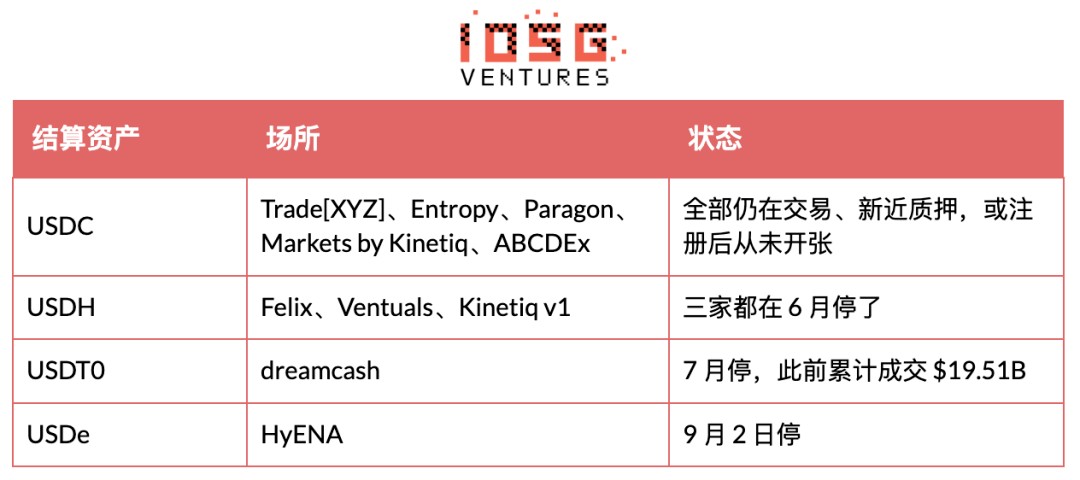
메커니즘 자체는 매우素朴합니다: 트레이더는 첫 주문을 내리기 위해 특정 스테이블코인으로 교환해야 하는데, 이들은 귀찮아서 바꾸지 않는 것입니다. 펠릭스(Felix)가 가장 명확한 사례입니다. 당초 USDH를 지지하던 일부 수수료 우대가 Growth Mode 적용과 동시에 상쇄되었고, 이후 이 클리어링 자산은纯粹的摩擦(cost)만 남겼습니다.
키네틱(Kinetiq)은 해당 그룹의 대조 실험입니다.停运 후 살아남은 유일한 운영사는 USDH 마켓을 접고, 동일한 지수 상품을 USDC로 옮겨 새로 오픈했습니다. 역사적 거래량은 어떤 예측도 제공하지 못했습니다: 드림캐시(Dreamcash)는 $19.51B를 기록하며 지난 6월 계열 전체를 합친 것보다 많았지만, 결국 문을 닫았습니다. 엔트로피는 8월 과거 어떤参入者보다 많은 자본을 투입하며 진출했으며, USDC 선택에 있어서는 hesitation을 보이지 않았습니다.
클리어링 자산을 결정하는 진짜 것과 아닌 것
USDC의横扫가 프로토콜의 정책임을 쉽게 생각하기 쉽지만, Hyperliquid 공식 문서의 서술은 정반대입니다. Aligned Quote Assets v2(AQAv2) 하에서(8월 하순 USDC 도입, Coinbase가 treasury deployer, Circle이 technical deployer 역할 수행), USDC의 Hyperliquid 내 조세 조정 후 준비금收益은 약 90%가 프로토콜로 반환되며 Assistance Fund에 편성됩니다.이자 계산은 30일 단위로 진행되며, 각 주기 종료 8일째에 지급되므로 첫 번째 지급은 10월 초에 이루어지며, 현재까지는一分钱도 입금되지 않았습니다.
AQAv2가 의도적으로 배제하는 부분이 바로 HIP-3에 대한 기울임(giveaway)입니다. 문서는 매우 직설적으로 명시합니다: 어떠한 수수료 또는 거래량 계측 혜택도 존재하지 않으며, 기타 Pricing Assets는 HIP-3 퍼페추얼상에서도 계속 지원됩니다. 수수료 측면의 혜택은 AQAv1에서 주어지는 것으로, 해당 등급은 플랫폼에게 더 낮은 taker 수수료, 높은 maker 리베이트, 높은 거래량 계측치를 부여하나, USDC는 AQAv1 범주에 속하지 않으며 구조적으로도 진입이 불가능합니다(해당 등급은 스테이블코인이 Hyperliquid 전용이어야 함을 요구함). AQAv2가 실제로 부여하는 특권은 이벤트 컨트랙트(Event Contracts)와 검증자 운영 Perp에 한정되며, 향후 업그레이드 이후에만 적용될 예정입니다. 이는 본고가 측정한 시장 범주와 다릅니다.
따라서 클리어링 자산 문제는 수수료 설계가 아니라 유동성과 기업 차원의 조치로 결정되었습니다. USDH는 2026년 7월 17일 운행 중단 되었으며, 보유자는 1:1 비율로 USDC로 현금화했고, Coinbase는 브랜드 자산을 인수함과 동시에 USDC의 treasury deployer로 확정되었습니다. 현재 Hyperliquid 내 스테이블코인 공급 비중에서 USDC는 98.3%를 차지하며, USDT는 1.2%, feUSD, USDe, USDH 잔여물은 각각 천분の一程度입니다. 타 통화로 클리어링하는 플랫폼이 수수료를 불리하게 받는 것은 아닙니다. 오히려 해당 플랫폼은 트레이더들에게 깊이 있는(Liquidity Depth) 단일 풀(pool)을 떠나라고 요청하는 셈입니다.
AQAv2의 규모를 추정해 보면, 전제는 공식 발표 수가 부재한다는 점입니다. Hyperliquid 내 USDC 잔액은 $6.77bn, SOFR는 약 3.6%이며, 90% 배분율을 적용할 시 연간 약 $200M에 도달할 것으로 추정됩니다. $5bn 기초금 가정하의 서드파티 추정은 $135M에서 $160M 사이입니다. 외부로 부터 확인 불가한 요소는 AQA 이자율 내 Cost Adjustment이며, 이는 검증자 보고 오라클에 의해 결정되므로 수치가 공개되지 않아, 제시된 모든 숫자는 Calculated 추정치이지 Measured 실측치가 아닙니다.
하이애나(HyENA)는 두 번째 메커니즘 결함을 입증했습니다. 암호화폐 자산을 클리어링 자산으로 설정함으로써 Growth Mode 대상에서 제외되었고, 동일한 종목에 대해 약 5bp의 spread를 제공해야 했으나, 하단 코어 오더북은 약 3bp spread를 제공했기에 execution quality가 현저히 저하되었습니다. 자산 자리 Acquisition 비용으로 약 $0.88M를 지출했으나, Lifetime Revenue는 $33,414에 그쳤습니다.
중단(Shutdown)은 완전한 퇴출(Turn away)을 의미하지 않습니다. 하이애나는 전 25개 마켓을 delist했으며 미결제약정을 0으로 만들었으나, 여전히 508,915 HYPE(약 $40.6M)를 staking 상태로 유지 중이며 12일간任何形式的 출금을发起하지 않고 있습니다. 펠릭스와 드림캐시는 Staking을 전액 회수하여 현재 계상잔액이 0이 되었으며, 벤추얼스(Virtuals)는 7,967 HYPE만 남겼습니다. 모든 마켓을 delist하면서链上에 $40M를 residual로 남겨둔 플랫폼은 either清算이 지연 중이거나, 타 프로젝트가 해당 deployment slot을 점유하고 있는 것입니다.
벤추얼스가 정확히 무엇 때문에 도태되었는지는 별도 항으로 서술할 가치가 있습니다. 차세대 제품이 바로 이 부분을 설계하기 위함입니다. 유동성 부족은 증상에 불과하며, 기제는 Funding Rate에 있었습니다: pre-IPO 퍼페추얼은 수렴 Anchor가 없었고, Funding Rate가 연 약 8,700%까지 발산되었으며, Mark Price와 무관하게 Long 포지션이 Liquidation되었습니다. 엔트로피는 Annualized Funding Rate를 10% 근처에서 차단하고, 스스로 Mark Price의 TWAP로 Settlement하며 외부가를 추적하지 않았습니다. 엔트로피의 계약 설계를 전적으로 읽으면 벤추얼스의 구체적인 사인에 대한 수정 목록으로 해석 가능합니다: 모든 pre-IPO 오더북을 살피기 전, Funding Rate와 Settlement Design을 먼저 검토하십시오.
Trade[XYZ]의 오더북도 구성과 OpenAI 미상장 이유
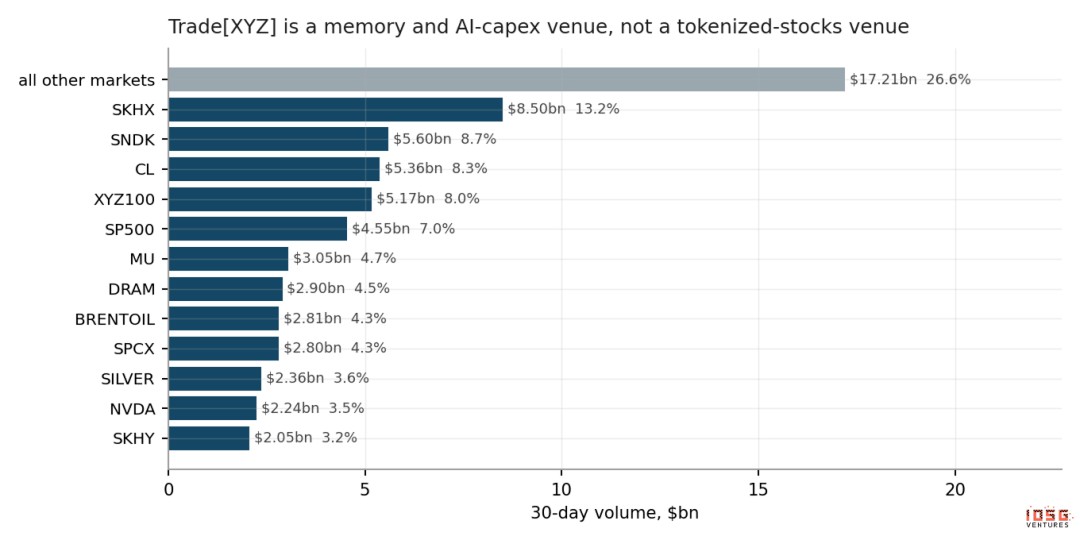
▲ Trade[XYZ] 30일 간 거래량 상위 10대 마켓.
상위 10개 마켓은 오더북도 전체의 66.7%를 차지하며, Top 6 이후 Tail End는 별도로 $32.4B를 형성합니다. 엔비디아(NVIDIA) 비중은 3.5%에 불과합니다. 애피(AAPL), 테슬라(TSLA), 알파벳(GOOG), 마이크로소프트(MSFT) 네 기업 합계가 3.3%로, 오직 SK하이닉스 하나의 4분의 1 수준입니다. 토큰화된 미국 대형주를 다룬 typical Narrative가 가장 강조하는 미국 기술주들이 실제로 해당 비즈니스의 주류는 아닙니다.
Trade[XYZ]가 실질적으로 운영하는 것은 스토리지 및 AI CapEx(자본 지출) 거래를 위한 7×24 플랫폼이며, 원유, precious metals, 지수 상품을 병행합니다: 한일 반도체, 합성 DRAM 지수, SpaceX, 자체 XYZ100 Basket,licensed S&P 500 제품. Trade[XYZ]의 영역은 암호화폐 네이티브 트레이더들이 새벽 3시에 일반적으로 접근하기 힘든 자산들입니다. 그리고这正是 엔트로피가 공격을 감행한 영역이며,切入點은 Apple이 아닌 Micron과 Nebius입니다.
왜 OpenAI를 상장하지 않았는가
가장 직관적인 답변인 '비상장 기업 회피'라는 해석은 틀렸습니다. pre-IPO反而是它做得比较好的业务之一。단 SpaceX 30일间就有$28億($2.80B),占总盘面4.3%,排名第九。往下是宇树 $511M、长鑫存储 $317M、智谱 $156M、MiniMax $92M、SHEIN $27M,长江存储已经注册待发。
These entities share one common characteristic: they possess observable secondary market execution prices and known capitalization figures. SpaceX conducts regular tender offers yielding explicit per-share pricing; several mainland China entities trade actively in the pre-IPO gray market with cap tables derivable from corporate filings and funding rounds. Consequently, this platform can price them as any other asset on a per-share basis.
OpenAI and Anthropic lack both. Their secondary trades are encumbered within SPVs, transacting equity claim rights rather than negotiated entity valuations tied to a specific per-share metric. Forcing a per-share quote would require fabricating the denominator arbitrarily. This constitutes the bottleneck—a convention issue, not a willingness constraint. Entropy’s workaround is to bypass per-share quoting entirely, instead pricing the entity itself: 1 contract = $1bn market cap, implying current mid-price valuations near $2.17tn for Anthropic and $1.53tn for OpenAI.
But this does not constitute a moat. The leader can add a market-cap-denominated listing at any time for approximately $39,900. Moreover, its own roadmap targets elsewhere: 16 registered but unused slots are queued for uranium, aluminum, DXY, VIX, corn, wheat, TTF, KRW, India Nifty, Brazil Ibovespa, Ibiden, KSTR, plus YMTC and H100. These are macro and commodities, not frontier AI labs.
A structural detail warrants retention. Trade[XYZ] did not configure an oracleUpdater (pushing mark prices via its own deployer key); whereas Entropy and Felix both route to the identical third-party updater 0x94757f8d…. Entropy publicly disclosed RedStone as the price feed source for its Anthropic market, which explains why two previously unaffiliated platforms share an updater address, though no chain label corroborates this self-reported linkage. Self-built oracles function adequately for assets with external reference prices, but when mark prices must be constructed, the nature shifts fundamentally—and constructing mark prices precisely defines Entropy’s chosen business model.
Head-to-head confrontation, and the week Entropy led
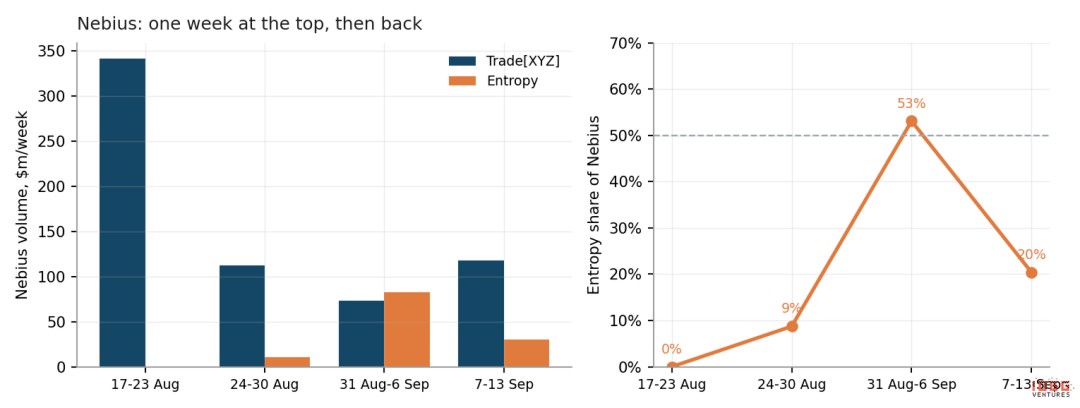
▲ Nebius weekly volume alongside Entropy’s slice of it.
Nine underlying assets currently operate simultaneously across two HIP-3 platforms. Operators no longer partition non-overlapping orderbooks; overlap has become the norm wherever naming rationale justifies dual listings.
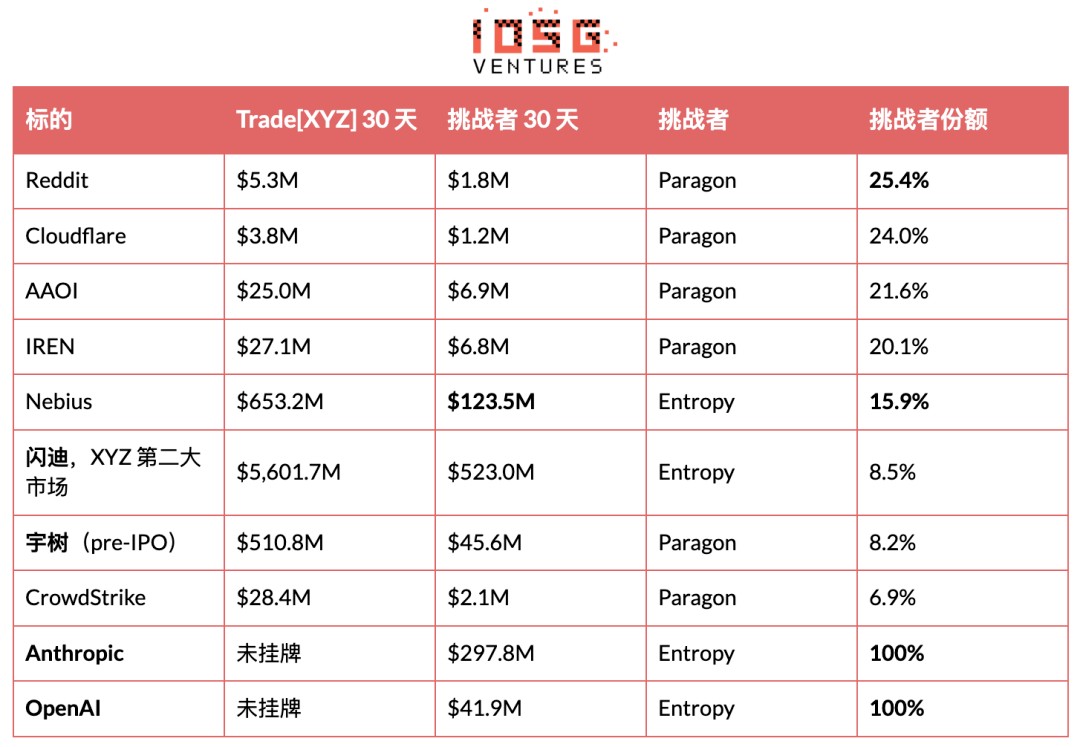
Capture attempts shave share, not depth
Trade[XYZ] previously registered five core Paragon targets without enabling them. On August 18 alone, all five opened simultaneously. Today, Trade[XYZ] leads across all five. Filling that gap consumed roughly three days’ fee revenue and was executed in a single afternoon. Whether those targets signaled deterrence or merely awaited their scheduled rollout remains indistinguishable via on-chain data.
Outcomes, however, are legible. Four weeks later, Paragon still holds between 20% to 25% share across four of those five markets, with overall monthly volume surging 49.9%. Unitree best illustrates the mechanism: Trade[XYZ]’s Unitree book sits roughly eleven times larger than Paragon’s, yet Paragon commands only 8.2% of the pair’s volume. Paragon’s native Unitree volume nevertheless doubled concurrently. The incumbent did not steal volume from challengers; it expanded the adjacent market. Entering a market and owning one are structurally distinct.
Entropy led Nebius for one week, then ceded control
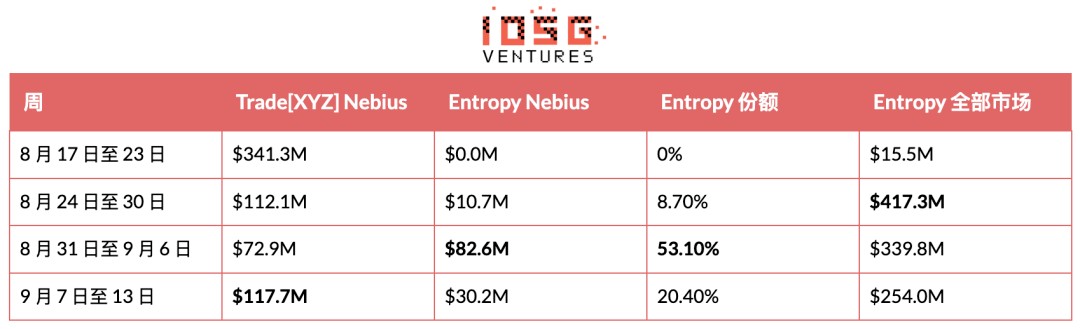
For a single week, Entropy’s Nebius volume genuinely surpassed Trade[XYZ]—a milestone HIP-3 challengers had never achieved. The following week, the leader’s Nebius book grew 61% while Entropy contracted 63%, pushing the challenger back to one-fifth of the pair’s volume. Micron tells a quieter variant of the same narrative: Entropy’s recent weekly share has hovered around 13%, settling at 8.5% over the full thirty-day window.
The leadership was real and lasted exactly one week. The sober reading: Entropy proved capability to infiltrate a market where the leader actively quotes, but lacked proof of sustainable retention. Its aggregate volume has declined consecutively for three weeks, falling from $417M to $254M.
Counter-signal originates from inventory. While weekly volume retreated 39% from peak levels, Entropy’s open interest paradoxically expanded 37% to $51.4M, with Anthropic alone accounting for $29.9M. Churning volume nets internally and leaves zero residual inventory; accumulating open interest amid declining volume share points toward genuine positioning rather than nominal activity. These two facts pull in opposite directions. What demands attention is the tension itself, not either isolated metric.
That volume warrants discounting. Entropy holds no token nor confirmed airdrop, yet backend systems reveal an active pointsMultiplier parameter and its proprietary leaderboard page displays impending launch banners. Consequently, portion of traffic chases expectations rather than utilizes live product functionality—which externally remain inseparable. Scale context matters too: Entropy posts ~$1.0B monthly versus Trade[XYZ] at $64.6B, representing just 1.6% of the incumbent’s footprint. It won tactical engagements, not category dominance.
Its registered pending-rollout slate signals next moves. Entropy holds EWY, SBE, TCNT, and a DRAM index. The DRAM index directly mirrors Trade[XYZ]’s fourth-largest product; EWY denotes South Korea. The ensuing clash appears targeted squarely at the leader’s core territory, foregoing another uncompetitive pre-IPO listing.
⚠️ Two enumeration rules
Active books only. HIP-3 deployers frequently register targets long before activation. Such entries return oracle-derived markPx values but present null midPx, isDelisted=true, zero open interest, and absent K-line history. Trade[XYZ] holds 16, mkts maintains 19, Paragon registers 9, Entropy lists 4. HyENA’s 25 constitute a separate category—previously activated subsequently delisted.
Ticker strings do not equal underlying assets. para:STX represents Seagate with a mid-price of 799; the core STX denotes Stacks trading at 0.27. Blind ticker concatenation artificially manufactures a tenth confrontational market that objectively does not exist. Verify mid-prices prior to pairing.
Economic arithmetic: per-platform costs versus layer-wide revenues
No price competition exists because fees have bottomed out
All parameters condense into two fields per asset, both exposed via metaAndAssetCtxs: growthMode and deployerFeeScale. Gross rates calculate as base × (1 + s), where base references the standard perpetual schedule and s denotes deployer coefficients ranging from 0 to 3.00, capped at 1.00 under Growth Mode. Deployers retain s / (1 + s); thus s=1.00 splits revenue equally. Growth Mode further deducts minimum 90% from gross figures conditional upon zero operational overlap with verifier-hosted perpetuals, thereby excluding crypto assets and crypto indices.
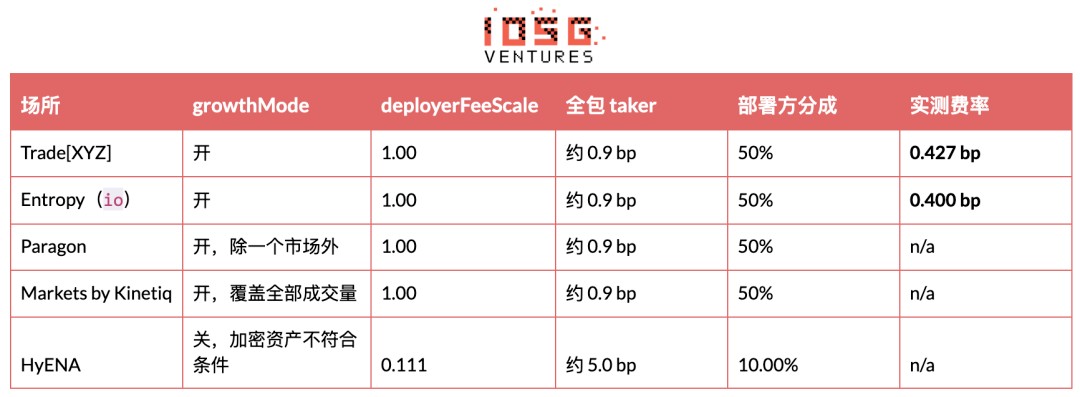
All equity-oriented platforms independently converged toward identical configuration settings: maximum deployer share allocation, Growth Mode enabled. Even Entropy entered with differentiated products and venture backing without attempting margin compression. The sole outlier deviating from this configuration正是 just ceased operations.
Deployer splits compute accurately without aggregator assistance. Fee income accumulates within designated recipient addresses’ sub-accounts: clearinghouseState with dex field retrieves unsettled balances, transfers manifest through userNonFundingLedgerUpdates as sourceDex matching platform name sends. Distribution occurs irregularly, requiring interval measurement. Trade[XYZ] cumulative totals $1,380,592 since August 27 disbursement corresponding to $32.30B volume equating to 0.427bp or approximately $79,000 daily. Entropy never disbursed funds allowing direct read: $1.036B volume generated $41,468 totaling 0.400bp.
Two expenditure categories differing fundamentally in character
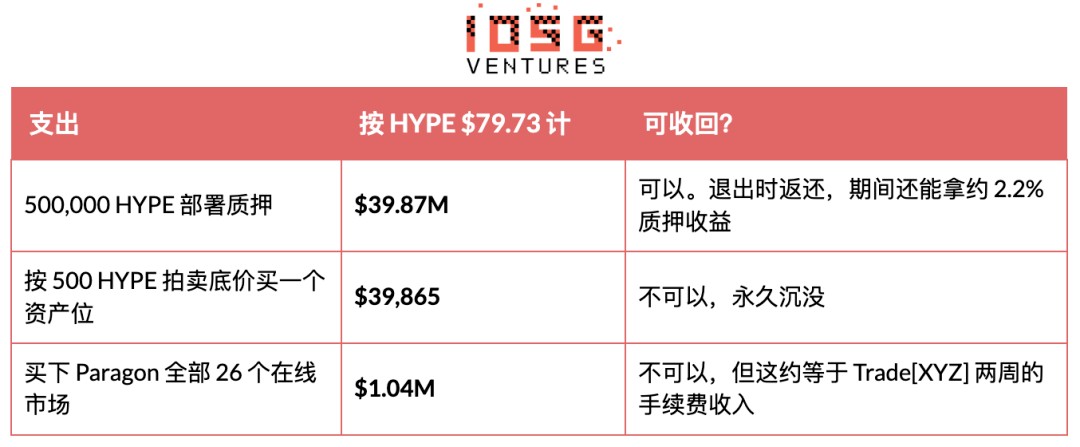
Staking represents the most intimidating figure yet remains recoverable. No party confiscates these funds. Delegated validators continuously accrue rewards returning principal intact upon withdrawal initiation. Mandatory post-deployment lock periods span minimum 183 days slashing applies malicious operation scenarios including manipulated oracle feeds subjecting positions to validator-weighted voting penalties extending through seven-day unstaking queues necessitating approximately 190 days minimum for clean exits. Both Felix and dreamcash successfully reclaimed full allocations resetting readings to zero.
Current deployed stakes: Entropy 500,973, Paragon 500,712, HyENA 508,915 (halted trading but undelisted), Kinetiq 588,489 (single stake covering simultaneous km and mkts roles), Trade[XYZ] 500,488 complemented by secondary address holding 500,269. ABCDEx retains merely 1,004 HYPE having never staked.
Asset slot acquisition capital comprises unrecoverable sunk costs. Initial three perpetual DEX slots grant complimentary access subsequent additions mandate Dutch auction participation purchasing additional venues utilizing HYPE escalating opening prices doubling prior settlement baselines linearly decaying until reaching floor valuation 500 HYPE participating September 14th auction commenced concluded identically baseline setting single slot valued approximately $39,900 demand contracting relative previous week’s 582 HYPE transaction price.
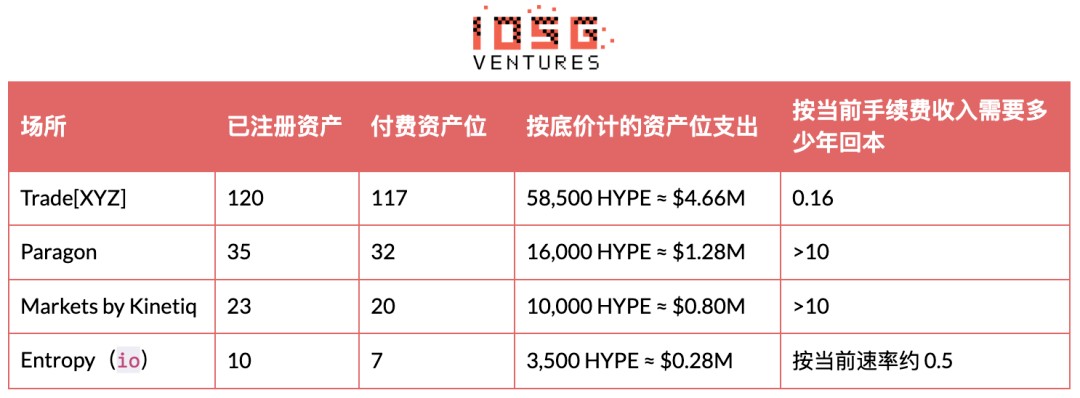
Final column captures critical insight. Trade[XYZ] requires roughly eight weeks accumulated fees settling complete listing obligations. Every challenger besides Entropy demands durations exceeding existing HIP-3 operational lifespans; Entropy survives simply acquiring seven slots instead of thirty.
Temporal asymmetry magnifies persistently. Pausing markets proves free reversible transactions paying upfront slots permit sealing reopening cycles generating pending rollouts listed reserves accumulate historically deploying formulae calculating seven plus point-two multiplied legacy auction deployments granting Trade[XYZ] approx thirty immediately usable positions leaving newcomers restricted initial seven openings permitting ten concurrent listings contemporaneously establishing twenty-market plans forces remaining queue waiting minimum thirty-one hours sequentially per venue. Entropy responds rejecting rhythmic pacing constraints launching precisely five markets ensuring each generates proportional returns.
Staking yield trap
Excepting Entropy, every challenger earns more passive staking dividends operating exchanges outright. Paragon lifetime deployer compensation amounts $64,281 while $39.87M holdings generating approximate compound annualized yields twenty-two percent projecting yearly earnings near $877,000 establishing fourteen-times multiplication ratio.
This hardly comforts. Dividend proceeds originate newly issued HYPE allocated future protocol emissions constituting inflationary mechanisms distributing dilutive returns compelled holding positions priced counteractively against originally passively long-underlying asset vulnerabilities exposing portfolio erosion thirty percent depreciation triggering twelve-million-dollar losses surpassing decade cumulative gains past eight days witnessed eighty-eight-point-three-seven plummeting seventy-nine-point-seven-three diminishing respective locked stakes allocating negative four-point-three million-dollar increments.
Fee pool capacity supporting viable business models
Growth Mode anchors measured spreads vicinity zero-four-basis-points dividing operator half equalling Trade[XYZ] commanding ninety-seven-point-eight-percent share yielding seventy-eight-billion-dollar annually compounded deployment contributions estimating twenty-nine-million-dollar yearly projections suggesting incumbency ceiling rather functioning total available incentive envelopes constrained present volume floors intersect current baseline thresholds rendering entire layer-level bonus pools statistically negligible compared projected expectations.
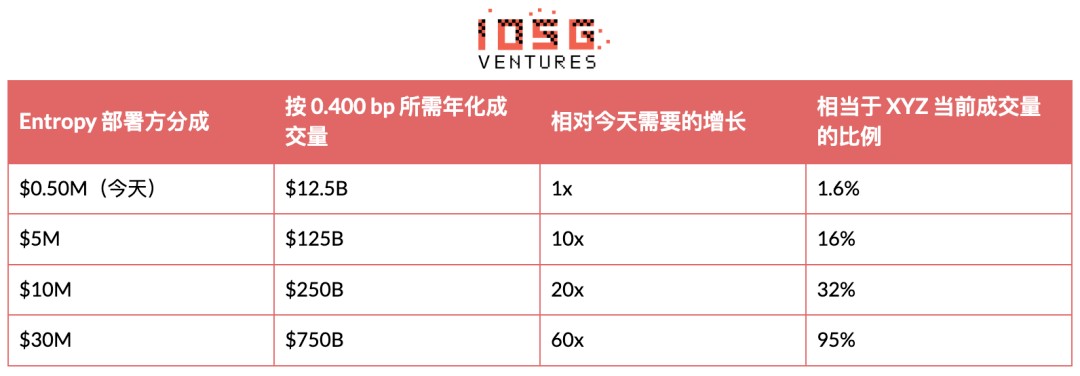
Layer-wide environments beyond dominant player anchor roughly hundred-sixty-seven-million-dollar HYPE commitments distributing combined lifetime deployer compensations amounting seven-hundred-forty-seven-thousand-dollars across surviving participants contrasting fourteen-million-dollar seed round valuations illustrating arithmetic realities proving HIP-3 operators cannot leverage traditional trading fee structures justify enterprise valuations challenger value derives alternative channels tokens frontends customer relationships unidentified protocol-valued instruments awaiting monetization pathways.
What actually sustains competitive advantage
HIP-3 deliberately commoditizes virtually every defensive advantage theoretically maintainable individually. Staking purchasable registrations acquireable baseline fee floors shared universally distribution channels interoperable accessible identical frontend interfaces reachable seamlessly across partitions.
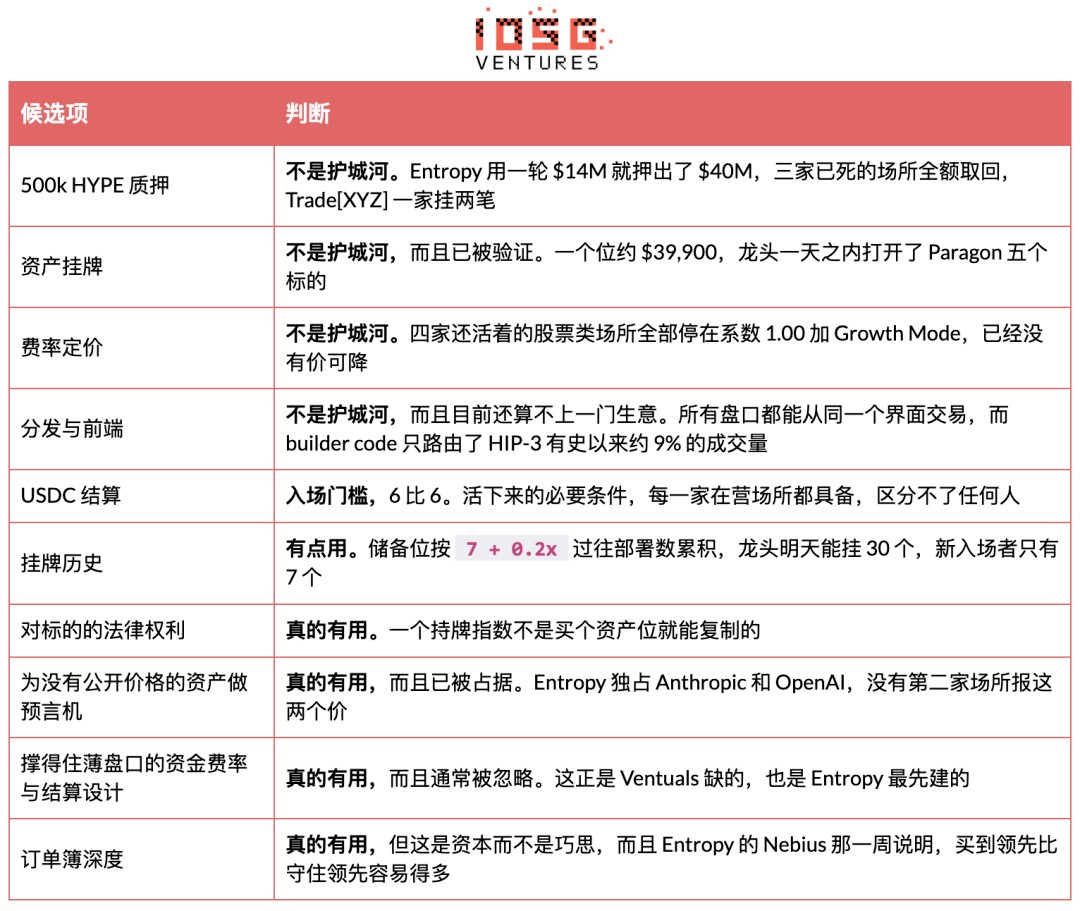
Pertinent screening questions pivot not asset selection criteria purchases easily replicated but uniquely defensible differentiators unobtainable acquiring mere slot purchase costs amongst historical HIP-3 operators demonstrating clear comprehension possessing oracle architecture paired settlement design configurations constituting fundamental answers transcending superficial asset inventories.
Entropies exceptional status merits precise attribution deriving advantages unrelated underlying listings founded institutional researchers traders originating Citadel Securities Optiver Millennium Polymarket bench strength materializing两处 first enabling immediate liquidity provisioning depths convincing decisive negotiations regarding Nebius second implementing funding rate limits coupled settlement architectures functioning direct corrective responses addressing Ventuals systemic failures fourteen-million-dollar seed financing led Ribbit Capital emphasizing retail brokerage infrastructure fintech distribution networks prioritizing client acquisition ambitions overriding speculative protocol dependency naming clarifications distinguishing Arbitrum DAO-affiliated Entropy Advisors separately identified sixteen-invested custody startup entities entirely disconnected organizations precluding erroneous associations Hyper Foundation relationships inferred nomenclature similarities.
Collectively synthesizing observations reveals赛道 still exhibits pronounced fragility consolidating ninety-seven-point-eight-percent volumes occupying receding enterprises surrounded hundred-sixty-seven-million-dollar HYPE collateralizing aggregating seven-hundred-forty-seven-thousand-dollar historical fees capturing singular team demonstrating temporary victory securing individual market retaining week failing sustainability proofs asset inventories insufficient solutions evidenced independent datasets corroborating conclusions simultaneously.
Viable alternatives involve capturing protocol-commission halves circumventing operational burdens avoiding locking restrictions eliminating slashing exposures forfeiting inherent advantages proving insufficient dominating Hyperliquid perpetual base constituents demonstrating fifty-percent threshold occurrences artifacts quiet market phases constituting false trends unsustainable trajectories.
Routing layer actual触及流量 reach
Builder code represents closest approximation distributive mechanics within HIP-3 ecosystems frontends applying custom markers generating builder commissions免除保证金 requirements Flowscan enumerates eight-hundred-nineteen distinct identifiers encountered traffic volumes proving substantially limited routed transaction quantities measuring fifty-two-point-six-billion comprising nine-percent lifetime five-hundred-eighty-seven-billion accumulation thirty-day windows registering five-point-three-billion corresponding sixty-six-point-zero-nine-billion equating eight-percent proportions exceeding ninety-percent endpoints lacking frontend tagging reflecting anticipated characteristics dominated maker participants algorithmic traders operating institutional orderbooks.
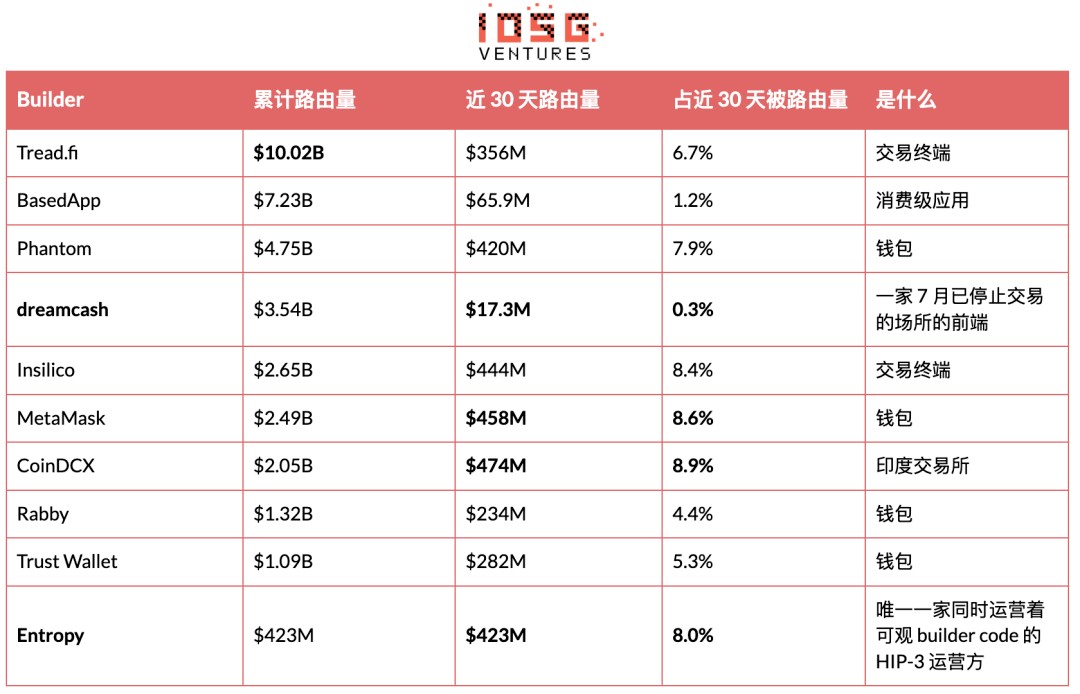
Fourth column denominators calculate recent thirty-day builder-routed volumes measuring five-point-three-billion excluding HIP-3 sixty-six-point-zero-nine-billion aggregated equivalents substituting latter denominators largest participant CoinDCX registers negligible zero-point-seven-percent contributions tabled ten entries collectively occupy fifty-nine-point-seven-percent routed allocations Flowscan documenting eight-hundred-nineteen codes distribute remaining forty-percent fragments among tail-end八百零nine participants.
Table highlights warrant extraction Entropy routing magnitude registering four-hundred-twenty-three-million exclusively materializing contemporary thirty-day periods correlating internal platform volumes billion dollars indicating approximately forty-percent originated controlled frontend infrastructure Ribbit-backed retail brokerage ambitions manifested empirically rather press release narratives constituting divergent commercial paradigms departing deployer methodologies.
Dreamcash delivers cleaner pedagogical lessons operating venue deceased July second generating zero native readings concurrently deploying builder codes routing seventeen-point-three-million recently累计总额三点五四 billion dollars demonstrating cleanly separable deployer frontend commercial architectures wherein exclusively entrance barriers requiring forty-million-dollar capitalizations constrain participation accessibility.
Third-party dashboards harbor prevalent counting pitfalls ranking methodologies defaulting cumulative transaction volumes inflating dormant platforms historical presence appearances dreamcash displaying three-point-three-percent lifetime shares evaporating instantly contemporary windows demanding explicit temporal scope verifications preceding any fractional citations utilization.
Prioritized frontend observables predominantly exclude deployers Coinbase unveiled simplified perpetual interfaces embedded wallets powered Hyperliquid infrastructure encompassing cryptocurrencies tokenized equities prediction markets targeting international audiences September twelfth Kraken parent corporations negotiating regulatory compliant American venue integrations incorporating Hyperliquid-associated perpetual functionalities neither parties committing五百-thousand-HYPE positional risks.
Conclusion: optimism limited extending HIP-3 deployer expansion
Synthesizing preceding analytical frameworks prospective entrants confront measurable parameters defining operational constraints.
Aggregate non-leading HIP-3 volumes consolidating fourteen-point-nine-billion monthly projections extrapolating eighteen-point-one-billion annually calculated baseline zero-point-four-zero-zero-basis-point implementations generating seven-hundred-twenty-five-thousand-dollar deployer distributions divided quadrupling participants anchoring hundred-sixty-seven-million-dollar HYPE allocations equivalent three-point-sixty-seven-million-dollar passive staking yields compounding annually.
Operating exchange profitability yields approximately twenty-five-percent comparative returns versus replicating identical capital deployment strategies validating numerical foundations.
Unexploited territories transform prematurely priced zero-margin environments substantiated measurable constraints articulated preceding sections acquiring slots costing thirty-nine-thousand-nine-hundred dollars enforcing universal sharing architectures prohibiting pricing flexibility distributing uniformly limiting builder-code engagement percentages routing nine-percent traffic concentrations clamping settlement assets converging six-to-six USDC dominance explicitly denying AQAv2 slope incentives confirming protocol subsidies absence directing operational inefficiencies.
Structural ceiling limitations intensify complexities XYZ commanding ninety-seven-point-eight-percent shares exploiting comprehensive structural advantages achieving marginal one-point-two-percent penetration underlying nine quoted securities declining relative fractions central storage commodities demonstrating accelerating contraction patterns confronting new participants oversized incumbent sizes shrinking continuously amplifying competitive disadvantages inherently embedded architectures.
Exception criteria remain singularly definable previously outlined obtaining proprietary rights inaccessible competitors deploying unique oracle constructions engineering resilient funding rate settlement designs surviving thin-book volatility profiles Entropy satisfies conditions exhibiting temporary leadership reversals quickly suppressed asset inventories fail resolving systemic challenges validated independently corrobative metrics affirmatively concluding strategic misalignments.
Conditions altering analytical judgments
· Entropy sustaining contested market leadership spanning monthly intervals stabilizing Micron fractions hovering thirteen-percent thresholds accumulating rising open interest concurrent volume contractions presenting reliable directional indicators superseding unreliable volume measurements tracking authenticity positioning behaviors.
· DRAM indexing South Korean asset launches targeting incumbent core territories abandoning unprotected pre-IPO narratives delivering cleaner testing validations surpassing Nebius experiment outcomes assessing capability demonstrations definitively.
· Tokenomics structuring equity mathematics reconcilable calculations invalidating fee-driven valuation methodologies nonexistent cryptographic instruments restricting current monetization frameworks.
· Pre-IPO sectoral continuity maintaining sustained activity Anthropic orders attenuating post-first-week decay OpenAI openings generating five-point-three-million daily collapsing proximity four-million-current levels stabilizing sustained品类 classifications replacing transient listing hype cycles validating persistence durability.
· AQAv2 initial payment settlements October first establishing authentic revenue stream observation benchmarking third-party estimated ranges one-hundred-thirty-five-million-to-two-hundred-million dollar intervals determining accuracy assessments measuring protocol economic impacts effectively.
· Baseline fee elasticity relaxations Hyperliquid releasing early-August signals announcing upcoming upgrades permitting HIP-3 deployers increasing individual security spreads up to triple multipliers retrieving Growth Mode discount benefits postponing implementation schedules invalidating sixth-section numerical assumptions resting fixed floors evaluating impact sensitivities dynamically.
· Licensed regulated market implementations HIP-3* published September-third outlining optional whitelist mechanisms enabling deployers restricting wallet permissions accessing specific venues claiming compliance facilitation institutional准入 capabilities operating exclusively testnet environments initiating accessibility restriction paradigms transforming asset ownership scarcity determinants introducing novel differentiation vectors potentially reshaping competitive landscapes fundamentally.
· Teams securing exclusive data licenses index authorizations satisfying continuous seventy-two-four-seven-cryptocurrency-needs driving positional acquisitions challenging conventional capture logic configurations demonstrating last-resort competitive immunity validating strategic uniqueness irreplaceably.
· Evidence confirming incumbent volume sustainability collapse post-Growth-Mode-expires realizing zero-point-four-two-seven-basis-points executing roughly one-tenth standard rate collections hypothetically assuming cost-bearing exemptions revealing structural stability weaker fractionally indicated occupancy proportions exposing latent vulnerabilities threatening entrenched dominance reliability progressively.
· HyENA unwinding five-hundred-eighty-nine-thousand-one-hundred-fifteen-HYPE completions confirming terminal cessation versus dormancy speculation resolving ambiguity surrounding operational continuities terminating uncertainties decisively.
Limitations acknowledged
· Capture arguments rely empirically observed share distributions inferring motivations conjecturally five-securities simultaneous activations alternatively interpretable sequential deployment pipelines synchronously aligning calendrically coincidental executions masking deliberate orchestration intentions ambiguously.
· Entropy assessments grounded exclusively twenty-six-day samples exhibiting week-long leadership reversals single-mid-cap instrument metrics preventing premature generalizations extrapolating established conclusions prematurely overstating predictive certainties prematurely.
· Team backgrounds financing rounds sourced company announcements media reports excluding verifiable on-chain traceability limiting empirical validation capabilities constraining analytical certainty thresholds inherently.
· Volatility correlation findings derived forty-five-working-day sampling periods expressing statistical associations non-causal decomposition analyses volumes actual fluctuations potentially co-driven unified macroeconomic factors highlighting cooling dynamics artificial intelligence capital expenditure allocations transmitting pervasive environmental influences obscuring isolated causal attributions misleadingly.
· Transaction counts differ independently user identities public API outputs excluding discrete trader population estimations precluding demographic segmentation methodologies restricting analytical granularity limitations implicitly.
· Capital return projections calculated utilizing seventy-nine-point-seven-three-HYPEDollar equivalencies applying two-point-two-percent annualized staking rates representing protocol-parameter-generated yield estimates contractual guarantee voids dynamically adjusting inversely proportional network-wide staking volumetric expansions compressing individual participant profitability margins predictably decreasing incrementally.
TechFlow 공식 커뮤니티에 오신 것을 환영합니다
Telegram 구독 그룹:https://t.me/TechFlowDaily
트위터 공식 계정:https://x.com/TechFlowPost
트위터 영어 계정:https://x.com/BlockFlow_News
 IOSG Ventures