AI threats are more urgent than quantum computing, with Ethereum accelerating the reconstruction of its cryptographic foundations.
Author: TechFlow
TechFlow Overview: The Ethereum Foundation has officially published the first blog post outlining its post-quantum and post-AI roadmap, announcing a doubling of the protocol security team size. Faced with the real-world impact of AI automation tools rapidly mining for underlying code vulnerabilities, Ethereum is accelerating its restructuring of foundational cryptographic assumptions.
This upgrade will completely abandon existing elliptic curve cryptography, shifting entirely to a conservative hash-based cryptographic system. Researchers including Justin Drake have advanced the full transition timeline to December 2028, compressing the originally planned schedule by a full year.
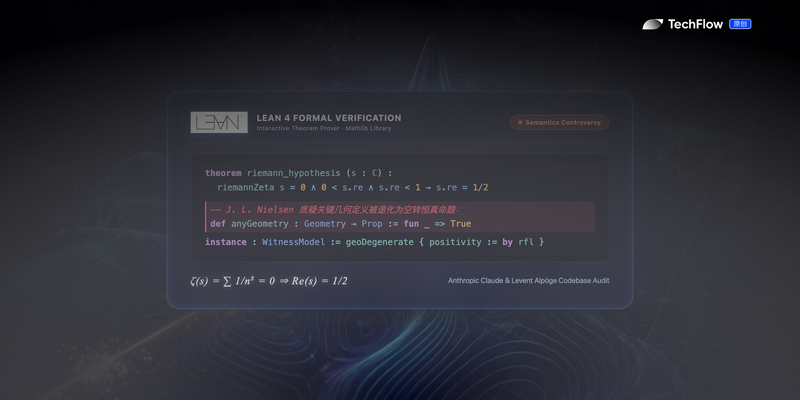
Foundation researcher Kev Wedderburn openly acknowledges that this engineering effort named PQAI is significantly more difficult than the 2022 "Merge," and its development window is even more pressing. To prevent rushed work from introducing code vulnerabilities, the team will heavily rely on formal verification to strengthen its defenses.
AI Vulnerability Mining Forces Doubling of Ethereum Security Team
For a long time, the crypto industry has largely viewed quantum computing as a distant threat ten years away, focusing on the potential cracking risks of Shor's algorithm against elliptic curve digital signature algorithms. However, Ethereum Foundation researcher Kev Wedderburn points out on the official Ethereum blog that artificial intelligence has become a more urgent and direct real-world risk than quantum computing.
With the evolution of large language models and automated code audit tools, AI's speed in finding underlying software security vulnerabilities far exceeds that of human security auditors. Currently, Ethereum's core clients and smart contract ecosystem heavily rely on manual audits and standard testing. Facing AI attack agents capable of conducting fuzz testing and path exploration around the clock, traditional defense mechanisms are losing effectiveness.
According to an in-depth report by Cointelegraph, to address this asymmetric offensive-defensive landscape, the Ethereum Foundation has decided to directly double the size of its protocol security team. The expanded team will move beyond passively patching vulnerabilities, instead pushing mathematical formal verification to the front lines of development. By using rigorous mathematical logic to prove that code behavior conforms to specifications, logical flaws will be eliminated at their root.
Abandoning Elliptic Curves, Shifting to Full-Stack Hash Cryptography
Beyond strengthening existing code defenses, Ethereum has also initiated a major overhaul of its underlying architecture named PQAI. The core of this transformation lies in fundamentally restructuring cryptographic assumptions, shifting entirely to a simpler hash-based conservative cryptographic system that has been rigorously tested by the cryptographic community for decades.
According to the technical path disclosed by officials, this foundational reconstruction precisely covers the three core pillars supporting Ethereum protocol operations. First is consensus-layer signature restructuring, which will fundamentally change how validators sign blocks and attestation messages on the beacon chain. Quantum-resistant hash signatures will replace the current BLS aggregate signatures, eliminating the risk of validator private key exposure.
Second is the transformation of user accounts and transaction authorization mechanisms. Ethereum externally owned accounts currently rely universally on ECDSA signatures. Once quantum computing power crosses a critical threshold or mathematical vulnerabilities arise in signature algorithms, user assets will be directly exposed. The new architecture will integrate account abstraction to comprehensively introduce quantum-resistant signature schemes, reshaping the wallet signing experience.
The third pillar is the upgrade of data availability verification methods. Ethereum will modify how the mainnet verifies data published by Layer 2 Rollups, gradually replacing the current KZG polynomial commitments with hash commitment schemes. This ensures that, without relying on elliptic curve assumptions, Rollup state transitions remain verifiable and secure.
Difficulty Surpassing the "Merge", Timeline Advanced to December 2028
In terms of development cycle and engineering complexity, the PQAI upgrade breaks Ethereum's historical records. Although the "Merge" completed in September 2022 achieved the consensus transition from proof-of-work to proof-of-stake, it did not overhaul the foundational elliptic curve cryptography layer; PQAI, on the other hand, aims to replace the entire protocol's cryptographic heart while the network continues to operate.
Wedderburn explicitly states in the article: "This upgrade is harder than the Merge, and we have less time." Under intense time pressure, developers are most likely to accidentally embed new logical vulnerabilities into the underlying protocol due to rushing work. This is precisely why the Ethereum Foundation chose to double the security team ahead of schedule before initiating the architectural changes.
According to the latest roadmap set by foundation researcher Justin Drake and others, Ethereum plans to complete the full PQAI architectural transition before December 2028. This milestone is exactly 12 months earlier than the long-term plan previously set by the Ethereum community for 2029, meaning the core development team has just over two years left for intensive full-stack development efforts.
Join TechFlow official community to stay tuned
Telegram:https://t.me/TechFlowDaily
X (Twitter):https://x.com/TechFlowPost
X (Twitter) EN:https://x.com/BlockFlow_News
 深潮TechFlow