
177M Additional Shares Yield Only $29.6M for Crypto; Saylor Injects $212M to Rescue Break-Issue Preferred Stock
By Lucas, TechFlow
On November 23, 2026, Strategy (ticker: MSTR), the world's largest corporate holder of Bitcoin, filed its latest Form 8-K with the U.S. Securities and Exchange Commission.
News wires focused on the routine accumulation, noting that between November 16 and 22, Strategy spent $29.6 million to buy 457 BTC at an average price of $64,898, pushing its total holdings to 851,305. However, laying out all four cash flow statements from this Form 8-K reveals that the coin purchases were merely a fraction of the week's capital movements; the real focus lies in the defensive tightening of its capital structure.
Bitcoin has trended downward over the past few weeks, briefly hitting a two-year low of $55,000 and consolidating around $64,000. As of November 22, Strategy had cumulatively invested $64.23 billion in BTC, bringing its blended average cost to $75,446 per coin, resulting in unrealized losses approaching $10 billion on its total holdings.
With the coin's price dipping below its cost basis, Michael Saylor's financing machine, which ran smoothly for the past two years, has been forced to shift gears.
Funds from Selling Common Stock: 80% Directed to Prop Up Preferred Shares
Details of the At-the-Market (ATM) offerings disclosed in the 8-K reveal that Strategy's financing channels in the preferred stock market have completely frozen.
Throughout the entire week of November 16–22, ATM issuance volumes for its four perpetual preferred stocks—STRF, STRC, STRK, and STRD—all dropped to zero. Although these four channels still show a combined unissued shelf registration capacity of $25.24 billion on paper, secondary market investors halted subscriptions amid the sharp Bitcoin sell-off.
The only instrument left to sell was MSTR common stock. During the week, Strategy offloaded 1,925,676 MSTR shares in the open market, netting $176.7 million after deducting underwriting fees.
The allocation of these life-saving funds exposed the company's true current priorities. Of the $176.7 million, only $29.6 million (16.7%) was used to purchase 457 BTC, while the remaining $147 million (83.3%) was directly transferred to a stock repurchase account.
Adding the $64.8 million of idle cash already on hand, Strategy deployed a total of $211.8 million during the week to repurchase 2,183,747 shares of floating-rate perpetual preferred stock STRC in the secondary market, representing an average repurchase price of approximately $96.99, below its $100 par value.
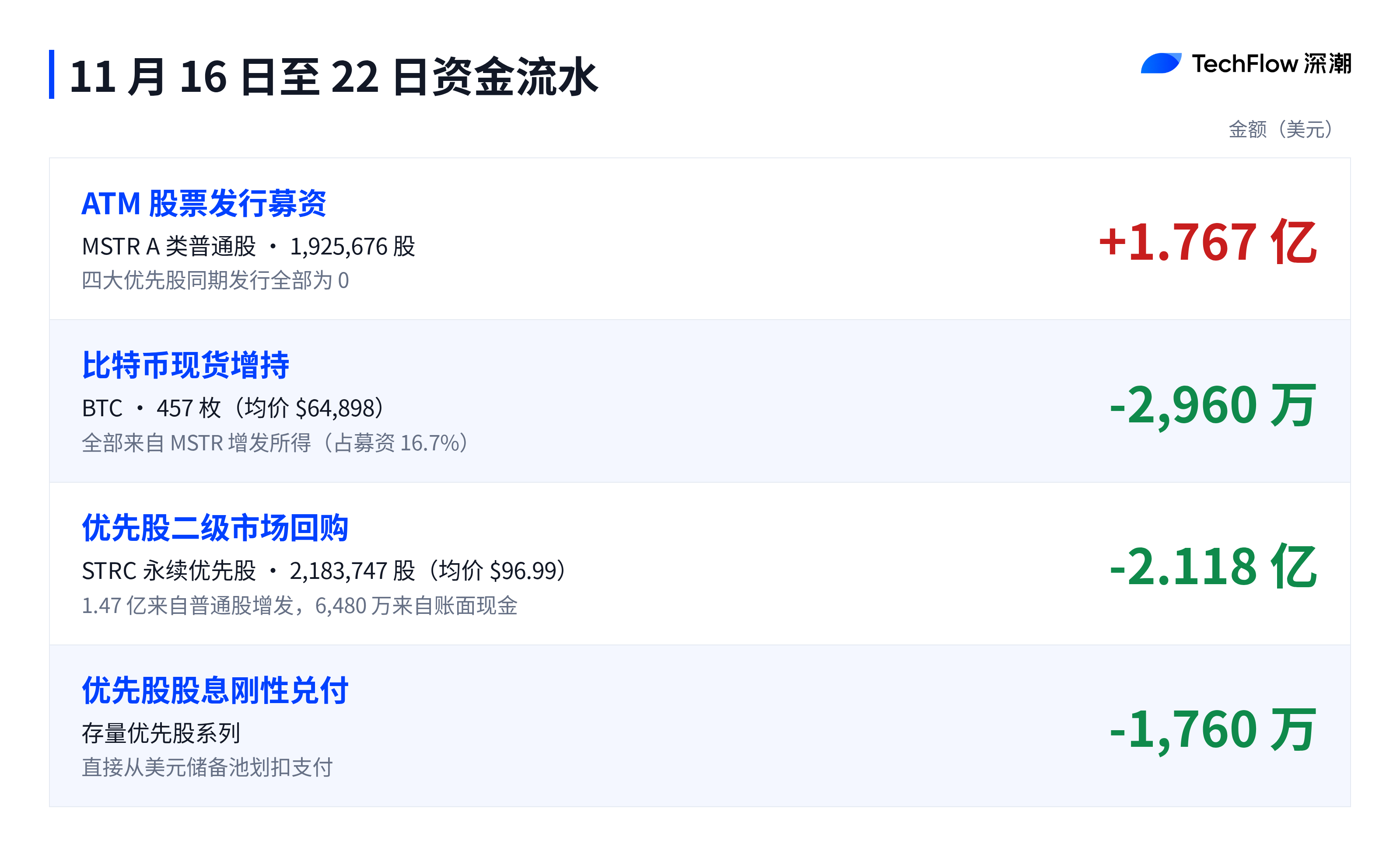
Over the past two years, Saylor relied on issuing high-yield preferred shares to attract institutional capital for buying BTC, but the situation has completely reversed. When the sharp Bitcoin decline pushed STRC below its par value, Strategy was forced to do the opposite: dilute common shareholders' equity by selling MSTR stock and using the proceeds to support the preferred share price, preventing a discount cascade in its self-built digital credit system.
Repurchase Authority Hiked to $4 Billion, $1 Billion Freed from Interest Reserve Pool
Beyond disclosing seven days of transaction flows, Strategy's board approved two resolutions on the same day, November 23, that directly rewrite the rules governing its capital pool.
The board raised the authorization ceiling for the "Digital Credit Securities Repurchase Program" from $3 billion to $4 billion. As of November 22, after accounting for $2.88 billion in cumulative historical repurchases, this dedicated repurchase pool retains $1.12 billion in available authority, while the MSTR common stock repurchase program maintains a separate $1 billion limit.
A more noteworthy move occurred on the cash reserve side. Strategy had previously split its dollar holdings into two buckets: a designated "USD Reserve" specifically earmarked for paying preferred dividends and interest on outstanding debt; and a flexible "USD Cash" bucket used for coin purchases and daily capital operations.
On November 23, the board officially authorized management to transfer up to $1 billion directly from the designated "USD Reserve" into the flexible "USD Cash" account.
Following the transfer, Strategy's "USD Reserve" balance dropped from $4.73 billion to $3.73 billion, after which $17.6 million was just deducted this week to pay preferred dividends; meanwhile, the readily accessible "USD Cash" balance surged to $1.09 billion, bringing total dollar liquidity to $4.82 billion.
Lifting the $1 billion originally locked in the interest buffer pool to convert it into mobile capital indicates management is stocking up ammunition for more severe market volatility. With over $1 billion in immediately accessible cash, it means that if Bitcoin continues to drop and preferred stocks like STRC face deeper discounts in the secondary market, Strategy can step in directly to scoop up and repurchase without having to wait each time for common stock issuance proceeds to clear.
The Stress Test for the Digital Asset Treasury Model Has Only Just Begun
Viewing this November 23 Form 8-K within a broader cycle, the business model of digital asset treasury companies is undergoing its first true test in a downcycle.
In a unilateral bull market, MSTR's stock price enjoyed a high premium relative to its bitcoin-backed net asset value, preferred shares issued smoothly at par, and the gears of debt issuance, equity issuance, coin purchasing, and NAV inflation meshed perfectly. The moment Bitcoin falls below the company's average holding cost, the common stock NAV premium evaporates, and preferred shares slip into negative territory, the entire capital structure shifts from "extracting liquidity from the market to buy coins" to "consuming cash and common stock equity to maintain liability-side credit."
As of November 22, Strategy still held a $4.82 billion cash buffer on its books, and all 851,300 BTC remain unpledged, meaning there is no traditional leveraged liquidation threshold in the short term. But as long as Bitcoin fails to reclaim the $75,400 cost basis, the core question Saylor faces weekly is no longer how many BTC he can buy the dip, but what dilution cost is required to stabilize the pricing of those hundreds of billions in preferred stock and debt.
Join TechFlow official community to stay tuned
Telegram:https://t.me/TechFlowDaily
X (Twitter):https://x.com/TechFlowPost
X (Twitter) EN:https://x.com/BlockFlow_News
 深潮TechFlow