Got an airdrop but can’t sell it: How to play Arthur Hayes’ FLOP ahead of its testnet launch tomorrow?
On November 24, 2026, Flop Labs (FLOP Network), with Arthur Hayes serving personally as CEO, will officially launch a roughly 90-day public testnet and genesis airdrop cycle.
When he returned to the forefront to take charge of this AI compute network in August this year, Arthur Hayes publicly placed a counter-cyclical bet. He believes the bubble in capital-intensive AI data centers is about to burst, which will leave behind a large surplus of consumer-grade GPUs, allowing ordinary people to mine and earn money at home with just an Nvidia RTX 5080 or even a Mac mini.
As the November 24 testnet launch approaches, community interest is rapidly heating up. Reviewing the economic model and participation rules published by Flop Labs, this testnet rewrites the traditional airdrop gameplay.
Spend 3 Tokens on Compute to Unlock 1 Airdrop Token
In recent years, retail investors have grown accustomed to free mainnet interactions on testnets and directly dumping tokens upon mainnet launch to cash out. FLOP has completely blocked this path.
According to the token allocation plan disclosed by Flop Labs, the network has no private sale, no presale, and no allocations for any venture capital firms. Approximately 3.5 billion to 4.4 billion FLOP tokens are planned for the genesis phase as testnet ecosystem incentives. By the time the mainnet launches in Q1 2027, all wallets that received airdrops will face strict lock-up restrictions.
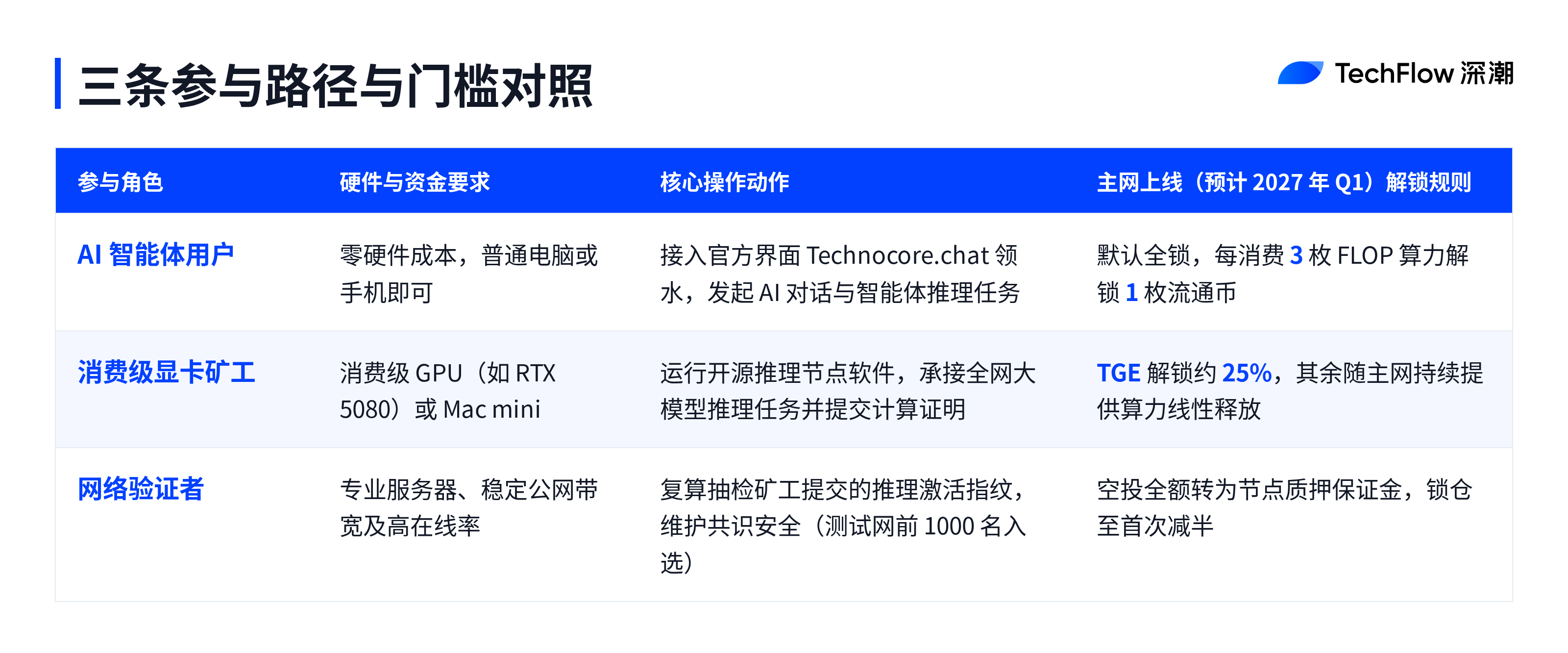
The genesis airdrops obtained by regular users through the agent experience path are locked by default. These locked tokens can only be used to pay for AI inference fees on the network or staked for yield. For every 3 FLOP worth of actual on-chain inference compute consumed by the user, the system will simultaneously unlock 1 freely tradable FLOP.
The unlock schedule for compute miners and validators is also strictly tied to actual work. Testnet miners providing GPU or Mac mini compute can only unlock about 25% of their airdrop rewards on mainnet launch day; the remaining 75% must be gradually released as they continue to provide valid AI inference on the mainnet. Meanwhile, the top 1,000 validators by testnet score will have their genesis airdrops directly serve as mainnet staking collateral, forced to lock until after the network's first halving.
Regarding block reward distribution, FLOP issues a reward of 96 tokens per block, halving every 730 days (dropping to a permanent 3 tokens per block after five halvings). Of these, 75% go to miners, 10% to validators, 10% are refunded to agent users calling the AI, and 5% go to stakers. Additionally, miners directly take 85% of each inference transaction fee.
The intent behind these rules is straightforward: airdrops are no longer free circulating chips, but rather a mechanism forcing early recipients to call models and consume compute, driving real inference transaction volume from the very first day of the mainnet cold start.
Comparison of Three Participation Paths and Thresholds
For participants preparing to join the testnet tomorrow, the official portal has been divided into three tiers based on hardware capabilities, with entirely different thresholds and returns.
On November 9, a developer successfully completed 12 rounds of on-chain inference settlements using a single Nvidia RTX 5080 graphics card in a public test with zero failures. If you don't have a high-end GPU, directly experiencing AI inference through the official portal is the only zero-cost way to accumulate test credits.
Rules Are Still Being Revised, But Fake Coins With The Same Name Have Already Emerged
Eve of the testnet launch, FLOP's file cabinet still contains quite a few unfinished drafts.
As of November 23, the official whitepaper from Flop Labs remains unreleased. The calculated 10-year total supply has been significantly adjusted from the initial 2.48 billion tokens to approximately 17.2 billion to 18.1 billion tokens. Even the official allocation slots for testnet validators haven't been finalized between "fully open" and "limited to 20 to 100 seats," pending pressure test data from the testnet.
The anti-cheating mechanisms will also only truly be tested once tens of thousands of consumer GPUs flood in tomorrow. To prevent miners from fabricating inferences to fraudulently claim block rewards, FLOP has designed four layers of defense: TEE (Trusted Execution Environment) proofs, TOPLOC model activation fingerprints, random validator recomputation audits, and 100% slashing of staked collateral. Early internal testing across dozens of nodes ran smoothly, but whether the recomputation latency of validator nodes can withstand high concurrency will depend on the actual performance over the next two weeks.
Compared to variable technical parameters, the minefield of fund security is already laid bare before everyone's eyes.
On the very day Arthur Hayes announced his appointment as CEO this August, multiple fake coins with the same name suddenly appeared on Solana via Pump.fun for speculative trading. Flop Labs has issued security notices multiple times, clarifying that there are currently no officially issued tokens, and all genuine rewards will only be claimable upon mainnet launch in Q1 2027, following the conclusion of the 90-day testnet. The official team has not set up any Telegram groups or Discord channels at present. All testnet access points and node code releases are subject to announcements on the official website and official X account. Any direct messages offering airdrop links or selling whitelists are scams.
Join TechFlow official community to stay tuned
Telegram:https://t.me/TechFlowDaily
X (Twitter):https://x.com/TechFlowPost
X (Twitter) EN:https://x.com/BlockFlow_News
 深潮TechFlow