After a single quarter of $4.1 billion in TradFi inflows: Huobi HTX in its 14th year, venturing deeper into "finance"
Author: TechFlow
Introduction
Today, you can hardly find a single CEX that doesn't support trading Nvidia.
Behind this collective shift, TradFi has undoubtedly become the core growth driver for crypto platforms.
When everyone is doing it, standing out requires not just having it, but executing it correctly.
At this inflection point of diverging paths and fierce competition, HTX, which just celebrated its 13th birthday, has delivered a Q3 2026 report full of highlights.
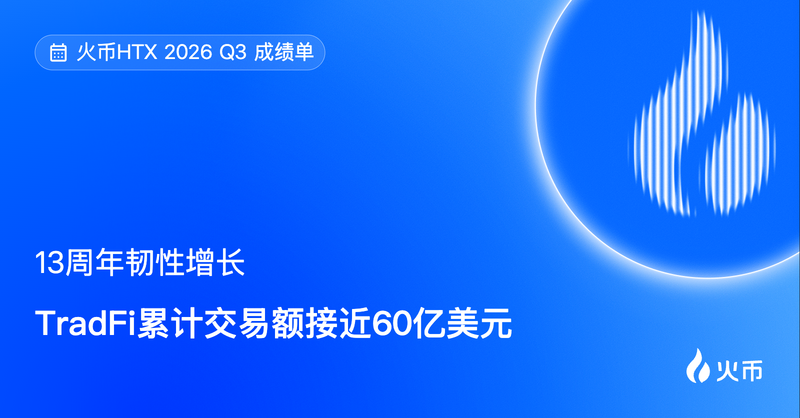
The most striking data lies in the TradFi sector: In Q3 2026, HTX's TradFi trading volume saw a quarterly increase of $4.1 billion, bringing the cumulative trading volume close to $6 billion.
From a more intuitive perspective, less than a year after the launch of its TradFi business, nearly 70% of the trading volume was concentrated in the past quarter alone.
While this scale may not yet indicate disruption or monopoly in today's TradFi landscape, it largely demonstrates that HTX has found its foothold in this track.
Looking deeper at more facets of this Q3 report, you will discover:
- A single trading event triggered $6.8 billion in derivatives trading volume;
- Platform-listed inaugural assets achieved a 500% surge;
- Quarterly $HTX burn volume reached 93.9 billion tokens, a 25.6% quarter-over-quarter increase.
From breaking through cross-boundary assets, to accumulating native capital chains, to the rigid feedback loop of on-chain revenue generation, as an established CEX, HTX's approach to the proposition of "the future of CEXes" is first manifested in TradFi, but goes far beyond it.
In its 14th year, how does HTX dive deeper into "finance"? Let's start with the most prominent TradFi sector.

TradFi: The Core Growth Engine of Q3
In the fiercely competitive TradFi sector, how did HTX achieve a doubling of trading volume within a single quarter?
Many people's initial reaction is that it comes from dense asset supply.
The data speaks for itself:
In Q3, HTX Derivatives listed 183 new assets, 154 of which were popular stock and index targets. To date, the platform supports trading assets across 278 stocks.
However, HTX's listing count is not the highest in the industry, nor is TradFi a simple formula where users automatically flock once assets are listed.
If asset quantity determines how full the shelves look, then curation quality determines who actually makes a purchase.
HTX's second pillar for capturing trading volume is curation, with asset layout tightly aligned across four major tracks:
- AI hardware and semiconductor computing power
- Global e-commerce and internet
- Asia-Pacific core leaders and broad market indices
- High-dividend value blue chips.
Moving beyond indiscriminate numerical stacking, what HTX aims to do is place the assets users want to trade most right at their fingertips.

The Pre-IPO contracts for POLYMARKET, OURA, and MOONSHOT listed in Q3 represent the most typical execution of this logic. These top-tier targets, often inaccessible to retail investors, not only generate massive buzz but also act as a powerful magnet for traders coming to HTX to engage in global opportunity speculation.
Asset supply answers "what to trade," while product experience determines "why trade here."
In terms of underlying product redesign, HTX introduced a dividend settlement mechanism into stock perpetual contracts. This ensures more continuous changes in position value during ex-dividend events, reducing interference from non-trading price adjustments, thereby aligning HTX TradFi further with the pricing continuity of traditional derivatives.
Another detail lies in the design of the asset detail page: it integrates market data, news, and corporate financial reports, while market rankings are split into dedicated categories for stocks, commodities, and ETFs, helping users better understand assets and manage trades more conveniently.
Simultaneously, through fee discounts, VIP tiers, $HTX token deductions, and special campaigns, HTX is committed to driving the actual net trading costs for TradFi into the industry's first tier.
By simultaneously transforming pricing, information, and costs, HTX gains stronger leverage to retain users when it comes to "trading globally."

Stepping back from a purely business perspective, compared to the straightforward growth in trading volume and user base, TradFi's greater significance lies in facilitating the platform's "species evolution."
When a crypto platform starts listing US stocks, it no longer serves just crypto natives, but a broader pool: those in regions with lagging financial infrastructure but still needing to allocate global premium assets; those wanting to trade US stocks without opening three or five brokerage accounts; those in the Asia-Pacific timezone who still want to react to Nvidia earnings reports during US market closures.
By expanding the platform's trading radius from "crypto assets" to "global assets," HTX has completed its species transformation from a "crypto trading platform" to a "comprehensive financial center." Meanwhile, existing users have more reasons to stay, while new users gain a stepping stone to enter Web3.
This is a path nearly all CEXes are taking, but the current routes have already diverged:
Some top-tier exchanges, leveraging their own capabilities, have embarked on a "multi-pronged" path including "real stocks + on-chain tokenized stocks + TradFi perpetual contracts." It is more comprehensive, broader, and offers greater imaginative potential, but due to the complexity of custody, institutional partnerships, and compliance, their steps tend to be heavier.
Others, smaller exchanges in the mid-to-lower ranks, focus on hot market segments with single-point aggression. They list quickly and pivot fast, operating flexibly and aggressively, but constrained by liquidity depth and risk control, they easily expose vulnerabilities when market conditions shift.
From this perspective, HTX's TradFi layout reveals its distinctiveness:
Focusing specifically on TradFi perpetual contracts makes HTX's moves appear lighter, yet without sacrificing substance. As an established CEX, HTX possesses 13 years of accumulated matching engine performance, deep liquidity, risk management foundations, trust building, and user bases, which substantially underpin the TradFi business.
Furthermore, with perpetual contracts dominating TradFi trading, securing this segment and delivering related services equates to capturing the core needs of TradFi.
Speed has its windows, weight has its moats. In the early stages, none of these paths can be definitively ranked, collectively forming a market that allows each player to showcase their unique strengths.
Behind the 500% Surge of Inaugural Assets: Capital Never Sleeps, Yield Generation Continues
TradFi can be central, but it won't be everything.
Continuously attracting and retaining capital through "efficiency" is crypto's signature strength, and also the confidence HTX holds as an established CEX amid 13 years of industry accumulation.
As Justin Sun, Global Advisor of HTX, shared during TOKEN2049:
The crypto industry is deepening its connection with traditional finance, while Crypto and digital finance are transforming how wealth is held and flows.
Wealth creation is the exchange's most primal appeal. Users chase wealth effects, and platforms chase user attention. This is undisputed and needs no avoidance.
Over the past quarter, HTX's inaugural asset "Niu Lai" served as the most direct example, surging over 500%. Additionally, assets like DOS and STONK reached peaks of up to 240% upon listing.
In every cycle, such assets serve as the market's most penetrating traffic engines, while the platform's eye for selecting and presenting assets keeps it continuously visible in the public eye.
But wealth-generating opportunities are fleeting. For most of the time, besides waiting for the next 500%, what else can be done?
Steady wealth growth becomes the key for platforms to transform "one-off trades" into "long-term AUM."
From this angle, over the past quarter, the most notable change in HTX's yield-generation side is "rhythm": the update mechanism for HTX Earn new token launch products has shifted from "weekly updates" to "real-time synchronization with platform listings."
In other words, as soon as the platform completes spot or derivatives listings for new coins, eligible trending new coins will almost simultaneously launch corresponding products in the Earn "New Arrivals" section. After users secure allocations in new token launches, they can seamlessly capture "listing dividends," preventing capital from idling.
Another set of product optimizations for asset yield includes: for large-balance holders, SVIP savings now offer BTC and ETH products; HTX Earn Savings activates trading bonus rates, offering a 4% base annualized return upon activation, and up to 9% after meeting trading volume thresholds, among others.
Additionally, the leverage and swap business expanded by 21 tradable assets, with XAUT becoming the first precious metal asset integrated into swaps, extending yield and collateral targets from crypto to physical precious metals.
On the flip side of yields lies the factor that truly gives users the courage to leave their money behind.
Beyond the fundamentals of 13 years of stable operations, HTX sequentially rolled out in Q3 features for mobile take-profit/stop-loss mechanisms and MMR-based liquidation risk controls. Stop-loss levels can automatically follow market movements, helping heavily positioned and high-leverage users flexibly protect principal during sharp volatility.
Meanwhile, compliance progress is accelerating: in Dubai, the establishment of HTX-related application entities received preliminary approval from VARA; in Pakistan, following the official release of virtual asset service regulations and the initiation of a licensing application mechanism, HTX is continuing local company establishment, formal license applications, and compliance system construction on top of already obtaining a No-Objection Certificate from PVARA. Multiple compliance initiatives drive HTX to expand its business boundaries globally without hindrance.
From front-end wealth creation to back-end risk defense, the competitive logic of CEXes is increasingly evolving from "trade matching" to "asset management efficiency":
Trading captures opportunities, while asset management ensures waiting also holds value;
And when funds can still generate substantial holding returns while waiting for the next trading opportunity, "leaving the platform" becomes a prohibitively high opportunity cost.
Official data validates the appeal of this mechanism: Nearly 500,000 users participated in HTX Earn throughout the quarter, with subscription amounts nearing $1 billion USDT.
Unlocking this highly efficient capital circulation path of "new token launches—trading—yield generation—risk control" also allowed the market energy the platform can mobilize to see a concentrated release during HTX's 13th-anniversary celebrations.
Spot trading-wise, HTX launched a cumulative 14 themed trading activities last quarter, attracting over 46,000 registrations, with related trading volumes surpassing $500 million USDT during the campaign period.
Derivatives-wise, the annual trading contest "Peak Competition III" accumulated 45,000 registrants, driving $6.8 billion in derivative trading volume, while simultaneous copy-trading volume grew 21% quarter-over-quarter.
Compared to the $6.8 billion derivative volume, perhaps more noteworthy within this dataset is the 21% share of copy trading: the former represents the platform's instantaneous explosive power, where metrics easily dip once rewards end; whereas the latter is a relationship-driven sustained business that better tests a platform's foundational strength.

25.6% Burn Growth: The Overt Line Is Deflation, The Covert Line Is Alignment
The expansion of asset boundaries by the TradFi sector and product updates boosting capital efficiency have yielded one of the most direct on-chain results:
In Q3 2026, $HTX burn volume reached 93.9 billion tokens, approximately $15.48 million, with the burn quantity growing 25.6% quarter-over-quarter. Cumulative burn and donation totals have now reached 127.17 trillion tokens.
Behind this burn mechanism lies a fundamental arithmetic logic:
Under regulations, HTX allocates 50% of its quarterly platform revenue to repurchase and subsequently burn $HTX.
In other words, the higher the platform revenue, the more buybacks occur, and the greater the burn.
This turns the burn data into the purest mirror, reflecting the platform's most authentic operational status.
Deflation is the overt value line of this burn dataset.
Expanding cumulative burn scales mean more tokens are being removed from circulation systems.
Although token prices do not rely entirely on supply and demand dynamics, rigid contraction in supply continuously improves scarcity expectations, establishing a value floor for $HTX as the ecosystem token.
Another covert value line brought by the burn lies in "alignment."
Trading volume proves how vast the platform's scale is, but as trading platform businesses grow richer, how can tighter value connections be established between products, scale, profitability, and ecosystem stakeholders?
Without a burn mechanism, value feedback between $HTX and platform operations usually transmits via sentiment: positive platform news boosts community confidence, potentially raising token value.
With a burn mechanism, burn volume directly and exclusively ties to the platform's actual operational performance, creating a clear and verifiable on-chain "cash flow link" between platform operations and token value:
As genuine capital repurchases and burns continuously occur openly on-chain, the platform's long-term commercial value and trust foundation are significantly strengthened. This transparency translates into psychological security for users, making capital more willing to stay on-platform to participate in yield generation, wealth management, and copy trading, or even to hold $HTX long-term to enjoy asset premiums from deflation.
The quarter-over-quarter burn growth exceeding 25.6% validates the correctness of product directions like TradFi breakthroughs and asset management efficiency. It serves as proof of growth quality closer to operational fundamentals than front-end trading volume, and acts as a concrete signal verifying the closed-loop transmission path of $HTX ecosystem value.
From CEX to "One Gateway to Trade Globally"
Returning to the initial question:
In its 14th year, how does HTX dive deeper into "finance"?
Re-examining this Q3 report from this perspective, rather than memorizing a single number, what deserves observation is perhaps the converging direction among these figures:
- TradFi: Pushing asset boundaries from crypto to global markets
- New token launches: Attracting attention and liquidity
- Asset management yield: Enabling the platform to host richer financial activities
- $HTX burns: Leaving a direct, clear, and verifiable value transmission path in chain records for platform operational results…
Thirteen years ago, the role of CEXes was cryptocurrency trade matching;
Thirteen years later, as the boundaries between crypto assets and traditional finance continue to blur, exchanges are tasked with handling not just the moments of buying and selling, but also asset allocation, holding yields, risk management, and capital flows across different markets.
Carrying the technology, products, users, and ecosystem capabilities accumulated over the past 13 years, standing at the starting line of its 14th year, HTX is making "one platform trading globally" more tangible and natural:
Not just crypto assets, but also including targets like stocks, indices, and gold;
Not just trading, but also fulfilling needs for new token launches, investments, and wealth management;
Tearing off the old label of a mere "crypto exchange" and accelerating its evolution toward a "comprehensive financial service platform."
Whether it's the surge in TradFi trading volume from $1.9 billion to $6 billion, or the 25.6% quarter-over-quarter growth in $HTX burns, these data outcomes showcase scale and largely prove one thing: a correct direction that resonates with users.
But a correct direction is merely an entry ticket.
Merely glancing at the broader picture through the TradFi lens, the gap between $6 billion in cumulative trading volume and the entire TradFi market's hundreds of billions in monthly volume indicates that on this path, HTX has far from finished running its course:
How can phased surges settle into sustained demand? How many cracks still need bridging between capital efficiency and product optimization? And beyond perpetual contracts, deeper TradFi business construction remains a long marathon testing technology, product, and compliance capabilities.
These questions cannot be thoroughly answered in a single quarterly report. They require longer-term validation embedded in HTX's future product iterations, compliance implementations, and TradFi expansions, awaiting the tests of time and the market.
At the depths of finance, beyond enriching asset lists, the utility, efficiency of capital, and the wealth opportunities behind them are the most fundamental links connecting users and platforms.
How to anchor certainty amidst capital tides' fluctuations, to truly dive deeper into "finance" — HTX's more extensive report cards are still being continuously delivered.
Join TechFlow official community to stay tuned
Telegram:https://t.me/TechFlowDaily
X (Twitter):https://x.com/TechFlowPost
X (Twitter) EN:https://x.com/BlockFlow_News
 深潮TechFlow