Podcast Notes | Tom Lee: Ethereum May Surge to $50,000 in This Cycle, Tokenization Is the Disruptive Force Behind Wall Street
Compiled & Translated by: TechFlow
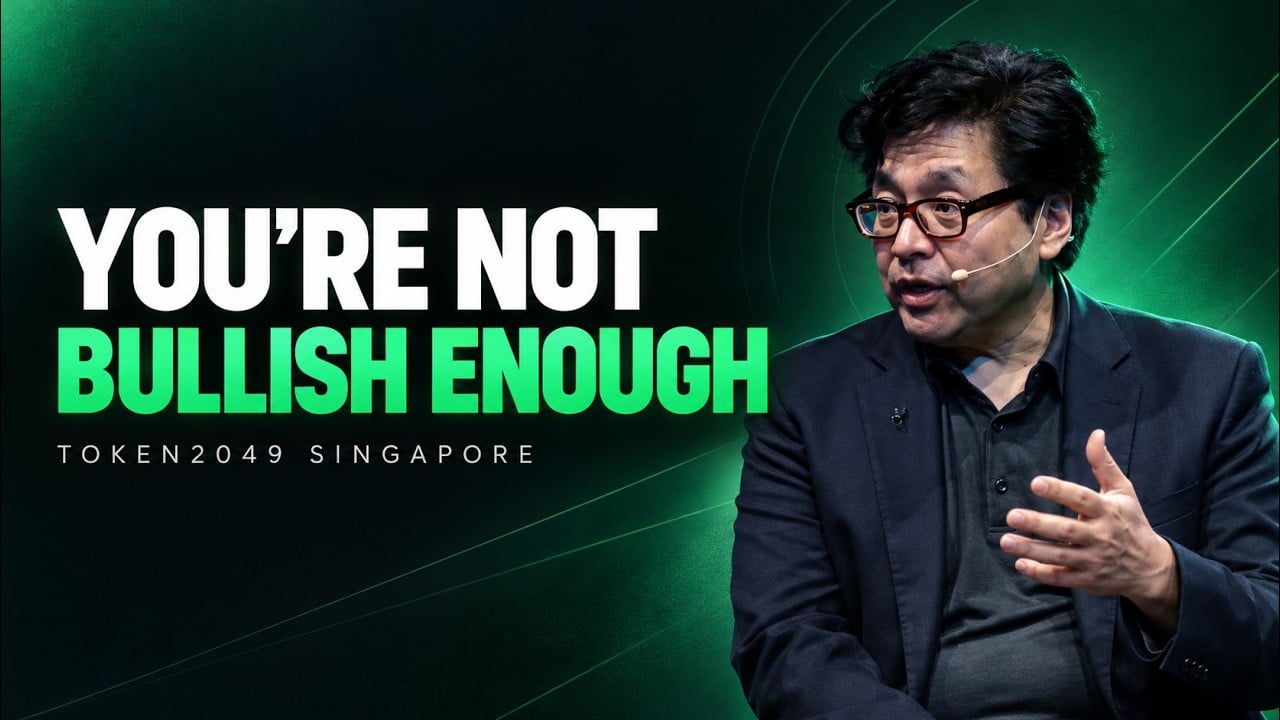
Guest: Tom Lee (Co-founder of Fundstrat, Chairman of the Board at BitMine, veteran Wall Street strategist)
Host: Host for the Ondo Finance special session
Source: TOKEN2049 × Ondo Finance Special Session (YouTube)
Original Title: Tom Lee: Ethereum Could Reach $50K This Cycle | TOKEN2049 | Ondo Finance
Release Date: 2026-10-08
Key Takeaways
- Bull Market Returns: The past 12 months were a crypto winter, but after the KBW conference, the market has entered a full bull market. Asia is the right place to be.
- Tokenization Blue Ocean: On-chain assets total only $3 to $4 trillion, while traditional capital pools reach up to $200 trillion, with roughly $7 trillion in new liquid assets added annually.
- Not an AI Bubble: Compared to the 90s internet boom, current AI infrastructure spending is about $30 trillion, comparable to the $35 trillion spent on the internet and mobile networks back then. We are roughly in 1997, with the AI bubble peak possibly arriving around 2033.
- Super Bullish on ETH: BitMine is betting on Ethereum as the future settlement layer, believing ETH is severely undervalued and could reach $25,000 to $50,000 this cycle.
- Institution-Led New Cycle: Unlike the retail-driven cycles of 2017 ICOs and 2021 NFTs, this cycle is driven by institutional products and genuine innovation.
- Tokenization Dismantles Banks: It enables trading of asset fragments like Alphabet stock, Starlink, and Tesla's FSD. The asset management industry will embrace it first, while Wall Street as a whole will move slowly.
II. Key Insights
- "I've never seen a bubble that everyone agrees is a bubble. If everyone thinks it's a bubble, you actually won't push it into a bubble."
- "We're roughly in 1997. Cisco didn't peak until 2000, and it lost half its value twice between 1993 and 2000. So I think we're still far from a bubble."
- "Ethereum is severely undervalued. In this bull cycle, it could easily hit $25,000 or $50,000."
- "By year-end, Ethereum should break its all-time high and surpass $5,000; Bitcoin will exceed $100,000, which would put Ethereum around $7,500."
- "If you're positioning for tokenization, the asset management industry is already embracing it, while Wall Street as a whole will be very slow."
- "Many large financial institutions that fail to establish crypto rails or strategies will become the NCRs and MCIs of this era."
III. Full Transcript
1. Asian Energy and the Return of the Bull Market
Host: You've attended multiple events across Asia recently. What's been your most direct impression?
Tom Lee: The past 12 months was essentially a crypto winter, but following the KBW conference—especially this week—we can clearly feel the shift. The market has returned to a full bull market. I believe being in Asia is the right call, because tokenization and many substantive advances in how banks are pushing blockchain and crypto are all happening here.
2. Tokenization: A $200 Trillion Blue Ocean
Host: Everyone is talking about tokenization. How much real room do you see for it?
Tom Lee: On-chain assets currently sit at roughly $3 to $4 trillion, but traditional capital pools are massive: public equities alone stand at $150 trillion, and fixed income at around $250 trillion. Plus, there's about $7 trillion in new liquid assets looking for homes every year. Crucially, trillions are locked in private equity and private credit with 4- to 10-year exit horizons, returning barely enough to match money market funds. Convincing high-net-worth individuals to move wealth on-chain while outperforming traditional allocations is the core of this transformation. It's a colossal addressable market.
3. The AI Bubble Debate: We Are Still in 1997
Host: Is AI already in a bubble now?
Tom Lee: The average fund manager today is about 35 years old. Most entered the industry in 2016, so they've never lived through the 2008 financial crisis or the dot-com bubble. I often say: "I've never seen a bubble that everyone agrees is a bubble." The data makes it clearer. The open internet launched in 1994. By 2026, the total infrastructure built for the internet and mobile networks will amount to roughly $35 trillion. Current AI infrastructure spending is about $30 trillion—the scale is comparable. Cisco didn't peak until 2000, and it cut its valuation in half twice between 1993 and 2000. My assessment is that we're closer to 1997 than anything else. The AI bubble's actual peak might not arrive until 2033.
4. The Core Logic Behind Heavy Bets on Ethereum
Host: Why did you put such a heavy bet on Ethereum for BitMine's balance sheet?
Tom Lee: Ethereum is the most neutral settlement layer for the future. It has the largest developer community and has maintained 100% uptime over the past 15 months. ETH is currently around $2,700 and has been range-bound for five years. The longer it consolidates, the bigger the breakout tends to be. I believe ETH is severely undervalued and could reach $25,000 to $50,000 this cycle. For year-end, I'm forecasting ETH will break its all-time high and clear $5,000, Bitcoin will surpass $100,000, and that dynamic should pull ETH to approximately $7,500.
5. An Institution-Led New Cycle
Host: How does this cycle differ from previous ICO and NFT runs?
Tom Lee: 2016 to 2017 was the ICO era, driven by retail investors. 2019 to 2021 was the NFT era, which was also heavily retail-focused. This cycle, institutions are building products at scale, sparking genuine innovation—like Ondo announcing its private markets business that very same day. With larger participants, deeper pockets, and real product utility, this will be a significantly larger cycle than before. The market hasn't fully priced this in yet, and crypto prices will experience some sharp volatility along the way.
6. How Tokenization Dismantles Banks
Host: What does tokenization mean for the traditional banking system?
Tom Lee: Investors always crave liquidity, low costs, and informational advantages. The bigger story here is the fractionalization of assets. At KBW, one company announced the ability to trade Alphabet stock directly within Google. In the future, people will be able to buy micro-positions in things like Starlink capacity or Tesla's Full Self-Driving software. The asset management industry will embrace tokenization first because its revenue model is tied to managed assets, which won't be disrupted. However, traditional banking functions that rely on capital commitment, fiduciary services, or insurance wrappers will become unnecessary in a tokenized world, leaving them highly vulnerable. The buy-side will aggressively force the sell-side to adapt.
7. The Future of the Financial System and Risk Warnings
Host: Looking ten years ahead, what will the financial system look like?
Tom Lee: The financial system currently represents about half of economic output. In an age dominated by AI agents and robots, finance could actually become the single largest sector, as financial activity expands dramatically in digital ecosystems. Another frequently overlooked statistic: 46% of Americans lack a traditional bank account. Prepaid cards function as their de facto bank, and this cash-storage model is incredibly expensive. One of crypto's fundamental values lies in expanding financial access to these unbanked populations. Finally, I want to issue a warning to traditional finance Chief Investment Officers: If you don't build out crypto rails or a clear crypto strategy, you risk becoming the NCRs (who missed the personal computer revolution) and MCIs (who missed the mobile network revolution).
Join TechFlow official community to stay tuned
Telegram:https://t.me/TechFlowDaily
X (Twitter):https://x.com/TechFlowPost
X (Twitter) EN:https://x.com/BlockFlow_News
 深潮TechFlow