Beyond low circulating supply and high FDV: What do better token issuance models look like?
By: Josh Riezman, Slater Santer (GSR)
Compiled by: TechFlow
TechFlow Brief: The token issuance model characterized by low circulating supply and high valuation is being voted against by the market: the median drawdown over one year exceeds 80%. This GSR research dissects the root causes with data and outlines several actionable alternative paths, offering valuable reference for project teams and early investors.
Key Takeaways
- The GSR research team partnered with consulting partners to catalog every token listing on major exchanges since 2013, covering over 2,300 launches, with data on performance metrics, circulating supply, FDV, sector, and other details for each issuance.
- Circulating supply at launch has been halved since the ICO era. The median circulating supply at initial listing dropped from 38% in 2017 to 13% in 2020, with only a partial recovery since.
- As issuance valuations rise, median circulating supply steadily declines: tokens with an FDV under $10 million sit at 97%, while those exceeding $1 billion drop to 14%.
- $1 billion+ launches performed the worst. Tokens launching with an FDV over $1 billion saw a median return of -81% after one year. Launches with less than 20% circulating supply fell approximately 75% after a year, while those with 30% to 50% circulating supply fell roughly 45%.
- This is no longer just a crypto issue. The stock market has converged on the same model: companies stay private longer, insiders accumulate stakes before the public can buy, and since 2019, IPO cohorts have underperformed the broader market over a three-year holding period.
- GSR is an active participant in token issuances and secondary markets. Our business includes market making and liquidity provision, issuance and listing advisory, and OTC execution, block trading, and concentrated position management for foundations, teams, and early investors.
The reality of low-supply, high-FDV tokens has been proven hundreds of times. A token launched with a high fully diluted valuation and a tiny fraction of circulating supply may spike short-term, but overall it inevitably bleeds continuously. However, we want to understand the dynamics of this process more deeply, both for our clients and for ourselves: does circulating supply determine average post-launch returns, is there a correlation with FDV, and what might solutions to this model look like?
The GSR research team partnered with consulting firms to catalog every listing on major exchanges since 2013, creating the first dataset of its kind covering over 2,300 token launches. What we found is not entirely optimistic. We tracked every token launch to date, meaning our dataset includes dead and delisted tokens, so these figures are not whitewashed by survivorship bias. The median exchange listing broke below its initial price within 3 days and dropped 50% within 90 days. Clearly, recent token launches have disappointed buyers. Why does this structure inevitably lead to this outcome, and what might a better launch look like?
Circulating Supply Halved, Valuations Unchecked
The ICO era had many flaws, but it put tokens directly into public hands. The median circulating supply at initial listings in 2017 and 2018 stood between 38% and 41%. As stricter regulation pushed fundraising toward private rounds, the model reversed: venture capital rounds dictated valuations, points and airdrop plans replaced public sales, and by 2020, the median circulating supply at listing had fallen to around 13%. It has only partially recovered since, hovering in the teens to low twenties percent range for most years.
However, looking at circulating supply numbers alone understates the problem, as supply must be evaluated alongside valuation. Releasing 5% of a sub-$50 million token has far less impact than releasing 5% of a $1 billion token.

The median circulating supply at listing steadily declined as issuance FDV rose: 97% for tokens under $10 million, 28% for $10 million to $100 million, 16% for $500 million to $1 billion, and 13% for over $1 billion. The higher the valuation, the thinner the supply. Clearly, this is not a coincidence, but a hardened pattern in our industry.
Why These Issuances Bleed
When only a small fraction of supply is tradable, modest demand can inflate the entire token's value. Everyone inside the issuance benefits on day one. VCs mark their positions to the listing price, the team's holdings are valued at the listing price, and the exchange gains a marquee asset. The only participants who benefit more from lower pricing are the buyers.
Then the unlock schedule arrives. Supply previously excluded from circulation begins entering the market on schedule, dumping onto prices discovered by only a small portion of the supply. None of this requires anyone to act with malice. The structure itself guarantees that incentives will produce the same result.
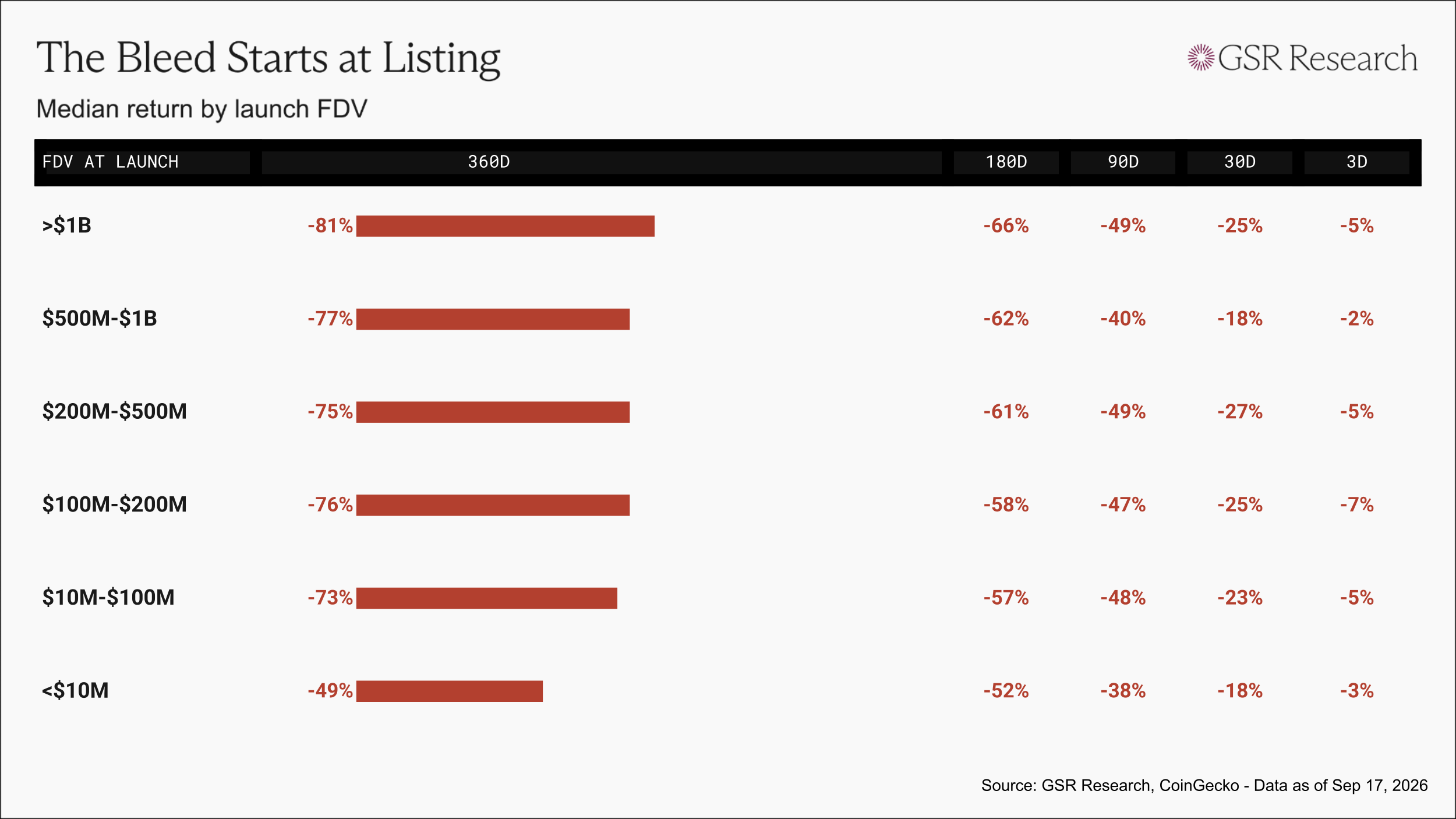
In our dataset, the median launch broke below its initial price within 3 days, dropped roughly one-fifth to one-quarter within a month, and neared a 50% drawdown by day 90. For project groups launching with an FDV over $1 billion, the median dollar invested was reduced to just $0.19 after 360 days.
Public Markets Are Following Suit
The low-supply, high-FDV model is often considered unique to crypto. Yet in recent years, public stock markets have drifted toward the same structure: companies like SpaceX stay private for up to a decade, accumulating stakes through rising valuations until listing, where they release only a tiny fraction of shares to public demand. Over a three-year buy-and-hold horizon, every annual IPO cohort since 2019 has underperformed the broader market, with recent cohorts ranking among the worst in recorded history.
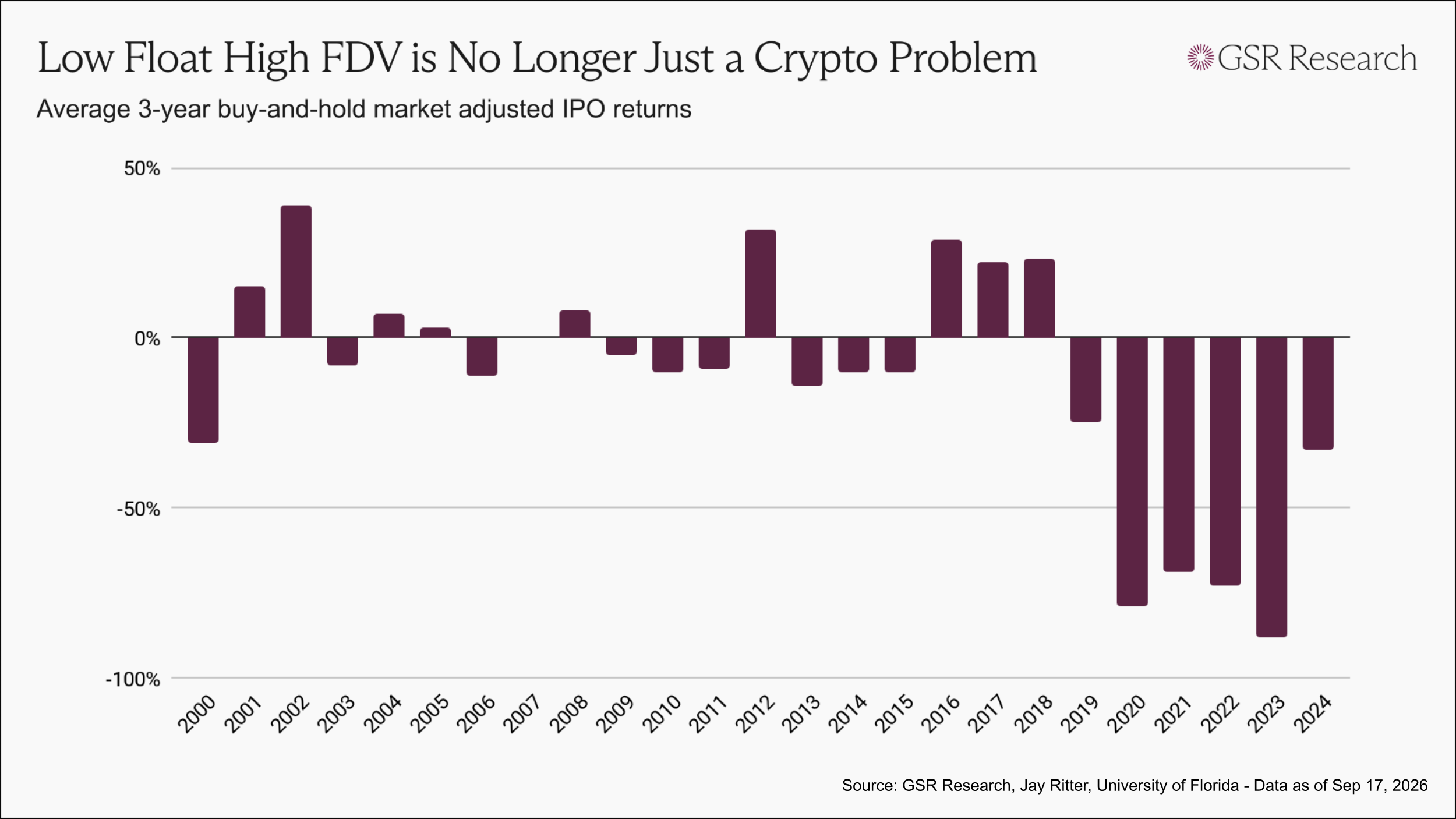
The crypto issuance problem is simply the modern IPO problem, just with faster unlocks and less disclosure.
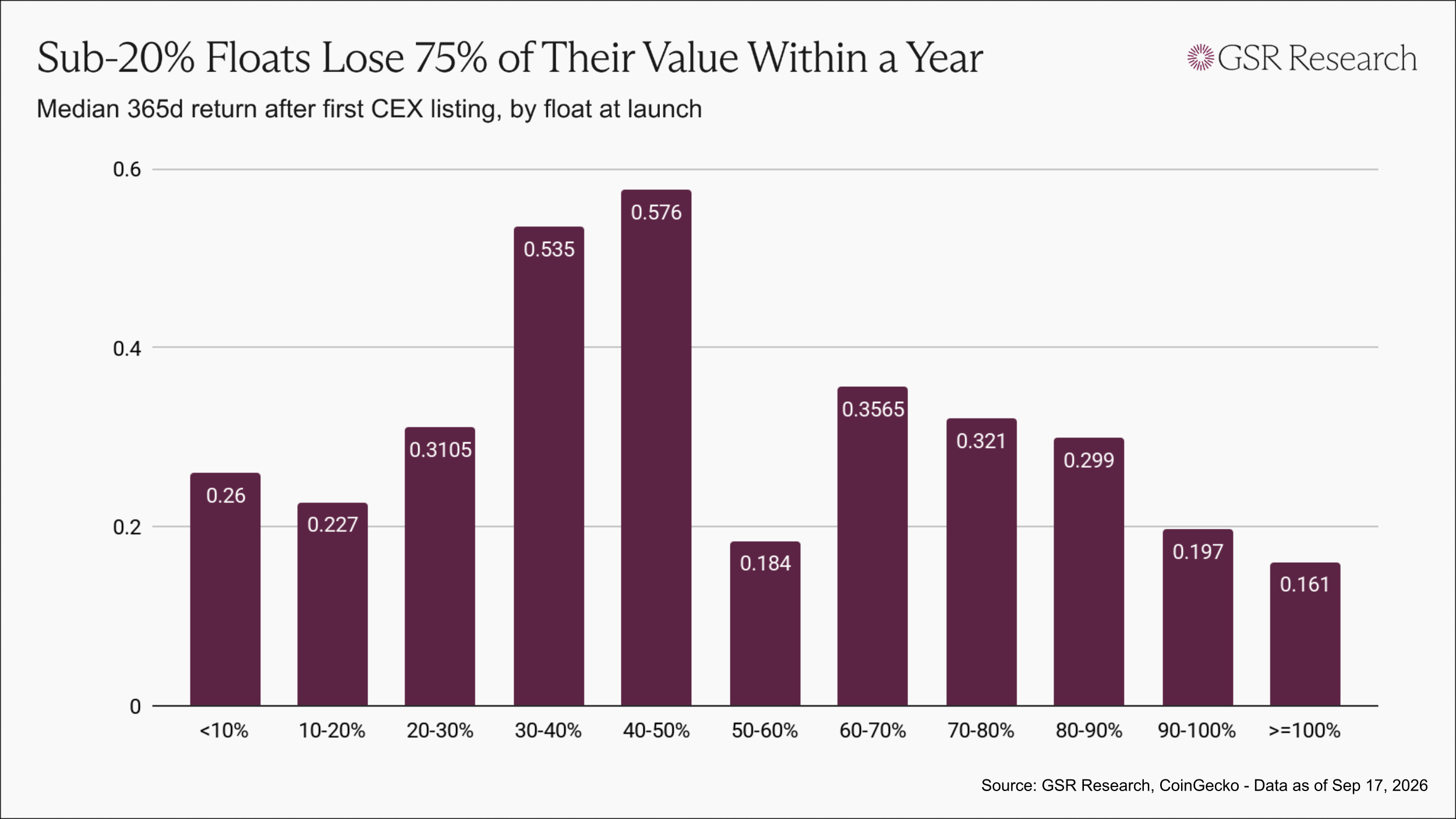
Within crypto, launches with under 20% circulating supply retain roughly $0.23 to $0.26 per dollar after one year. Launches with 30% to 50% circulating supply retain about $0.55, more than double the former. This relationship breaks down at the extreme end, as near-fully-circulating launches are primarily low-cap and meme coins, but within the mid-range tiers, allowing broader circulating supply outperforms supply designed purely to manufacture scarcity.
What Solutions Look Like
There is no single solution, and we remain skeptical of anyone peddling a one-size-fits-all answer. But from our vantage point participating in hundreds of launches, the actionable levers are clear.
First, issuance pricing must allow both holders and traders to profit. Enduring communities in this sector belong to the few assets where the public could buy in early and cheaply. Simply put, if you let your holders profit, you naturally cultivate a community. Selling the first public allocation at the highest private valuation does the exact opposite, recruiting holders into positions that will only disappoint them. This also drives away traders. A token that grinds downward from day one gives traders zero actionable space: no two-way liquidity, no rationale for building short-term positions, and no one to absorb sells when holders want out. These two groups are complementary. Traders provide the liquidity and volatility holders need; holders provide the demand base that makes the market worth trading. An issuance priced solely for insiders loses both. Projects should sell to the community earlier and at lower prices, rather than exposing the public to risk for the first time at the peak.
Second, circulate enough supply to make price discovery authentic. That ratio needs to be markedly higher than the 13% to 20% lows seen from 2020 to 2022, and it must be evaluated relative to valuation, not in isolation. By way of reference, typical stock IPOs usually float around 30%, with 50% considered very high; in crypto, floating over half for a flagship asset at listing is rarely appropriate. The goal is for circulating supply to be large enough that the opening price is meaningful.
Finally, expand the scope and timing of participation. Access opportunity matters just as much as circulating supply. We've seen the recent rise and proliferation of syndication platforms, allowing small checks to participate on VC terms, alongside reputation-gated allocations for real users, public sale channels, on-chain auctions, and fully circulating fair launches. Each approach carries tradeoffs. But all of them push in the right direction toward broader participation.
Furthermore, legal and compliance landscapes have improved significantly. In Europe, MiCA already permits issuers to offer tokens directly to the public. In the US, draft proposals for the CLARITY Act consider capped direct sales to retail investors. If passed, the argument that securities law forces a private accumulation model would weaken considerably, making issuance structure a strategic choice rather than a regulatory constraint.
How GSR Can Help
Every issuance is unique. Stage, sector, jurisdiction, venue strategy, community, and unlock design all influence what reasonable circulating supply and valuation should look like. The answer for a $50 million project is not the answer for a $5 billion project.
GSR collaborates with token issuers, foundations, and investors to provide issuance and listing advisory—including circulating supply sizing, valuation, allocation, and unlock design—while offering market making and liquidity services across listing venues, as well as OTC execution and block trading for participants managing concentrated positions or staged unlocks.
Our industry keeps learning the same lesson. Projects that build enduring holder bases will be those that price issuances so the public can win, circulate sufficient supply to make prices authentic, and allow insiders to benefit at a slower pace: moving with the community, rather than ahead of it.
Join TechFlow official community to stay tuned
Telegram:https://t.me/TechFlowDaily
X (Twitter):https://x.com/TechFlowPost
X (Twitter) EN:https://x.com/BlockFlow_News
 @GSR_io