Ethereum Launches Glamsterdam Public Testnet, All Tools with Hardcoded Gas Limits Must Be Updated
Author: Ethereum Foundation
Translated by TechFlow
TechFlow Digest: Ethereum's upcoming Glamsterdam upgrade brings a dual overhaul of block construction and Gas pricing. Any wallet, indexer, or estimator with hardcoded maximum Gas limits will crash outright. The foundation has opened a public testnet early, giving developers months to adapt, but time waits for no one.

tl;dr
Meet Platåberget: an early testnet for the Glamsterdam (Gloas + Amsterdam) upgrade, now open to the public. This upgrade introduces breaking changes for application developers. Notably, any tools relying on hardcoded maximum Gas limits (such as wallets, indexers, and Gas estimators) will break and require updates. Take advantage of this early opportunity to test!
Platåberget is a short-term testnet designed for the community to test these changes. Unlike previous developer networks that lasted only briefly, Platåberget is planned to run for several months, providing the community with a stable environment to experience post-Glamsterdam Ethereum and get opportunities to test and break things before Glamsterdam is activated on the longer-term testnets Sepolia and Hoodi.
What’s in the Glamsterdam Fork
The Glamsterdam upgrade brings significant changes to both the consensus and execution layers. Highlights include:
Protocol-integrated proposer-builder separation: This is a major change to how blocks are constructed, proposed, and validated, including new builder API flows and PTC checks. Infrastructure reliant on block production and validation pipelines should expect to be impacted.
Block-level access lists: Introduction of mandatory block-level access lists that record accessed state locations and post-transaction changes. Block-level access lists are stored separately from the block body and can be exchanged between execution layer nodes via eth/71.
Gas re-pricing: A coordinated set of Gas cost changes aiming to lower the Gas floor to approximately 200 million. Any tool with a hardcoded maximum Gas limit will be affected.
Larger contracts and initialization code: Increasing the maximum deployable contract size from 24 KiB to 64 KiB, and the maximum initialization code size from 48 KiB to 128 KiB.
Forward-compatible consensus data structures
Platåberget’s validator set is relatively small but publicly joinable. Anyone can deposit new validators and test their own validator and builder deposit flows. ePBS represents a major change to the consensus layer, and we want to ensure all independent stakers, DVT projects, custom software, and large-scale operators have ample opportunity to test their infrastructure. The Glamsterdam fork on the testnet is scheduled for August 20, leaving enough time for deposits and preparation for the fork transition.
Another major change in Glamsterdam is Gas re-pricing. These changes will impact a broader audience since they touch every wallet, indexer, and Gas estimator on the network. Use this opportunity to identify which tools or assumptions in your systems might break before the fork goes live on mainnet.
The complete list of included EIPs is tracked in the Glamsterdam meta EIP-7773.
Using Platåberget
Please refer to the Platåberget resources page for summaries of included EIPs, client support, and launch status; consult the devnet-8 specification for network setup, configuration values, bootnodes, and client release information.
The Platåberget page provides a one-click network addition flow to configure your EL and CL clients, along with a faucet providing testnet ETH to cover deposit and Gas fees.
Keep the following points in mind when running nodes:
The public will be able to submit validator or builder deposits via the Dora browser
The genesis validator set will not pre-allocate auto-staking to a few entities, but instead will be bootstrapped through public deposits, with some ETH allocated at genesis to help launch.
Client releases: Releases for each client are optional; please verify if your chosen client already includes this version.
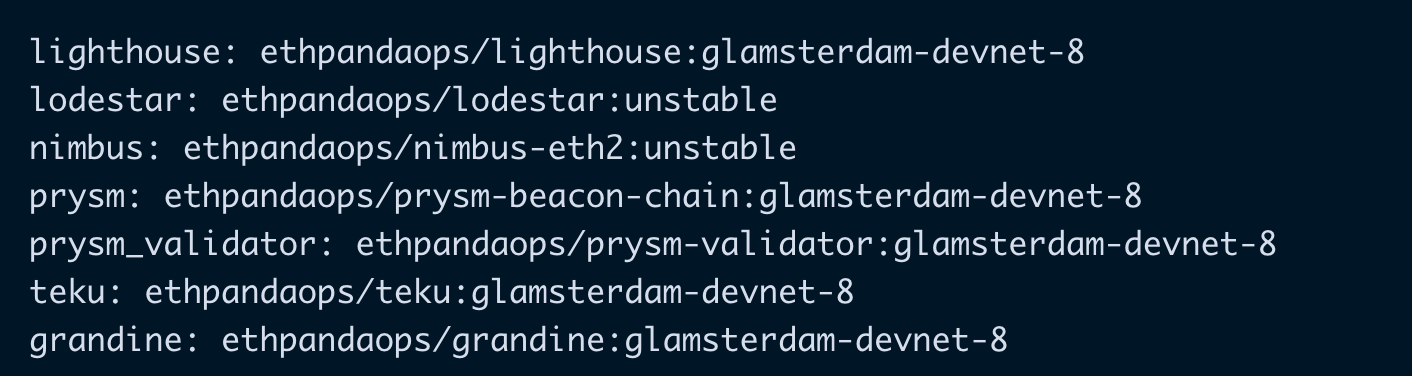
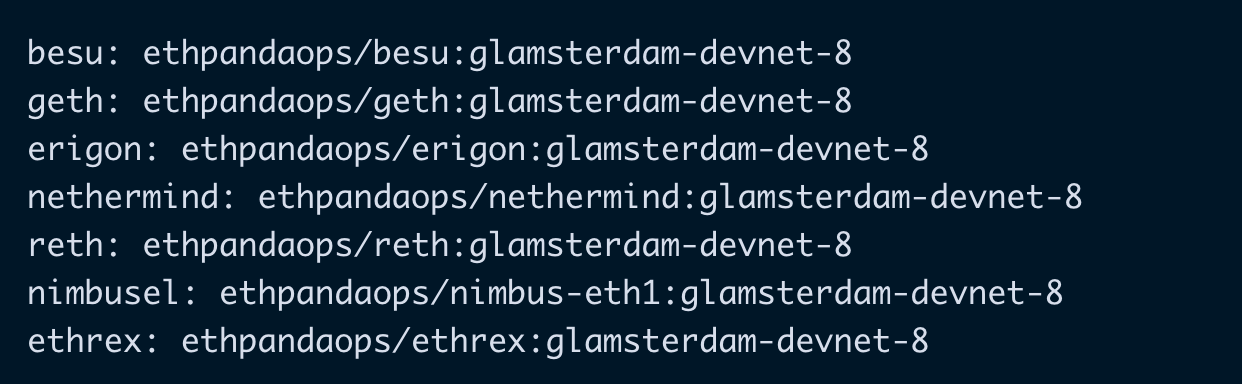
Client Images
For now, until client teams prepare tagged release versions, please use our ethPandaOps container images below.
Consensus Layer
Execution Layer
Support and Feedback
If you find errors or issues in the specifications, the best channel for feedback is the Ethereum R&D Discord server. If you prefer not to use Discord, you can also raise them in the following spec repositories: consensus specs, execution specs, execution-apis, builder-specs, and beacon-APIs.
Platåberget gives the community the opportunity to experience post-Glamsterdam Ethereum and start discovering issues.
Gas re-pricing is particularly important for application developers: any tool relying on hardcoded maximum Gas limits (such as wallets, indexers, and Gas estimators) will break and need updating. We hope to see dApp and wallet developers alongside infrastructure operators testing on Platåberget, as these changes are most likely to catch downstream tools off guard.
Re-pricing affects more than just block Gas limits: individual operation prices will also change, and EIP-8037 introduces an independent state Gas dimension for operations that create new state. Creating accounts, deploying code, or writing to new storage slots is now metered at a fixed cost per state byte (CPSB), charged at runtime rather than upfront. The practical consequence is that standard ETH transfers are no longer always a fixed 21,000 Gas: transfers to existing accounts still cost 21,000 (now broken down into TXBASECOST + COLDACCOUNTACCESS + TXVALUECOST), but sending funds to non-existent accounts will additionally incur a state Gas fee calculated at runtime as STATEBYTESPERNEWACCOUNT × CPSB. Anything assuming 21,000 covers all transfers, or estimating with a single Gas dimension, needs reassessment: see EIP-2780 for decomposed intrinsic costs, and EIP-8038 for increased state access costs.
Once feedback is integrated into client software and specifications, a provisional developer network will follow within a month to test extreme consensus scenarios.
After these development networks run stably for a period, the existing long-term testnets (Sepolia, Hoodi) will undergo the Glamsterdam fork. Once they complete the upgrade and stabilize, the next step will be Ethereum mainnet’s transition to Glamsterdam 🎊.
For those who want to track progress in more detail, the best channels are the Ethereum R&D Discord server, the All Core Dev calls, the Glamsterdam upgrade tracker, or the EthPandaOps Glamsterdam devnet GitHub repository.
Catch you on Platåberget 🐻❄️!
Join TechFlow official community to stay tuned
Telegram:https://t.me/TechFlowDaily
X (Twitter):https://x.com/TechFlowPost
X (Twitter) EN:https://x.com/BlockFlow_News
 @ethereum