Podcast Notes | After binge-watching 141 investment blogger videos on YouTube, I found everyone is just bullish on these 5 stocks.
Compilation & Translation: TechFlow

Episode Name: 21 YouTubers Agree on 5 Stocks. My Entry Points (BWB - Business With Brian, Single Episode)
Host: Brian (Brian Ferraro, Independent Investor Channel Host, BWB 429K Subscribers)
Duration: 25:19 (Released on Aug 25, 2026, 127K Views per Episode)
Tickers Involved: Alphabet (Google) / Nvidia / Micron / CoreWeave / Uber
Disclosure: Brian personally holds Nvidia (over 12% of his portfolio, at his limit), Google, Micron (buying on plan), and Uber; he does not hold CoreWeave. His views are directly tied to his own portfolio, and this episode includes a paid sponsorship (Galaxy Premium Yield, a cash management tool provider). All price levels below are outputs from his personal models and do not constitute investment advice.
1. After Watching 141 Videos, Only 5 Stocks Are Repeatedly Mentioned
One creator took on a grueling task: over 11 days, they watched every one of the 141 stock-related videos across 21 YouTube investing channels, noting down each mentioned ticker one by one into a spreadsheet.
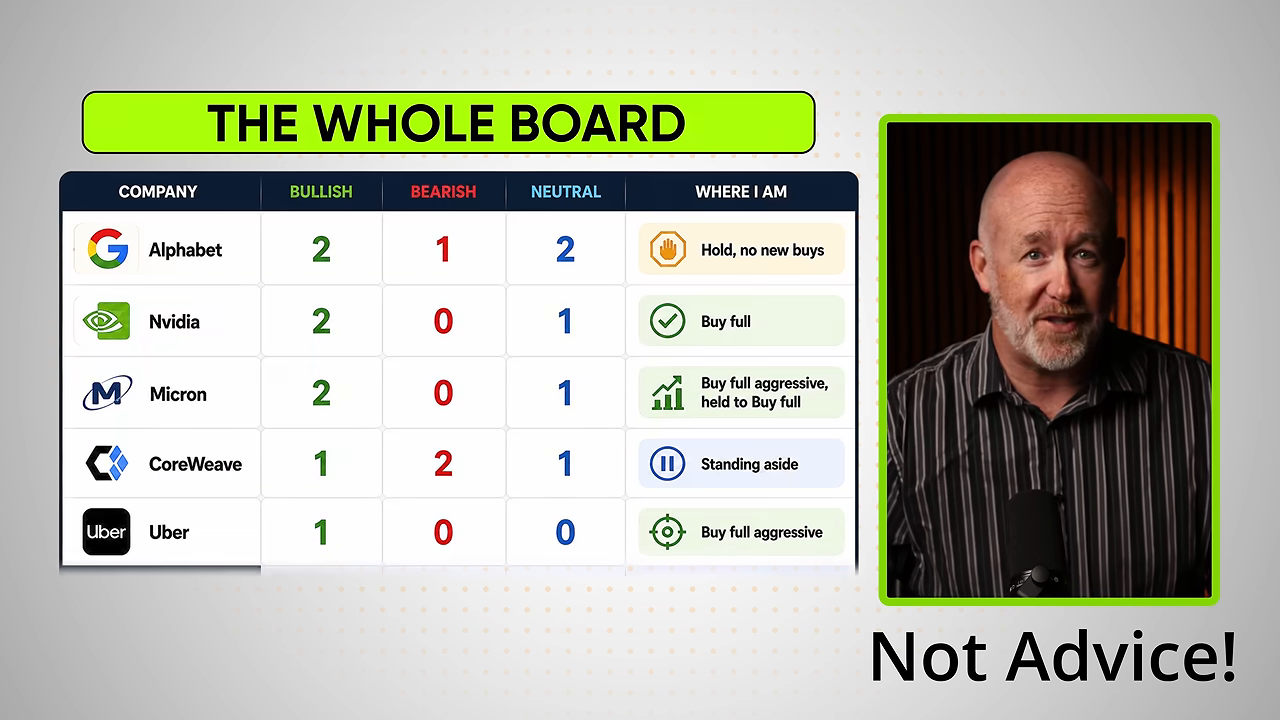
In the end, the entire spreadsheet boiled down to just 5 repeatedly mentioned companies: Google, Nvidia, Micron, CoreWeave, and Uber. The other hundred-plus companies were basically mentioned once and then vanished without further discussion.
But don't rush to copy their trades yet. Eisman, the real-life inspiration for the main character in The Big Short, also consumed this podcast content. His reaction was to sell his Google position immediately, with a single reason: these AI stocks are actually the same trade—they either all win or all lose.
In this compilation episode, investment blogger Brian broke down and tallied the themes of those 141 videos again: 76 focused on chips, cloud infrastructure, and AI models, accounting for just over half. In other words, out of these five "repeatedly favored" stocks, four (Google, Nvidia, Micron, CoreWeave) are essentially the same AI bet wearing different names. Only Uber stands truly independent.
Below, we break down why people like each stock, what concerns everyone has, and Brian's own trading positions and entry points.
2. Google: Buffett Is Adding, Current Price $362, But He Only Opens Half Position
Why It's Bullish
Based on trailing earnings, Google is currently trading at one of its cheapest valuations in a decade. At $362, it has dropped about 14% from its all-time high in May. Valuation-focused video creators generally peg its fair value between $350 and $450.
On the news front: Warren Buffett's Berkshire Hathaway recently significantly increased its Google position, nearly doubling it, pushing Google into Berkshire's top three holdings.
What Everyone Fears
Flip the metric, and the answer reverses: based on sales, Google sits in the most expensive 3% over the past decade. The exact same company can yield two opposite conclusions on the same day; the difference lies entirely in which line of the income statement you're looking at.
One creator ran an experiment during a live stream worth remembering: he first asked viewers, "At what price would you sell your Google shares?" and everyone wrote down a number. Then he revealed the news of Buffett's addition and asked again, "Would you change it?" Everyone changed it. A single headline can make you abandon your own rules—the most authentic weakness of retail investors.
Brian's Move
Current price $362: Only opens a half position (half of his normal position size), and only via monthly dollar-cost averaging, not heavy concentration. The reason boils down to that dual metric: both cheap and expensive can be true simultaneously, so buy less and pace it out.
3. Nvidia: Current Price $221, Valuation Says 1/3 Discount, But Some Are Betting on Trouble
Why It's Bullish
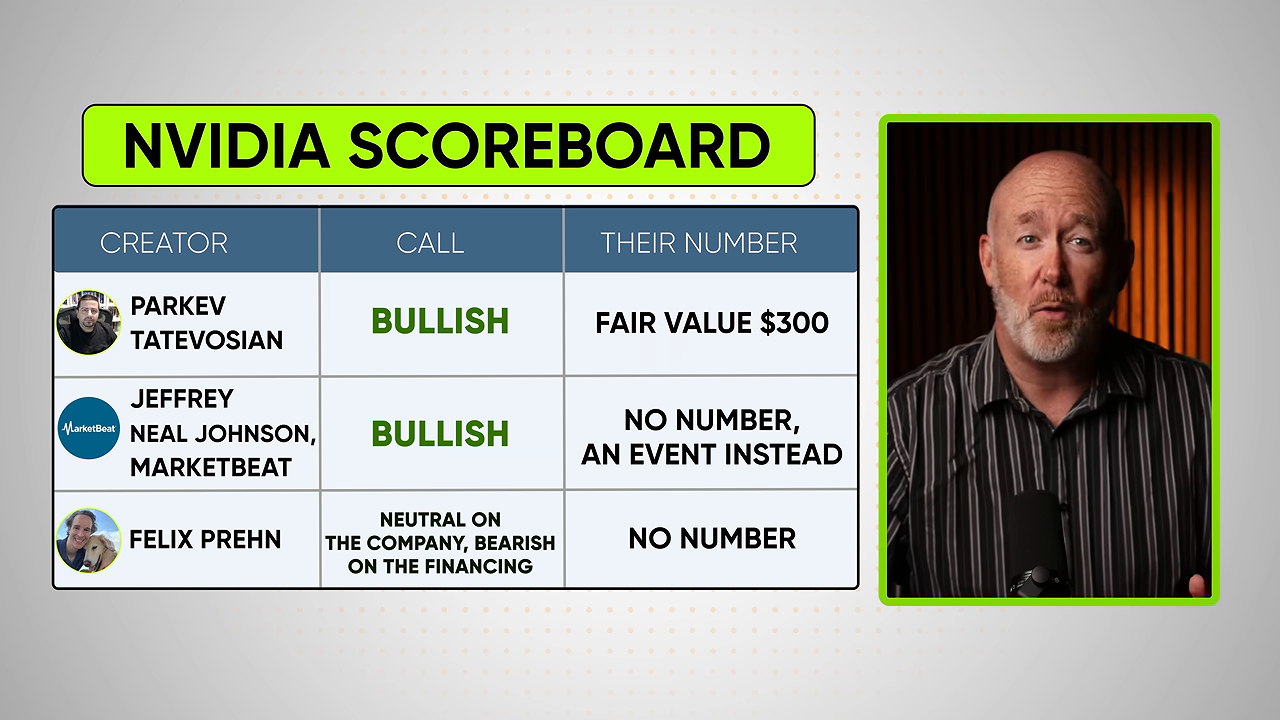
One creator plugged Nvidia's assets, liabilities, and equity into an Excel sheet, calculating an intrinsic value per share of roughly $300. At $221, it trades at a discount of about one-quarter to one-third versus the model. Brian's own model puts fair value at $290, while sell-side analysts average $330. All numbers point in the same direction: undervalued.
What Everyone Fears
The truly alarming figures lie outside the financials: Nvidia's customers have borrowed approximately $500 billion to buy chips. This amount approaches double Nvidia's full-year revenue, comes with a repayment period stretching five years, and the debt ultimately funnels back into pension fund balance sheets. The cost of insuring against Nvidia's debt defaults has already doubled since late May. While the market mouths bullishness, the insurance market is voting with capital to say "not confident."
Brian's Move
He calculates fair value at $290, but his Nvidia position is already at 12% (his self-imposed limit), so no adds. He strictly refuses to buy below $148: If the chain of borrowing to buy chips truly breaks, dropping to $148 isn't a bargain—it's catching a falling knife, and the thesis is broken.
4. Micron: Fair Value $1,450, Yet Price Has Broken Key Moving Average, He Continues Buying Per Plan
Why It's Bullish
Brian's model assigns Micron a fair value of roughly $1,450, representing the largest upside potential on the entire list. Furthermore, Micron's production capacity is fully booked with orders through 2027, leaving zero supply glut worries.
What Everyone Fears
Two metrics must be read together: based on realized earnings, Micron currently trades at a 22x P/E—not cheap. The "cheap" figure often cited is a 6x forward P/E based on next year's expected profits. Both can coexist under one premise: the market assumes Micron's future profits will triple. When you buy Micron, you are fundamentally betting on whether this "tripling" materializes.
Moreover, Micron is a cyclical stock; cyclicals right at the peak often look deceptively cheap. Historically, memory chip companies have fallen 70% from their highs more than once.
Brian's Move (Most Detailed Segment)
His model contradicts itself: one side says Micron is cheap, the other says it's expensive compared to its own historical multiples. He chooses to listen to the bear case and keeps position sizing conservative.
Specific rules:
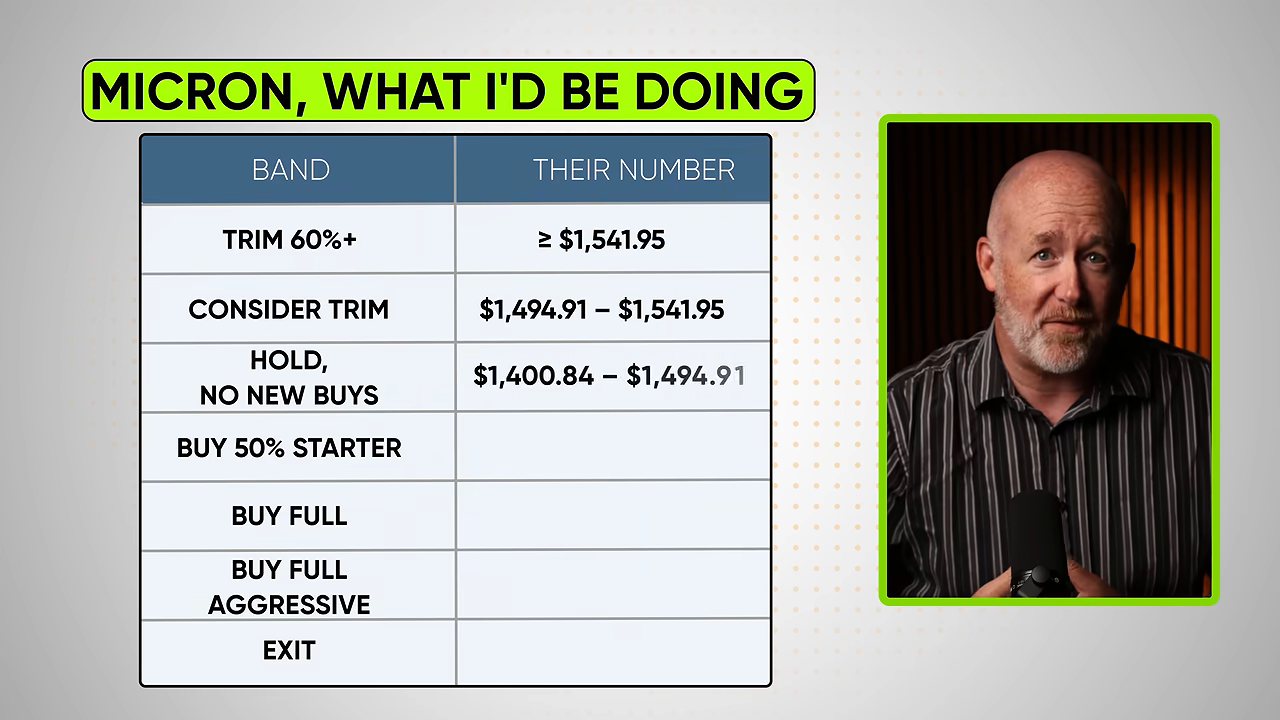
- The 50-day moving average at $961 acts as the master switch. The price has broken below it, so he continues buying per the original plan (adding absolutely nothing extra).
- He will only increase the position once the price reclaims $961.
- $434 is the "thesis broken" signal line; dropping there means the entire story has shifted, invalidating previous analysis.
As a side comparison: another creator's strategy is to buy at $135, add at $275, and add again at $500, chasing breakouts after every new high. This momentum trader approach is the exact opposite of Brian's "wait for pullbacks to buy" mindset. For the same stock, both work perfectly fine; it just depends on who you are.
5. CoreWeave: Retelling an Old 1999 Story? Zero Shares Bought, Hands in Pockets Watching
Why It's Bullish
Holding $130 billion in contracted orders, one creator sets its fair value at $113 against a current price of $104.
What Everyone Fears
In 1999, a US tech darling named Lucent did this: it lent money to customers, who used those funds to buy Lucent equipment, which Lucent then recorded as revenue. The numbers looked spectacular until a customer requested another $90 million loan and was denied, filing for bankruptcy weeks later. Investors suddenly realized the demand had been entirely fabricated by the seller funding itself.
Nvidia now agrees in SEC filings to take back all unleased compute capacity from CoreWeave through 2032. Translation: a portion of the demand on CoreWeave's books may simply be the seller backing up its own client. Structurally identical to what Lucent pulled in '99.
Brian's Move
Zero position, watching from the sidelines. CoreWeave has only been public for 17 months, insufficient historical data for him to chart entry ladders. He emphasizes: watching from the sidelines and holding positions are two completely different things; never mistake "not buying" for "shorting and secretly accumulating later."

6. Uber: The Only Non-AI Bet, Independent Price Models Diverge by Just $10
Why It's Bullish
Uber runs on cash flow: generating roughly $10 billion in free cash annually against a $150 billion market cap, placing it in the cheapest third of the last decade. Out of the 141 videos, it's the only stock mentioned by just a single creator, yet it ironically receives the deepest buy rating on Brian's entire list.
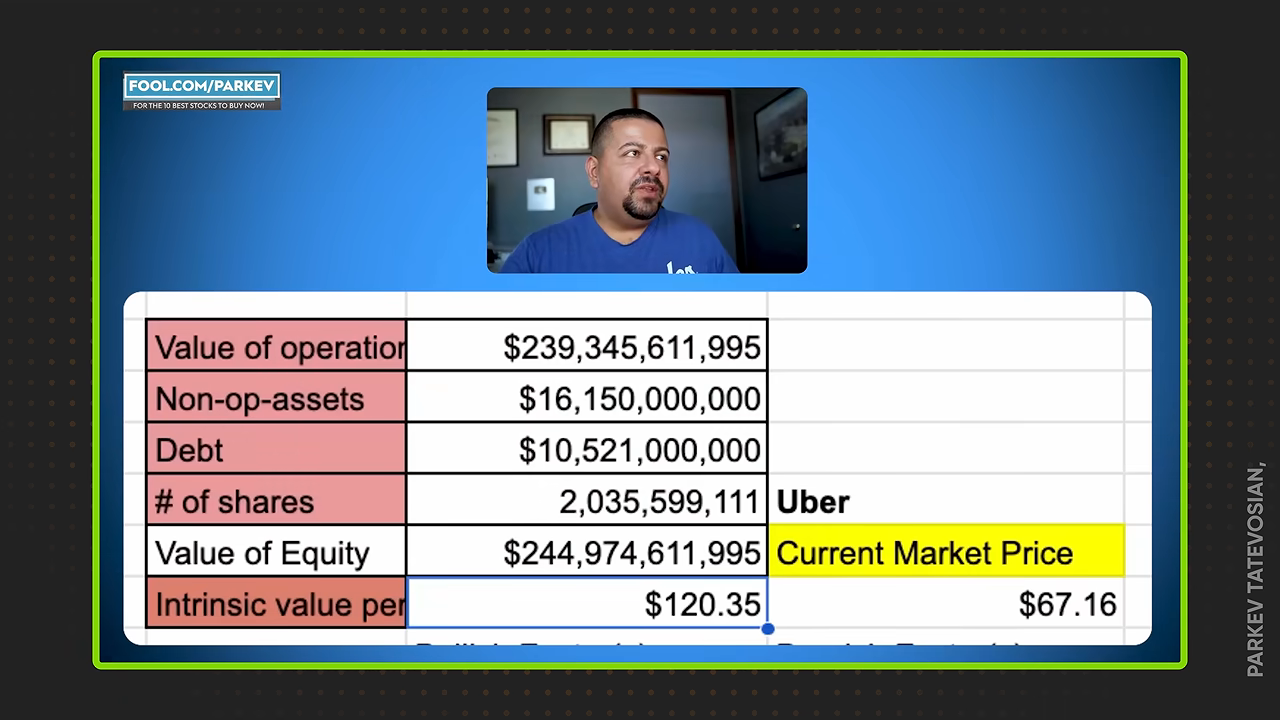
A telling detail proves its valuation depth: that independent creator calculated Uber's fair value at $120, while Brian calculated $109. They never cross-checked each other's work, yet the results diverged by only $10, roughly 5%. Current price sits at $67 (just after a 7% drop on recording day).
What Everyone Fears
Autonomous driving. Either Waymo-type fleets steal Uber's ridership, forcing Uber to maintain its own vehicle fleet, morphing into a vastly different asset-heavy business. That looms as the ceiling over its valuation.
Brian's Move
Deepest buy tier, full position sizing. His decision hinges on cash flow rather than GAAP earnings (which contain one-off items; cash flow is cleaner). The market prices Uber assuming "future profit degradation," while he prices based on cash flow sustainability. The gap is his margin of safety.
7. Take This Framework Home: 4 Questions Before Buying Any Stock
Brian's entry ladder isn't magic; it boils down to four questions:
- Is it expensive or cheap relative to its own history? (Don't compare to peers; compare to itself.)
- What assumptions are already priced in? (Micron example: current price assumes profits triple—do you believe it?)
- Are you confusing a good company with a good price? (A bad company at a cheap valuation, or simply a bad business?)
- What would make you change your mind? (This question costs nothing, but could save your portfolio.)
He adds one practical reminder: write down your exit price before entering. Finding an exit route mid-drawdown requires a completely different psychological state. The former is discipline; the latter is panic selling.
8. Step Back: You Think You Hold 5 Companies, But You Actually Hold One Bet
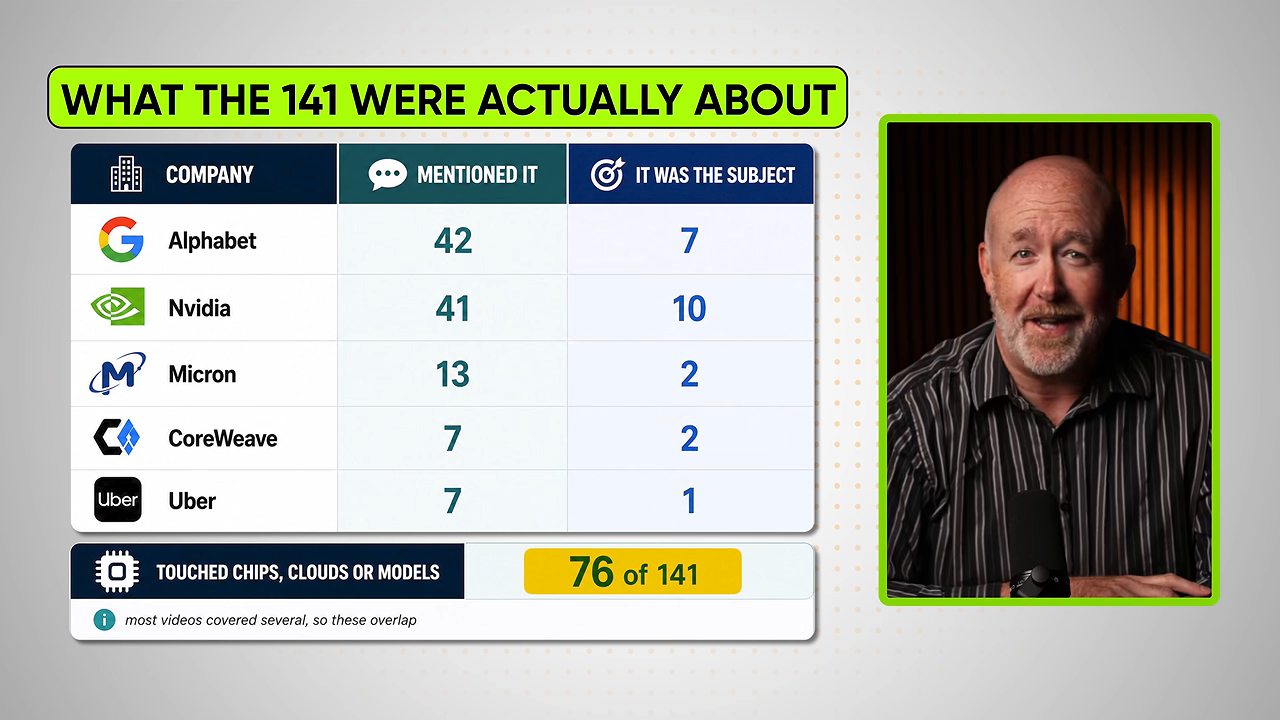
Brian finally tallied the theme distribution across the 141 videos:
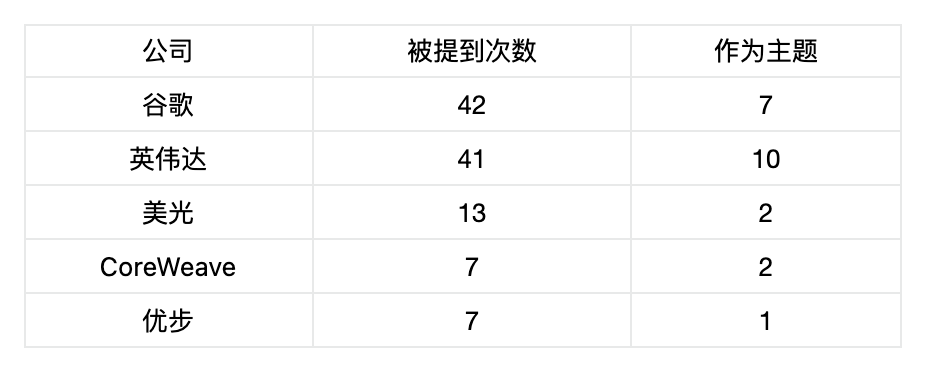
Over half of the videos (76/141) discuss the exact same narrative: chips, cloud, and AI models. Even Uber, this "solely independent" name, carries risk (autonomous driving) that still rides on Nvidia's silicon.
Which is precisely why Eisman's quote deserves the opening spotlight: if your watchlist was compiled from videos like these, you think you've diversified across 5 companies, but you've actually just consolidated exposure to the same AI wager under five different labels. Brian even confesses guilt: "My own watchlist was built the exact same way."
Join TechFlow official community to stay tuned
Telegram:https://t.me/TechFlowDaily
X (Twitter):https://x.com/TechFlowPost
X (Twitter) EN:https://x.com/BlockFlow_News
 深潮TechFlow