Russia's Bank Capital Drain and Crypto Crackdown: Public Withdraws €24 Billion from Banks This Year, Bill Limiting Total Crypto Purchases Set to Take Effect
Author: Claude, TechFlow
TechFlow Editor's Note: On August 4, Russian President Putin signed the "Law on Digital Currency and Digital Rights," with core provisions taking effect on September 1. Non-qualified retail investors cannot purchase more than 300,000 rubles (approximately $3,600) worth of cryptocurrency annually through any single licensed intermediary in Russia, and the central bank's draft limits purchasable assets to Bitcoin, Ethereum, and USDT. Almost simultaneously, Bank of Russia data shows that in the first 7 months of 2026, the public withdrew approximately 24.4 billion euros in cash from the banking system, with July's monthly increase in cash circulation hitting a new high for the year. With traditional bank deposits rapidly 流失 on one side, and crypto asset purchases being capped on the other, the two escape routes available to ordinary Russians are narrowing.
Banks Are Bleeding: 24.4 Billion Euros in Cash Outflow in 7 Months

Russians are moving cash out of banks. According to reports from UK media outlets such as the Financial Times and The Washington Post, in the first 7 months of 2026, the amount of cash withdrawn by Russians from the banking system reached approximately 24.4 billion euros (about 2.4 trillion rubles). Data from the Russian local financial data platform Banks.ru shows that this wave of cash withdrawals began in early March, with about 300 billion rubles leaving personal accounts each month.
The speed of outflow is accelerating. Bank of Russia data shows that cash circulation increased by 607.3 billion rubles in April, increased by 381.2 billion rubles in May setting the highest May record since 1995, increased by 449.7 billion rubles in June, and increased by another 643.4 billion rubles in July, the largest monthly increase since 2026. As of July this year, the total amount of cash held by Russian residents and enterprises has exceeded 21.9 trillion rubles.
Deposit data from specific banks illustrates the problem even better. Gazprombank lost 299.5 billion rubles in personal deposits over 4 months, accounting for 10.8% of its total deposits; Rosselkhozbank lost 270.5 billion rubles, a decline of over 15%; Russia's largest private bank Alfa-Bank lost 179.4 billion rubles, a decrease of 5.6%. Even the traditionally stable Sberbank was not spared, losing 211.6 billion rubles in June alone, and another 31.8 billion rubles in July.
This Money Has Not Disappeared, But Flowed into Cryptocurrency
While cash is flowing out of banks, crypto trading volume is rapidly expanding. In February 2025, Russian Deputy Minister of Finance Ivan Chebeskov stated at the Alfa Talk conference that daily cryptocurrency trading volume in the Russian private sector reached about 50 billion rubles, equivalent to approximately $648 million at the exchange rate at the time, with millions of citizens participating annually.
Chebeskov's exact words were: "The annual trading volume of cryptocurrency in our country exceeds 10 trillion rubles, all occurring outside the regulatory zone." This statement highlights the real anxiety of the Russian regulatory layer. The public is not treating cryptocurrency as a speculative toy, but rather as a savings tool to combat ruble depreciation, evade capital controls, and cope with financial uncertainty.
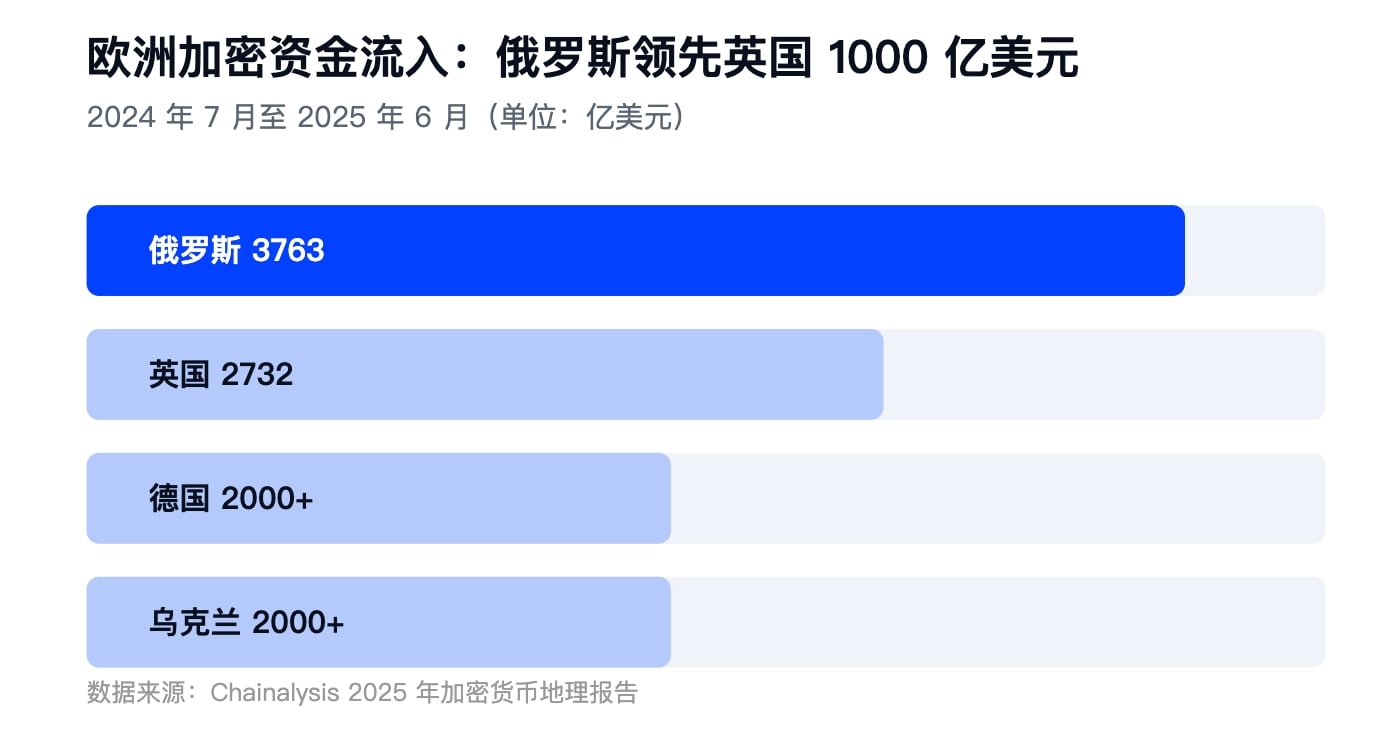
Data from Chainalysis corroborates the size of this market from another angle. From July 2024 to June 2025, cryptocurrency fund inflows received by Russia reached $376.3 billion, nearly 1.4 times that of the UK's $273.2 billion, ranking first in Europe. Sergei Shvetsov, Chairman of the Supervisory Board of the Moscow Exchange, estimates that Russian users pay approximately $15 billion in fees to overseas crypto platforms annually.
New Crypto Law Takes Effect on September 1, Retail Investors Locked at 300,000 Rubles Annually
The government chose to use legislative means to incorporate this gray channel. On July 21, 2026, the Russian State Duma completed the second and third readings of the "Law on Digital Currency and Digital Rights" within one day; on August 4, Putin signed it into law. The core provisions of the law will officially take effect on September 1, 2026.
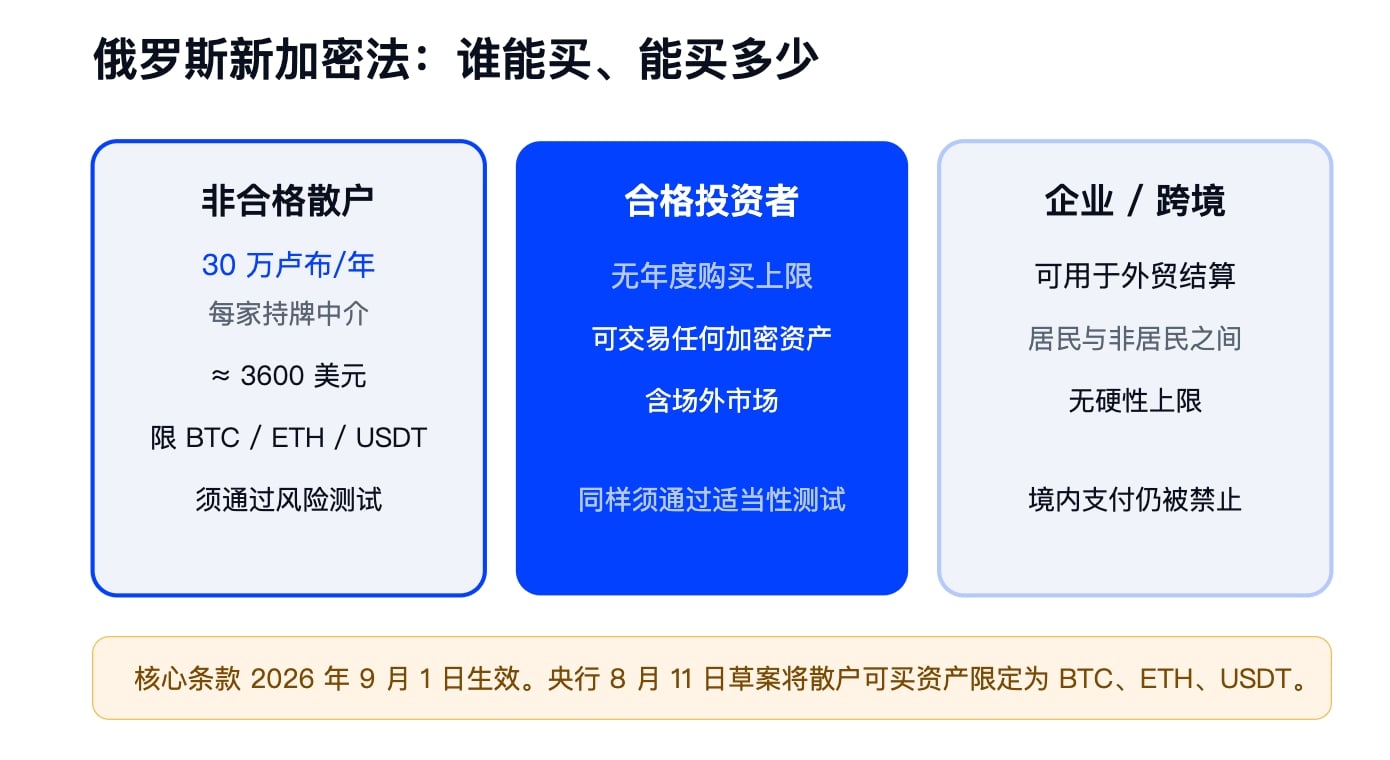
For ordinary retail investors, the law stipulates strict access conditions. Non-qualified investors must pass the suitability test of the Bank of Russia, and the amount of cryptocurrency purchased annually through any single licensed intermediary must not exceed 300,000 rubles, equivalent to approximately $3,600 to $3,800. On August 11, the Bank of Russia issued a draft directive preliminarily limiting crypto assets purchasable by retail investors to three types: Bitcoin, Ethereum, and USDT.
Qualified investors are not subject to this restriction and can trade freely on exchanges and in the OTC market. Enterprises and importers/exporters can also use cryptocurrency for cross-border settlements, which has no hard cap. The law simultaneously retains the ban on using cryptocurrency to pay for goods and services within the country.
In other words, if ordinary people want to preserve value via crypto assets, they can only buy about $3,600 per year per platform; whereas enterprises and high-net-worth individuals still have plenty of channels. This design leaves the outlet for "large-scale outflows" at the institutional end, while tightening the retail end.
Why Are Banks Bleeding? Two Explanations Exist Simultaneously
Regarding the cash outflow, Russian officials and the market have provided different versions of explanation.
Officials from the Bank of Russia and the Ministry of Finance repeatedly emphasized that there are no plans to freeze resident deposits, with Finance Minister Anton Siluanov even calling related rumors "fake news." Deputy Governor of the Central Bank Alexei Zabotkin publicly stated in August 2025 that restricting withdrawals would cause "destructive consequences" for the financial system.
The Central Bank attributes the cash surge to several technical factors: VAT increased from 20% to 22% starting January 2026, and bank acquiring business was also included in VAT, driving SMEs to switch to cash for tax avoidance; frequent interruptions in mobile communication and the internet since spring caused digital payment failures, forcing residents and enterprises to hoard cash; additionally, declining deposit interest rates also reduced the attractiveness of deposits.
But the market level offers another narrative. The Financial Times and The Washington Post cited analysts and anonymous former finance officials stating that behind the public's cash withdrawals lies concern over rising war costs, asset nationalization, and instability in the banking system. Russian prosecutors transferred approximately $51.5 billion in private assets to state control last year, and in June seized approximately $7.6 billion in assets related to agricultural tycoon Vadim Moshkovich. These events have allowed rumors that "deposits may be expropriated by the government" to continuously ferment.
September 1 Is Not Just When the Crypto Law Takes Effect, Digital Ruble Also Goes Live
It is worth noting that September 1 is also the day the Bank of Russia's central bank digital currency "Digital Ruble" opens to ordinary users. Twelve systemically important banks including Sberbank, VTB, Alfa-Bank, Gazprombank, and T-Bank must enable customers to conduct Digital Ruble transactions, and retailers with an annual turnover exceeding 120 million rubles must also accept Digital Ruble payments.
This means that on the same day, Russia will simultaneously do two things: on one hand, incorporate private crypto transactions into the regulatory framework through licensed intermediaries, and on the other hand, pull retail payments back into the official system through the central bank digital currency. For ordinary Russians, the attractiveness of bank deposits is declining, crypto purchase limits are locked, and the Digital Ruble offers a third path, but this path is completely controlled by the state.
When 24.4 billion euros in cash surges out of the banking system and $650 million in daily crypto transactions circulates in the gray zone, the law signed by Putin on August 4 is more like a watershed. For ordinary Russians, channels to autonomously control wealth are becoming fewer, and behind every choice lies different ownership of control rights.
Join TechFlow official community to stay tuned
Telegram:https://t.me/TechFlowDaily
X (Twitter):https://x.com/TechFlowPost
X (Twitter) EN:https://x.com/BlockFlow_News
 深潮TechFlow