Hyperliquid Ecosystem Landscape: From On-Chain Perpetual Exchange to Global Value Circulation Infrastructure
Author: JamesX
Abstract
Hyperliquid is no longer adequately categorized merely as "an on-chain perpetual futures exchange." A more accurate description is: it uses its high-performance on-chain order book, HyperCore, as its trading and liquidity layer; HyperEVM as its composable finance layer; HYPE as its security, governance, and value-recapture asset; and through HIP-3, builder code, native spot markets, and stablecoin mechanisms, connects external developers, frontend distributors, market makers, and asset issuers into a single account and margin system.
This structure has formed a clear positive feedback loop: trading depth attracts traders, traders attract frontends and developers, frontends bring new order flow, more order flow improves market-making efficiency and generates fees, and fees cycle back into HYPE through mechanisms like the Aid Fund. It does not follow the traditional L1 path of "launch token first, then subsidize applications," but instead establishes a high-frequency, high-revenue core product before expanding outward to the application layer.
The paper draws six core conclusions:
First, HyperCore’s product-market fit has been validated. Official Info API snapshots show cumulative volume of approximately $5.31 trillion, cumulative users of about 2.405 million, current platform-wide perpetual open interest (OI) of roughly $12.06 billion, daily snapshot volume of $6.68 billion across the platform, of which $6.59 billion is from perpetuals.
Coinbase Institutional’s July 2026 study estimates its on-chain perpetual volume share has risen from ~16% at the start of the year to ~37%, with an OI share of ~57%; CoinGecko’s analysis across different time windows also concludes it accounts for roughly 40% of on-chain perpetual volume and nearly 60% of OI. Specific percentages vary by statistical window, but the judgment of being the "undisputed leader" does not rely on a single data source.
Second, HIP-3 has become a second growth engine, but currently remains highly dependent on trade[XYZ]. In this paper’s snapshot, native perpetual markets contributed ~$2.85 billion in daily volume and $7.65 billion in OI; 10 HIP-3 deployers collectively contributed ~$3.74 billion in daily volume and $4.41 billion in OI.
In other words, HIP-3 now accounts for ~56.8% of platform-wide perpetual daily volume and ~36.5% of OI. However, trade[XYZ] alone contributes over 99% of HIP-3’s volume and OI. The true conclusion at this stage is not "HIP-3 is fully decentralized," but rather "one successful deployer has proven the demand for open market infrastructure, while other deployers have yet to prove scalability."
Third, HyperEVM’s ecosystem asset size is real, but cannot be calculated by simply summing app TVLs. DefiLlama estimates Hyperliquid L1 on-chain application TVL at ~$1.264 billion; on-chain stablecoins at ~$6.178 billion, of which USDC is ~$6.042 billion.
Meanwhile, the Hyperliquid Bridge page shows ~$5.43 billion in locked value, and HLP ~$187 million. These figures measure different things: app collateral, stablecoin supply, bridged assets, and market-making vaults respectively, with overlapping definitions.
Kinetiq’s kHYPE alone holds ~$850 million in TVL, with a large portion deposited into lending, yield, or AMM protocols; mechanically summing all protocol TVLs would severely overstate external capital.
Fourth, builder code is Hyperliquid’s most underrated business model innovation. It allows Phantom, Based, and pvp.trade
to distribute HyperCore liquidity without self-building matching, clearing, and market-making networks, charging custom frontend fees to users. Cumulative builder revenues for these three reached approximately $20.63 million, $15.06 million, and $7.95 million, respectively. CoinGecko, based on HyperTracker May 2026 data, confirms this.
This proves Hyperliquid is not just an end-user product, but can serve as a "wholesale liquidity layer" for other wallets, trading apps, and social frontends.
Fifth, HYPE’s value recapture quality is strong among crypto assets, but valuation is not inherently cheap. DefiLlama’s fee interface shows ~$977 million in fees over the past 12 months and ~$41 million over the last 30 days; the latter annualizes to only ~$499 million, indicating current monetization speed has significantly declined from last year’s peak.
Based on CoinGecko’s snapshot of ~$13.1 billion circulating market cap and $59.1 billion fully diluted valuation (FDV), MCap / past 12-month total fees is ~13.5x, FDV / past 12-month total fees is ~60.5x; using the last 30-day annualized figure, these ratios jump to ~26x and ~118x.
Fees are not net profit, and circulating supply metrics have significant discrepancies, so these should only be viewed as valuation thermometers, not traditional P/E multiples for equities.
Sixth, Hyperliquid’s primary contradiction has shifted from "can the product work?" to "can expansion offset centralization and cyclical risks?" The most critical validation in the next 12–24 months is not setting another short-term volume record, but whether: HIP-3 sees a second and third viable deployer; non-crypto assets and the HIP-4 results market form a stable open spread; AQA stablecoin yields become genuinely sustainable revenue;
HyperEVM generates external demand independent of HYPE circular staking; and validator composition, code openness, bridge/oracle governance improve. Our baseline judgment is: Hyperliquid is one of the highest-quality fundamental on-chain trading infrastructures available today, but HYPE behaves more like a risk asset priced for high growth rather than an undervalued "fee stock."
I. Research Methodology
1. Data Source Tiering
This paper employs a three-tier evidence framework.
Tier 1: Official Info API, validator and vault status, official project documentation, and audit pages. Architecture, parameters, market counts, volume, OI, and staking status prioritize this layer. Tier 1 focuses on protocol official and on-chain data, including Hyperliquid official documentation.
Tier 2: Independent aggregated data from DefiLlama, Dune, CoinGecko, etc., used to cross-check TVL, fees, stablecoins, market cap, and ecosystem protocol scale. Aggregator platform tags may lag, so they are not used to replace protocol mechanism descriptions.
Tier 3: Institutional and independent research, including Coinbase Institutional, CoinGecko Research, public on-chain event post-mortems, and regulatory filings, used for cross-validating competitive share, risk events, and supply definitions.
Real-time states observable by only one source will be explicitly marked as "Official API Snapshot"; when two sources conflict, the conflict is retained with explanation. For example, HYPE circulating supply, Hyperliquid TVL, fee annualization, and HLP scale cannot be discussed independently of dates and definitions.
2. Four Commonly Confused Metrics
Volume vs. Open Interest (OI). Volume measures turnover over a period; OI measures positions still bearing market risk. High volume does not equal high retention; high OI may stem from a few large positions. This paper reports native perpetuals, HIP-3, and spot separately, avoiding lumping them into a single "trading volume."
TVL, Bridge Deposits, and Stablecoins. App TVL represents assets deployed in DeFi contracts; Bridge TVL represents custodied or mapped assets entering the system; stablecoin supply refers to on-chain issuance; HLP is the active market-making and clearing vault. They may represent statistical projections of the same underlying assets across different layers and cannot be summed.
Fees, Revenue, and Token Recapture. Traders pay gross fees; a portion may go to deployers, builders, referrers, or other participants; the protocol’s share then enters mechanisms like the Aid Fund. This paper’s "fee multiple" uses total fees and deliberately avoids calling it a P/E ratio.
Circulating Market Cap vs. FDV. CoinGecko reported ~222.4 million circulating HYPE and ~955.3 million total supply at snapshot; however, a 2026 fund filing previously cited ~258–298.3 million circulating. Differences relate to Aid Fund token burns, restricted tokens, and data vendor classification adjustments. This paper presents CoinGecko’s consistent pricing and market cap for internal calculation but applies a discount in conclusions.
3. Unified Scoring for Top 20
Top 20 is not a simple TVL leaderboard. Trading frontends lack traditional TVL; HIP-3 deployers’ key metrics are volume and OI; lending protocols focus on deposits and effective borrowing; yield protocols additionally assess underlying risk. We first build candidate pools by sector, then score uniformly under the same framework:
Scale & Adoption (25)
Are there genuine funds, users, volume, or OI?
Business Quality (20)
Is revenue sustainable, or reliant on short-term subsidies?
Strategic Importance to Hyperliquid (20)
Does it expand assets, capital efficiency, entry points, or development capabilities?
Product Differentiation (15)
Does it offer irreplaceable products or technology?
Security & Transparency (10)
Audit coverage, permissions, risk disclosure, and operational history?
Token Capture & Incentive Sustainability (10)
If tokenized, is value recapture clear; if not, are commercial rights verifiable?
Scores are research-based relative rankings, not investment ratings, nor do they imply expected token returns. Scale metrics across sectors are category-calibrated; thus, a frontend with multi-billion dollar volume does not necessarily overshadow a lending protocol with hundreds of millions in TVL.
II. What Exactly is Hyperliquid: An L1 Designed Around Trading
1. HyperCore: Core Trading & Financial State Machine
Describing Hyperliquid as an L1 composed of HyperCore and HyperEVM, both secured by HyperBFT consensus. HyperCore is not a set of smart contracts deployed on a generic EVM, but a native state machine optimized for trading, handling perpetuals, spot order books, margins, clearing, vaults, oracles, and staking. Current official performance specs indicate it can process ~200,000 orders per second with single-block finality. Official Architecture Docs
The benefit of this design is that matching, cancelations, margin checks, and clearing execute in a unified environment, avoiding frequent cross-contract calls typical of on-chain order books. The trade-off is explicit: core code openness, validator governance, and protocol upgrade processes warrant closer scrutiny than "fully public smart contract-defined applications." Hyperliquid’s competitive edge and governance risks stem from the same architectural choice.
2. HyperEVM: Not Another Chain, But a Composable Layer Sharing Consensus
It explicitly shares HyperBFT consensus with HyperCore. Developers can deploy EVM apps and interact with HyperCore via CoreWriter and read-only precompiles. This means lending protocols can read native spot assets, vaults can hedge against perpetual markets, LSTs can serve as collateral, and apps can build around the same account system. HyperEVM Docs
As of this writing, officials still classify HyperEVM as alpha. This label does not mean unusability—it boasts >$1B app TVL—but implies professional capital should not equate it with mature, multi-year publicly tested EVMs. Contract audits only cover app code, automatically eliminating neither底层 upgrades, precompiles, cross-layer accounting, nor external custodial risks.
3. HIP-1, HIP-2 & Native Spot
HIP-1 defines the native token standard; HIP-2’s Hyperliquidity mechanism allows new spot assets to launch orderbooks via protocol-driven liquidity. Together they solve "how long-tail assets get continuous quotes on day one without mature market makers." Hyperliquidity doesn’t conjure depth out of thin air; it provides initial markets via deterministic curves and inventory rules, gradually attracting professional market makers.
Official API snapshots list ~489 spot tokens and 324 spot pairs, with 24-hour spot volume ~$79.3 million. Compared to billions in daily perpetual volume, spot remains secondary; yet it handles settlement, collateral formation, and price discovery for HYPE, LSTs, bridged BTC/ETH/SOL, and ecosystem assets. Measuring spot’s strategic value requires looking beyond immediate fee generation.
4. HIP-3: Turning "Launch a Perpetual Exchange" Into Protocol Permission
Allows external teams to deploy independent perpetual DEXes, managing market, oracle, margin, and settlement parameters, while sharing fees. Each deployer must stake 500k HYPE, with slashing for misconduct. Users still trade USDC in a unified account, avoiding new capital silos per market. HIP-3
This effectively turns the heaviest parts of exchange operations—matching, risk control, clearing, and liquidity networks—into a public base, letting deployers focus on asset discovery, oracle design, and distribution. trade[XYZ] proved demand with US stocks, indices, commodities, and other markets; however, deployers hold significant power over oracles and market parameters, making after-hours prices, gaps, liquidity, and forced liquidations highly sensitive. HIP-3’s moat isn’t just "more markets," but enabling capital and accounts to be reused across different operators.
5. Builder Code: Liquidity Distribution Network
Allows third-party frontends to charge builder fees upon user authorization. For wallets or trading apps, this is a highly capital-efficient path: no need to maintain matching engines, insurance funds, or market maker relationships, yet onboard users to Hyperliquid and share trading economics. Fee Documentation
Trading can be embedded into Telegram and social scenarios. Risks exist: the same order flow may pay protocol fees, deployer fees, and builder fees; if users are price-insensitive, distribution growth may dilute effective protocol rates; if price-sensitive, builders may enter rate wars. For Hyperliquid, this turns customer acquisition into an open alliance network. Phantom can embed perps natively, Based can build mobile super-apps, pvp.trade
6. HLP, Aid Fund & Value Recapture
HLP is the protocol vault system participating in market making, clearing, and other strategies. Official API snapshots show HLP equity ~$187.2 million, historical cumulative PnL ~$89.1 million; DefiLlama concurrent TVL ~$187.1 million, showing high alignment between independent metrics. HLP is not a stable-yield product: it bears market-making inventory, liquidation, manipulative, and extreme-volatility counterparty risks, with historical loss days and rule adjustments already recorded.
The Aid Fund receives a portion of protocol fees and purchases HYPE; official docs treat held HYPE as burned. Comparing CoinGecko’s total supply of ~955.3 million against the 1B max supply yields a nominal difference of ~47.7 million, but this cannot be simply attributed to single-point fee buybacks, as supply labels and burn confirmation timing shift. A more robust method tracks separately: total fees, protocol actual share, Aid Fund net buys, total supply changes, and team/community unlocks.
7. HIP-4: From Perpetual Trading to Prediction Markets
HIP-4 marks Hyperliquid’s further expansion from linear price trading into non-linear event trading. Result contracts use full collateralization, relying on no leverage, funding rates, or traditional clearing mechanics; prices reflect the market’s implied probability of specific outcomes.
On August 14, 2026, Hyperliquid announced fee activation for Outcome Markets deployed by validators post-network upgrade. Opening result positions is free; fees apply only on close or settlement. For Tier-0 users without historical volume, taker opening fee is 0%, taker closing fee is 0.07%. Thus, measured across a full open-exit cycle, average transaction costs are roughly half those of standard non-result spot trades.
Significance extends beyond new fee income; it prepares for third-party deployers to configure custom fee scales. If HIP-4 eventually opens deployment following HIP-3’s path, Hyperliquid gains native issuance capability across perpetuals, spot, prediction markets, and bounded option-like products. Currently, fees first apply to validator-deployed markets, not equivalent to permissionless Outcome Markets being fully live.
III. Ecosystem Data Profile: Scale Established, Structure Still Imbalanced
1. Core Snapshot

These figures reveal an intentionally formed "dumbbell structure": one end holds trading scale and stablecoin supply, the other HYPE staking and LSTs; intermediate spot, lending, options, yield trading, and consumer apps are still maturing. The trading layer nears local-scale centralized platforms, while the application layer remains early-stage L1.
2. Perpetuals: Core Markets & HIP-3 Handoff
Native market snapshots cover ~232 perpetual assets. BTC, ETH, and HYPE dominate OI at ~$2.74B, $1.74B, and $1.33B respectively, comprising most native OI. Concentration yields deeper liquidity but means protocol fees and HLP risks remain highly sensitive to a few high-leverage assets.
HIP-3 lists 10 builder DEXes and ~261 markets, but activity is highly uneven. trade[XYZ] hosts ~114 markets, $3.735B daily volume, and $4.385B OI; hyna, para, mkts combined hold only tens of millions in OI; other deployers show near-zero snapshot-day volume. In short, "open market count" is achieved, but "operator diversification" lags.
Estimates place Hyperliquid’s share in on-chain perpetual volume and OI at ~37% and ~57% respectively; competitively, Coinbase Institutional July 2026 Research
reported ~39.5% volume, 59.1% OI, and 63.4% TVL at earlier windows. CoinGecko 2026 Perpetual Markets Report
Absolute values differ slightly, but both confirm Hyperliquid’s OI dominance exceeds volume dominance, indicating stronger capital retention and large-position capacity rather than "wash-turnover volume pumping."
3. Stablecoins: USDC Already Systemic Single-Point Dependency
DefiLlama snapshots show ~$6.178B on-chain stablecoins, ~$6.042B USDC (~97.8%); USDT ~$100M; USDe, feUSD, USDH smaller. This high USDC concentration enables unified margins and deep liquidity but funnels issuer, bridge, compliance, and redemption risks into one asset.
2026’s aligned quote asset (AQA) arrangement strengthens this tie. Baseline rules grant aligned stablecoins lower taker fees, higher maker rebates, and greater volume tier weighting; early rules required deployers to collectively stake 1M HYPE and share ≥50% of off-chain reserve yields with the protocol.
Circle and Coinbase subsequently became USDC’s tech deployer and treasury deployer. Latest AQAv2 announcement states ~90% cost-adjusted reserve yields will be shared, though accrual starts August 26, 2026, with first payments in early October—unrealized revenue at cutoff.
Sensitivity analysis: using $6.04B USDC, 3%-4.5% annualized reserve yields, 90% share ratio yields theoretical annual revenue of $163M-$245M, unadjusted for specific "cost deductions" and assuming flat stablecoin balances. Forward-looking, not current income. USDH has exited processes but retains redemptions, further confirming the stablecoin race outcome isn’t multi-currency equilibrium but USDC as de facto standard.
4. HyperEVM: How Much of $1.26B TVL is "New Demand"?
Kinetiq’s kHYPE TVL ~$850M, stHYPE ~$177M; just these two LSTs map to >$1B nominal assets. They’re subsequently deposited into HyperLend, Morpho, Felix, Pendle, AMMs, and yield vaults. Thus, most app TVL isn’t additive capital outside the $1.26B, but HYPE repeatedly cycling through "stake → receive LST → collateralize borrow → redeploy."
This isn’t illusory booms. Composability genuinely boosts capital efficiency, and borrowing, hedging, and term trading create real demand. But investors must distinguish two growth types:
- Internal Financialization: HYPE/LST recursively collateralized within ecosystem, highly sensitive to HYPE price, liquidation thresholds, and incentives;
- External Asset Inflow: USDC, BTC, ETH, SOL entering externally for trading, lending, payments, proving stronger exogenous ecosystem demand.
Dune’s HyperEVM dashboard records ~2.05M transactions and 24.5K active addresses in weekly windows near snapshot, proving non-empty chain usage; yet compared to 2.4M cumulative trading users, EVM active users remain a small subset. HyperEVM’s next phase goal must shift from "hosting HYPE collateral" to "generating cashflows and user behaviors independent of HYPE."
5. Fees & HYPE Valuation: High Quality, Yet Growth-Sensitive
DefiLlama fee interface shows platform totals: ~$41M past 30 days, ~$6.56M past 7 days, ~$977M past year, ~$1.476B lifetime. Last natural day may be partial, so single-day annualization is avoided. 30-day annualized ~$499M, clearly below last year’s level, reflecting shifts in volume mix, fee structures, deployer splits, and market volatility.
Snapshot shows HYPE ~$59.07, MCAP ~$13.14B, FDV ~$59.07B, total supply ~955.3M. Calculated from same source: CoinGecko Snapshot
/ Past 12-Month Total Fees
MCAP basis: ~13.5x; FDV basis: ~60.5x.
/ Recent 30-Day Annualized Fees
MCAP basis: ~26.3x; FDV basis: ~118x.
This table has three limits. First, total fees split between protocol, HIP-3 deployers, builders, etc., not direct HYPE holder profit. Second, token recapture relies on Aid Fund buys and burn rules, not analogous to cash dividends. Third, third-party circulating supply discrepancies significantly alter "MCAP multiples." Therefore, a more rational tracking framework splits HYPE into four drivers: trading fee recapture, staking security demand, HIP-3/AQA business staking locks, and future unlock/incentive dilution.
6. Staking & Validators: Strong Economic Security, Yet Concentrated Rights
Official snapshot shows ~437.3M HYPE staked by validators, 28 of 34 not jailed. Hyper Foundation controls 5 validator nodes totaling ~212.5M HYPE, ~48.6% of total staked. Foundation alone sits below 2/3 consensus threshold, but nearing half reality means validator count ≠ power dispersion.
Issuance curve shows ~2.37% annual base yield at ~400M total staked; approximating 437.3M yields ~2.27%, mapping to ~9.9M HYPE annual emissions. Estimate per official formula, not fixed promise. At snapshot price, nominal annual emission value ~$585M, opposing token flow against protocol fee buybacks. Viewing only burns ignores staking emissions (overstates net deflation); viewing only emissions ignores business staking locks (underestimates HYPE utility demand). Staking Docs
7. How Professional Investors Build Verifiable Valuation Models
Most practical approach isn’t slapping a fixed "exchange multiple" on Hyperliquid, but monthly maintaining an Income-Supply Bridge Table. Income side splits into at least four: native perpetual total fees × protocol retention rate; HIP-3 total fees × protocol share rate; spot & other Core fees; AQA non-trading income. Builder fees belong to third-party frontend income; unless protocol splits otherwise, exclude from HYPE revenue. HLP PnL ≠ protocol recurring income.
Supply side starts with期初 total supply, adds staking emissions, community incentives, unlocked allocations, subtracts verifiable burns for期末 economic supply. Aid Fund purchases are demand upon execution, supply reduction only upon confirmed burn; recording once while triple-counting as revenue, buyback, and burn causes double-counting. Business staking reduces tradable float but assets remain with stakers, not permanent destruction.
Finally, track three ratios simultaneously:
- FDV / Protocol Net Income: prices pricing after full future supply enters market;
- MCap / Net Buyback or Burn Value: direct demand support for current float;
- Enterprise Value-Adjusted / Recurring Income: cautiously deduct protocol-disposable net assets from MCAP, but exclude user deposits, bridge assets, or HLP participant equity.
Sensitivity analysis must vary at least four variables: perpetual volume, effective fee rate, protocol retention rate, HYPE circulating supply. Set separate assumptions for AQA income: avg USDC balance, net reserve yield, actual share ratio. This clarifies whether optimistic valuations rely on "volume growth" or unrealized stablecoin income + lower circulating supply assumptions. If valuation only holds when all variables take optimistic values, margin of safety is thin.
IV. Hyperliquid Ecosystem Top 20: Sector-Aligned Selection, Unified Scoring
1. Overall List
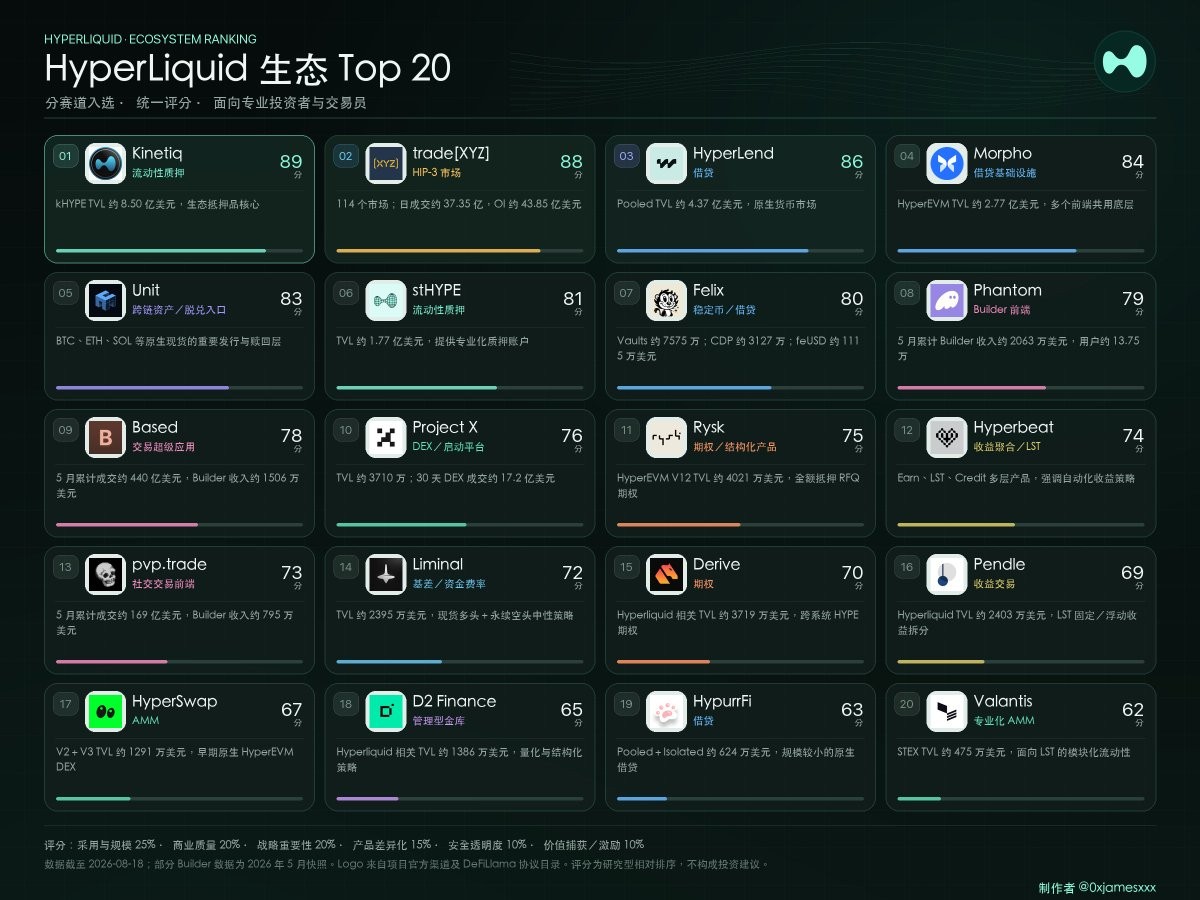
The list deliberately excludes HLP, HyperCore, or Hyperliquid Bridge as "ecosystem projects" (they belong to protocol core); excludes unlaunched, points-only, or roadmap-only projects. Rankings explained by sector below, not repetitive promo material.
2. Staking & HYPE Capital Layer: Kinetiq, stHYPE
Kinetiq (89) stands as HyperEVM’s most vital asset-layer project. kHYPE converts native staking positions into composable collateral, distributing stakes via validator scoring. ~$850M TVL proves scale but reveals systemic concentration risk: kHYPE conversion/oracle/liquidity failure simultaneously impacts lending and yield protocols.
Project discloses Spearbit, Zenith, Pashov, Code4rena multi-round audits & $1M bounty, boosting transparency but not eliminating underlying validator slashing, withdrawal queues, or secondary market discounts. Kinetiq’s moat is network effects; its risk is network effects.
stHYPE (81) offers 1:1 backed liquid staking token, doc-specified base yield ~2.2%, standard redemptions require ~7-day unbonding. Its specialized stake account supports HIP-3 or AQA business staking needs, combining "obtaining validator yield" with "acquiring protocol operating rights"; correspondingly, slashing conditions, ~90-day max business exit cycles, and delegation permissions grow complex. Difference vs Kinetiq isn’t simple yield高低, but collateral distribution, validator selection, and professional account capabilities.
3. Lending, Stablecoins & Collateral: HyperLend, Morpho, Felix, HypurrFi
HyperLend (86) most closely resembles HyperEVM native "money market," offering pooled, isolated, dynamic rates, flash loans. DefiLlama pooled TVL ~$437M; quarterly disclosures show ~$173M active borrowing, proving passive deposits aren’t sole driver.
Core risk: HYPE/LST collateral correlation; bull markets expand balance sheets via recursive lending, rapid price drops trigger simultaneous oracle, clearing, and DEX liquidity pressure. Cantina, Ackee, Pashov audits add value, but risk parameter governance equally critical.
Morpho (84) on HyperEVM acts more as infrastructure than single frontend. DefiLlama records ~$277M TVL; Morpho’s own dashboard late July showed ~$316M deposits, $90.4M effective borrowing, $225M TVL; non-contradictory due to differing "deposits, net TVL, borrowed assets" definitions.
Felix, Hyperbeat frontends can build vaults on its permissionless markets. Modularity expands distribution, splitting risk into market params, oracles, curators, and frontend multi-layer accountability.
Felix (80) operates Liquity-style CDP stablecoin feUSD alongside Morpho-backed lending vaults. DefiLlama records ~$31.27M and $75.75M TVL respectively, feUSD supply ~$11.15M; these metrics likely contain cross-collateral overlap, cannot be summed as independent capital.
Felix’s strategic value lies in building local-denominated assets and credit markets; challenge: in a system where USDC holds 97.8%, feUSD must prove existence via superior capital efficiency and yield scenarios, not sustain anchoring solely via subsidies.
HypurrFi (63) offers pooled & isolated lending, combined scale ~$6.24M. Proves long-tail lending demand exists, but post-HyperLend/Morpho scale/distribution dominance, small protocols must build moats via unique collateral, risk parameters, or frontend UX. Small scale amplifies whale exits, NPLs, and insufficient liquidators, hence lower scale/security maturity scores.
4. Markets, Frontends & Order Flow: trade[XYZ], Phantom, Based, pvp.trade
trade[XYZ] (88) embodies HIP-3 success and concentration. Snapshot shows ~$3.735B daily volume, $4.385B OI surpassing many independent derivatives platforms. Core value brings traditional risk exposures (stocks, indices, commodities) into unified USDC accounts. Standard HIP-3 fees typically exceed native perpetuals, shared between Hyperliquid and deployers;
growth models can drastically cut fees. Investors must monitor: off-hours oracle updates, index component/corporate action handling, extreme gap margin coverage, and replicability by second deployers.
Phantom (79) integrates perpetuals into mainstream self-custody wallets.
As of May 25, 2026, Phantom cumulative volume ~$39.4B, users ~137.5K, builder revenue ~$20.63M, nominal builder fee ~0.05%. Per CoinGecko Builder Research
confirms its perps driven by Hyperliquid, convertible from Solana assets to USDC on Hyperliquid. Phantom Help Docs
Strongest "external user entry" evidence, but user relationships/brand remain with Phantom; Hyperliquid faces long-term risk of infrastructure commoditization by frontends.
Base Hyperliquid as underlying; same builder research estimates cumulative volume ~$44B, users ~42.6K, revenue ~$15.06M. Higher per-user volume aligns closer to high-frequency pro users. Based’s potential lies in cross-product account UX; risk: builder-on-builder/multi-layer fees obscure real costs for traders. Based (78) attempts mobile/web/spot/perp/prediction/paycard trading super-app. Official Docs
clarifies positioning; May third-party estimates: cumulative volume ~$16.9B, users ~28.2K, builder revenue ~$7.95M. Validates "trading-as-social" distribution channels, introduces private key authorization, bot usability, herd chasing, referral incentive conflicts. Pro users should evaluate frontend permissions and underlying positions separately. pvp.trade (73) embeds Hyperliquid trading into Telegram/social groups. Quickstart Docs
5. Spot, DEX & Asset Entry: Unit, Project X, HyperSwap, Valantis
Unit (83) doesn’t win on TVL, but provides issuance, redemption, native spot entry for BTC, ETH, SOL etc. Official spot snapshot shows Unit-associated assets contribute significant spot volume, expanding Hyperliquid from "USDC & perps only" to multi-asset financial system.
Discloses Guardian MPC, compliance screening, geo-restrictions; independent risk research questions MPC counterparties, audit visibility, custodial transparency. Commercial importance high, but not trustless bridge; pro capital should model contract risk, signatory risk, issuer freeze, redemption flows separately. Unit Docs
Near snapshot shows ~$37.1M TVL, ~$1.717B DEX volume past 30 days, ~$1.61M fees, but protocol-confirmed 30-day income ~$230K. Huge volume/TVL ratio indicates fast capital turnover, possibly skewed by low fees, routing, incentives; fee-income gap reminds investors not to equate volume directly with token value capture. Project X (76) among HyperEVM’s most active spot DEX/token launch platforms. DefiLlama Page
Discloses PeckShield audits etc. Strategic position: instant liquidity for long-tail tokens/non-orderbook assets; facing Project X aggregators & HyperCore native spot, must differentiate via concentrated liquidity efficiency, asset exclusivity, or superior launch UX. HyperSwap (67) early HyperEVM native AMM, V2+V3 combined TVL ~$12.91M. Official Docs
details modules, admin/integration risks, discloses multiple audits. Suited for kHYPE/stHYPE LST swaps, carries clearing depth significance exceeding TVL; but current scale, liquidity concentration, module permissions keep it early-cap pro infrastructure. Valantis (62) STEX modular specialization AMM for homogeneous/strongly correlated assets, Hyperliquid TVL ~$4.75M. Docs
6. Yield, Options & Asset Management: Rysk, Hyperbeat, Liminal, Derive, Pendle, D2
Emphasizes no naked option selling, no liquidations, no re-collateralization. Provides volatiltiy monetization for HYPE holders, structured orderflow for market makers. Primary risks not leverage liquidations, but expiry settlement, bid isolation, IV pricing, contract/collateral opportunity costs. Rysk (75) offers full-collateral covered calls & cash-secured puts via RFQ, HyperEVM V12 TVL ~$40.21M. Rysk Docs
Discloses strategy & audits; pro investors still must drill into each vault’s real holdings & exit liquidity. Hyperbeat (74) offers automated Earn vaults, beHYPE LST, Morpho-based credit products, related segments ~$23.08M, $8.02M, $1.09M. Multi-layer combo lowers user ops costs but increases risk-stack complexity: users potentially exposed to underlying LST, lending market, curator, automated execution, frontend permissions simultaneously. Official Docs
describes isolated & pooled modes. Yields appear market-neutral but bear funding rate reversal, leg execution, spot custody, perp ADL, lending costs, capacity risks. In extremes, "price delta neutral" ≠ "liquidity & platform risk neutral". Liminal (72) pairs spot longs with Hyperliquid perp shorts, capturing funding rates & basis, TVL ~$23.95M. Official Docs
notes HYPE stays in Hyperliquid-side bridged vault, options settle on Derive Chain. Expands capital utilization scope but introduces cross-system messaging, vaults, centralized matching, another chain’s settlement risks. Suitable for pro users with clear vol views/risk budgets, not ordinary "staking for yield". Derive (70) connects HYPE collateral to options markets, Hyperliquid-related TVL ~$37.19M. Derive on HYPE
Pendle (69) splits yield assets into principal & future yield rights, Hyperliquid-related TVL ~$24.03M. Value: makes yield from kHYPE lockable, leveragable, curve-tradeable. Risks: expiry liquidity, yield source shifts, point expectations; when market pays excessive premium for future incentives, apparent fixed-yield certainty may mask principal token discount.
D2 Finance (65) offers externally managed quant/structured vaults, Hyperliquid-related TVL ~$13.86M, platform-wide ~$28.37M. Disclosure mentions Hyperliquid, Derive, OTC, Anchorage Porto components. Key isn’t strategy names, but net exposure, max drawdown, valuation timestamps, redemption cycles, manager permissions, counterparties. Multi-platform strategies reduce single-market dependency but introduce ops/custodial risks into on-chain products.
V. How Different Roles Participate & Profit in the Ecosystem
"Participate" ≠ "guaranteed profit". Hyperliquid funnels trading, market making, staking, development, and distribution revenue streams into one system, stacking price, leverage, smart contract, governance, and operational risks together. Pro participants must first define what they sell: directional risk, liquidity, volatility, capital, tech, or user distribution.
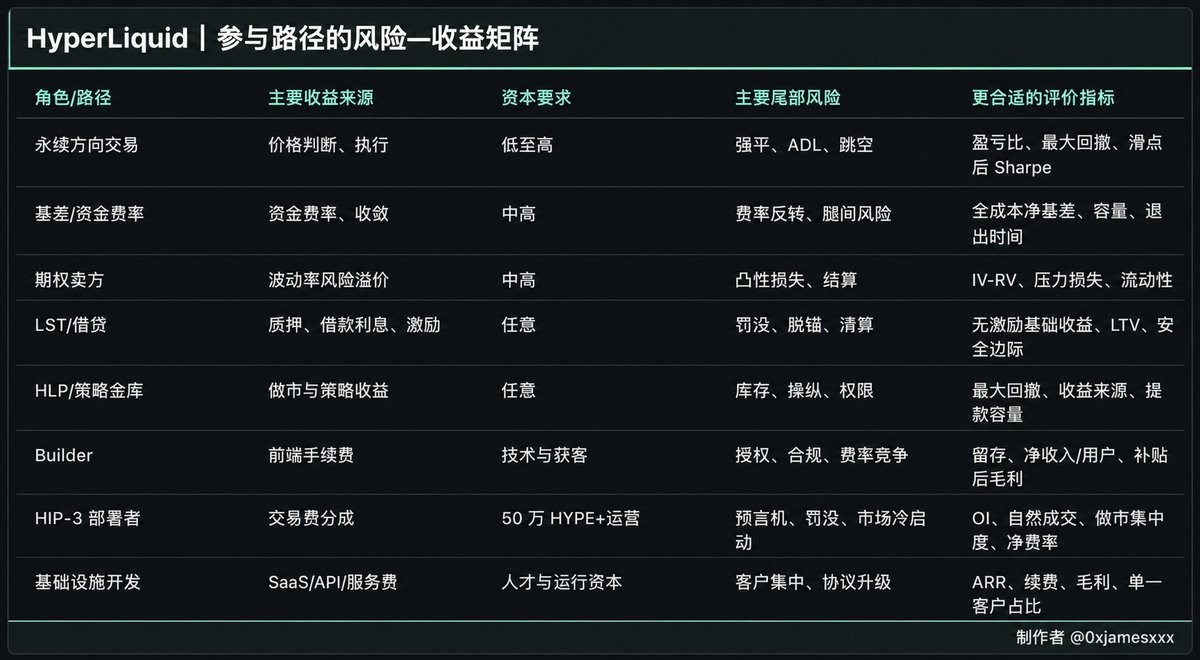
1. Traders: Evolve from Directional to Multi-Dimensional Yield Management
Path A: Native Perpetual Directional & Relative Value Trading
Direct method: trade BTC, ETH, HYPE, long-tail perp assets. Advantages: unified margin, deep orderbooks, fast finality, transparent position data. Pro trader marginal edge stems from execution, position management, cross-market pricing, not "on-chain" novelty itself.
Actionable framework splits expected returns into:
Expected Net Return = Directional/Spread Return + Funding Rate Income − Trading Fees − Slippage − Funding Rate Expense − Liquidation/ADL Tail Loss.
Continuously monitor OI/Volume, funding rate percentiles, orderbook depth, clustered liquidation prices, HLP/whale positions. When OI spikes without sync volume/depth growth, liquidation/ADL risks rise non-linearly.
Path B: HIP-3 Cross-Asset & Off-Hours Strategies
trade[XYZ] lets traders access stocks, indices, commodities via same USDC account. Typical strategies: crypto/tech stock relative value, weekend macro event hedges, commodity/inflation themes, cross-platform basis.
Greatest danger isn’t wrong direction, but misunderstanding "whose price you’re trading." Traditional markets close, but HIP-3 contracts may still trade/liquidate, referencing discontinuous spot; corporate actions, index rebalances, session changes, oracle anomalies cause basis shocks. Position limits should calculate worst-case gaps, not normal volatility.
Path C: Funding Rates & Basis Arbitrage
Traders can buy spot/Unit assets on Hyperliquid, short perps, or build delta-neutral positions across platforms. Returns from positive funding rates, spot-futures convergence, lending spreads. Liminal productizes this, but self-execution usually better controls counterparties & exit.
Common misjudgment: annualizing current funding rates directly. More robust: use 30-90 day historical distributions, factor in funding reversals, borrow costs, cross-chain waits, slippage per leg; set emergency deleveraging plans if one leg fails to fill.
Path D: Options & Volatility
Rysk & Derive provide covered calls, cash-secured puts, tail protection, vol curve trades for HYPE/related assets. HYPE holders can sell upside for premiums, or buy downside protection to limit comp drawdowns for staking/DeFi positions.
Option returns look beyond APR. Selling options本质 is bearing convexity loss; compare IV vs realized vol, factor liquidity discounts, exercise settlement, cross-chain exits into Greeks-independent risk budgets.
Path E: Liquidity Provision & Market Making
Pro market makers can provide liquidity on HyperCore, HIP-3, Project X, HyperSwap, Valantis, or indirectly via HLP. Revenue from maker rebates, spreads, funding rates, incentives; costs from inventory skew, adverse selection, gas/infra, oracles, contract risks.
HLP closer to "handing funds to protocol-level market making/clearing strategies," not risk-free savings. Autonomous MM requires low-latency systems, risk limits, cross-market hedges, 24/7 ops. Common principle: returns come from selling liquidity; extremes maximize liquidity demand & concentrate losses.
2. Developers: Revenue from Protocol, Deployers, Frontends, Infrastructure Layers
Path A: Become Builders, Distribute HyperCore Liquidity
Proven non-theoretical business model. Devs don’t need to rebuild exchanges, but find unique distribution: specific regions, asset communities, strategy workflows, risk tools, institutional clients. Wallets, trading bots, social apps, pro terminals integrate order interfaces & charge builder fees. Phantom, Based, pvp.trade
Healthy unit economics track: signup-to-first-trade conversion, 30/90-day retention, per-active-user volume, builder revenue, rebates/subsidies, support/compliance costs. High volume reliant solely on one-time rewards lacks sustainable value.
Path B: Deploy HIP-3 Markets
Teams stake 500k HYPE, launch perpetual DEXes for specific assets, share trading fees, control market design. Potential directions: regional stocks, rates, commodities, compute power, prediction metrics, crypto long-tails.
True barrier isn’t frontend, but trusted price sources, market maker coverage, risk params, corporate actions/expiry settlement, legal boundaries, anomaly handling. At $59, 500k HYPE nominal stake ~$29.5M; capital threshold itself filters lightweight teams. Deployer revenue must cover staking opportunity cost, market maker subsidies, oracle/ops expenses.
Path C: Build HyperEVM Financial Apps
Lending, options, yield vaults, insurance, payments, data products directly leverage HyperCore via CoreWriter. Most attractive paths aren’t copying existing AMMs on other chains, but exploiting Hyperliquid unique states: real-time positions, funding rates, clearing, HIP-3 markets, unified margins.
Examples: position-risk-based credit, automated option overlays, cross-HIP-3 portfolio margin analysis, institutional-grade audit/accounting, clearing insurance, or风控 APIs for builders. Security budget must include smart contract audits, precompile interactions, oracles, keepers, admin perms, emergency pause flows.
Path D: Data, Execution & Risk Infrastructure
As markets specialize, steady revenue often comes from "selling shovels": low-latency nodes, historical data, tax/accounting, portfolio risk, MM custody, strategy backtesting, oracles, account abstraction, compliance tools. Don’t need heavy directional exposure or token issuance.
Developers should avoid mistaking points/token valuations as business models. More sustainable path: verify who pays in stablecoins first, decide later if tokens coordinate networks.
3. On-Chain Whales & Capital Managers: Scale as Advantage & Constraint
Path A: HYPE Staking & LST Redeployment
Large players can delegate native staking, hold kHYPE/stHYPE, deploy in lending, Pendle, AMMs. Base yield ~2%+, extra from lending, liquidity, incentives. Larger scale = tighter exit capacity focus: 7-day unbonding, LST secondary market discounts, lending pool utilization make book-redemption ≠ instant-exit.
For whales, optimal isn’t recursive max-leverage collaterization, but independent risk limits per layer. Drill down to calculate "same underlying HYPE" counted multiple times across protocols; run 30%, 50%, 70% price drop & 5%-15% LST discount stress tests.
Path B: HLP or Protocol Vaults
Passive capital enters HLP/third-party yield vaults for MM, funding rate, strategy returns. Evaluation focuses on historical max drawdown, withdrawal windows, position transparency, extreme event rules, strategy capacity, not recent 30-day APR. Historical positive cumulative PnL ≠ zero chance of daily massive losses.
Path C: Lending & Stablecoin Liquidity
Large USDC can lend in HyperLend, Morpho/Felix, provide liquidity for feUSD, AMMs, other assets. Returns from borrowing demand, incentives, trading fees. Risks: smart contracts, NPLs, stablecoins, oracles, curators, concentrated withdrawals.
Whales prioritize markets with sufficient effective borrowing & clearing depth. $5M pool at 20% APY suits $1M capital, but $20M capital will compress yields upon entry & become market itself upon exit.
Path D: Strategic Staking & Business Rights
500k HYPE supports HIP-3 deployment; AQA requires higher aggregate staking; large players can delegate capital to ops teams for deployer economics/governance arrangements. This is "operating capital", not pure staking. Returns depend on market volume/fees, losses from slashing, ops failure, HYPE price drops.
Before participating, clarify capital/operator relations via legal entities, signature perms, profit sharing, slashing liability, exit clauses, disclosures. On-chain verifiable staking ≠ offline governance.
Path E: Cross-Market MM & OTC
Large players with multi-platform accounts/inventory can MM, arbitrage, provide block liquidity across Hyperliquid, CEXs, other DEXes. Advantages: balance sheet strength, internalized inventory, lower marginal hedge costs; constraints: fragmented cross-platform capital, withdrawal delays, API failures, rising extreme-vol correlations.
Whale goal: risk-adjusted repeatable returns, not absolute volume ranking. Any strategy relying on "instant cross-chain/CEX withdrawal when needed" must test that channel as potentially temporarily closed under stress.
VI. Moats, Competition & Vulnerabilities
1. Real Moat Isn’t TPS, But Composable Liquidity
High-performance chains, low fees, fast matching replicable; harder to replicate three agglomerated networks:
- Capital Network: $12B OI, $6B stablecoins, mature MM inventory;
- Distribution Network: Official frontend, wallets, bots, pro terminals share liquidity via builder code;
- Dev Network: HIP-3 deployers & HyperEVM apps directly call same accounts & financial states.
When new frontends instantly gain depth, new markets instantly reach existing USDC, new apps use HYPE/LST collateral, network effects expand from exchange to platform. Hyperliquid’s defense maintains low friction between layers, not forever #1 frontend.
2. Competition with Other Perp DEXs
Competitors like Aster, Lighter, edgeX, Variational, Jupiter, dYdX excel in retail distribution, privacy/zk proofs, orderbooks, RFQ liquidity, Solana users, governance history. Migration costs low, rewards/fees quickly shift monthly volume rankings, so single-month market share ≠ permanent moat.
Hyperliquid currently stronger on OI & unified capital layer. CoinGecko reports show OI share significantly > volume share, implying deeper risk absorption & position retention. Competitors swapping points for short-term high turnover won’t shake core; but similarly deep, lower effective fee, more collateral, open governance platforms will compress Hyperliquid’s premium.
3. Competition with Centralized Exchanges
On-chain perpetuals still dwarf global centralized derivatives market. Public research estimates May 2026 Hyperliquid platform-wide perpetual volume ~14.4% of Binance’s, ~6.6% of all CEXs. Indicates massive growth space, but ultimate benchmark isn’t other DEXs, but Binance, OKX, Bybit, traditional broker liquidity, fiat onramps, compliance coverage.
Hyperliquid advantages: self-custody, transparent state, composability, global 24/7 launch speed; disadvantages: fiat channels, institutional legal certainty, CS, market surveillance, privacy, regional availability. HIP-3 non-crypto market success directly touches securities/commodities/derivatives regulatory boundaries.
4. Fee Splitting Double-Edged Sword
HIP-3 & builder code expand volume, but slice every fee dollar to more roles. Coinbase research specifically notes HIP-3 expands non-crypto markets,未必 cannibalizes native perps; simultaneously, deployer splits reduce protocol’s per-unit take rate.
Thus investors track two metrics simultaneously: total volume growth & protocol net fee rate. If volume doubles, net rate halves, HYPE recapture未必 grows; if open distribution drives volume growth far exceeding fee dilution, platform strategy truly succeeds. Counting all builder revenue as HYPE revenue = common valuation error.
VII. Risks: Separating "On-Chain Transparency" from "Trustlessness"
1. Validator & Upgrade Governance Concentration
Foundation nodes ~48.6% staking, current most direct concentration metric. Below standalone consensus control threshold, but enough to heavily impact validator selection, social coordination, market confidence. Official validator count growth ≠ automatic rights dispersion; critical factors: non-foundation staking %, client diversity, node geography/ops entity distribution, upgrade flows, governance rules during outages.
2. Core Code Openness & Verifiability
Also provided reports, but bridge audits ≠ comprehensive public review of core consensus, clearing, upgrade code. Closed/partially closed code reduces early attack surface leakage, but hinders external researchers verifying behavior independently. For systemic-scale platforms, this is governance debt to gradually improve with maturity. Official Eco Wiki still notes L1 code not fully public. Bridge audited by Zellic etc, official audit page
3. Clearing, Manipulation & ADL
March 2025: trader manipulated margin via high-leverage ETH position, HLP lost ~$4M, protocol lowered some leverage, adjusted margin transfer rules. Same month JELLY market manipulated, validators intervened to delist & settle at specific price, later tightened OI caps & clearer limits. System avoided larger losses, but proved emergency states rely on validator coordination, not fully mechanical unstoppable rules.
Estimates ~5.51B liquidations, $2.1B ADL occurred in ~12 mins. Exact numbers depend on methodology, but ADL existence undeniable: profitable traders still subject to forced reduction. Pro users must separate "platform has no bad debt" from "my positions immune to forced reduction". Oct 2025 extreme deleveraging event, public on-chain study
4. Oracles & Non-Crypto Assets
HIP-3 hands oracle/market design power to deployers. Crypto spot 24/7, stocks/commodities have closures, corporate actions, circuit breakers, index rebalances, holidays. If perp markets trade continuously, oracles choose between "tradable price" & "official spot price". Either choice widens basis/manipulation space in certain hours.
Risk management relies not just on "price from known data vendors", but checking update frequency, anomaly filtering, backup sources, after-hours margin, gap settlement, deployer perms. trade[XYZ]'s scale elevates these from product issues to systemic issues.
5. Bridges, Custody & Stablecoin Concentration
USDC ~97.8% of stablecoins, Unit assets rely on Guardian/MPC & external custody/issuance flows. On-chain position transparency ≠ underlying BTC/ETH/SOL/fiat reserves trustless. Issuer freezes, signatory coordination, regulatory orders, redemption interruptions, bridge contract vulnerabilities all inject externally into Hyperliquid.
Bridge, Unit, Circle, Coinbase assume different roles. Investors avoid substituting "official integration" for risk splitting: official only reduces coordination friction, cannot eliminate reliance on issuers, custodians, legal entities.
6. HyperEVM Composable Contagion
After LST, lending, yield vaults, AMMs nest, single price drop propagates along "collateral discount → oracle update → lending liquidation → DEX sell → discount expansion" path. Single protocol audit passing ≠ portfolio security. Risks across Kinetiq, HyperLend, Morpho, Felix, Pendle, Valantis require asset-flow tracing, not brand-level shielding.
Additionally, HyperEVM remains alpha. CoreWriter, precompiles, cross-layer interactions enable product innovation, but may produce boundary conditions unfamiliar to standard EVM audit tools. Large capital should set contract whitelists, per-protocol limits, emergency exits, chain-level halt plans.
7. Token Supply, Valuation & Cycle
Conflicts with CoinGecko circulating definitions precisely why pros must build own supply bridge tables. HYPE circulating supply varies by tens of millions across data sources; future unlocks, community incentives, staking emissions alter supply. Using single screenshot to calc "real deflation" unreliable. Public Fund Filing
Income side highly cyclical too. Perpetual volume, leverage demand, funding rates shift with volatility/bull-bear cycles. ~$1B fees past year ≠ guaranteed replication next year; recent 30-day annualized already halved. If HYPE price high, staking emissions USD-value high, protocol must absorb supply via sustained fees & new business locks.
8. Regulation & Market Integrity
Stocks, commodities, predictions, result markets push Hyperliquid from crypto derivatives to broader financial products. HIP-4 has restricted mainnet result markets, permissionless version mostly testing; don’t write roadmap as fully live reality.
Closer to traditional financial targets → stricter regional limits, securities/commodities attributes, manipulation, insider info, sanctions, consumer protection. Protocol frontends geo-block, but third-party builder/on-chain contract responsibility boundaries remain regulatory redefine-prone. Not imminent single-event, but structural discount to embed long-term in valuation.
VIII. Next 12–24 Months: Three Scenarios & Verifiable Indicators
1. Bull Case: Upgrading from Crypto Perp Leader to Global Risk Trading Layer
Under bull scenario, HIP-3 spawns 2–3 independent deployers hitting $1B+ OI tiers, trade[XYZ] ceases monopolizing >99% activity; stocks, commodities, macro markets generate stable fees, HIP-4 result markets complete permissionless mainnet launch & sustain liquidity. Phantom, Based builders continuously bring external users, not just poaching existing eco traders.
AQA USDC reserve yields兑现 as agreed, stablecoin balances maintain/rise, becoming second revenue stream decoupled from trading volatility. HyperEVM TVL growth driven more by external USDC/BTC/ETH & real borrowing, not HYPE/LST price pumps & recursive collateral. Foundation validator share drops, code/upgrade transparency improves.
In this scenario, HYPE valuation logic shifts from "high-revenue perp DEX" to "multi-market financial network," justifying higher multiples fundamentally.
2. Base Case: Retain On-Chain Leadership, Coexist Growth & Fee Dilution
Base case: Hyperliquid remains on-chain perp #1, OI stays high share, volume share fluctuates with competitor incentive cycles. HIP-3 continues growing, still overwhelmingly trade[XYZ]-driven; HIP-4 & non-crypto markets expand gradually, constrained by oracles, MMs, regulation.
USDC AQA yields visible income, but below naive balance×Treasury yield gross estimate. HyperEVM TVL modest growth, staking/lending still HYPE/LST-dominated. Protocol annual fees below past peaks but significantly above most L1s; builder/deployer splits lower per-unit HYPE recapture.
In this scenario, project fundamentals remain excellent, token performance hinges more on entry valuation, supply unlocks, market risk appetite. For investors, "good protocol" ≠ "good price."
3. Bear Case: Trading Cycle Drawdown Compounded by Systemic Events
Bear case doesn’t require Hyperliquid technically defeated.只要 overall market volatility & leverage demand fall, competitors slash fees, HIP-3 fails to disperse deployers, AQA yields miss expectations, recent 30-day fee annualization continues dropping. Simultaneous oracle/bridge/LST depeg/HLP/ADL events trigger demands for higher risk discounts.
HYPE depreciation lowers USD staking security value, triggers LST collateral liquidations; eco TVL & token price may reinforce downward spiral. If foundation validator share, code openness, supply definitions stagnate long-term, institutional adoption may remain trading-focused, not balance-sheet holding.
4. Monitoring Dashboard
Platform-Wide OI
Bull confirmation: growing & asset/deployer diversified; Base: maintain highs; Alert: OI & depth synchronously plummet.
HIP-3 Concentration
Bull confirmation: XYZ share significantly <80%; Base: still >90%; Alert: new deployers consistently zero volume.
Protocol Net Fees
Bull confirmation: AQA/new markets offset fee dilution; Base: fluctuate with market; Alert: 30-day annualized persistently below emission value.
External Stablecoins/Assets
Bull confirmation: net inflows USDC/BTC/ETH; Base: balances flat; Alert: concentrated redemptions or bridge balance declines.
HyperEVM Composition
Bull confirmation: non-HYPE collateral & real borrowing rise; Base: LST dominant; Alert: recursive staking expands, utilization falls.
Builder Quality
Bull confirmation: external new users, high retention; Base: volume growth but concentrated; Alert: user/revenue sharp drop post-subsidy retreat.
Validator Concentration
Bull confirmation: foundation share consistently falling; Base: ~half; Alert: share rising or node entities shrinking.
Risk Events
Bull confirmation: transparent rules, controlled losses; Base: occasional minor incidents; Alert: frequent intervention, expanded ADL/bridge events.
IX. Final Verdict: How to Qualify Hyperliquid
From product view, Hyperliquid completed the hardest step: built on-chain orderbook network capable of hosting pro positions, generating ~$1B annualized fees. Its advantage isn’t "DEX works well," but unifying trading, asset issuance, development, frontend distribution, and staking rights into one platform.
Expanding markets & user entry points; from ecosystem view, Top 20 formed clear tiers: Kinetiq, HyperLend, Morpho constitute HYPE capital layer; Unit, Project X, AMMs constitute asset/spot layer; trade[XYZ], Phantom, Based, pvp.trade
drive orderflow. Rysk, Liminal, Derive, Pendle, D2 convert directional trading into volatility, basis, yield products. Shortcomings equally clear: TVL overly centered on HYPE/LST, HIP-3 on XYZ, stablecoins on USDC, validator rights still concentrated.
From token view, HYPE serves four demands simultaneously: staking security, business license staking, fee recapture, eco collateral. Value capture more direct than多数 generic L1s. But $59B FDV, circulating supply definition disputes, recent fee slowdown, staking emissions prevent valuation from resting on "buyback & burn" alone. AQA reserve yields could be major catalyst, but haven’t started accruing at cutoff; await cashflow verification.
Therefore, our neutral conclusion:
Hyperliquid is currently closest to the "on-chain global trading infrastructure" narrative, but its investment returns will increasingly hinge on ecosystem expansion quality, not sheer perpetual volume growth. For traders, greatest value lies in unified capital & cross-asset markets, but must price for ADL, oracles, off-hours gaps; for developers, biggest opportunity exploits ready liquidity for distribution, risk, new markets, not recreating generic DEXes; for whales, core isn’t hunting max APR, but managing correlated tail risks across HYPE/LST, lending, vaults, external custody.
Future most decisive three numbers aren’t HYPE short-term price, but: non-XYZ HIP-3 OI, HyperEVM capital non-driven by HYPE/LST, and protocol net income post-all splits. If all three rise synchronously, Hyperliquid upgrades from卓越 exchange to financial network; if stagnant long-term, remains excellent, highly profitable on-chain exchange, but struggles to fully realize infrastructure-tier valuation.
Join TechFlow official community to stay tuned
Telegram:https://t.me/TechFlowDaily
X (Twitter):https://x.com/TechFlowPost
X (Twitter) EN:https://x.com/BlockFlow_News
 @0xJamesXXX