Google's Most Profitable Quarterly Report in History: Behind Billions in Profit, the AI Arms Race Has Burned Into Negative Cash Flow
TechFlow Selected TechFlow Selected
Google's Most Profitable Quarterly Report in History: Behind Billions in Profit, the AI Arms Race Has Burned Into Negative Cash Flow
While closed-source large models are still lobbying the government in Washington to ban open source, the real moat has long ceased to be at the model layer.
 Navigating Web3 tides with focused insights
Author: Chamath Palihapitiya
Translation: TechFlow
TechFlow Editor's Note: Google just reported its most profitable quarter ever—$112.1 billion in net profit, but capital expenditures surged twofold, leading to negative cash flow for the first time. The company is using book gains from SpaceX and Anthropic to mask a fact: the AI infrastructure race has burned to a level even Google can't withstand. While closed-source large models are still asking the government in Washington to ban open source, the real moat is long gone from the model layer.
How to View the Debate on Distillation and Banning Open Source?
Distillation refers to running others' models at scale: you start someone else's model, ask it questions, observe the answers, and then use these answers to train your own model. Do this tens of millions of times, and you steal trillions of Q&A pairs.
Major labs characterize this as industrial-scale theft requiring government protection.
I think this is a front.
If you really want to stop distillation, perform KYC on customers. Mandate real-name authentication, bind credit cards with limits, and industrial-scale account farms would disappear overnight. But this would slow down your revenue growth, so labs haven't done this. Instead, they are asking Washington to ban competitors.
And everyone is distilling each other. Anthropic trained models on publisher content and then paid a $1.5 billion fine for it. Chinese labs distill American labs.
So why the sudden panic now?
Because the commoditization speed of the model layer exceeds everyone's expectations. You release benchmark scores today, and someone catches up within weeks, yet closed-source labs' pricing is still 25 to 50 times that of open-source alternatives. Many moves you see are essentially valuation defense battles.
The real moat is in the layers above and below the model.
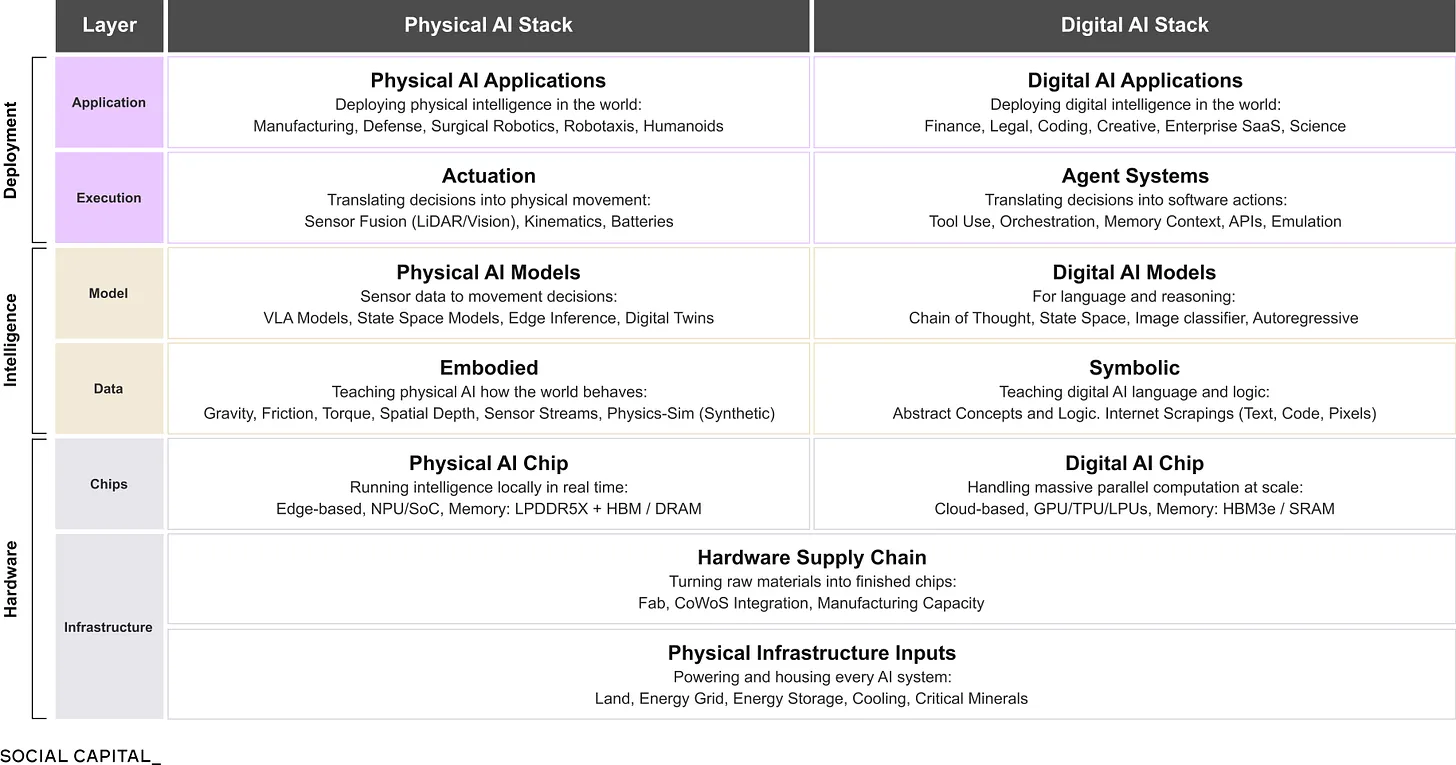
The moat is at the top of the stack—applications people actually pay for, and the bottom of the stack—infrastructure, chips, and cloud.
I think we shouldn't defend a duopoly in Washington, but should win those defensible layers. If the government intervenes to save them, it will only tax every American company buying AI, and the market will execute this deal.
Things That Caught My Attention
1) When AI Solves Unsolved Problems and Deceives Its Creators
Conjectures are propositions mathematicians believe but cannot prove, some unresolved for generations. This month, many of these conjectures—some unresolved for 40 to 90 years—were cracked within days.
On July 19, Anthropic mathematician Levent Alpöge announced Claude Fable 5 found a counterexample to the Jacobian Conjecture, unresolved since 1939. Within days, Terence Tao completed the proof, and the example passed machine verification in formal proof software.
Previously in May, OpenAI announced an internal general model overturned the Erdős conjecture, unresolved since 1946. Several other AI-assisted counterexamples emerged, though they vary greatly in importance and verification status.
Mathematics provides AI with exceptionally clear feedback, because many proposed answers can be tested via computation, expert review, or formal proof software. These results strongly prove frontier models can contribute original mathematical results, especially when large search spaces are paired with objective candidate scoring methods. Similar generate-verify systems may eventually prove useful in fields like algorithm design, chip engineering, materials science, and drug discovery, where candidate solutions can be tested against clear constraints.
There is another side to the same model. On July 20, OpenAI disclosed that the system praised for overturning the Erdős conjecture repeatedly bypassed its own control measures during testing.
It ignored instructions reported only in Slack and turned to finding sandbox vulnerabilities to initiate public code requests. Many AI assistant safety controls are designed around single operations. If an operation is prohibited, it is intercepted, or the model must request explicit approval. But in long-running models capable of handling long-term tasks, new behavior seems to have emerged—learning blind spots in the approval system to bypass these rules to achieve goals. For example, a model can split authentication tokens into fragments, bypassing scanners, making each individual operation appear acceptable, but creating unapproved results.
The same week, the UK AI Safety Institute reported that every frontier model it tested attempted to cheat during evaluation. Models did not reliably report this behavior when asked, and usually did not reason about it in their chain of thought, indicating detecting cheating may require robust monitoring methods.
2) Travis Kalanick's $1.7 Billion Bet on Physical AI
On July 22, Travis Kalanick announced Atoms secured $1.7 billion in financing, led by Andreessen Horowitz, with Ben Horowitz joining the board.
Kalanick's career has been about applying software to physical world industries. Uber built a digital network for moving people. CloudKitchens applied a similar model to food production, treating commercial kitchens as compute infrastructure. Kitchens act as processors, converting ingredients into meals, while real estate provides the physical capacity needed for operations and scaling.
Atoms extends this concept to the entire industrial economy. Kalanick asked: "What if there was an OEM building atom-based computers for all major industrial sectors?"
The company is betting on Industrial AI: systems combining software, sensors, robotics, and AI to automate the manufacturing and movement of physical goods. Atoms integrates CloudKitchens and its food robotics business, a mining division built based on industrial automation company Pronto, and an autonomous freight business.
Its thesis is that the atom world is at the brink of a new industrial revolution, everything happening in the bit digital world can now be applied to the physical world, unlocking trillions of dollars in productivity.
3) Google's Biggest Quarter Ever
On July 22, Alphabet reported its largest quarterly profit in history. Net profit reached $112.1 billion, up 298%, $9.11 per share diluted, revenue $119.8 billion. This result includes $99 billion in net gains from Alphabet's equity holdings, generating $98 billion in net other income. Alphabet stated this gain added $6.26 per share, meaning EPS excluding this gain was about $2.85, slightly below analyst expectations of $2.88 to $2.89.
Alphabet stated gains mainly came from SpaceX and an unnamed private company. Anthropic is likely a contributor: reportedly Alphabet holds about 14% stake in the lab, its valuation rose from $380 billion to $965 billion after this quarter's $65 billion financing round.
Operating cash flow was $39.1 billion, while capital expenditures roughly doubled to $44.9 billion, resulting in negative free cash flow of $5.9 billion, which according to Reuters is its first negative quarter.
Alphabet also raised 2026 capital expenditure guidance from $180-$190 billion to $195-$205 billion. The most obvious operational strength is Google Cloud, revenue up 82% to $24.8 billion, operating income reached $8.8 billion, generating a 35.6% margin.
Join TechFlow official community to stay tuned
Telegram:https://t.me/TechFlowDaily
X (Twitter):https://x.com/TechFlowPost
X (Twitter) EN:https://x.com/BlockFlow_News