The Larger the Fund, the Worse the Return? Micro Funds + SPV Are Becoming the New Standard for VC
TechFlow Selected TechFlow Selected
The Larger the Fund, the Worse the Return? Micro Funds + SPV Are Becoming the New Standard for VC
The era of traditional blind pool funds is coming to an end.
 Navigating Web3 tides with focused insights
Author: Shoal Research / Odin
Compiled by: TechFlow
TechFlow Editor's Note: Traditional VC ten-year blind pool funds are being replaced by a hybrid model—small managers use lean micro funds paired with deal-by-deal SPVs for co-investment. This not only lowers LPs' blended fee rates but also allows GPs to focus more on early-stage investment. This article breaks down why the "small fund + SPV" combination is superior to a single large fund both mathematically and in terms of incentive mechanisms, and why co-invest is becoming the industry standard.
The Era of Traditional Blind Pool Funds Is Passing
The structure of traditional VC is a ten-year closed-end blind pool fund. LPs agree to let GPs manage their capital for up to ten years (often actually longer), with no decision-making power over individual investments. GPs can freely invest in any opportunity within the agreed scope.
This obviously requires a high degree of trust. But this design was originally intended for companies managing single-digit or low double-digit millions of USD for early-stage investment. At that time, when a company became an obvious opportunity in the eyes of LPs, it was often close to exit.
Today the situation is completely different: companies have more financing rounds, larger amounts, and LPs are more mature. Many LPs are themselves former founders or executives in strategic fields; they can identify good opportunities earlier, making co-investment decisions simpler.
Essentially, blind pools should not always be VC's default choice. Their role is to take risks at the early stage, when VCs must find conviction earlier than everyone else. But once a company has metrics of obvious attractiveness or market position (possibly as early as Series A, at least by Series C), lower-fee co-invest tools are often more suitable—both reducing the cost of capital and gathering a group of LPs with aligned interests.
Technical Infrastructure Lowers SPV Operating Costs
Over the past five years, better back-office infrastructure has reduced the friction of establishing SPVs deal-by-deal. Independent GPs and small partnerships can now deploy more capital and invest more precisely by "dual-holding" two complementary tools:
A small fund, allowing LPs to diversify investment in early-stage opportunities (which are essentially high-risk and difficult to evaluate), equivalent to a portfolio of options.
Curated co-invest opportunities, allowing LPs to increase holdings when companies become increasingly attractive, equivalent to targeted investment.
Of course, both strategies have their space, depending on the LP base and GP preferences. But small fund managers are finding it increasingly difficult to access co-investment capital without using SPVs, while pure SPV managers may also be willing to operate without a fund.
"The best investments I've been involved in all have strange ownership structures—added a bit later, with some opportunistic tools stacked on top. Trying to make something as messy as early-stage VC rigid, turning it into a model, immediately forces out the wrong mindset."
——Enrico Melis, Animal Syndication Company
In the past, early-stage companies would build relationships with large late-stage investors to obtain co-investment capital. But this strategy has become increasingly risky in recent years because the market is concentrated in fewer hands, and they are only interested in narrower opportunities. There are even reports that large firms are undermining small fund fundraising, attempting to control more of the market.
Of course, there are also mid-sized funds with capital to continue funding follow-on rounds for portfolio companies. If they adopt reasonable process alpha strategies to allocate reserves, they may provide attractive returns on a larger capital pool. But this may not suit small firms—scale not only drags performance, but growing firms inevitably slide towards consensus, losing the agility of independent investors or small partnerships at the frontier.
LP Demand for Optionality Is Growing
"LP co-investment activity is expected to grow gradually over the medium term. As more institutional investors build internal resources and portfolio infrastructure, enabling sustained co-invest in diversified deal flow, the gradual institutionalization of large LP direct investment projects will improve the risk-return profile of this strategy and expand the pool of LPs capable of selective execution."
——PitchBook Analyst Report
The demand for co-invest in VC has become a cliché. Everyone wants it, but no one seems to really know how to use it. However, this is likely the "growing pains" when the industry starts treating co-invest as an ideal standard, similar to the broader private equity industry. Over time, better tools, standards, and talent will catch up with practice.
Frankly, the current desire for co-invest rights in VC is largely driven by FOMO and the blind application of the power law. Essentially, if investors encounter a "hot" portfolio company, LPs want to buy in themselves to gain status and IRR metrics.
Because this behavior is driven by opportunism, LPs often lack true understanding or processes to be competent for these investments. There is also a learning curve for LPs here.
For example, some LPs pressure emerging managers in a difficult fundraising environment, demanding zero fees and zero carry for SPVs. Eliminating carry is a poor way to align interests, unless the LP's main goal is simply to harvest dealflow. This handling of co-invest partly explains why GPs default to fund bloat.
Despite these frictions, co-invest activity will obviously continue to increase. This is the natural evolution of the market seeking to maximize investment opportunities and reduce blended fee costs.
Advantages of Hybrid Economics
In previous articles, we examined how adopting private equity-style co-invest rights and fee schedules would improve the economics of VC mega funds. The same applies to the small market.
Imagine two hypothetical scenarios:
First, a manager raises a $10 million micro fund, supporting 30 initial investments of $250,000, then uses deal-by-deal SPVs (GP commitment 2%, no management fee, 10% carry) for curated co-investment.
Second, a manager raises a $38.3 million fund. This is the size required to make exactly the same investments (including co-investment) as in the first scenario entirely from within the fund (without SPVs).
Assuming the portfolio results are the same in both scenarios, generating 4x total return, the micro fund wins on DPI due to less fee drag.
Of course, for a GP just starting out charging a 2% management fee, this means less immediate income. But the fund will close faster, provide superior performance, and make future fundraising smoother. Actually, based on the premise that a $10 million fund is more likely to achieve higher multiples than a $38.3 million fund, the compensation gap from carry will shrink rapidly. Meanwhile, the GP still has available salary, and LPs can access attractive dealflow.
The radical proposition here is: income should be linked to performance.
Numbers are only a small part of the picture. The micro fund wins mathematically, but this is actually not particularly important.
The key is that micro fund GPs are more aligned with the success of their investments. This hybrid structure incentivizes missionary-type GPs, rather than fee mercenary-types, which will systematically improve investment decisions and returns.
Smaller funds also allow GPs to operate more effectively as independent investors, maximizing their surface area of specificity. They do not face pressure to make hires that may not be needed to justify fee income. Their funds are small enough to continue focusing on the earliest stages, without pressure to chase larger, later-stage rounds. This is an ideal setup for investors skilled at frontier investment.
Better Standards for SPVs
"Co-investment rights have become one of the most concrete tools for small and emerging managers to demonstrate deal access capability and deepen LP relationships. Offering co-investment rights gives LPs a concrete reason to commit capital to less known managers even when managing liquidity pressure in the current environment."
——PitchBook Analyst Report
The market is evolving, and small managers are starting to use deal-by-deal terms more effectively. This is driven by the overall trends of fundraising friction and capital concentration. SPVs have become an important lifeline for managers to support portfolio companies in follow-on rounds.
However, this evolution is not yet complete; there is still much work to do before LPs can accept SPVs without concern and obtain performance returns. This is partly an infrastructure issue, but mainly an education issue. GPs and LPs need to understand current standards and how to improve these standards.
Therefore, we surveyed 56 GPs earlier this year.
Get the SPV Survey Report: https://spvsurvey.joinodin.com/
51 out of 56 GPs invest in Pre-Seed or Seed stages, 80% manage funds smaller than $100 million, and 61% have five or more years of venture capital experience.
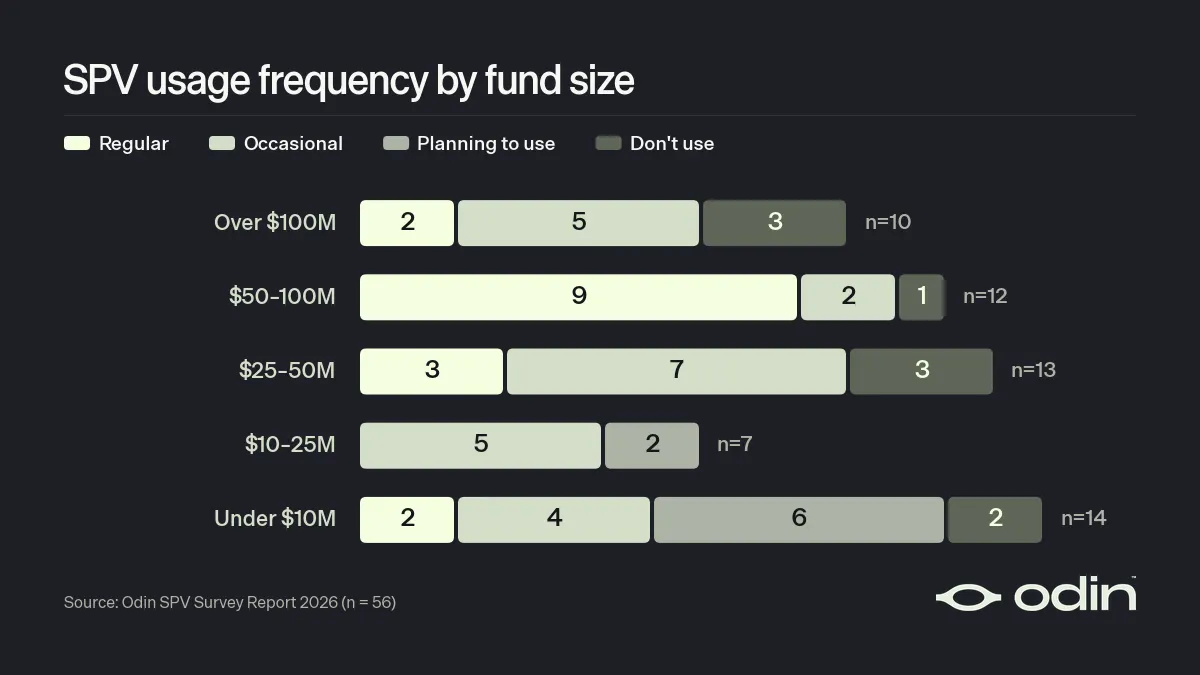
Figure: SPV adoption rate by fund size distribution, 39 out of 56 surveyed GPs are already using SPVs, usage rate is highest in $50 million–$100 million funds. Source: Odin SPV Survey 2026
Adoption rate is already high, with 39 out of 56 GPs already using SPVs, of which 16 use them frequently and 23 occasionally. Among the remaining 17, 8 plan to start using SPVs in the future, bringing current and potential users to 84%. Usage rate is highest among more experienced GPs, and those managing $50 million to $100 million funds; these operators have networks capable of providing capital, but reserves are insufficient to cover follow-on investments.
The main use case for SPVs is follow-on capital, with 39 out of 47 respondents indicating use (or planned use) of SPVs reporting this.
"Our seed fund invests at the earliest stages. We adopt a light reserve model, turning instead to use SPVs directly for growth stage financing. This makes a $20 million fund feel much larger for our companies, enabling us to deploy more capital on winners without running out of capital."
——Amy Brandenburg, Denver Ventures
Economic terms are usually LP-friendly. A management fee of 0-0.5% is the clear norm, mentioned by 45% of respondents. Carry is most commonly 16-20%, mentioned by 46% of respondents, though a significant proportion of 26% charge only 1-10%. Two-thirds of managers pass setup and management costs directly to LPs. However, regarding GP's own lead investment commitment, 44% invest only 0-0.5%, and only 27% commit 2% or more.
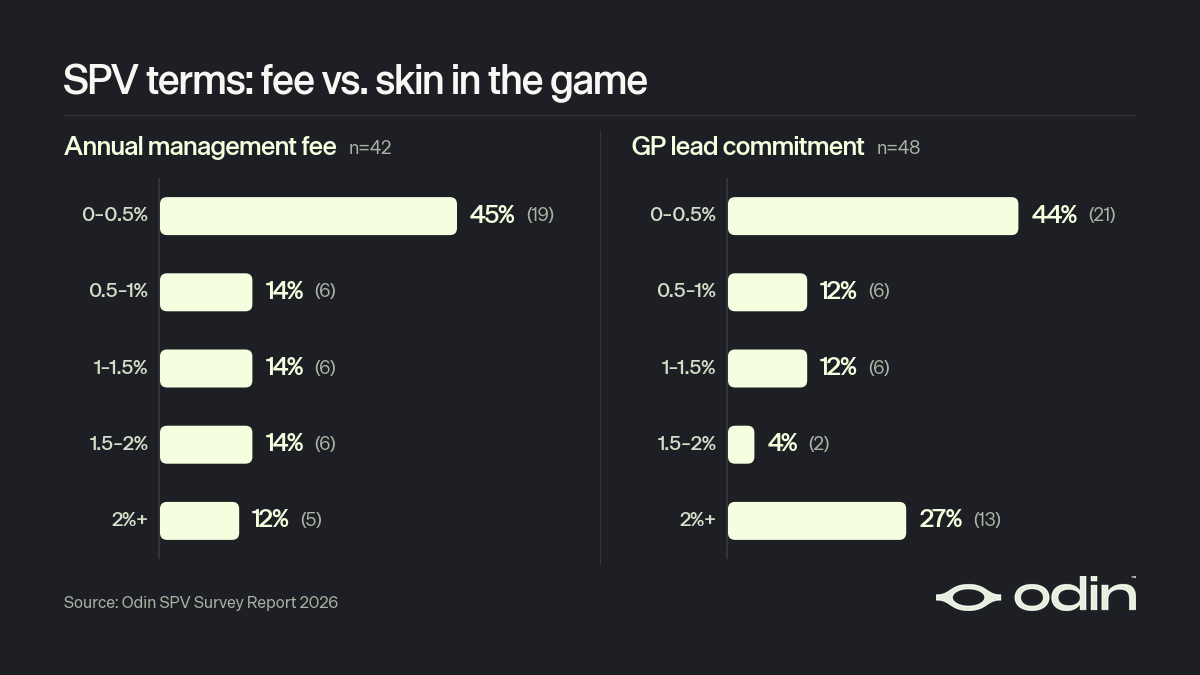
Figure: SPV terms distribution, management fee 0-0.5% is norm (45%), carry most commonly 16-20% (46%). Source: Odin SPV Survey 2026
Where the market diverges on terms, there is clearly an opportunity to establish better standards, improve outcomes, and eliminate friction in the process. The goal should be to reduce costs for GPs, ensure they truly take risk, enable them to focus on quality of results rather than increasing fee income, and reward LP loyalty with priority allocation rights.
"Overall we believe in the principle of dancing with the one that brought you. Therefore, although SPVs help attract new LPs, existing LPs always get priority access to opportunities."
——Dan Kimerling, Deciens
In these cases (GP managing follow-on capital for fund investments), a good SPV usage template might look like this:
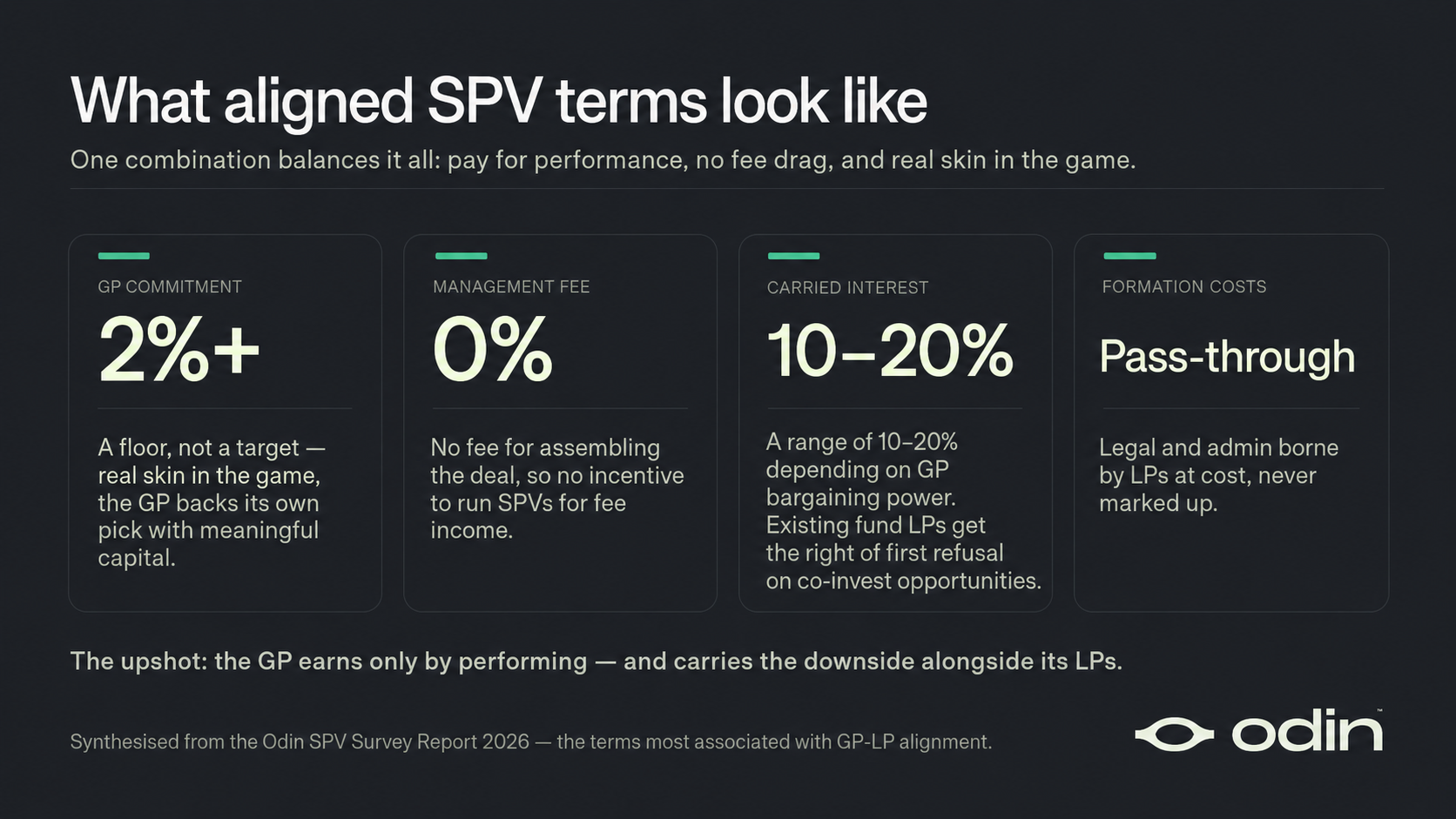
Figure: Aligned SPV terms template—GP commitment ≥2%, management fee 0, carry 10-20%, setup fees borne by LPs at cost. Source: Odin
As always, there will be exceptions.
If the SPV is unrelated to the fund, then the GP commitment might be better understood as a percentage of the lead investor's net worth, rather than a fixed minimum.
Most importantly, SPVs must not be used as intermediary tools to obscure deal economic terms or shield fund performance from excessive risk. They must be structured and offered in a transparent and honest manner, with clear objectives and aligned incentives.
"SPV is just a tool, liking or hating them makes no sense. Strong feelings should belong to how they are structured, whether there is two-way transparency, and how they are managed."
——Helen Min, Articulate
Incentives and Outcomes
The last element is simple advice for LPs.
If small funds perform better, then standard fee incentives pushing managers towards expansion are obviously crazy. If the key to sustained outperformance is maintaining fund size (thus maintaining consistent strategy, organization size, and target investments), then outperforming small managers should have space to increase fee percentages, rather than expanding the fee base.
Therefore, they are expected to seek to manage additional capital through SPVs to fulfill obligations to founders. This arrangement is also economically beneficial for LPs, improving alignment and reducing fee drag.
In return, LPs must increase their readiness to participate in these transactions, understand relevant terms, the cost of breaking commitments, and the portfolio approach required to obtain performance returns. Additionally, they must be willing to provide attractive compensation through carry for successful co-investments.
As all these elements converge over the coming years, the industry will become stronger. Shifting towards a higher level of co-investment represents a long overdue evolution, breaking away from the absurdity of over-extended 10-year tools and counterproductive fee incentives.
Join TechFlow official community to stay tuned
Telegram:https://t.me/TechFlowDaily
X (Twitter):https://x.com/TechFlowPost
X (Twitter) EN:https://x.com/BlockFlow_News