South Korean Exchange Long-Tail Anomaly: Why Is the Listing Effect So Prominent?
TechFlow Selected TechFlow Selected
South Korean Exchange Long-Tail Anomaly: Why Is the Listing Effect So Prominent?
85% of funds are crowding into altcoins, structural barriers create a unique KRW new listing bonus.
 Navigating Web3 tides with focused insights
By: Heechang Kang
Translated by: Luffy, Foresight News
The Korean crypto market is completely opposite to the global mainstream landscape.
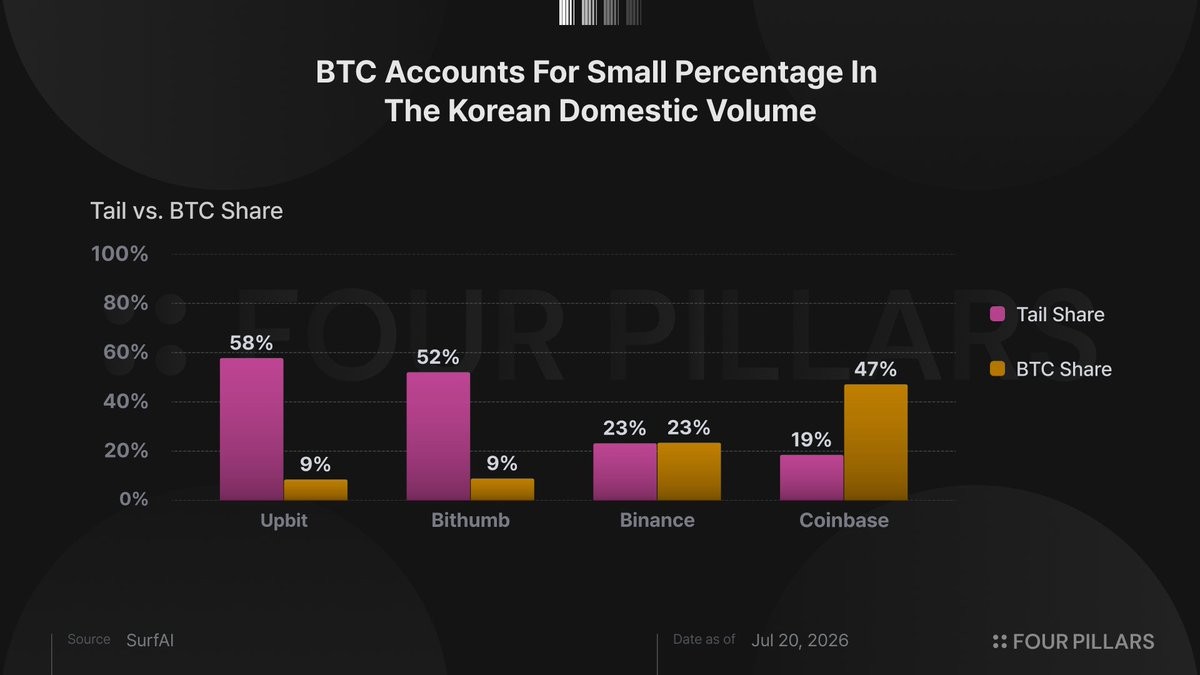
The chart above intuitively demonstrates this abnormal market characteristic. Within a recent statistical cycle, long-tail small coins accounted for 58% of Upbit's and 52% of Bithumb's trading volume; Bitcoin only accounted for 9% of transactions in the Korean market. In comparison, Bitcoin's trading volume share on Binance and Coinbase was 23% and 47% respectively. The KRW spot market volume ranks second globally, with a weekly average transaction volume of about $26 billion, accounting for 30% of the global spot total trading volume. Such a huge market exhibiting capital preferences completely opposite to the global trend is by no means an accidental phenomenon of a niche market.
As early as Q1 2024, the single-quarter transaction volume of KRW trading pairs reached $456 billion, once surpassing the US dollar to become the top fiat currency track in the crypto market transaction volume. However, only 15% of the huge capital flowed to Bitcoin and Ethereum, while the remaining 85% all surged into altcoins and newly listed tokens, creating a unique liquidity bonus for new listings in the KRW market.
Strong long-tail demand directly spawned the two leading local exchanges. Upbit jumped into the top five globally in trading volume thanks to this wave, occupying more than 80% of the South Korean market share, later data fell back to 72%; Upbit and Bithumb together monopolize nearly 96% of South Korea's trading volume.
The duopoly sits on a massive retail base. At the beginning of 2025, registered users on exchanges exceeded 16.2 million, surpassing the 14.5 million stockholders in the South Korean stock market. Regulatory data shows that at the end of 2024, traders who completed real-name verification reached 9.7 million, a 25% increase in half a year, and users' crypto asset holdings doubled to $77.5 billion. Investor age structure is concentrated in 30s (29%), 40s (27%); 66% of users hold less than 500,000 KRW. A large number of small-value active retail investors are exactly the core group for long-tail small coin transactions.
85% of Trading Volume Concentrated in Altcoins
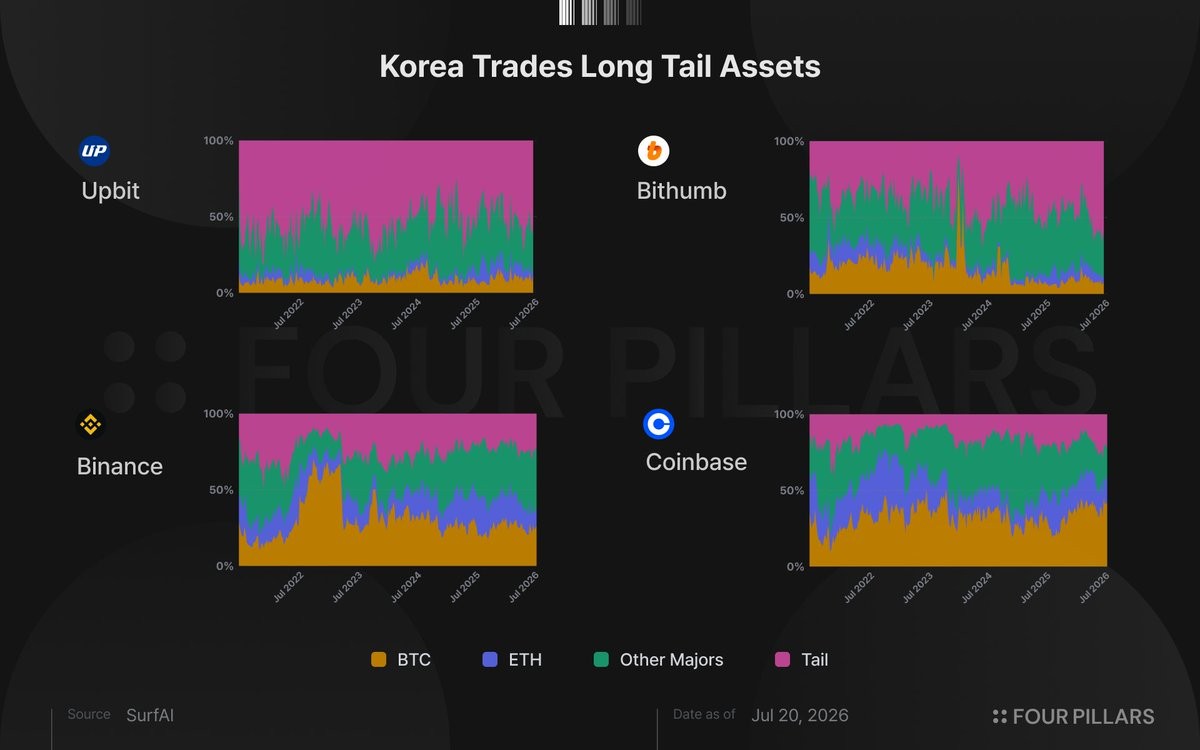
Global mainstream exchanges take BTC and ETH as the trading core, but the Korean market is completely inverted: 85% of local trading volume flows to altcoins, Bitcoin only 9%, Ethereum 6%. This unique capital preference stems from four structural constraints that limit legal investment channels for Korean risk capital:
- Lack of compliant derivatives. There are no legal crypto futures, options, or leveraged products within South Korea. The demand of overseas traders to seek profits through derivatives can only be realized locally by relying on highly volatile spot altcoins, making small coins a de facto "natural leverage tool" for retail investors.
- Capital controls isolate overseas institutions. Mandatory real-name local bank accounts and rules supporting only KRW deposits and withdrawals directly isolate overseas market makers and cross-market arbitrage teams. Market pricing is completely dominated by local retail investors, lacking professional institutions to hedge sentiment; once a market trend forms, it will continue to amplify.
- Narrow exchange listing pool. Upbit only supports KRW trading, with about 324 listed coins; Binance and Bitget have over 700 listed coins. The same local capital can only be diverted to fewer targets, and every newly listed token can receive far more capital attention than global platforms.
- Nationwide retail market culture. There are almost no institutional participants in the market, digital products spread quickly, and hot trends spread rapidly among the public. Capital will simultaneously flock to popular new coins, forming a unified buying wave; the US market relies on ETFs and corporate funds to stably hold BTC and ETH, while South Korea has long lacked institutional buying power.
New Listings Pumping: Liquidity Loop in a Closed Market
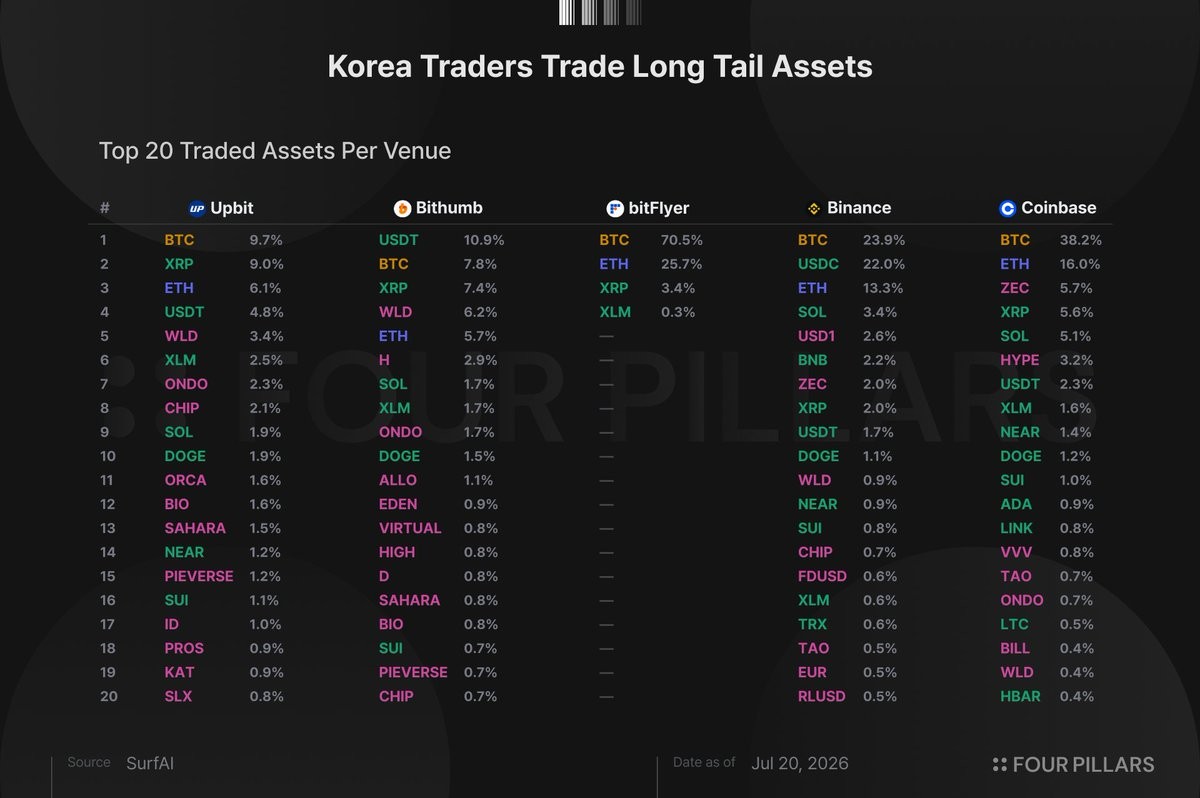
Every new coin listed on Upbit and Bithumb will drive surging market trends. PRL's 24-hour trading volume surged 5500% upon listing, SLX price doubled upon listing, HYPER rose over 100%, AZTEC rose 82%, SKR trading volume surged 700% and price rose 62%. New listings have also become a competitive means for the two exchanges to fight for market share: In September 2025, Bithumb's share rose to 46%, and Upbit immediately listed 7 new coins within 10 days to fight back.
Intraday speculation also forms a fixed pattern, known in the industry as the "9 AM Market Trend". At 9 AM Korean Standard Time every day, multiple unknown altcoins will surge collectively. Retail investors bet on the next hot coin every day; the trigger point for the market trend is not industry news, but purely unified retail trading behavior.
Even if deposit and withdrawal channels are frozen, speculation enthusiasm remains undiminished. In November 2025, Upbit suffered a hacker attack and suspended deposits and withdrawals, but retail funds still speculated on tokens such as ORCA and RAY within the platform. The industry calls it "Fishing Net Style Pumping"; the platform earned $340,650 in fee income in one day. In February 2026, ZKsync surged nearly 970% during the platform maintenance period, directly triggering regulatory investigations, once again confirming the speculation loop in a closed market.
Capital controls isolating overseas arbitrage funds are the core reason why pumping trends can continue to rise. The hallmark phenomenon is the "Kimchi Premium": the mean maintains at 2%-3%, and the peak reached 10.88% in March 2024. However, the market trend has two sides; at the end of 2025, the premium turned from positive to negative, and the short-term premium effect brought by new listings simultaneously weakened significantly.
Fading Hype: The Lifecycle of New Listing Bonuses
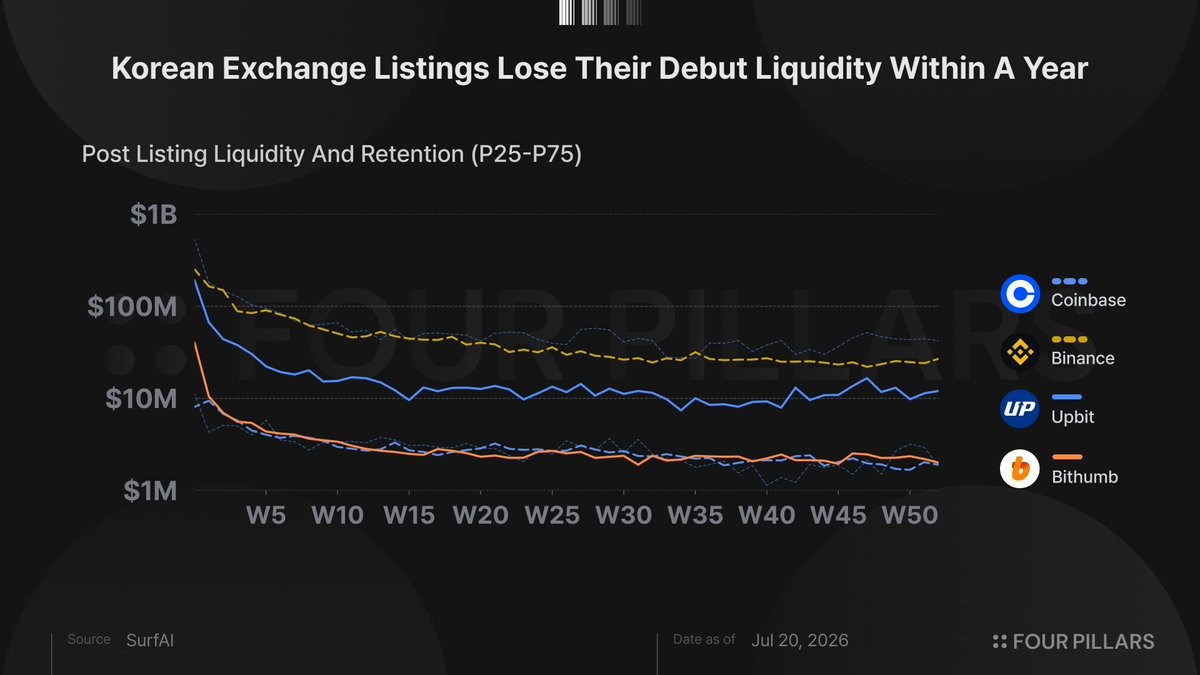
The chart above shows the fading pattern of new listing hype. Liquidity for all tokens is highly concentrated in the early stages of listing. The median liquidity of Upbit's newly listed tokens will lose the vast majority within 10–15 weeks after listing; but it will not drop to zero completely, forming stable bottom liquidity. When listed for a full 51 weeks, the weekly median liquidity of surviving tokens stabilizes at $11.3 million, second only to Binance's $25.6 million, and about 5 times that of Coinbase ($2.3 million) and Bithumb ($2.2 million).
However, token retention performance is not optimistic. After being listed for a full 51 weeks, only 42.7% of Upbit's and only 40.5% of Bithumb's tokens can maintain trading volume above 10% of the listing peak; this ratio is 43.6% for Binance and as high as 63.8% for Coinbase. Coinbase's new listings have low initial hype and steady trends, making it easier to hold the 10% liquidity threshold; Korean coins welcome huge trading volumes upon listing, and even if only 10% remains, the absolute volume is still considerable. But overall, nearly 60% of Korean newly listed tokens lose the vast majority of initial capital within one year.
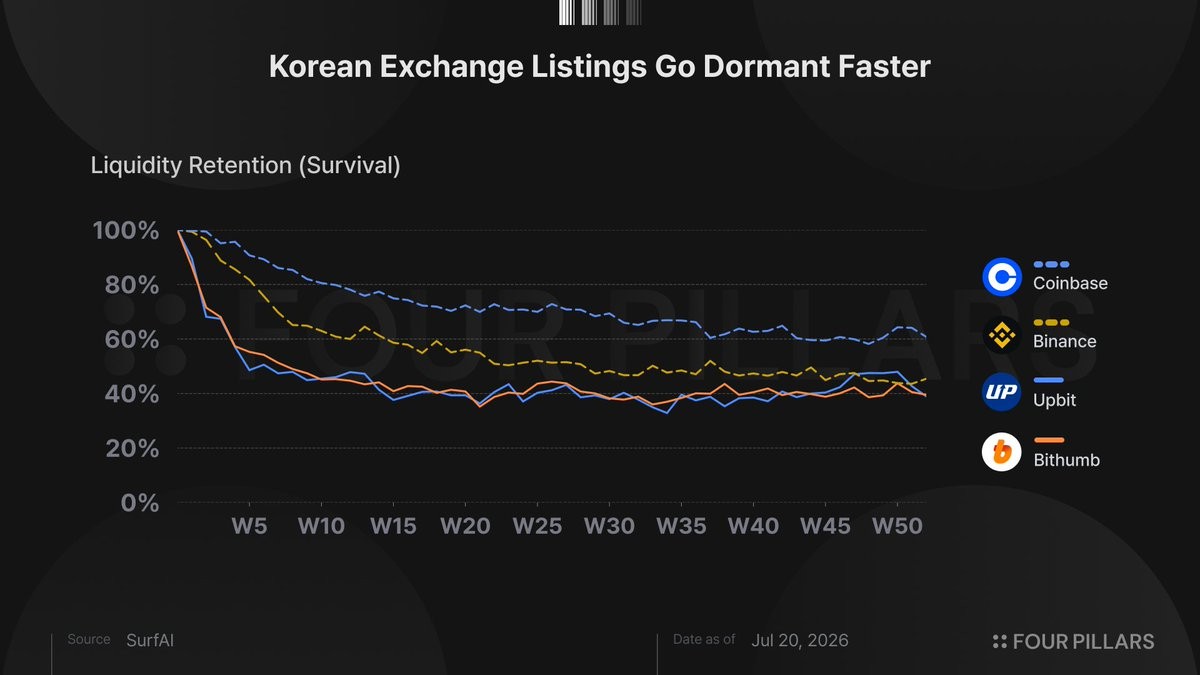
Objectively speaking, the Korean market has a profound but selective memory. The first few months after listing will complete a violent elimination, and only a few targets can precipitate long-term large liquidity. KRW new listings are not permanent stable traffic, but a one-year "screening assessment"; ultimately, only about a handful of tokens can obtain stable tens-of-millions-level liquidity.
Join TechFlow official community to stay tuned
Telegram:https://t.me/TechFlowDaily
X (Twitter):https://x.com/TechFlowPost
X (Twitter) EN:https://x.com/BlockFlow_News
 Four Pillars