Trillion-dollar gateway for retirement funds? Franklin Bitcoin Dividend Reinvestment ETF comes with an inherent selling pressure ceiling
TechFlow Selected TechFlow Selected
Trillion-dollar gateway for retirement funds? Franklin Bitcoin Dividend Reinvestment ETF comes with an inherent selling pressure ceiling
Leveraging Human Inertia to Structure Bitcoin: This Product Conceals Three Fatal Risks.
 Navigating Web3 tides with focused insights
By Thejaswini M A
Translated by Saoirse, Foresight News
The easiest way to control other people’s money is to wait until they let their guard down and stop paying attention. A significant portion of financial institutions’ revenue is built purely on human procrastination and inertia.
Years ago, economists Richard Thaler and Shlomo Benartzi concluded that trying to persuade people through argument is futile. Rather than exhausting oneself in debate, it’s far more effective to design rules that harness people’s default behavior—their tendency to do nothing. Clearly, most people won’t bother to actively opt out.
If employees must manually fill out forms to enroll in a retirement savings plan, fewer than half participate. But if enrollment is set as the default—requiring manual action to opt out—participation jumps above 90%. Auto-renewing subscriptions operate on the same principle: over half of paying subscribers never actually use the service. Last week, I subscribed to watch the FIFA World Cup, fully aware that I’d completely forget about the subscription once the tournament ends.
A critical prerequisite for this mechanism is that the person holding the funds must be different from the person designing the investment allocation. Employers select the pool of eligible funds for 401(k) plans; employees passively enter that preconfigured system.
On June 18, Franklin Templeton filed applications to launch two ETFs embedding this “default allocation” logic into Bitcoin investment.
Viewed within the broader macro capital landscape, the capital moat these products create is negligible.
The decision to buy Bitcoin outright remains a major barrier to mainstream adoption. Even Trump’s appearance at a Bitcoin industry conference—briefly easing public concerns—does not eliminate this barrier.
Financial advisors must proactively allocate Bitcoin and justify the decision to both clients and compliance departments. If Bitcoin’s price halves, the advisor bears full liability for losses. Due to professional risk, the vast majority deliberately avoid Bitcoin—and never recommend it to clients.
Advisors construct standardized portfolio models, selecting underlying funds themselves; clients simply hold the allocated assets passively. When reviewing account statements, clients see only generic labels like “U.S. large-cap equities: 40%,” without digging into the actual underlying holdings. If an advisor selects this dividend-reinvestment version of the fund, clients unknowingly hold Bitcoin.
This product isn’t designed as a trap to deceive retail investors—firms know retail investors actively check their holdings. Instead, this architecture is explicitly tailored for financial advisors.
This is Wall Street’s core playbook. The $4 trillion target-date fund industry grew precisely this way: the default allocation itself is the product—if users choose to do nothing, they automatically hold the asset. Investors who manually input ticker symbols and pick stocks themselves fall outside this logic; Franklin Templeton doesn’t expect to attract such retail investors. The real target capital lies downstream—in the hands of other professional practitioners.
Dividend Reinvestment Plans (DRIPs) are among the most hands-off “set-and-forget” tools in investing: when stocks issue dividends, the cash doesn’t land in your account—it’s automatically reinvested into more shares of the same stock. You continuously accumulate positions you already own, with virtually zero active management required. That’s what DRIP means.
Franklin Templeton has inverted this mechanism: its two funds—the Franklin U.S. Equity Bitcoin Dividend Reinvestment Index ETF and the Franklin U.S. Innovation Sector Bitcoin Dividend Reinvestment Index ETF—will not reinvest dividends into equities. Instead, all dividends will be used to purchase Bitcoin directly.
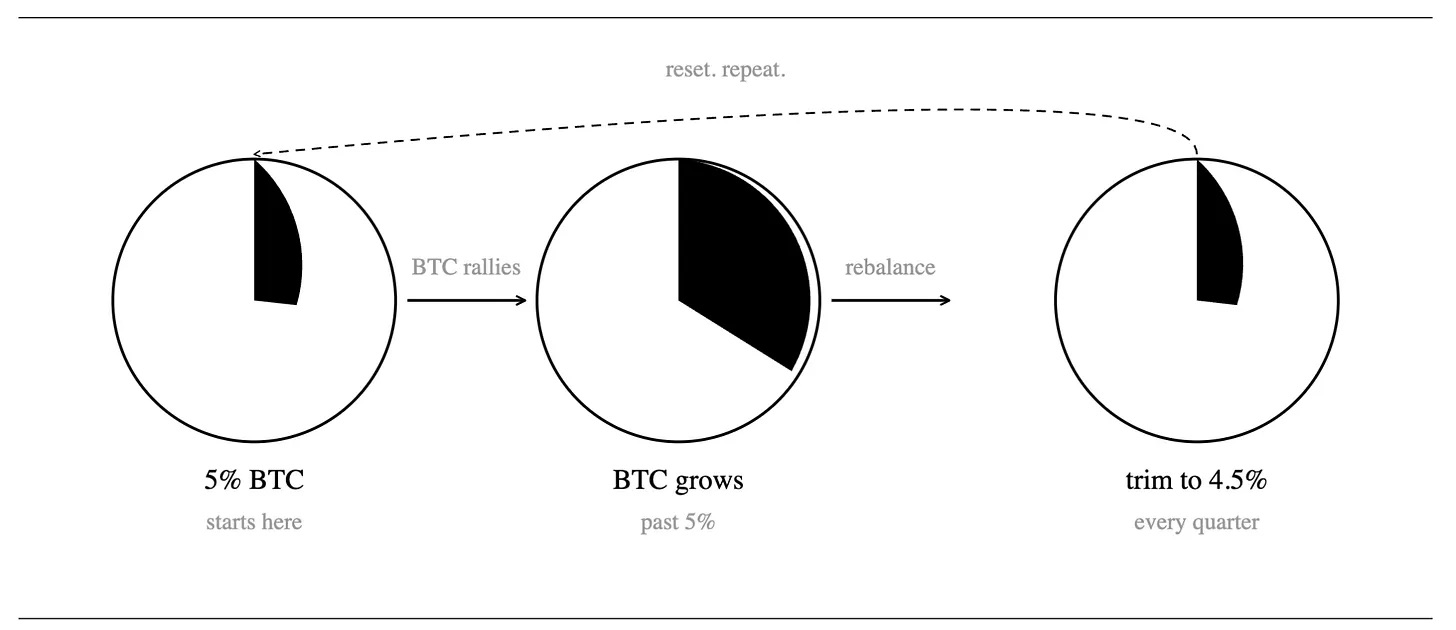
For the Bitcoin allocation, the funds plan to hold spot Bitcoin ETFs, Bitcoin futures, and options. The product includes an asymmetric quarterly rebalancing rule: if Bitcoin surges and its weight exceeds the 5% target, it will be trimmed to 4.5% during the next quarter’s rebalance. A hard cap also applies—Bitcoin holdings may never exceed 20% of the fund’s total assets.
The initial allocation is 95% equities / 5% Bitcoin. All dividends distributed each quarter will be fully allocated to Bitcoin purchases. If Bitcoin’s price rises and its weight expands beyond 5%, the fund will sell Bitcoin during quarterly rebalancing to bring the weight back down to 4.5%, redeploying the proceeds into equities.
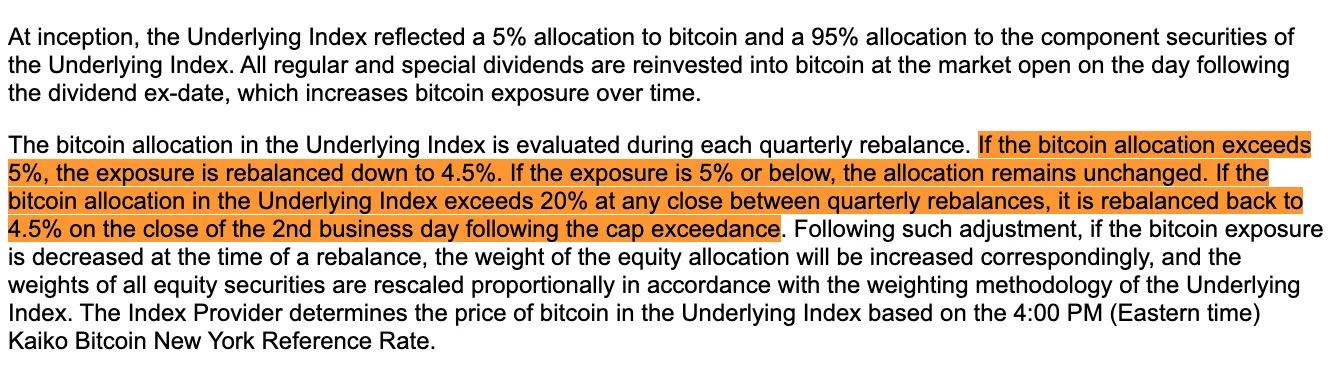
Even if Bitcoin’s price soars between rebalances, its weight in the fund will never breach the 20% ceiling.
To bypass extensive regulatory processes, Bitcoin holdings will be held exclusively by Franklin Templeton’s wholly owned Cayman Islands subsidiary, which will manage the spot crypto, futures, and options allocations.
Both funds track proprietary indices customized by VettaFi. Franklin Templeton plans to officially launch them on September 1. The fee section in the filing remains blank—management fees have yet to be announced.
Beyond Optimism: Facing Reality
At first glance, integrating Bitcoin into the Wall Street ecosystem and adding a stable new buyer base sounds promising. But crunching the numbers reveals that the supposed incremental demand is merely a trickle.
Broad-market U.S. equity indices yield ~1.05% annual dividends; innovation-sector indices yield just 0.52%. Both funds launch with a 95% equities / 5% Bitcoin allocation, and only dividends from the equity portion fund Bitcoin purchases. This translates to roughly 1% of the broad-market fund’s total assets being allocated annually to Bitcoin—and just 0.5% for the innovation fund.
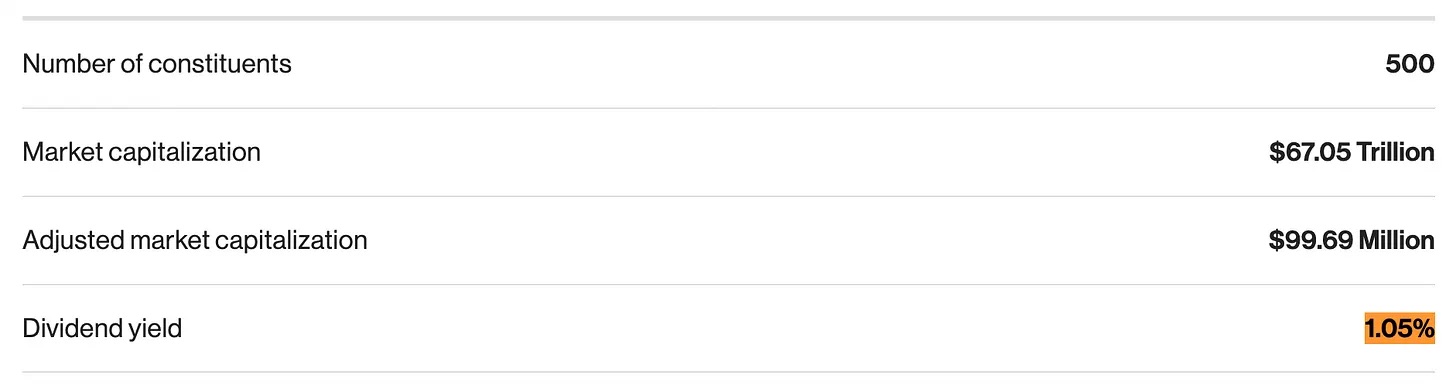
Applying this to Franklin Templeton’s existing Bitcoin ETF ($359 million AUM), the annual incremental Bitcoin buying power amounts to just $3.6 million. With Bitcoin’s daily trading volume averaging ~$36 billion, the fund’s entire year of Bitcoin purchases would be absorbed by the market in under one minute.
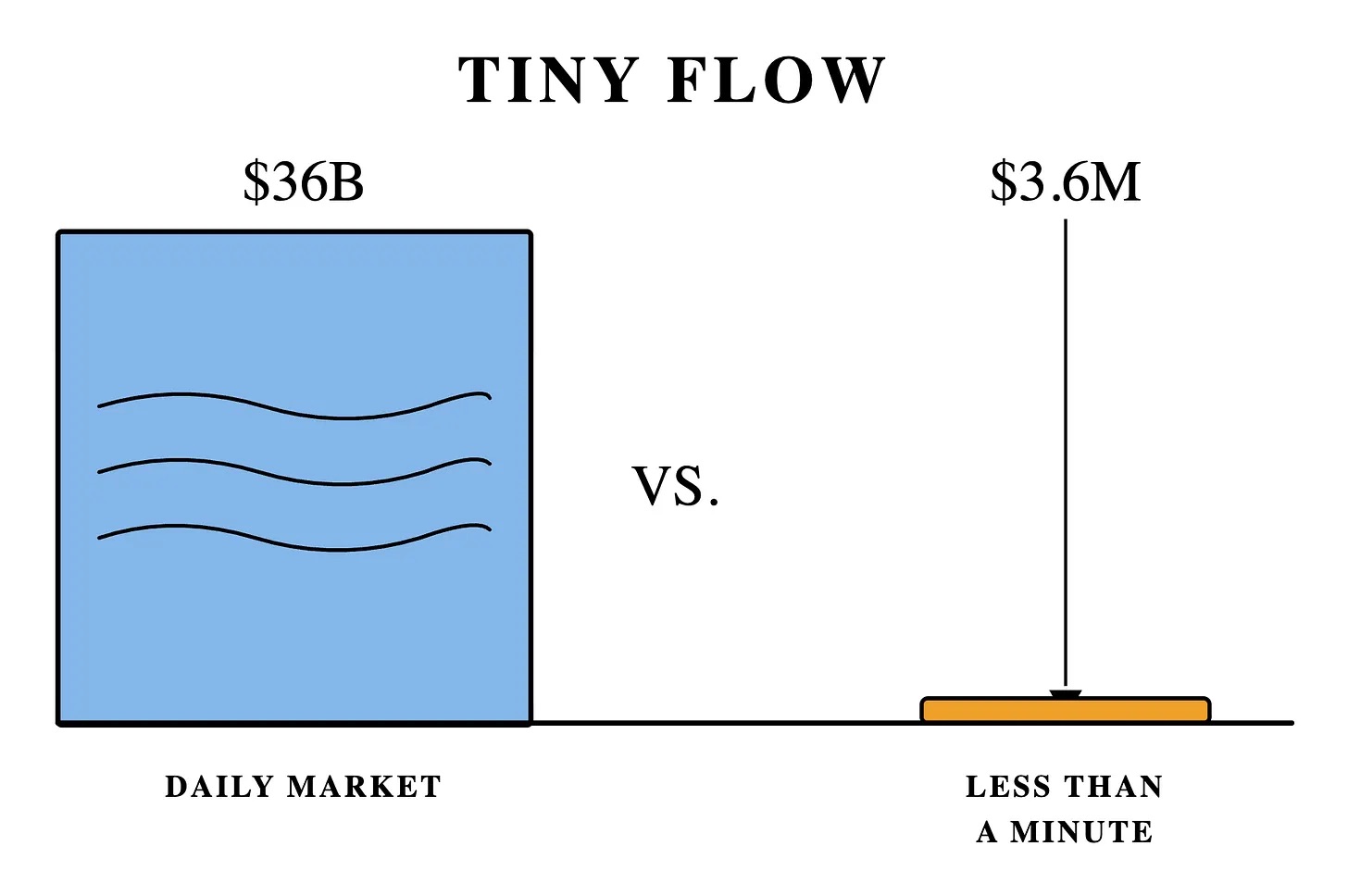
The innovation-sector fund harbors deeper flaws: it heavily weights low- or zero-dividend stocks like NVIDIA, Apple, and Microsoft. Since Bitcoin purchases rely entirely on equity dividends, the fund lacks consistent cash flow for reinvestment. Combined with the quarterly rebalancing’s inverse mechanism—selling Bitcoin whenever its weight exceeds 5%—the higher Bitcoin’s price rises, the more aggressively the fund sells. During a bull market, sustained selling pressure easily offsets the meager buying power generated by dividends. By design, this product is structurally ill-suited to hold appreciating assets long-term.
When Bitcoin rallies, this fund becomes a passive seller.
Why? Index funds face mandatory, predictable trading—traders know exactly when and what they’ll buy or sell, allowing them to front-run arbitrage opportunities. Franklin Templeton’s two funds invert this dynamic: they’re algorithmic, passive, continuous selling tools. The fund buys Bitcoin the day after dividends settle; it sells Bitcoin uniformly each quarter. Short-term traders can precisely anticipate these timing points—and profit from both sides of the trade.
The selling pressure from a single fund of this size is negligible—a mosquito bite. But if dozens of similar products proliferate, cumulative selling pressure could become systemic. If large volumes of such capital flood the market, Bitcoin’s rallies would face persistent selling—creating an impenetrable price ceiling.
Beyond this core “default allocation” logic, the filing contains three additional clever design features:
- Compliance circumvention: Many wealth management firms prohibit direct crypto allocations internally—but this fund is labeled externally as a “U.S. large-cap equity product.” Advisors can therefore allocate it compliantly, achieving indirect Bitcoin exposure.
- Offshore compliance structure: Bitcoin holdings reside solely in the Cayman Islands subsidiary—a standard, legally sound method for mutual funds to hold commodity-like assets, preserving the fund’s existing tax status and conforming to industry norms.
- Tax complications: Dividends are automatically converted into Bitcoin before reaching your account—but you still owe taxes on that income. Your funds are locked in crypto, yet you must pay taxes using separate cash—on income you never physically received.
For this model to truly scale, such funds must become default options in retirement plans—or sit immediately adjacent to the default lineup. The 2006 Pension Protection Act granted employers legal cover to auto-enroll employees in 401(k) plans with default fund allocations.
Back then, only 5% of 401(k) plans offered target-date funds; today, coverage stands at 96%, with industry AUM exploding from $100 billion to $4 trillion.
In August 2025, Trump signed an executive order lifting restrictions, permitting 401(k) plans to include cryptocurrency. In March 2026, the U.S. Department of Labor released a draft rule: fiduciaries who include alternative assets like crypto in retirement plan menus may qualify for liability safe harbor protections.
The public comment period ended June 1. To finalize regulations by year-end, procedural steps must conclude well before then. Compared to merely adding crypto as an optional investment, making it a default retirement allocation faces far higher implementation hurdles. Thus, regardless of the final rule’s wording, corporate legal teams broadly expect most employers to wait—monitoring court rulings that confirm the scope and safety of the liability safe harbor before acting.
The core of this system was never about persuading anyone to buy Bitcoin. Attention is humanity’s scarcest resource—any model that eliminates thinking and runs on inertia will inevitably win.
The entire system needs only to exploit human inertia.
Join TechFlow official community to stay tuned
Telegram:https://t.me/TechFlowDaily
X (Twitter):https://x.com/TechFlowPost
X (Twitter) EN:https://x.com/BlockFlow_News