AI Inference Market Landscape Analysis: How Can Crypto Projects Break Through?
TechFlow Selected TechFlow Selected
AI Inference Market Landscape Analysis: How Can Crypto Projects Break Through?
Inference is the ultimate battleground for AI—traditional cloud giants versus decentralized networks, with privacy, verification, and agent economies vying for dominance.
 Navigating Web3 tides with focused insights
Author: 0xSammy (Khala Research)
Translated by: AIdidiaoJP, Foresight News
The current AI inference market is no longer a monolithic cloud services market—it resembles a “risk” chessboard. Every provider is vying for distinct territories: hyperscale cloud providers dominate the enterprise continent; routers control trade corridors; and decentralized networks fight fiercely on the open frontier.
The previous AI cycle centered on model training—but it’s now increasingly clear that inference holds immense economic value. Many may be hearing the term “inference” for the first time—so what exactly is it?
Training creates AI models; inference is the process by which a model generates an answer when prompted or given a task.
AI Inference Market Overview
Training dominates headlines because it powers those astonishing outputs. Yet in reality, inference currently captures most of the economic value—every prompt, agent loop, image generation, trade execution, tool call, and code edit must run somewhere.
Routers Are the Real Bottleneck
On the “risk” chessboard, the most valuable territories are often narrow bottlenecks that determine how armies move next. In the inference market, routers play precisely this role. Positioned between demand and supply, they decide where each request goes—and which provider gets paid.
A prime example is OpenRouter, whose protocol processed 4.7 quadrillion tokens last week.
This economic activity shows no signs of slowing—especially as trillions of agents go live.
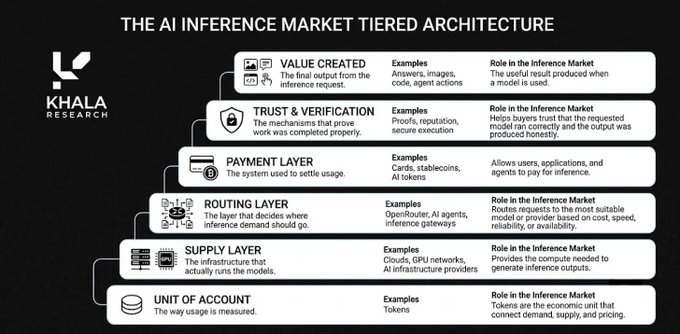
So what does a complete inference market require? Core components include:
- Tokens are becoming the unit of account
- OpenRouter is rapidly emerging as the core exchange layer—last week alone, its LLM marketplace consumed 4.7 quadrillion tokens.
- Specialized supply-side players: Fireworks, Together, Replicate, Baseten, Groq, and major hyperscalers.
- Crypto-native AI networks: Chutes, Akash, io.net, Nosana, Targon, Venice, NuNet, and others building permissionless infrastructure.
Don’t view all these providers as competing in the same market—they’re not.
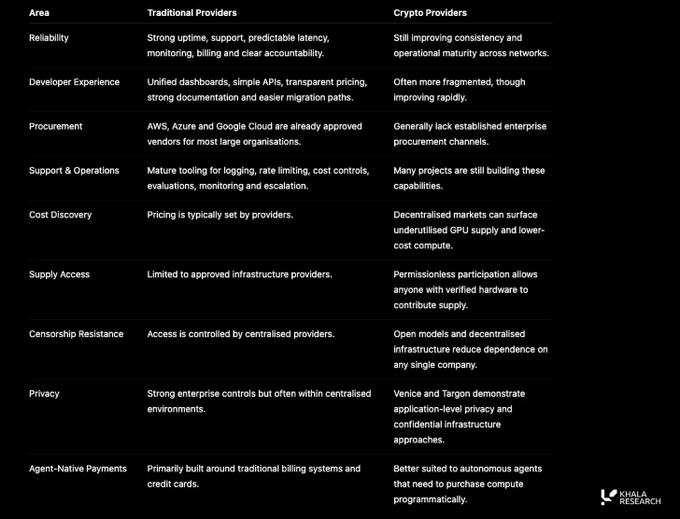
Traditional providers sell reliability, developer experience, and enterprise procurement workflows.
Crypto AI networks emphasize cheaper supply, open access, privacy, verifiability, and novel incentive loops.
Recent restrictions by Anthropic—blocking users outside the U.S. from accessing its Mythos model (Fable 5)—have reminded many of the risks of overreliance on a single cutting-edge proprietary model.
Interestingly, the two worlds are beginning to overlap—particularly around privacy, confidential computing, and agent-native payments (Venice and Targon stand out here).
How to View the AI Compute Market
A better lens divides the market into two camps: traditional and crypto-native:
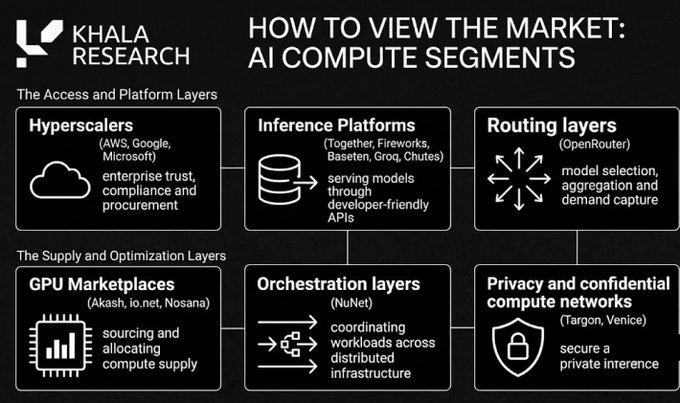
The traditional side sells reliability, developer experience, and enterprise procurement.
Crypto networks compete primarily on open access, lower-cost compute supply, privacy, verifiability, and novel incentive mechanisms enabling seamless global capital coordination.
Why Inference Is the Real AI Market
The model layer remains important—but model quality is compressing faster than expected. Open-source models have reached 90–95% of frontier-model quality at just 10% of the cost (e.g., Z.ai’s GLM-5.2).
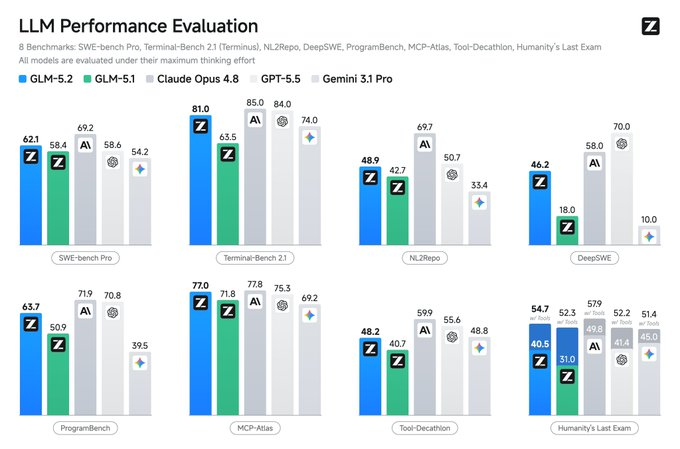
Open-source models iterate continuously; Chinese labs keep driving prices down. Frontier models retain premium pricing—but beneath them, token-based price competition is already fierce.
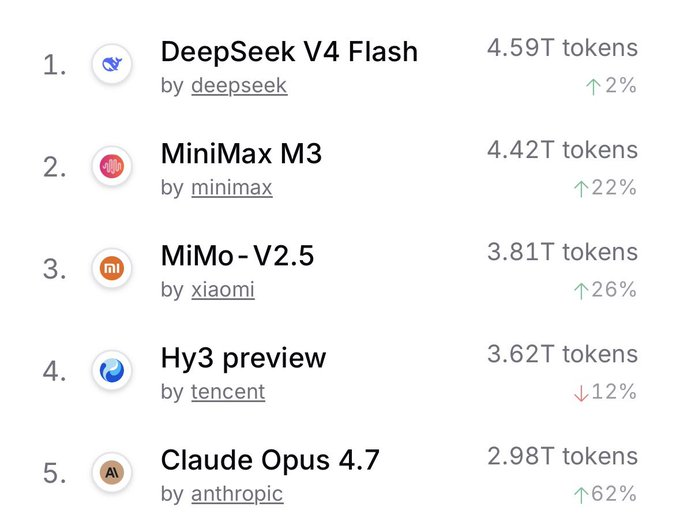
That’s why the routing layer has become critical: the same open-source model may be offered by five different providers at five different prices. Developers don’t want to hardcode a single endpoint—they need routers.
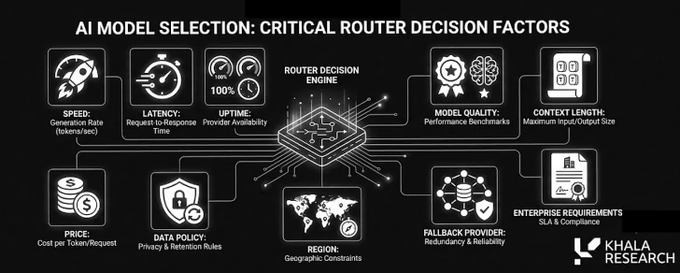
Routers can select based on price, latency, privacy, reliability, and more.
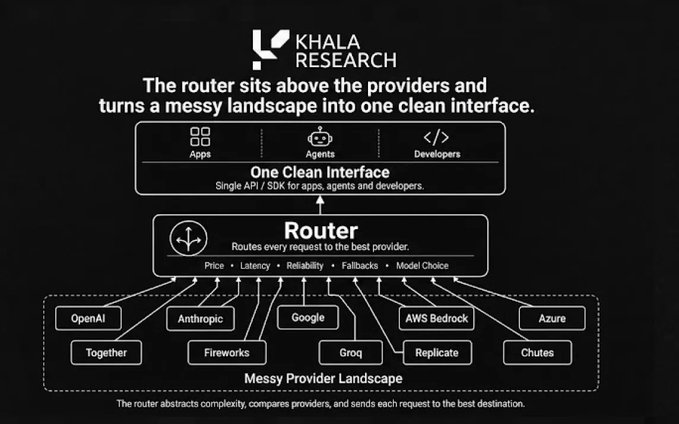
They sit atop all providers—transforming chaos into a clean, unified interface.
That’s precisely what OpenRouter got right—and explains why venture funds poured $113 million into its recent Series B round to capture this routing opportunity.
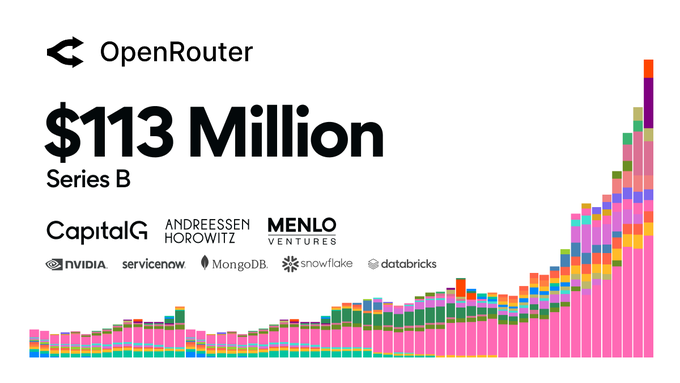
OpenRouter is rapidly becoming the market interface: one key unlocks access to hundreds of models across multiple providers. The real value isn’t in the model list—it’s in routing each request to the provider best suited for that specific task.
This begins to resemble energy markets: users don’t care which power plant generated the electricity—they only care whether the light turns on, the price is fair, and the system is stable.
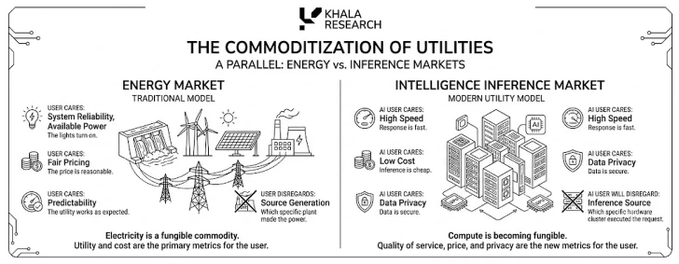
AI users will think this way increasingly—caring not which GPU cluster served the token, but whether the response is fast, cheap, private, and reliable.
Traditional Inference Providers

The traditional side is fragmenting into four categories:
i) Hyperscalers: AWS, Google, Microsoft
They control the “fortified continents.” They win—not because they’re always cheapest—but because they’ve already captured enterprise procurement, compliance, identity, security, and billing systems. Directly attacking this position is prohibitively expensive.
They win on enterprise trust. Large companies buy not just tokens—but compliance, security, procurement convenience, and accountability when things go wrong.
ii) Routing Markets: OpenRouter and various AI gateways
Routers sit above model providers, directing each request to the optimal option. As model leadership shifts weekly, hardcoding a single model grows increasingly fragile. AI needs aggregators—just like crypto.
iii) Optimized Open-Source Model Services: Together, Fireworks, Baseten, Groq
These are not just cheap APIs—they’re performance infrastructure companies focused on speed, batching, scaling, fine-tuning, custom endpoints, and production support.
iv) Model Markets: Replicate and Hugging Face–like platforms
Inference extends far beyond chat. Images, video, voice, embeddings, robotics models, simulations, and multimodal agents all require models to run. Markets make long-tail model demand easily accessible.
Crypto-Native AI Inference Providers
Decentralized networks are the “guerrilla territories.”
Crypto inference networks don’t try to outspend AWS on its home turf. Instead, they open new fronts: uncensored models, cheaper GPU supply, private inference, agent-native payments, and workloads that don’t require hyperscale-level reliability.
The crypto side is often loosely labeled “decentralized compute”—but that’s too vague. At least five distinct directions exist:
- Serverless inference networks
- Decentralized GPU markets
- Confidential computing networks
- Private AI applications and gateways
- Orchestration layers
They shouldn’t be analyzed interchangeably.
i) Chutes: Crypto-Native Inference
@chutes_ai is best understood as a decentralized inference platform—not merely a GPU marketplace.
Core idea: Developers don’t want to rent GPUs or manage infrastructure—they want a working endpoint. Chutes serves open-source models via familiar APIs, backed by decentralized GPU supply.
Key question: Can top usage translate into paying, recurring demand? Cheap tokens help—but only if developers trust uptime, latency, and reliability.
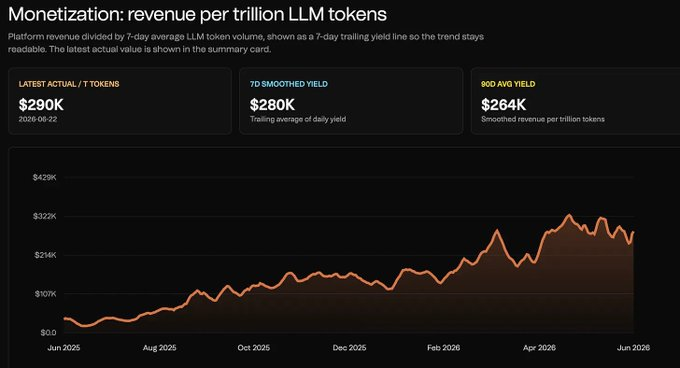
Its revenue per trillion tokens continues rising—indicating potential sustainability and viability.
ii) Akash: GPU Auction Layer
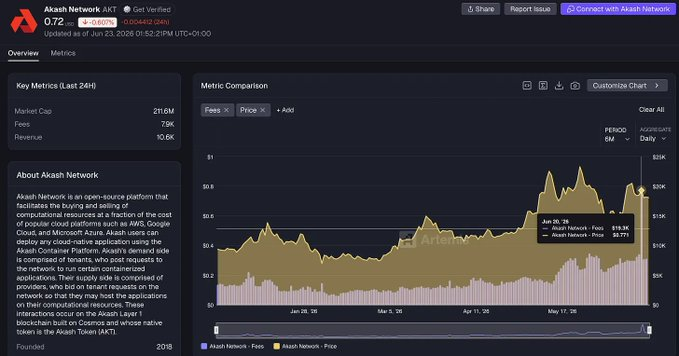
@akashnet is a decentralized cloud marketplace.
Users define required compute; providers bid to supply; workloads run under leases. It functions more like a compute marketplace than a direct inference router.
Best suited for price-sensitive workloads tolerant of infrastructure volatility—and not requiring deep integration with AWS/Azure/Google Cloud. Fees correlate with token price and show upward trends.
iii) io.net: Decentralized GPU Cloud
@ionet leans closer to a decentralized GPU cloud provider.
Core value proposition: Access distributed GPU supply at lower cost and faster provisioning—ideal for AI teams needing compute without signing long-term cloud contracts or accepting hyperscale pricing.
Execution challenges remain: hardware validation, reliability, scheduling, support, and consistent performance. Raw GPU access has value—but higher-margin layers lie in routing, inference management, and orchestration.
io.net has performed exceptionally well over the past 30 days—annualized revenue stands at $12.3 million.
iv) Targon: Confidential Computing
@TargonCompute (built by @manifoldlabs) focuses on confidential computing for AI workloads.
It tackles an obvious problem: many users refuse to run sensitive prompts, models, or data on infrastructure operated by unknown third parties.
Targon delivers protected execution via trusted execution environments (TEEs), encrypted virtual machines, remote attestation, and confidential GPU infrastructure. In short: it proves workloads run in secure environments—and minimizes what operators can observe.
This is especially relevant for private inference in finance, healthcare, and enterprise AI. Confidential computing isn’t magic—it shifts trust onto hardware, firmware, and attestation systems.
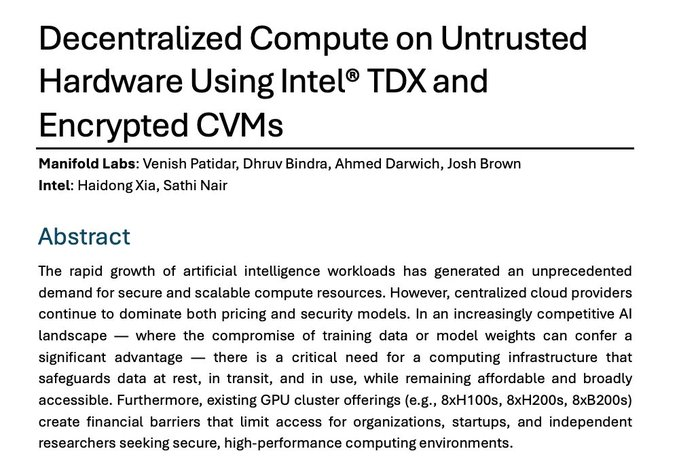
Last year, the protocol reported $10.4 million in annual revenue and co-authored a research paper with Intel titled “Decentralized Compute on Untrusted Hardware.”
v) Darkbloom: Private Inference on Idle Macs
Darkbloom (built by @eigenlabs) takes a different path.
Rather than sharding large models across random GPUs, it turns idle Apple Silicon Macs into a private inference network. Models run locally on Macs; requests are encrypted and routed to verified providers.
Its value proposition centers on privacy and cost—not maximizing frontier-model performance.
This matters because “no node holds the full model” doesn’t automatically guarantee prompt privacy. Darkbloom explicitly targets privacy—but still must prove scale, performance, and developer trust.
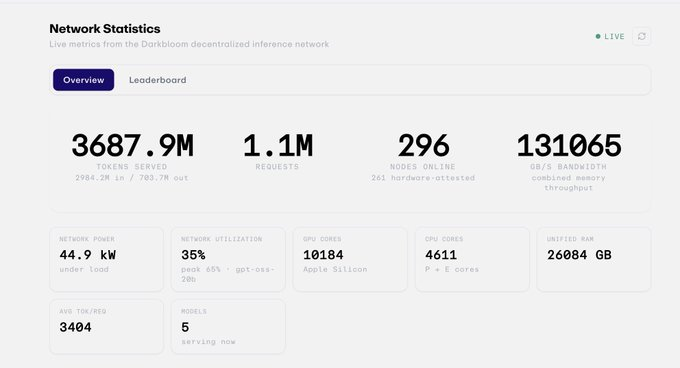
The network currently comprises 300 machines, serving 2 billion tokens and 1 million requests.
vi) Venice: Consumer-Facing Private Inference
@AskVenice occupies a different space than networks like Akash or io.net. It functions more as a private AI application and inference gateway—not primarily a GPU marketplace.
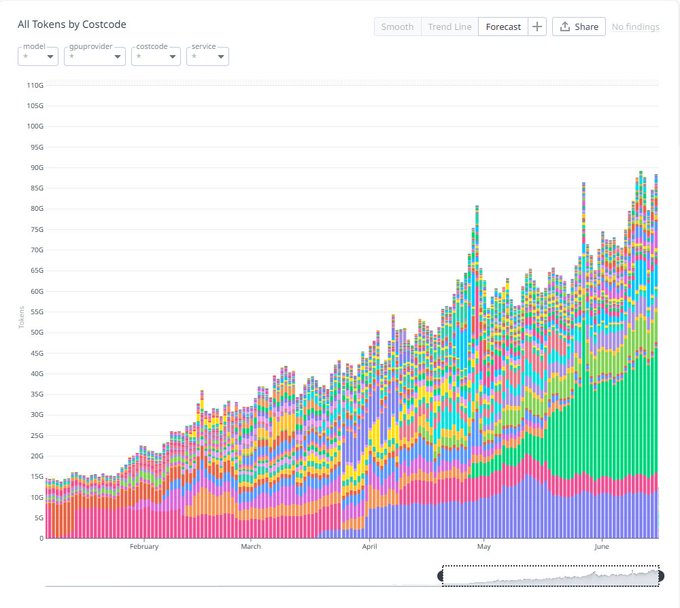
Its gateway throughput has reached 85 billion tokens per day (@ErikVoorhees data).
Most users want an AI product that respects privacy, accesses powerful models, and doesn’t hoard their data.
Venice packages infrastructure concepts into a consumer-facing experience—centered on private prompts, open-source models, uncensored access, API functionality, and tokenized compute via VVV and DIEM.
The DIEM component is particularly interesting—it points toward broader agent-economy ideas: offering $1/day compute access. The market has recently assigned a strong valuation to this concept.
If agents require persistent inference access, compute credits begin resembling agent-native assets—around which entire secondary markets could form.
An agent that can directly hold and spend compute rights is more practical than one dependent on humans regularly swiping credit cards.
This highlights a deeper crypto-AI thesis: agents ultimately need access to funds, identity, memory, and compute—and crypto systems provide the programmable framework for these resources.
Venice doesn’t compete head-to-head with OpenRouter on model breadth—but rather on privacy, access, and tokenized compute. This is a legitimate niche—but the critical question is whether demand for private AI products will grow large enough to sustain its token model beyond current narrative cycles. My judgment: as AI proliferates, the privacy narrative will only strengthen.
vii) NuNet: Distributed Compute Orchestration
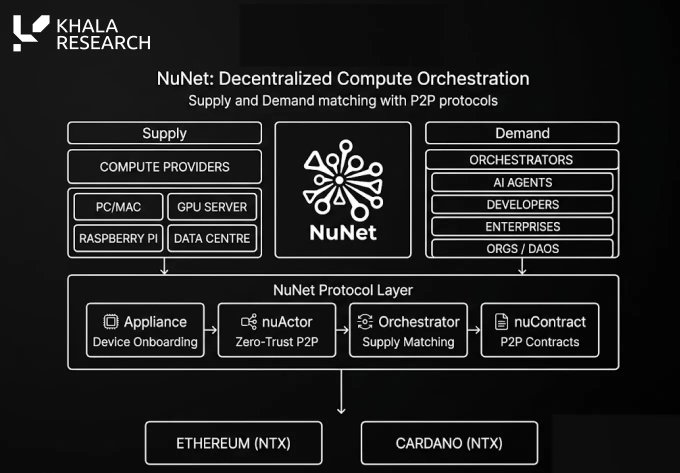
@nunet_global is often grouped with decentralized compute projects—but a more useful framing is “orchestration.”
Orchestration involves matching workloads to the most suitable compute resources—and coordinating execution across diverse machines, environments, and locations.
As AI moves beyond centralized cloud infrastructure, this becomes increasingly vital.
Future AI systems will likely span cloud GPUs, edge devices, on-premise servers, robots, phones, sensors, and decentralized provider networks.
Warehouse robots can’t wait for cross-regional API responses; drones can’t assume perfect connectivity; field robots need local inference when networks fail.
Thus, orchestration is emerging as a distinct and meaningful category.
NuNet’s challenge lies in translating this coordination problem into a functioning economic network—with sufficient supply, demand, and developer adoption.
viii) OpenServ: Agent Orchestration, Not Pure Inference
@openservai is best understood as an agent infrastructure and orchestration platform—not a decentralized inference network.
This distinction matters because agents represent one of the clearest future sources of inference demand. A typical chatbot may invoke a model once—but an agent repeatedly invokes models: infer, use tools, check output, call another model, act—and loop.
This creates heavy inference demand—already drawing attention within crypto circles.
OpenServ thus relates to the inference market from the demand side—not the supply side. If the platform becomes a useful place for developers to build, deploy, and coordinate agents, it will naturally become the layer routing inference to various providers underneath.
The key question is whether OpenServ can become a true agent execution layer—or merely another agent marketplace with a token.
After multiple conversations with the team, I believe its capabilities extend beyond the latter. Its inference framework demonstrates several notable benchmark results—and its roadmap includes a proprietary model.
If OpenServ masters agentized operational workflows, inference becomes an input—not the primary product.
In an agentized world, the most valuable layer will be where agents spend significant continuous time and resources.
ix) Dolphin AI: Product-Driven Decentralized Inference
@dphnAI stands out because it starts from model demand—not GPU markets.
The Dolphin model family already enjoys a reputation for uncensored open-source models—giving the network a clearer raison d’être.
This matters because many decentralized inference projects are supply-first: “We have GPUs—now who will buy?”
Dolphin flips this: starting from a set of models people already want to use—and then building a decentralized inference network around that demand.
Its architecture is often described as peer-to-pool: GPU owners contribute capacity to specific model pools—not individual buyers leasing dedicated nodes. Requests route to pools; available nodes process them.
This is a better design for unreliable consumer-grade supply. If someone contributes an idle gaming GPU, they may not stay online indefinitely—pooling models absorbs such volatility more naturally than one-to-one leasing markets.
More interesting is verification. Dolphin is pioneering live-weight proofs—essentially checking whether the model weights actually loaded during service match the model the node claims to run.
This matters because cheating is among the hardest problems in decentralized inference. Nodes might claim to run expensive models while secretly serving smaller, cheaper, or quantized versions. If the network cannot detect this, credibility collapses entirely.
x) c0mpute: Distributed Inference for Agents
@c0mputeAI deserves attention because it tackles one of decentralized inference’s hardest problems: running large models across dispersed GPUs on the open internet.
Its Shard Engine splits models across multiple machines—rather than requiring one massive server to host the full model. This is especially relevant for frontier-scale open-source models too large or restricted for conventional hosting routes.
@virtuals_io’s link represents a crucial demand-side angle. Virtuals is building an agent economy—and agents are heavy inference users: they plan, call tools, trade, verify results, and loop. This creates demand for cheap, open, censorship-resistant inference.
Caveat: this remains early-stage. c0mpute must prove performance under real load, node reliability, verification, and prompt privacy.
But the direction matters: GPU markets sell compute access; c0mpute aims to distribute the models themselves.
Traditional vs. Crypto Inference
Both will coexist—each possessing distinct, understandable advantages.
What to Watch
Paid Token Volume
Markets should shift away from raw token-processing metrics—unless those tokens generate revenue. Free-tier activity and subsidized usage can inflate numbers without proving real product-market fit.
Paid inference demand is the critical metric—it’s more sustainable and supports long-term viability.
ii) Revenue Per GPU
Decentralized compute networks are only sustainable if GPUs earn more inside the network than outside. If emissions are the main incentive for providers, supply vanishes once incentives taper. GPU providers calculate opportunity cost.
iii) Router Integration: Distribution
Distribution often matters more than infrastructure itself.
OpenRouter integrations, coded agents, wallets, payment endpoints, developer tools, and consumer apps—all represent potential demand sources.
Payment endpoints are channels through which software can pay for services directly via API.
iv) Verification
GPU cheating, fake capacity, and unreliable providers remain real risks.
Networks need robust hardware verification, encrypted traffic, reputation systems, and meaningful penalties for bad actors.
v) Privacy Guarantees
Private inference remains one of crypto-AI’s strongest opportunities—but guarantees must be real. Marketing privacy is easy; secure execution, local-first architecture, data minimization, and auditable infrastructure are far harder.
vi) Token Value Capture
The strongest token models tightly couple demand to actual inference usage. This may involve buybacks, burns, staking requirements, compute rights, or revenue-linked mechanisms.
Broad AI narratives alone won’t suffice long-term.
Core Conclusions
The Endgame Is Demand Control
On the “risk” chessboard, holding scattered territories isn’t enough. You need connected regions, reinforcement routes, and durable supply lines.
The same applies to the inference market. Winners will control demand, routing, verification, and settlement—owning GPUs alone is insufficient.
The inference market makes AI begin to resemble financial systems:
- Every generated token carries a cost,
- Every endpoint carries profit,
- Every agent loop creates demand,
- Every router acts like a market maker,
- Every GPU network becomes a supply source…
Traditional providers currently dominate developer experience and enterprise trust layers.
Crypto AI networks explore an alternative frontier: permissionless supply, private inference, verifiable compute, tokenized access, and agent-native (KYC-free) payments.
In the near term, winners are unlikely to be the most decentralized networks—but rather those making decentralized inference feel ordinary and reliable—via fast endpoints, strong documentation, dependable uptime, transparent pricing, verified supply, and genuine paid demand.
Chutes remains one project worth watching closely—because it comes closest to transforming Bittensor-backed compute into a functioning inference market, rather than just a GPU narrative. Eigen Labs’ “Darkbloom” fits similarly.
Akash and io.net represent supply-side challengers; Targon embodies the confidential computing thesis; Venice represents the private AI demand layer; NuNet points to orchestration for a more distributed compute future.
Broader thesis:
“AI models may become increasingly commoditized—but the inference market is unlikely to follow the same path.”
Maximum value will accrue to entities that route work, verify work, settle work, and capture demand.
This is precisely where the next crypto-AI opportunity may emerge—at least until physical AI becomes competent in society.
Join TechFlow official community to stay tuned
Telegram:https://t.me/TechFlowDaily
X (Twitter):https://x.com/TechFlowPost
X (Twitter) EN:https://x.com/BlockFlow_News
 @0xSammy