








The era of Bitcoin’s dominance over crypto has ended.
TechFlow Selected TechFlow Selected
The era of Bitcoin’s dominance over crypto has ended.
In the future, the development of the crypto industry will decouple from Bitcoin’s price.
 Navigating Web3 tides with focused insights
By Charlie
Translated by Luffy, Foresight News
For years, the entire cryptocurrency market’s price action has revolved around Bitcoin. That era is now coming to an end.
The crypto economy has now bifurcated into two distinct camps: endogenous assets and exogenous assets.
“Endogenous” refers to the traditional crypto categories widely recognized by the public—tokens and projects whose value is entirely dependent on the broader crypto market’s performance. “Exogenous” assets, while nominally part of the crypto space, increasingly exhibit price behavior independent of the crypto market.
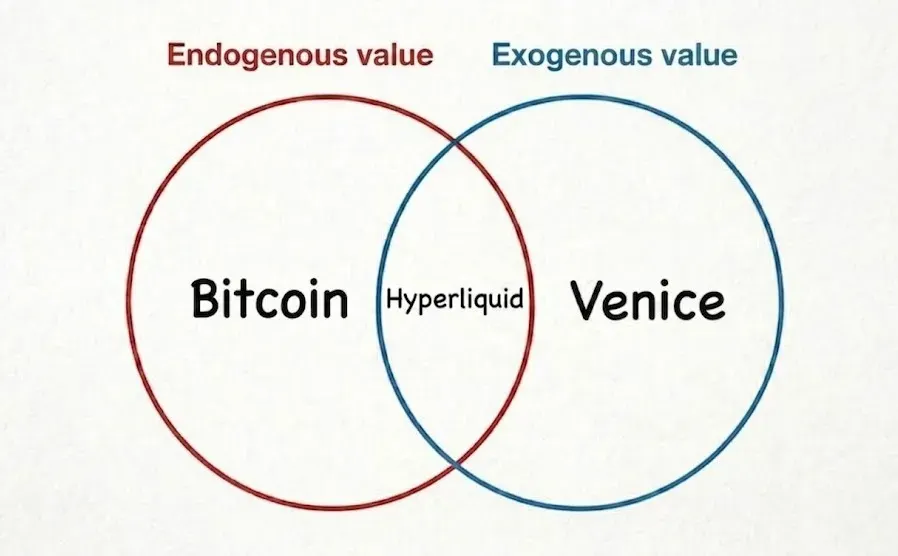
Bitcoin’s value stems from its intrinsic properties, which in turn manifest in its price. Rising prices reinforce market perception of its fundamental value attributes. At bull-market peaks, Bitcoin is hailed as the “interstellar universal currency”—the scarcest digital liquid asset in human hands; at bear-market troughs, it is dismissed as a digital collectible with no cash flow backing.
Hyperliquid occupies a middle ground between these two camps. While much of its business remains tied to crypto market conditions, both its supply and demand sides are steadily expanding. Many onchain financial infrastructure projects fall into this category, with underlying assets gradually shifting toward real-world asset tokenization.
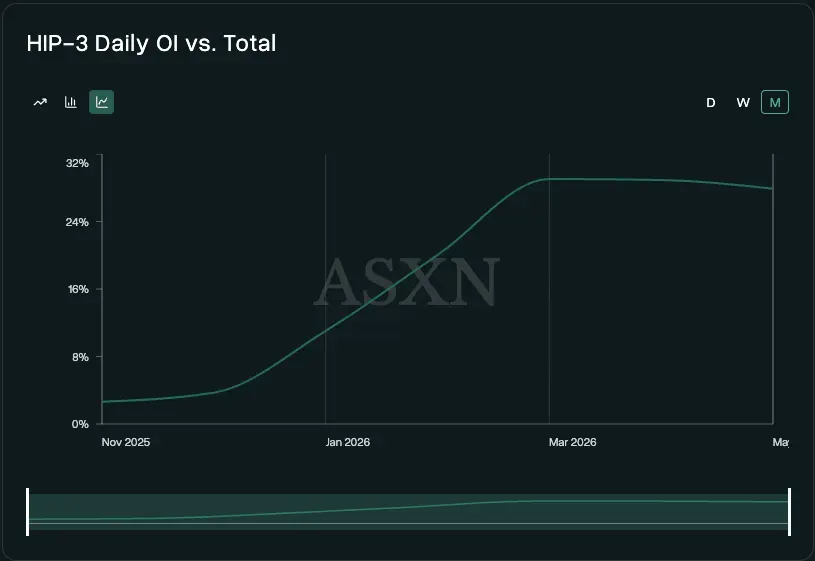
HIP-3 open interest serves as a rough proxy for non-crypto trading activity. Currently, HIP-3 contracts account for approximately 30% of Hyperliquid’s total open interest—up from just 4% in November 2025. The upcoming HIP-4 prediction market will further accelerate growth, bringing in new users and new trading instruments.
Projects like Venice belong fully to the exogenous camp, with development logic completely decoupled from the crypto market. Though some user overlap exists, Venice’s business model leans toward consumer-grade AI—not native crypto products like Uniswap. Uniswap’s core business remains facilitating trades of endogenous assets, meaning its revenue naturally fluctuates with asset prices; Venice, by contrast, packages private multimodal inference services under a “pay-as-you-go + subscription” pricing model.
Venice’s only meaningful link to crypto is its use of a token as a value carrier—and the fact that some of its compute providers have crypto-industry backgrounds. Erik Voorhees, Venice’s founder, is a long-time crypto veteran who believes tokens, when used effectively, can serve as powerful marketing tools.
Publicly traded Figure offers another illustrative case. This fintech lending company built its own blockchain to reduce home equity loan approval times to under five minutes. For Figure, blockchain is merely enabling infrastructure—the core value lies in its lending business itself.
The large-scale emergence of exogenous sectors—both in token markets and public equities—carries profound implications. Historically, because most business models were deeply tethered to crypto asset prices, purely bottom-up fundamental investing was nearly impossible. Crypto has seen waves of “blockchain-over-Bitcoin” narratives before—but each cycle ultimately reverted to Bitcoin-driven momentum. Why? These sectors failed to establish stable demand or generate sustainable revenue; even when revenues materialized, they rarely translated into token value. Once token prices stalled, projects lost their foundational support.
This cycle is fundamentally different. Today, we clearly see paying users and clear monetization logic. Demand across most sectors is quantifiable—not driven solely by sentiment. Simultaneously, the mechanisms by which tokens serve as value carriers continue to mature. Venice earns revenue from real user payments for AI inference services—its operations remain largely unaffected by broader crypto market downturns, since it never relied on token price appreciation. This cycle possesses two critical advantages absent in prior cycles: sustainable, real-world usage demand—and investors beginning to allocate capital based on fundamentals rather than narrative alone.
The stablecoin sector in private markets reflects the same trend. In March 2026, Mastercard announced plans to acquire BVNK for up to $1.8 billion—just 15 months after BVNK raised its Series B round at a $750 million valuation. Another stablecoin-related firm, Bridge, was acquired by Stripe in February 2025 for $1.1 billion; according to Stripe’s annual report, Bridge’s current annual business growth rate stands at 4x. All these companies’ trajectories have decoupled entirely from crypto market cycles.
This is not a bearish take on endogenous assets. Just as gold—and small-cap gold miners—retain portfolio allocation value, Bitcoin and other endogenous crypto assets retain their own legitimate role. But the drivers of performance and market correlations between these two asset classes have diverged fundamentally—and the data confirms it.
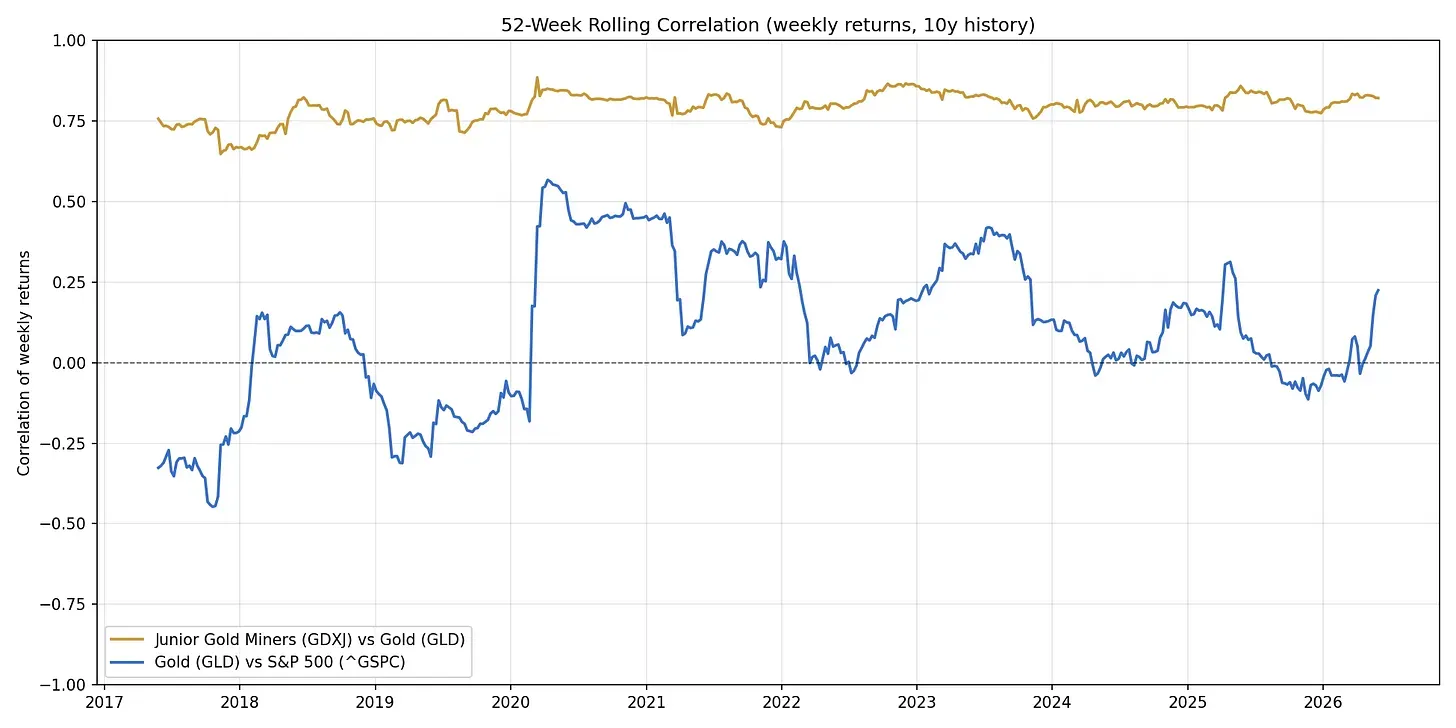
This analogy makes it concrete: Small-cap gold mining stocks historically correlate with gold prices at ~0.75—a dynamic mirroring today’s traditional crypto market, where most crypto assets behave like leveraged gold miners, with Bitcoin as the underlying gold. The blue curve in the chart represents a different relationship: Gold and the S&P 500 both respond weakly to macroeconomic forces—but each follows its own independent logic. This is precisely the trajectory exogenous assets will follow. Over time, these assets will progressively detach from Bitcoin-driven price movements.
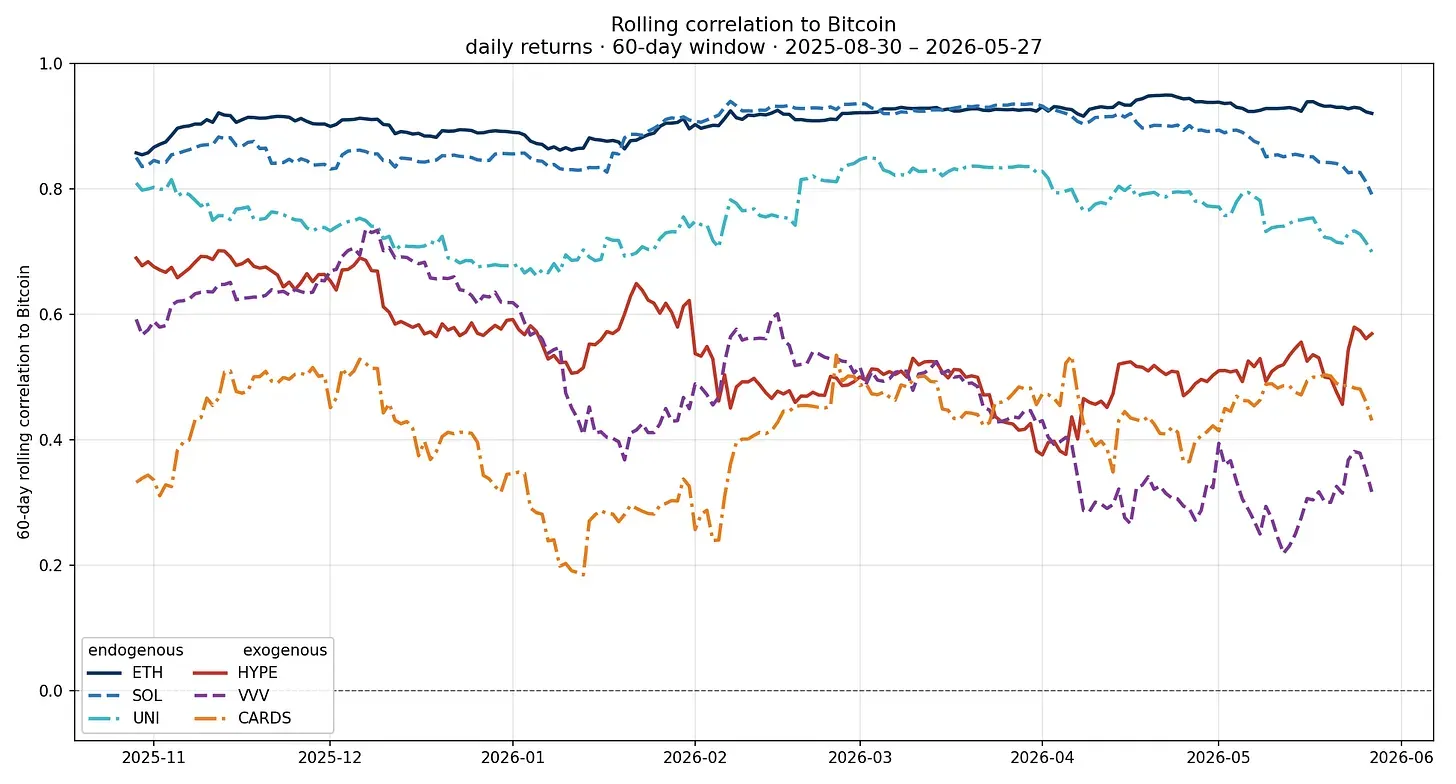
It should be noted that many exogenous projects issue tokens themselves—a phenomenon that both validates the above trend and constitutes a special case.
Currently, the vast majority of endogenous assets still move in near-perfect lockstep with Bitcoin; a few exogenous assets show reduced correlation, but given their short operating histories, these signals remain too preliminary to be highly indicative. Industry patterns consistently follow a sequence: fundamentals evolve first, and market correlations shift afterward.
This shift has completely rewritten industry analysis logic. Analyzing exogenous assets requires fundamental due diligence akin to traditional corporate research: mapping paying user cohorts, modeling unit economics, and assessing industry moats. Bitcoin price is no longer the primary reference point—analyzing such projects resembles how fintech investors conduct diligence, with the added nuance of asset custody as a distinctive layer.
Below are exogenous sectors currently showing strong growth potential:
- Onchain exchanges and broker-dealers
- Clearing and redemption solutions for long-tail asset tokenization
- Deep integration of crypto and AI (e.g., private inference, distributed open-source model training like Psyche by Nous Research)
- Next-generation digital banks (privacy-focused Payy and Raycash merit attention; Aztec and Zama—providing programmable privacy infrastructure—are also promising)
- Lending (Morpho has become the institutional repo market’s dominant choice; smaller players like Valinor and 3jane focus on private credit niches)
- Stablecoin issuers and real-world asset tokenization service providers
- Payment rails (Stripe and Tempo lead in general-purpose payments; Coinbase leads in agent-native payments)
- Non-financial crypto consumer products (e.g., Venice, Collector Crypt—projects that anchor tangible business value in tokens, driving product adoption and marketing effectiveness)
- Agent economies (core opportunities lie in the access layer—agent, service provider, and creator ecosystems—where substitutability is low. Cloudflare leads in deployment, though whether it will charge traffic fees or offer only foundational infrastructure remains unresolved)
At present, investing in equity stakes of relevant enterprises remains the most reliable way to gain exposure to these sectors; high-quality token investments remain rare exceptions. Token utility will only expand as value-capture mechanisms mature—a process requiring coordinated efforts from regulators and the entire industry. Progress is already underway: regulatory-wise, the CLARITY Act advances steadily; industry-wise, institutions like Blockworks push for greater market transparency. Token mechanism optimization remains a long-term endeavor.
Yet none of these details alter the central trend: the crypto market’s drivers are shifting from monolithic to multifaceted. Industry research priorities are pivoting from interpreting Bitcoin price charts to deep-diving into corporate fundamentals. Over the next decade, there will be no need to wonder why the “crypto market” no longer moves in unison—because the industry’s structural landscape has already been transformed.
Join TechFlow official community to stay tuned
Telegram:https://t.me/TechFlowDaily
X (Twitter):https://x.com/TechFlowPost
X (Twitter) EN:https://x.com/BlockFlow_News


