A Comprehensive Guide to the DEUS Token Economic Model of XMAQUINA
TechFlow Selected TechFlow Selected
A Comprehensive Guide to the DEUS Token Economic Model of XMAQUINA
XMAQUINA is a DAO focused on the humanoid robotics sector. Through on-chain governance and the DEUS token, it transforms equity in private robotics companies—previously accessible only to institutional investors—into an on-chain capital allocation system that is accessible, price-discoverable, and liquid for a broader range of participants.
 Navigating Web3 tides with focused insights
How a DAO Can Efficiently Participate in the Equity Structure of a Leading Global Humanoid Robotics Company
The humanoid robotics industry has moved beyond conceptualization into real-world deployment.
In 2025 alone, this sector attracted nearly $14 billion in funding. Top-tier companies—including Figure AI, Apptronik, 1X Technologies, NEURA Robotics, and Agility Robotics—collectively command valuations exceeding $85 billion. Despite rapid growth, market access remains constrained to private markets, with participation largely limited to institutional capital.
XMAQUINA was designed specifically to address this structural gap.
This DAO has already established verified equity positions across five private humanoid robotics companies—and governs those positions entirely on-chain. The DEUS token serves as the coordination layer underpinning the entire system.
This article outlines how the system operates—and why it matters.
Overview of XMAQUINA
XMAQUINA is a governance-first capital allocation layer focused exclusively on the humanoid robotics sector.
It identifies, acquires, and manages equity stakes in humanoid robotics companies while building infrastructure to make those stakes accessible and liquid on-chain. Historically a relatively closed market, the humanoid robotics sector gains a structured entry mechanism through XMAQUINA.
The ecosystem comprises four tightly integrated layers:
- The DAO governs treasury and capital allocation decisions via on-chain voting. No funds are deployed without explicit approval from token holders.
- The Robotics Capital Markets Protocol (RCM Protocol) provides liquidity infrastructure, transforming illiquid robotics equity into tradable on-chain markets.
- The DEUS token functions as a coordinating asset bridging governance and liquidity.
- DEUS Labs incubates new projects aligned with humanoid robotics investment logic—acquiring equity at inception and extending the ecosystem beyond external capital allocation.
This architecture integrates capital formation, governance, and liquidity into a unified system.
Core Problem
Private robotics markets remain structurally inaccessible.
Participation typically requires accredited investor status, incurs high transaction costs, and relies heavily on slow, opaque secondary markets—where settlement may take weeks and market access often hinges on personal networks.
This creates a severe disconnect between value creation and participation opportunities.
Introducing the Robotics Capital Markets Protocol
The Robotics Capital Markets Protocol transforms traditionally illiquid robotics equity into accessible, on-chain markets.
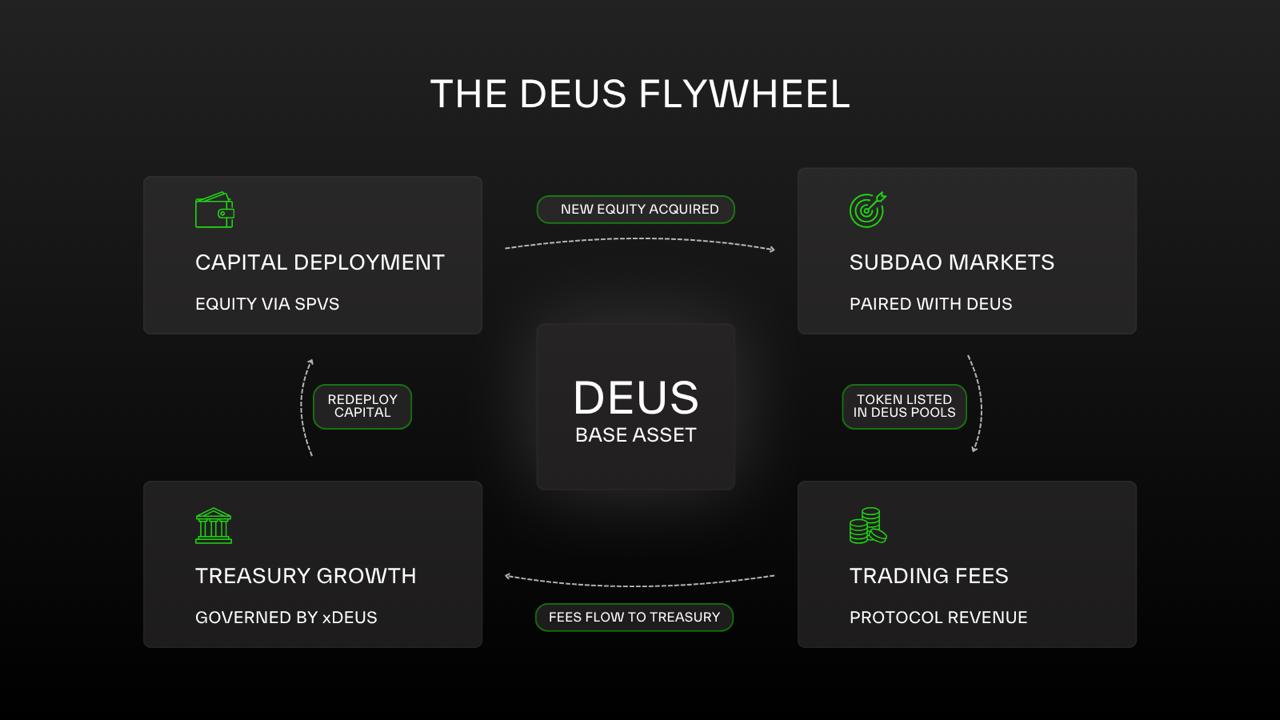
Each equity position acquired by the DAO is held through a dedicated Special Purpose Vehicle (SPV), represented by a bespoke SubDAO token. These tokens are paired with DEUS tokens and made available for trading on-chain—providing sustained market access for private humanoid robotics companies.
The protocol follows a clearly defined operational workflow:
- The DAO identifies and invests in projects;
- Corresponding equity is held via SPV;
- A matching SubDAO token is minted and injected into a DEUS liquidity pool;
- Fees generated from trading activity flow back to the DAO treasury.
The DEUS token serves as the foundational asset across all markets. As new equity positions are added, trading volume increases—generating more fees, expanding the treasury, and enabling further capital deployment.
This forms a self-reinforcing cycle linking capital deployment, liquidity, and treasury growth.
The protocol captures value both at project launch and continuously through ongoing trading—while governance determines how that capital is allocated across the ecosystem.
Portfolio
Real Equity from Private Robotics Companies
XMAQUINA holds direct equity stakes via purpose-built SPVs—not synthetic asset mappings or derivatives.
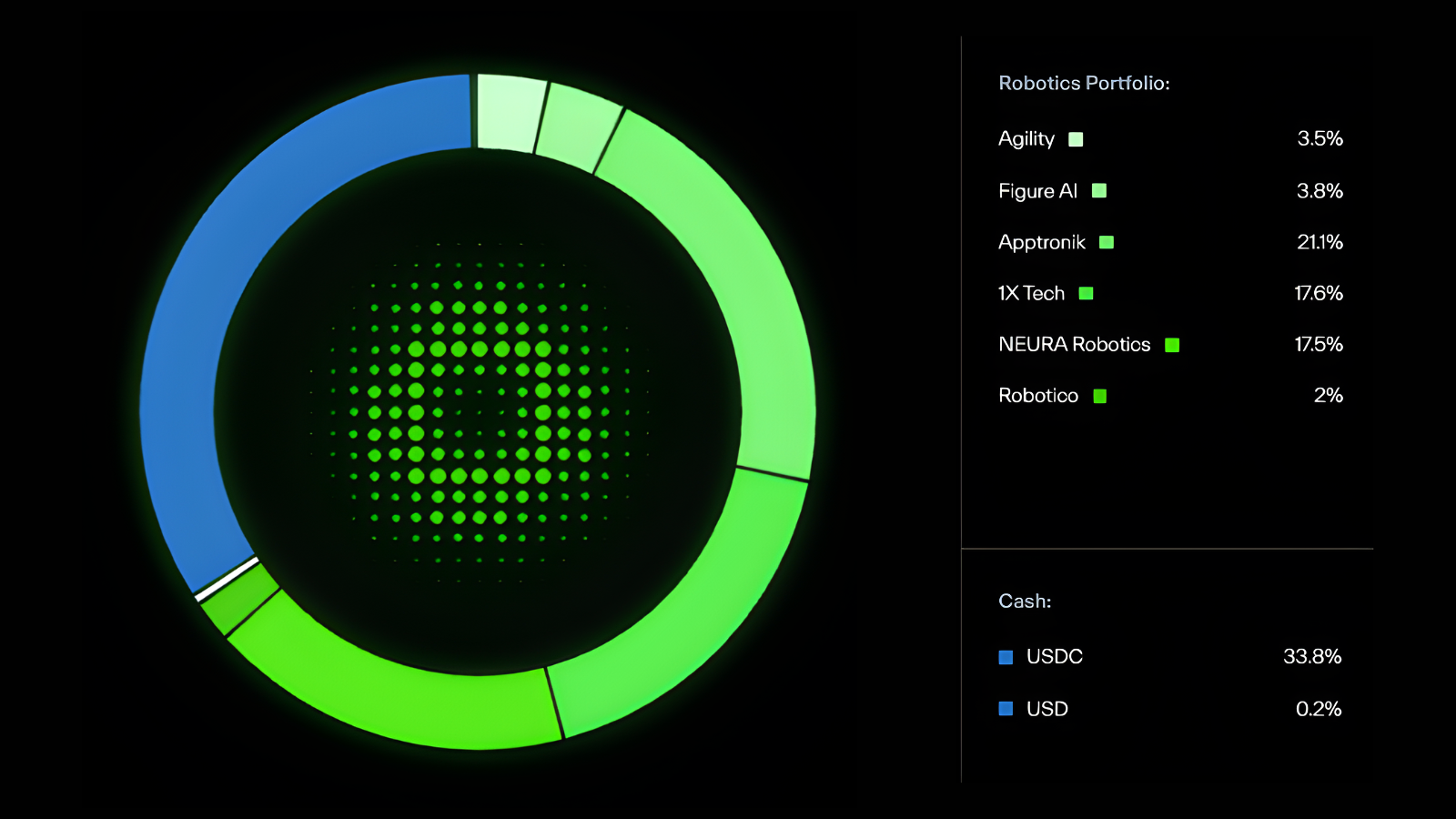
The current portfolio includes seven investments across six companies—giving investors early exposure to leading humanoid robotics firms ahead of their public market debut.
Apptronik
Total funding: $935 million; valuation: $5.5 billion.
The DAO’s stake in preferred shares has appreciated 103%.
The company is developing Apollo—a humanoid robotics platform for manufacturing and logistics—and has launched pilot programs with multiple industrial partners.
1X Technologies
Total funding to date: $136.5 million.
The DAO’s stake has appreciated 119%.
The company focuses on consumer-facing humanoid robots and has begun early residential deployments.
NEURA Robotics
Currently fundraising at a $4.3 billion valuation.
The DAO’s stake is carried at cost.
The company is building cognitive robotics systems alongside a shared intelligence layer.
Figure AI
Total funding exceeds $1 billion; valuation: $39 billion.
The DAO holds common stock.
Its humanoid robot system is already operating in industrial environments under continuous daily use.
Agility Robotics
Total funding: ~$680 million; valuation: $1.8 billion.
The DAO holds preferred shares.
Its Digit robot is among the first humanoid robots approved for commercial workplace deployment.
XMAQUINA’s portfolio continues to expand—all allocations and performance data are transparently disclosed via the DAO portal.
The DEUS Token
Functions Within the XMAQUINA Ecosystem
The DEUS token is not a passive asset.
It acts as the coordination layer across governance, capital deployment, and liquidity infrastructure—operating across five core dimensions.
1. Treasury Exposure
DEUS tokens represent governance rights over a treasury holding equity in humanoid robotics companies.
Such opportunities are typically reserved for institutional capital. Through the DAO, this exposure is collectively organized—its investment opportunities sourced from publicly formed capital and regulated distribution.
2. Governance
DEUS token holders directly participate in all capital allocation decisions—including:
- Treasury fund deployment
- Portfolio construction
- Protocol parameter adjustments
- Ecosystem expansion decisions
Governance is executed via xDEUS, with voting power increasing based on long-term alignment. This ensures decision-making authority rests with long-term participants—not short-term actors.
3. Value Distribution
All value generated within the ecosystem is governed by DEUS token holders—including:
- Trading fees from the RCM Protocol
- Returns from equity positions
- Outcomes from DAO-incubated projects
Distribution decisions are made on-chain and may include:
- Reinvestment
- Buybacks
- Incentive mechanisms
No automatic distribution mechanisms exist—all value flows require governance approval.
4. RCM Protocol Integration
Every SubDAO token in the Robotics Capital Markets Protocol is paired with DEUS tokens.
This makes DEUS the foundational liquidity asset across all markets. As new equity positions are onboarded and new markets created, DEUS’ centrality in trading activity strengthens accordingly.
Protocol fees generated by these markets flow back into the treasury—reinforcing the capital base governed by DEUS token holders.
5. DAO Incubation
Through DEUS Labs, the DEUS token extends its role beyond external capital allocation.
Incubated projects—such as Robotico—are introducing new infrastructure into the humanoid robotics ecosystem. The DAO holds equity in these projects from inception—extending its exposure to data, analytics, and coordination layers surrounding the core asset class.
This adds an additional pathway for long-term value creation aligned with the broader robotics investment thesis.
The DEUS Flywheel
The DEUS token represents governance rights over a treasury holding real equity in leading humanoid robotics companies.
DEUS token value is structurally tied to the expansion of the Robotics Capital Markets Protocol:
As trading activity grows, fees accumulate at the treasury level; treasury growth enables further capital deployment—expanding the number of markets and reinforcing the cycle.
This system links capital formation, liquidity, and governance into a unified positive-feedback loop—where each layer amplifies the next.
Conclusion
Humanoid robotics has entered a phase of tangible, real-world implementation—with capital and capability converging around a handful of leading companies.
Until now, access to this vertical has remained largely confined to private capital.
XMAQUINA proposes an alternative model.
It integrates capital formation, governance, and liquidity into a single unified system—enabling participation to be organized on-chain and allocation decisions made collectively.
Its goal goes beyond gaining exposure to the robotics sector—it aims to build the full infrastructure required to make that exposure accessible, priceable, and allocatable.
As the market matures, advantage will shift away from isolated individual positions—and toward mastery of mechanisms capable of coordinating capital and liquidity across the entire ecosystem.
How to Trade the DEUS Token
At TGE, the DEUS token launched simultaneously across multiple on-chain venues and centralized exchanges.
On Base, DEUS is available for trading on Aerodrome and Virtuals Protocol, offering Base ecosystem users seamless access.
DEUS also launched on Solana via Sunrise DeFi, with liquidity deployed across Solana DEXes as part of its cross-chain rollout.
For centralized exchange listings, live trading pairs can be viewed on:
Resource Links
- Official Website: https://www.xmaquina.io/
- Documentation: https://docs.xmaquina.io/
- X: https://x.com/xmaquina
- Discord: https://discord.gg/xmaquina
Join TechFlow official community to stay tuned
Telegram:https://t.me/TechFlowDaily
X (Twitter):https://x.com/TechFlowPost
X (Twitter) EN:https://x.com/BlockFlow_News
 @xmaquina