OKX Exchange OS Returns Trading Markets from “Centralized Authority” to “Bazaar”
TechFlow Selected TechFlow Selected
OKX Exchange OS Returns Trading Markets from “Centralized Authority” to “Bazaar”
If Web3 solves the question of “who can issue assets,” Exchange OS addresses the question of “who can create markets.”
 Navigating Web3 tides with focused insights
Thousands of years ago, markets were inherently peer-to-peer. Two people met at a bazaar—one had grain, the other cloth—and negotiated and traded directly, with no third-party approval required. Markets emerged organically, and pricing power resided entirely with the transacting parties.
Later, intermediaries entered the market, shifting authority from individual vendors to a handful of large trading venues: stock exchanges, commodity exchanges, regulatory bodies, and clearinghouses. These entities decided what could be traded and what could not, who was qualified to operate a market—and who was not.
With the advent of blockchain, users can now trade peer-to-peer, and assets can flow freely on-chain without centralized institutions acting as trusted intermediaries. Yet in practice, even on-chain, the question of “who gets to create a market” remains firmly in the hands of a few platforms and protocols. Want to launch a perpetual futures market? You either build your own matching engine, margin system, and liquidation logic from scratch—or submit your market for approval and listing on an existing platform, surrendering both pricing control and user ownership.
OKX’s newly launched Exchange OS aims to fundamentally change this: returning the right to launch markets to everyone.
How Exchange OS Restores the Market
Exchange OS is an open-protocol infrastructure built by OKX on X Layer. Core exchange capabilities—order matching, margin management, liquidation, settlement, and unified accounts—are no longer closed, proprietary products confined to single platforms. Instead, they are modular, composable protocol-layer services accessible to anyone. In other words, Exchange OS is not an exchange itself—it’s the foundational infrastructure upon which any exchange can be built.
To make this more intuitive, consider this analogy: Exchange OS plays the same role in financial markets that HTTP plays on the internet. HTTP opened up communication protocols, enabling anyone to build websites and services without reinventing protocols, servers, or routers. Likewise, Exchange OS opens up the underlying infrastructure—anyone can launch a market on top of it.
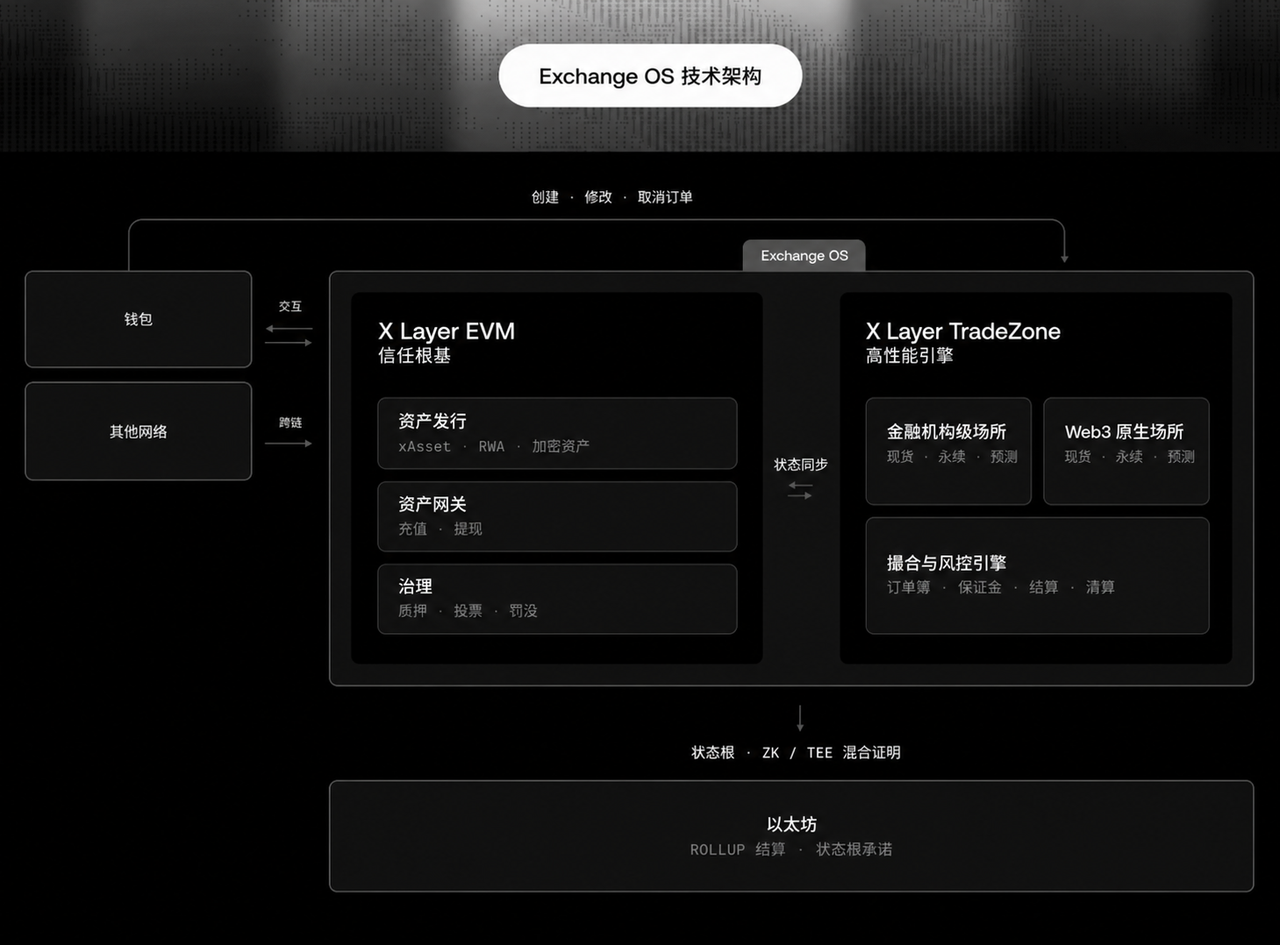
If you want to create a market, simply stake X Layer’s native asset to deploy your own market on Exchange OS—including spot, perpetual futures, and prediction markets—no application, no platform approval required. All core exchange capabilities—matching engine, margin system, liquidation mechanism—are already implemented at the protocol layer and ready for immediate use. This saves time and effort, letting you focus entirely on designing and operating the market you envision.
Market creators can be quant teams, real-world asset (RWA) institutions, new L1 projects—or any individual who identifies a tradable demand and wants to turn it into a live market.
Different deployers can build distinct market forms atop Exchange OS. Some embed their market directly into a centralized exchange (CEX) app, offering users a seamless, traditional-exchange-like experience with one-click access. Others enable direct connection via self-custodial wallets, preserving full on-chain autonomy. Both models share the same underlying protocol stack—identical rules and identical infrastructure. Deployers choose their deployment approach based on their own judgment of user needs and compliance requirements. OKX provides only the infrastructure—neither prescribes nor endorses any specific compliance model.
One Account, All Markets
For ordinary users, the most immediate impact of Exchange OS is a dramatic improvement in account experience.
Today, an active on-chain trader often juggles multiple venues: participating in prediction markets on Polymarket, opening perpetual contracts on a DEX, buying spot assets on a centralized exchange. Accounts are siloed, funds are fragmented, and margin cannot be shared across venues. Every time a new market launches, users must reallocate capital—depositing fresh funds into a new market and a new account.
This experience resembles pre-interoperability social platforms: you maintain one follower list on Weibo, another on X, and start over again on Xiaohongshu—re-registering, reconfiguring profiles, and rebuilding social graphs each time you switch platforms. You’re doing the same thing repeatedly, yet expending multiples of the effort. Web3 social aimed precisely to solve this: using an on-chain social graph to anchor identity and relationships, so one identity and one set of follows work universally—maintain once, apply everywhere.
Likewise, Exchange OS brings “unified identity and unified capital” to the world of trading. One account, one pool of capital, powers spot, perpetual futures, and prediction markets—all managed centrally at the protocol layer. Participating across multiple markets requires no cross-venue transfers, no multi-account management, and no repeated deposits when new markets go live. Maintaining a single account covers all markets.
For professional traders, this means a fundamental leap in capital efficiency. The same capital is no longer fragmented and locked across separate platform accounts—it can simultaneously serve multiple markets and strategies. For example, while participating in a prediction market, you can use the same margin to hedge the underlying asset via perpetual contracts—a level of capital reuse previously nearly impossible, but natively supported by Exchange OS.
Any Verifiable Event Can Become a Market
For those wanting to launch markets, Exchange OS unlocks yet another possibility.
Imagine these scenarios: A crypto-technical user believes the question “Will a certain L1 surpass Ethereum this year?” deserves a price; an RWA institution wants to tokenize shares of a private fund and make them tradeable on-chain; a quant team spots arbitrage opportunities in perpetuals for a low-cap token and wants to launch its own market.
How do they realize these ideas? They could build an entire system from scratch—but that’s prohibitively complex and expensive, feasible only for elite institutions. Or they could partner with a platform—but platforms impose their own review criteria, listing timelines, and revenue-sharing terms, and often decline niche markets. Despite real demand, markets remain unrealized.
Exchange OS removes this barrier entirely: Users can turn trending events into prediction markets; communities can transform topics into tradable propositions; institutions can convert assets into on-chain markets. Everyone focuses on what they do best—the infrastructure challenge is handled by Exchange OS.
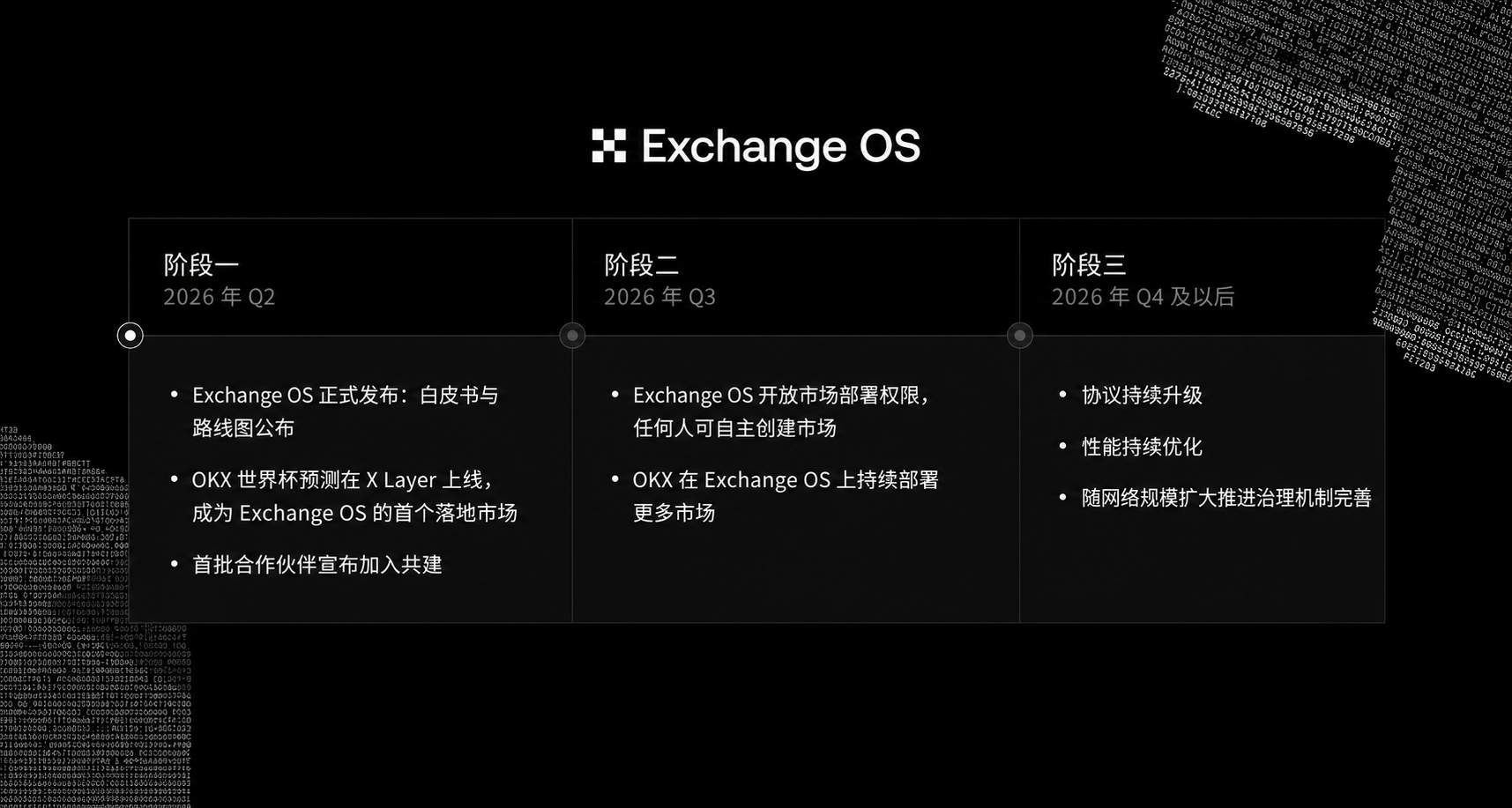
In the past, tradable assets were determined by platforms—mostly hundreds of tokens, plus occasional derivatives, while niche demands rarely made it onto listings. Now, any event that is objectively verifiable can theoretically become a market on Exchange OS. For the first time, market boundaries are no longer defined by platforms—but by the real world’s universe of verifiable events.
The broader ecosystem implication is profound: market quantity and diversity will no longer be constrained by any single platform’s operational capacity or commercial priorities—but driven instead by genuine market demand. Wherever people want to trade, a market can exist.
Entrusting Fund Security to Code
No discussion about open markets can avoid one critical question: Is it secure? And in crypto markets, this question carries extraordinary weight. Over recent years, too many platforms have attracted users with claims of “decentralization,” only to abscond with deposited assets through various means. Users have learned the hard truth: a platform declaring itself secure is not the same as it actually being secure.
Exchange OS answers this head-on: User funds are locked inside protocol smart contracts—no party can unilaterally withdraw them, including market deployers and OKX itself. Security does not rely on trusting any institution, but on transparent, auditable code and immutable protocol rules. The protocol is fully open-source—anyone can inspect every line of logic.
The worst-case scenario is a poorly designed market launched by a deployer—not a platform exit scam stealing users’ funds. These two risks are fundamentally different: the former is market risk; the latter is trust risk. Exchange OS eliminates the latter.
Meanwhile, OKX’s own markets built on Exchange OS follow the exact same protocol rules as those deployed externally. OKX has no backdoor at the protocol level, no platform privileges, and cannot bypass rules to grant preferential treatment to its own markets.
Of course, “anyone can launch a market” also necessitates mechanisms to deter malicious behavior. Exchange OS addresses this by requiring market deployers to stake X Layer’s native asset—serving as economic collateral. If a deployer harms users, the governance council may penalize this staked asset, with penalty severity proportional to the misconduct. Launching a market incurs cost; misbehaving incurs cost—that’s the economic foundation sustaining the entire system.
Exchange OS in Historical Context
To grasp Exchange OS’s significance, we must situate it within a longer historical arc.
Over the past decade-plus of blockchain development, pivotal moments have repeatedly reshaped power structures. Bitcoin enabled peer-to-peer value transfer—the first time people could send money without banks. Ethereum empowered anyone to issue assets, democratizing “token issuance”—a capability once reserved exclusively for institutions. Automated Market Makers (AMMs) allowed anyone to create liquidity pools, eliminating reliance on professional market makers. Prediction markets turned “events” into tradable assets for the first time, expanding market boundaries from asset prices to all human-judgment-based outcomes verifiable in reality. Each step decentralized a power once held by a select few.
Exchange OS represents the next evolution along this path: empowering anyone to build complete financial markets. What was once feasible only for top-tier exchanges is now a composable, protocol-layer service available to all. This is the liberation of market creation rights. Drawing a parallel to internet evolution: In Web1, content was produced by a few websites and institutions, and users were passive consumers. Web2 democratized content creation—anyone could write articles or launch channels as technology spread. Web3 extended openness to the asset layer—anyone can mint tokens or create liquidity pools, drastically lowering barriers to financial participation.
Exchange OS advances this trajectory one step further: making “launching a market” something anyone can do. If Web3 solved “who can issue assets,” Exchange OS solves “who can create markets”—precisely the form next-generation financial infrastructure should take.
Thousands of years ago, anyone could open a bazaar stall. Exchange OS restores that freedom—on-chain.
Read the Exchange OS Whitepaper and join us in building the future of trading markets.
Join TechFlow official community to stay tuned
Telegram:https://t.me/TechFlowDaily
X (Twitter):https://x.com/TechFlowPost
X (Twitter) EN:https://x.com/BlockFlow_News
 OKX
OKX