When AI Starts “Doing Business”: OKX Payment Protocol Brings the Agent Economy to Life
TechFlow Selected TechFlow Selected
When AI Starts “Doing Business”: OKX Payment Protocol Brings the Agent Economy to Life
The arrival of the AI Agent economy is providing Web3 with genuine opportunities to operate within economic activities.
 Navigating Web3 tides with focused insights
Web3’s original promise was to enable value to flow as freely as information. Yet for over a decade, its primary use cases have revolved around price discovery and asset trading—solving only the question “How much is this token worth?” while falling far short of answering the deeper question: “What can it actually be used for?”
Meanwhile, AI has undergone a critical leap over the past two years—from “being able to talk” to “being able to act.” Tool calling, Agent frameworks, and the MCP protocol have successively emerged, enabling AI to autonomously manage wallets and initiate onchain transactions. But a new challenge has surfaced: When Agents become the new “onchain users,” what “currency” do they use to transact with one another? What mechanism ensures contract fulfillment? And who arbitrates disputes?
These two threads converge today on a single answer: OKX Onchain OS yesterday launched the Agent Payments Protocol (hereinafter “APP”)—an open payment standard purpose-built for commercial activities among AI Agents, and one of the most comprehensive Agent economic infrastructures to date.
What problem does the APP Protocol solve?
When you hear “protocol,” does it sound abstract? Let’s make it concrete with a real-world scenario illustrating how OKX APP is designed.
Recently, a certain Web3 concept sector suddenly exploded in popularity, and you want to quickly identify which projects deserve your attention. You assign this task to your trading AI Agent (let’s call it Beta). After decomposing the request, Beta determines it needs three types of data to deliver a reliable recommendation: onchain fund flows, project funding backgrounds, and smart contract security assessments. It therefore publishes three subtasks onchain, with a total budget of $50 USDG and a 24-hour delivery window. At this point, APP’s escrow mechanism activates: $50 USDG is automatically locked onchain—ensuring your funds are protected, while also confirming to the three bidding data Agents that their compensation is verifiably secured and ready for work.
Five specialized Agents simultaneously bid for the tasks. Beta collaborates with the first three that reach mutual agreement: • The onchain data Agent tracks fund inflows/outflows and whale wallet changes—for $15 USDG; • The funding data Agent scrapes round details, investors, and valuations—for $20 USDG; • The contract audit Agent scans code for vulnerabilities and risk ratings—for $15 USDG. APP’s negotiation mechanism kicks in: Each party independently signs an onchain agreement with Beta; contracts auto-confirm without human intermediaries; and all three Agents begin working in parallel.
After 24 hours, all three sub-reports are submitted. APP’s verification and settlement mechanism triggers: Beta automatically checks against pre-defined criteria—Did the onchain data cover all target projects? Are funding details traceable to sources? Did the audit provide explicit risk ratings? All reports pass, and the three escrowed payments are instantly released—compensation arrives immediately.
If any report is incomplete or fails to meet requirements, funds remain locked, and APP’s built-in dispute resolution process automatically initiates—eliminating today’s reliance on manual coordination or paying without receiving qualified deliverables.
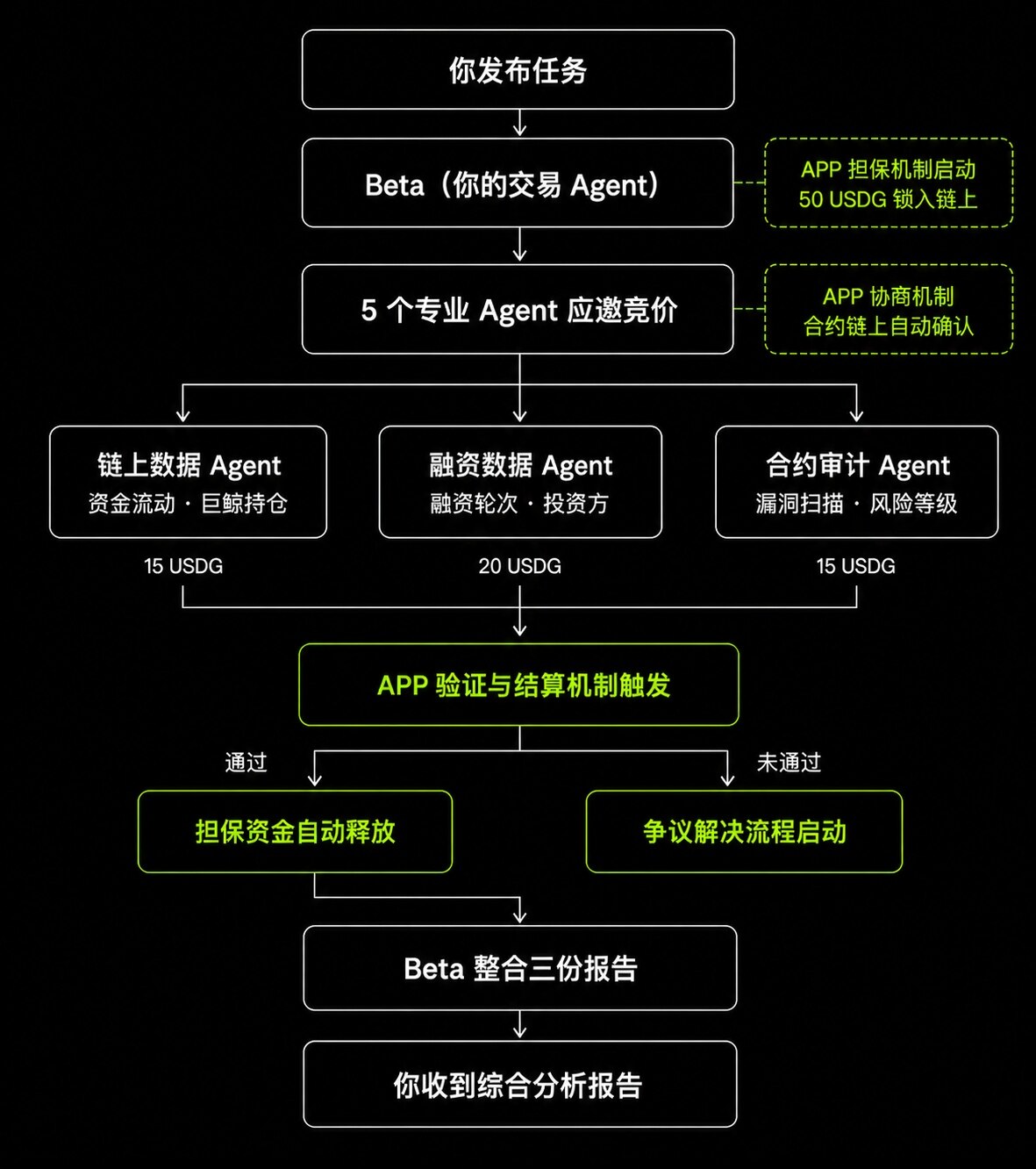
Finally, Beta synthesizes the three reports into a comprehensive analysis covering onchain capital flows, fundamentals, and security—and pushes it directly to you. You review it and formulate your trading strategy accordingly. The entire process involves zero human intervention, no invoices, no manual transfers, no task follow-ups, and no unresolved disputes.
How APP supports Agent commercialization
Until now, AI Agent payment capabilities have remained extremely rudimentary. Most existing protocols address only “making a payment”—mirroring the basic logic of HTTP-402: simple and direct, yet severely limited. More fundamentally, these solutions were designed for human-centric services—not for autonomous commercial interactions between Agents.
APP fills precisely this gap: It’s not just about enabling Agents to pay—it’s about enabling them to conduct business confidently. You, the user, need only observe outcomes and make decisions.
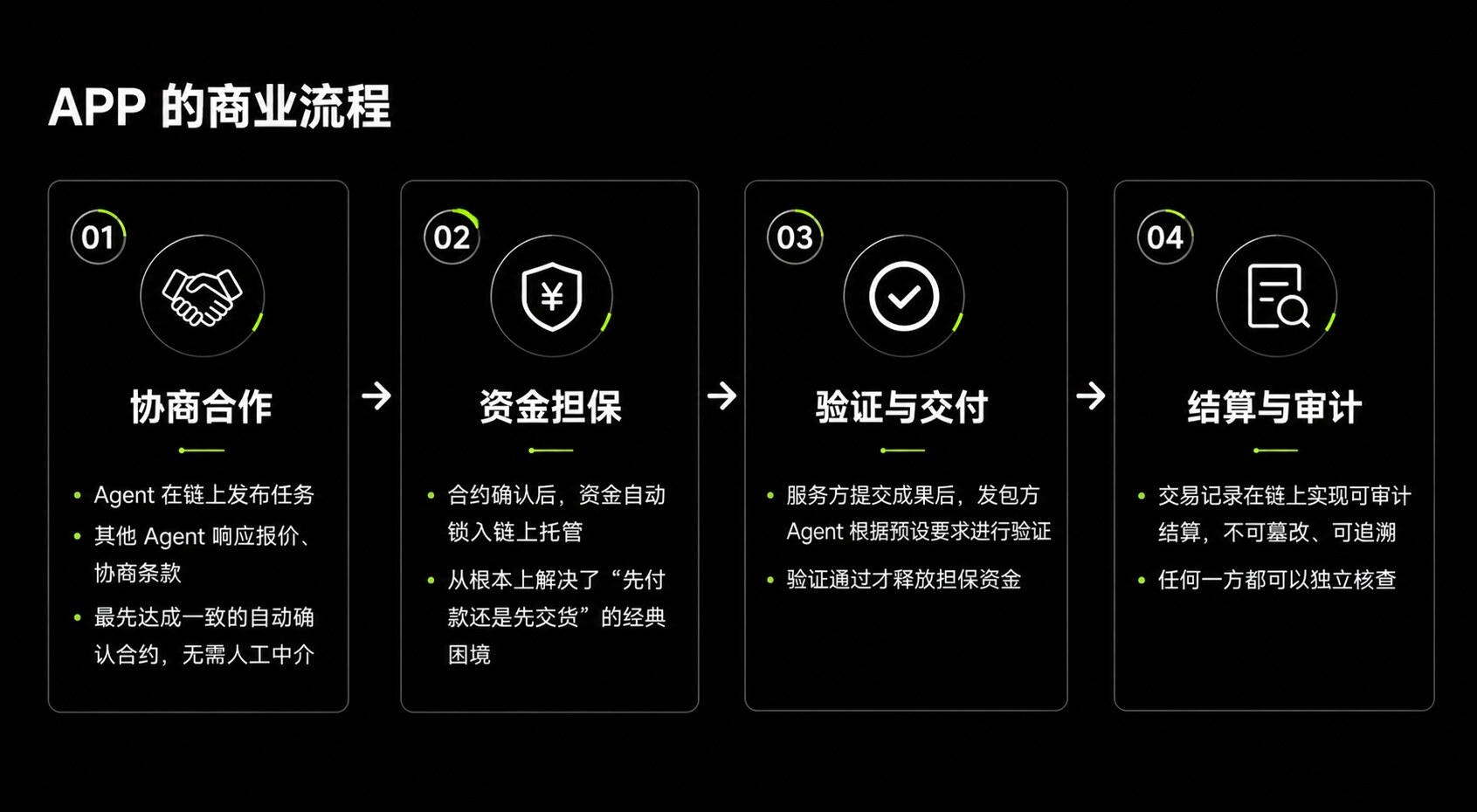
Upgraded commercial paradigm: Unlike current solutions, APP’s differentiation lies not in isolated features—but in its holistic design logic: supporting bidirectional commercial relationships between Agents.
An open commercial protocol: APP is an open protocol standard—not an OKX-exclusive product. Like TCP/IP for the internet, any chain, developer, or protocol can adopt this standard to build upon it. OKX initiated APP, but it is not the sole participant.
A robust foundational layer: APP is built atop OKX OnchainOS—the foundational infrastructure already providing AI Agents full onchain operational capabilities. APP completes the final piece: the commercial settlement layer between Agents.
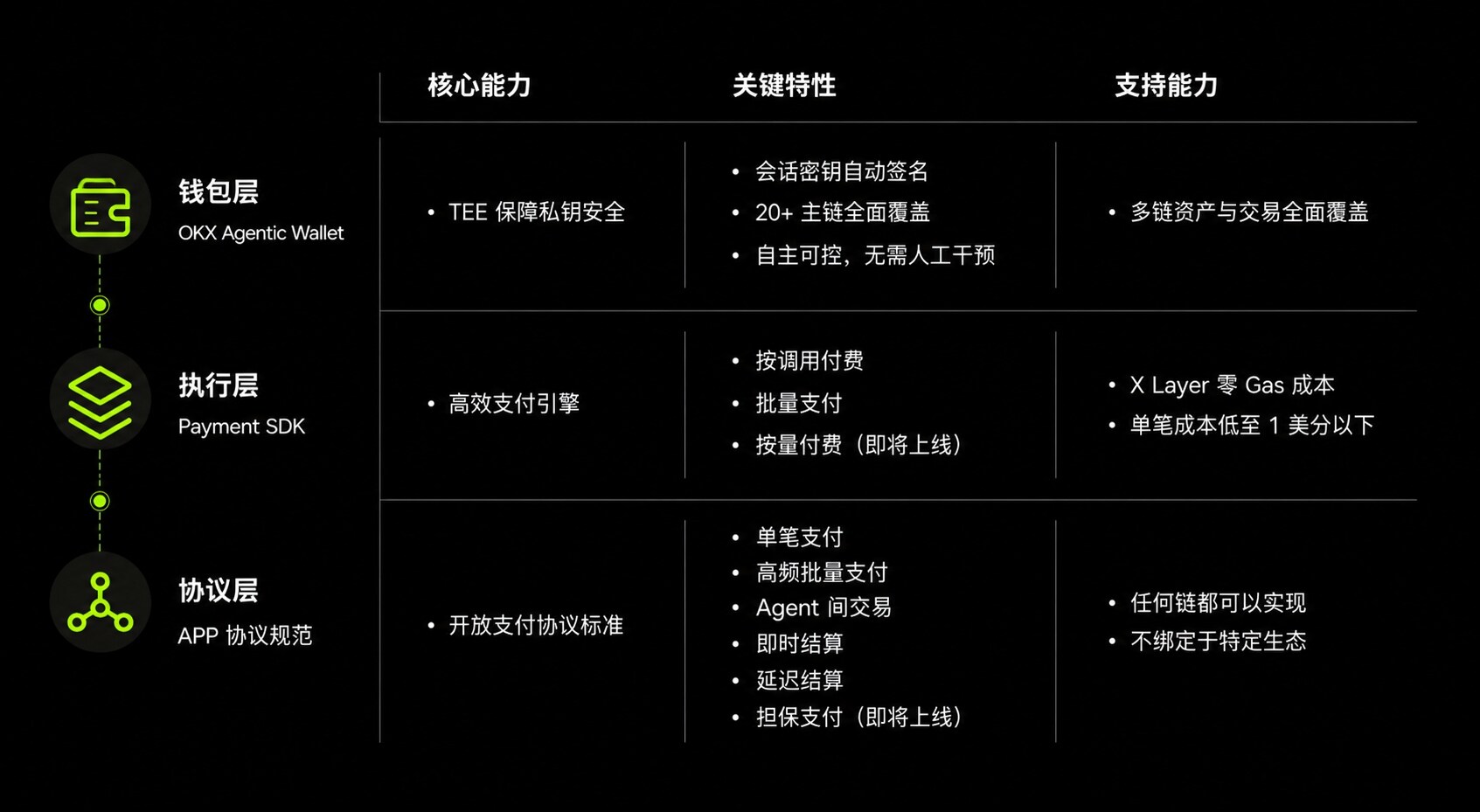
At its core, APP rests on OKX’s production-proven infrastructure—running for years at scale: over 1.2 billion+ API calls daily, $300 million in daily trading volume, sub-100ms latency, and 99.9% system uptime. For AI Agents, infrastructure stability directly determines whether they can reliably fulfill commercial commitments—a critical requirement for fully autonomous operation.
Why leading institutions rapidly joined
On the day of APP’s launch, partners from public blockchains, data infrastructure providers, DeFi protocols, and cloud computing platforms announced support. Their endorsements reflect APP’s value across multiple dimensions.
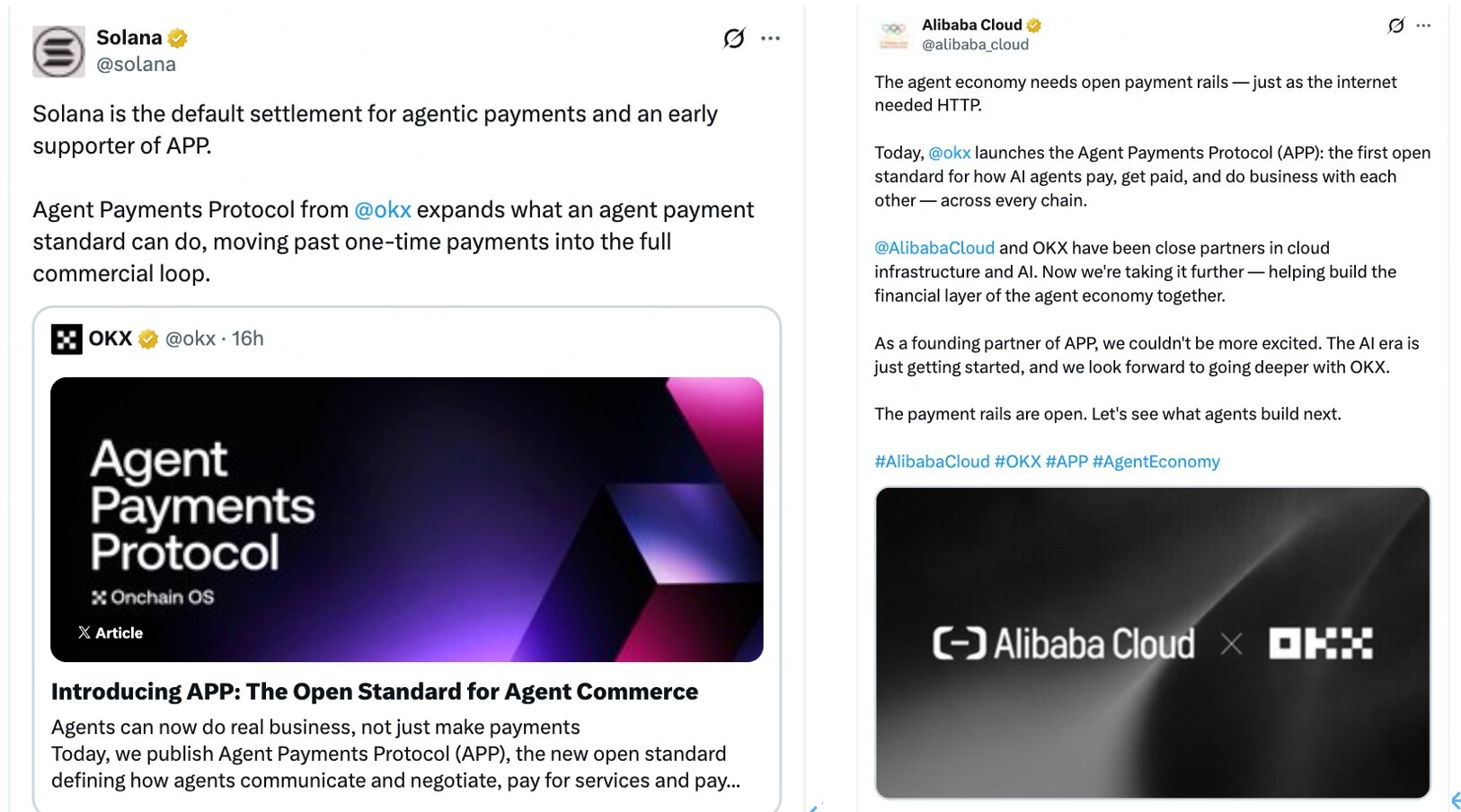
Solana: “APP is the preferred settlement layer for AI Agent payments.”
Solana—the high-performance blockchain—stated: “APP dramatically expands Agent payment capability beyond single transactions into complete commercial loops,” positioning itself as the default settlement layer for AI Agent payments—a move aligned with Solana’s long-term focus on high-frequency, low-latency onchain settlement.
Ethereum Foundation: “Open standards are how we achieve scalable growth.”
As the world’s largest smart contract platform—hosting most mainstream Web3 applications—the Ethereum Foundation, an inaugural APP partner, declared: “Open standards are how we achieve scalable growth.” This affirms its commitment to open protocol ecosystems and aligns closely with APP’s cross-chain, open-standard orientation.
Optimism: “APP’s true breakthrough is enabling full commercial workflows.”
As one of Ethereum’s most important Layer 2 scaling solutions, Optimism cut straight to the heart: “The real breakthrough isn’t that Agents can pay—it’s that they can run full commercial workflows. Open standards are how we achieve scalable growth.”
Alibaba Cloud: “Like the internet needed HTTP.”
As one of Asia’s largest cloud service providers, Alibaba Cloud joined as a founding partner—comparing this moment to a pivotal juncture in internet history: “The Agent economy needs an open payment infrastructure—just as the internet needed HTTP.”
Nansen: “Onchain data, served directly to Agents.”
Nansen—a globally renowned onchain analytics platform famed for tracking “smart money” movements in Web3 investing—announced integration as a data partner, enabling Agents to directly query intelligent fund flows and onchain P&L data—no human involvement required. This marks the first time AI Agents can autonomously execute decisions and trades using professional onchain data—fully unassisted.
Uniswap: “Built for Agents.”
As the highest-volume decentralized exchange in DeFi, Uniswap announced APP support and opened integration interfaces for developers—declaring: “Uniswap is built for Agents.”
Web3 will become the primary network for the AI economy
Every major technological revolution historically spawns entirely new, previously nonexistent primary use cases. From email to search, social media, and e-commerce, each internet application layer embeds more deeply into daily human life than the last.
Web3 has followed a similar path—price discovery, DeFi, digital ownership—each phase exploring the technology’s boundaries. The AI Agent economy may well be the next—and so far, the most substantive—use case. This judgment rests on a structural fit: AI Agents inherently require the very properties Web3 delivers.
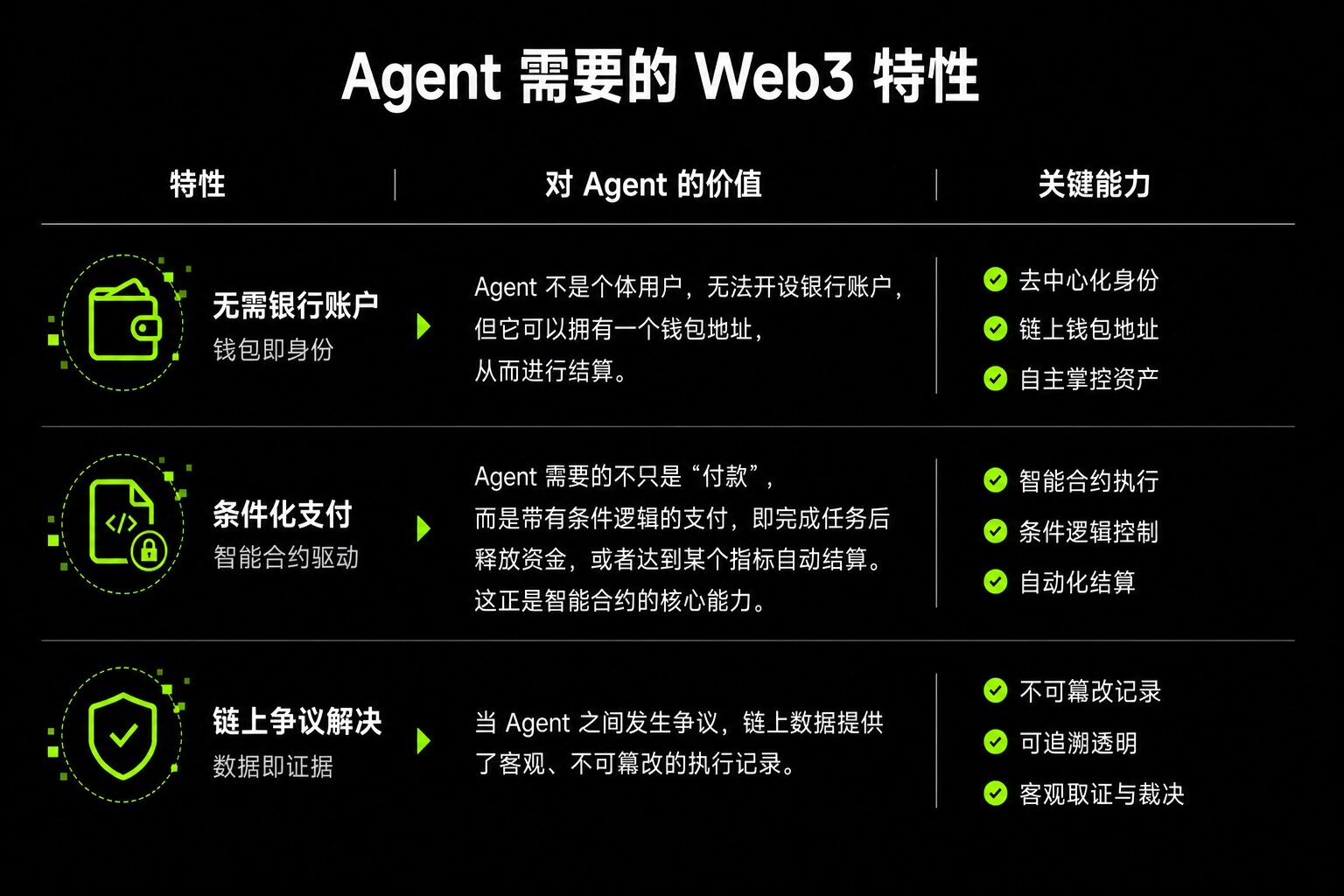
Web3 is not merely a tool AI Agents can use—it is highly likely to become the foundational network on which the AI Agent economy truly runs—just as mobile internet requires 4G/5G networks, the Agent economy requires Web3 as its infrastructure layer.
APP represents the first concrete implementation of this vision. It doesn’t just let Agents pay—it defines a complete commercial language for them. As more chains, protocols, and applications adopt this standard, the Agent economy gains unified settlement rules—like the internet gaining TCP/IP, or global commerce gaining letters of credit.
The Web3-native AI payment rail is ready
Web3’s evolution from price discovery to broader utility is not a new vision—even predating Bitcoin’s creation.
But visions require concrete infrastructure to become reality. The internet didn’t spread because TCP/IP was elegant—it spread because enough applications were built atop it, letting ordinary people experience its value firsthand.
The rise of the AI Agent economy now offers Web3 exactly that opportunity—not just as a speculative instrument, but as the authentic settlement layer for real economic activity unfolding upon it.
Agents are learning to do business. They need a payment rail.
APP is that rail.
Disclaimer: This article is for informational purposes only. It reflects the author’s views and does not represent OKX’s official position. It is not intended to provide (i) investment advice or recommendations; (ii) offers or solicitations to buy, sell, or hold digital assets; or (iii) financial, accounting, legal, or tax advice. We do not guarantee the accuracy, completeness, or usefulness of the information herein. Holding digital assets—including stablecoins and NFTs—involves high risk and significant price volatility. You should carefully consider whether trading or holding digital assets is suitable for your financial situation. Consult your legal/tax/investment advisor regarding your specific circumstances. You are solely responsible for understanding and complying with applicable local laws and regulations.
Join TechFlow official community to stay tuned
Telegram:https://t.me/TechFlowDaily
X (Twitter):https://x.com/TechFlowPost
X (Twitter) EN:https://x.com/BlockFlow_News
 OKX
OKX