Five Value-Based Rationales for Corporate Bitcoin Sales
TechFlow Selected TechFlow Selected
Five Value-Based Rationales for Corporate Bitcoin Sales
Breaking Free from the “HODL” Mindset: Analyzing Flexible Asset Management Strategies
 Navigating Web3 tides with focused insights
By Allard Peng
Translated by Saoirse, Foresight News
Recently, Strategy announced it may sell some of its Bitcoin holdings to achieve operational objectives—a move that sent shockwaves across the market. The company had previously maintained an unwavering stance against selling any Bitcoin; in fact, Saylor once joked on social media that he would liquidate other assets before ever selling Bitcoin.
In reality, selling Bitcoin is a legitimate and viable operational option for enterprises holding Bitcoin reserves. The “never sell” principle reflects a long-term investment philosophy aligned with the broader crypto industry’s emphasis on holding for the long haul. Even as “HODLing” remains widely celebrated, selling Bitcoin remains a rational choice in many scenarios.
At the individual level, Bitcoin sales are often used to improve quality of life—such as purchasing real estate, traveling, funding children’s education, or covering large, unexpected medical expenses. For corporations, however, every business decision ultimately aims to enhance shareholder value.
In Q1 2026, Bitcoin miners collectively sold 25,376 BTC, using the proceeds to pivot into artificial intelligence (AI) businesses. Management determined that AI projects offered a more favorable risk-return profile than holding Bitcoin. This gives rise to a foundational logic: when higher-return investment opportunities exist, selling Bitcoin to redeploy capital is entirely justified. For Bitcoin-heavy firms like Strategy, selling Bitcoin can generate tangible value—driven by five key reasons.
Reason One: Increasing Bitcoin Holdings Per Share
Bitcoin holdings per share constitute a core metric for evaluating how effectively a company manages its Bitcoin reserve. A rise in this metric over time directly reflects Bitcoin’s return on investment. The conventional method to boost this figure is to acquire more Bitcoin, thereby increasing total holdings—but another effective approach is to repurchase shares, reducing the number of shares outstanding. Both methods increase Bitcoin holdings per share.
If a company’s stock price trades below the intrinsic value represented by its Bitcoin assets, selling Bitcoin to repurchase shares will raise Bitcoin holdings per share. In such cases, the reduction in total Bitcoin holdings will be smaller than the reduction in shares outstanding. When operating cash flow cannot cover fixed obligations—such as preferred dividend payments or bond interest—and the stock price is undervalued, selling Bitcoin to meet these obligations minimizes the erosion of Bitcoin holdings per share.
Reason Two: Optimizing Capital Structure and Lowering Financing Costs
Credit rating agencies exert significant influence over capital market flows. Adhering to their assessment criteria helps companies secure financing smoothly. Previous reports have analyzed practical ways to improve credit ratings—stronger ratings directly reduce corporate financing costs.
S&P Global recognizes the value of cash reserves. Strategy adopted this strategy accordingly: as of January 2026, its cash reserves reached $2.2 billion, substantially alleviating investor concerns about its ability to pay preferred dividends.
Companies can sell Bitcoin to bolster cash reserves, meeting capital market expectations and enabling lower-cost bond issuance. Simultaneously, using Bitcoin proceeds to repay debt reduces senior liabilities and enhances the appeal of preferred equity financing.
Over the long term, differences in financing rates compound via the power of interest compounding—lower-cost debt lightens the corporate financial burden and boosts net income.
Reason Three: Legitimate Tax Planning
Currently, U.S. regulations impose no wash-sale restrictions on Bitcoin. Companies can therefore sell Bitcoin to realize paper losses, then immediately repurchase it—effectively lowering the tax basis of their Bitcoin holdings and offsetting taxable income. Strategy employed this tactic during the 2022 market bottom.
This tax advantage remains valid today. Companies can combine loss-offset strategies with share buybacks and debt repayment to achieve multiple synergistic benefits.
Reason Four: Countering Negative Market Sentiment
The Bitcoin industry is still young, and misinformation abounds. Some false narratives claim that if Strategy sells Bitcoin, it would directly destabilize the entire crypto market and invalidate its Bitcoin-HODLing business model.
However, if Strategy sells 50,000 BTC and neither the Bitcoin price nor its own stock price experiences sharp volatility, such rumors would be decisively debunked—helping capital markets accept Bitcoin-reserve-based business models.
Markets possess inherent self-correcting mechanisms. Sensationalism is largely driven by media outlets and independent content creators; professional investment institutions rely on rigorous due diligence—not superficial commentary—to make decisions. This is the most subjective of the five reasons.
Reason Five: Discount Repurchase of Preferred Shares
This operational strategy receives relatively little attention. When floating-rate financial instruments trade significantly below par, companies can repurchase them at steep discounts—effectively extinguishing high-cost liabilities.
Such a transaction is equivalent to closing a short position on the company’s own preferred shares—with zero interest expense and no borrowing cost. Take STRC, for example: issued at a face value of $100, if its market price falls to $82, Strategy can use proceeds from Bitcoin sales to repurchase shares at a $18-per-share profit—tax-free.
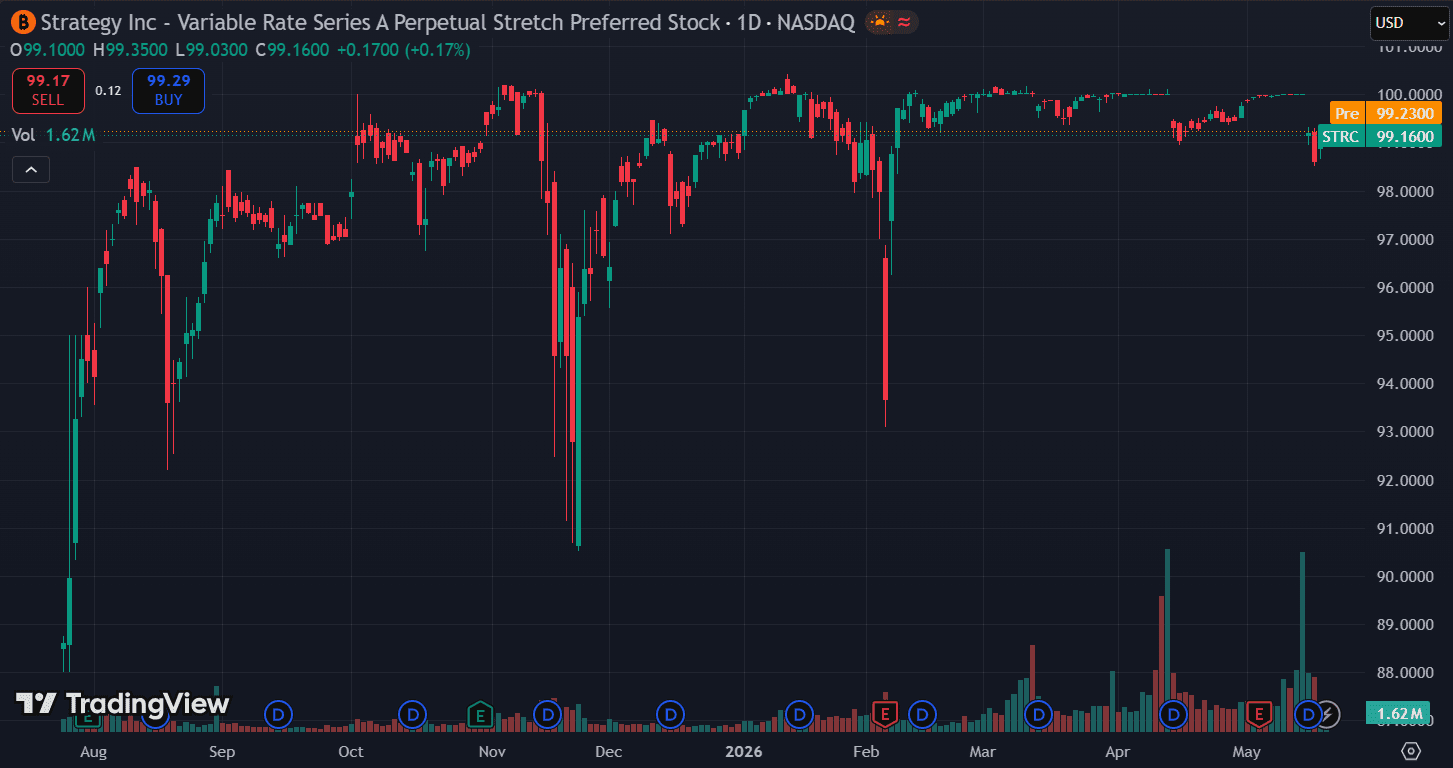
STRC Price Performance Since IPO
Preferred share price declines do not necessarily coincide with Bitcoin bear markets; leveraged trading can trigger cascading liquidations. Companies can opportunistically repurchase shares at depressed prices—avoiding future increases in dividend payouts and associated cash outflows.
Conclusion
Corporate Bitcoin sales need not be viewed as bearish signals. In numerous circumstances, selling Bitcoin actively safeguards both corporate and shareholder interests. As a monetary asset, Bitcoin provides enterprises with flexible liquidity management options—the key lies in deploying it rationally to maximize value.
Join TechFlow official community to stay tuned
Telegram:https://t.me/TechFlowDaily
X (Twitter):https://x.com/TechFlowPost
X (Twitter) EN:https://x.com/BlockFlow_News
 @BitcoinMagazine