What’s Behind AI’s First Internet Celebrity Karpathy Joining Anthropic?
TechFlow Selected TechFlow Selected
What’s Behind AI’s First Internet Celebrity Karpathy Joining Anthropic?
Not an ordinary job switch in Silicon Valley, but a migration of knowledge and power.
 Navigating Web3 tides with focused insights
Author | Hualin Wuwang
Editor | Jingyu
A few years ago, if someone had told me that one of OpenAI’s co-founders would join Anthropic to help its rival advance pretraining research, I’d have assumed they were describing a plotline from science fiction.
But today, that’s exactly what happened.
Andrej Karpathy is a name that needs no introduction in the AI community. He taught Stanford’s CS231n course, is arguably the most popular science communicator in deep learning, co-founded OpenAI, and previously led Tesla’s Autopilot team. A single tweet from him can ignite massive interest in a technical direction; a YouTube video he uploads explaining Transformers routinely surpasses one million views.
And this is the person who just announced he’s joining Anthropic.
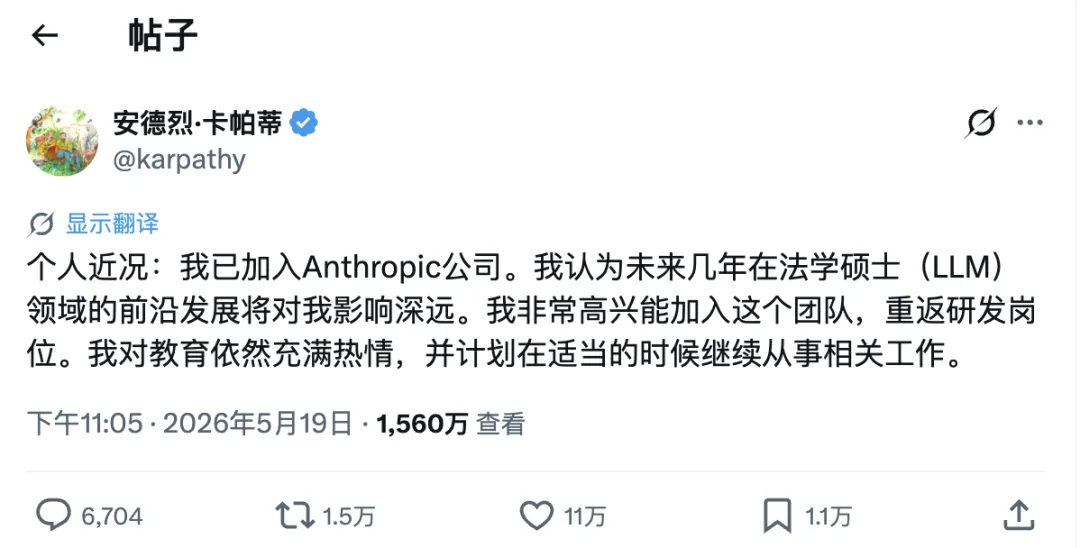
Karpathy’s official announcement on X | Source: X
Karpathy will focus on pretraining research at Anthropic and lead a newly formed team whose core mission is to accelerate exploration in pretraining using Claude.
Pretraining forms the foundational bedrock of large model capabilities. Whoever achieves breakthroughs here gains a decisive first-mover advantage in the competitive landscape over the coming years. Anthropic’s decision to place Karpathy squarely in this domain leaves little room for interpretation.
Yet reducing this move to “just another top researcher changing jobs” would vastly underestimate its significance.
What makes Karpathy uniquely valuable—and exceptionally rare in the AI world—is the rare convergence of technical credibility and broad public influence. He’s not merely an excellent coder or paper author; he’s the kind of researcher whom other elite researchers willingly follow and collaborate with.
There’s a widely held belief in the industry that when a highly respected researcher joins an organization, it often triggers a wave of career reassessment among peers. Karpathy’s arrival may well serve as the signal flare heralding a significant talent influx into Anthropic.
Even more intriguing is his motivation. In 2015, Karpathy was one of OpenAI’s co-founders and witnessed firsthand the organization’s evolution—from its original nonprofit ideals to its current form. Later, he joined Tesla, briefly returned to OpenAI, and eventually left to launch his own startup.
His choice to join Anthropic this time carries unmistakable symbolic weight.
01 Anthropic: The Unstoppable Winner
Viewing Karpathy’s move in isolation risks overlooking a crucial context: Anthropic has recently entered an unusually strong growth phase.
Two weeks ago, data from the Ramp AI Index quietly went viral across tech media outlets.
The report showed Anthropic’s enterprise adoption rate rose by 3.8 percentage points in April to reach 34.4%, while OpenAI’s dropped by 2.9 percentage points to 32.3%. This marks the first time in Anthropic’s history that its enterprise adoption rate has surpassed OpenAI’s—though the margin remains narrow, the directional shift carries enormous significance.
In the same week, Anthropic launched a Claude version tailored for small businesses, integrating tools commonly used by SMBs—including QuickBooks, PayPal, HubSpot, Canva, and DocuSign—and embedding AI capabilities directly into users’ daily workflows. This signals a clear strategic pivot downward: Anthropic is no longer focusing exclusively on enterprise clients but actively expanding into broader markets.
One day earlier, Anthropic announced a partnership with the Bill & Melinda Gates Foundation, pledging $200 million over four years—in funding, Claude usage credits, and technical support—to advance global health, education, and economic development. While the dollar amount isn’t record-breaking, the narrative value is immense: a company originally defined by its emphasis on “AI safety” is now concretely demonstrating its commitment to “responsible AI.”
Karpathy’s hiring arrives precisely at a pivotal moment—just as Anthropic’s valuation nears $1 trillion and its enterprise adoption has officially overtaken OpenAI’s—making it the crowning highlight of this extraordinary momentum.
Fortune magazine captured the sentiment bluntly in its headline: “Anthropic seems unable to stop winning.”
02 Why Not Return to OpenAI?
Where there are winners, there are inevitably those under pressure.
Karpathy is not the first high-profile researcher to leave OpenAI for Anthropic.
In fact, Anthropic’s founding team—including Dario Amodei, Daniela Amodei, and several other key researchers—collectively departed OpenAI in 2021 to establish the company. In essence, Anthropic was born from an internal strategic divergence within OpenAI.
Over the past few years, as OpenAI accelerated its commercialization and productization—ramping up releases, prioritizing revenue, and drawing ever closer to Microsoft—some researchers who prioritize “pure research” or “safety-first principles” began voting with their feet.
Karpathy’s decision to join Anthropic lands at a particularly sensitive juncture. OpenAI has recently intensified its external communications—simultaneously advancing multiple fronts: the GPT series, the o-series models, Sora, and Operator. Industry insiders privately liken OpenAI’s internal pace to “running three marathons at once.” Amid such rapid expansion, retaining researchers who deeply value research rigor—not just sky-high valuations—has become an increasingly difficult challenge.
Of course, OpenAI still commands exceptional talent density and resource scale; one departure won’t shake its foundations. But if such mobility becomes a trend, the real concern lies in the shifting industry expectations it signals.
As one tech analyst put it plainly: “AI development is no longer just a technology race—it’s a war for knowledge leadership. When an influential researcher moves, it can reshape the entire industry’s research priorities.”
Karpathy’s influence within the deep learning community perfectly embodies this insight. His Stanford lectures and YouTube videos serve as foundational reading for many researchers currently working at top AI labs. Where he goes implicitly endorses the idea that “this direction is worth betting on.”
03 Pretraining: Betting on the Future
Returning to the specific focus of Karpathy’s move to Anthropic: pretraining.
Over the past two years, industry attention has largely centered on application-adjacent areas—reasoning, multimodality, agents, and RAG. Some believe foundational model capability breakthroughs have entered a phase of “fine-tuning and optimization,” rather than fundamental leaps forward.
Anthropic clearly disagrees. Assigning Karpathy to build a dedicated team exploring “using Claude to accelerate pretraining research” represents a bold bet on a more foundational, longer-term, yet potentially higher-reward direction.
This reflects an intriguing logic: using existing large models to assist in pretraining the next generation of large models—a paradigm of “AI helping AI evolve.” This path remains nascent, lacking a mature roadmap—but if successfully realized, it could yield nonlinear improvements in both training efficiency and capability ceilings.
Entrusting this mission to Karpathy constitutes a daring strategic bet by Anthropic on the technical front.
Today’s AI talent war has long transcended the simple act of recruiting engineers. It has evolved into a contest for “narrative authority”: whoever attracts researchers capable of defining research agendas sends a powerful message to the entire industry—“We are the protagonists of this game’s future.”
Karpathy’s choice may well be precisely that kind of signal.
Join TechFlow official community to stay tuned
Telegram:https://t.me/TechFlowDaily
X (Twitter):https://x.com/TechFlowPost
X (Twitter) EN:https://x.com/BlockFlow_News
 极客公园
极客公园