

On the Eve of TGE: A MegaETH Ecosystem DeFi Gold Rush Guide
TechFlow Selected TechFlow Selected
On the Eve of TGE: A MegaETH Ecosystem DeFi Gold Rush Guide
See the practical guide to the top 10 mainstream applications in the MegaETH ecosystem.
 Navigating Web3 tides with focused insights
Author: Ignas | DeFi Research
Translation: Saoirse, Foresight News
Over a dozen MegaMafia ecosystem applications have officially launched on the MegaETH mainnet. The MEGA token generation event (TGE) is scheduled for April 30. The pre-TGE price is set at $0.179, and with a total supply of 10 billion tokens, its fully diluted valuation (FDV) stands at approximately $1.79 billion.
Note, however: the pre-TGE pricing references the fully diluted valuation—not the actual circulating market cap. In the immediate post-launch phase, only around 10% of tokens will enter circulation; some industry sources suggest the actual circulating supply may be even lower. As such, MEGA’s real-day-one circulating market cap is estimated at roughly $180 million—or potentially less.
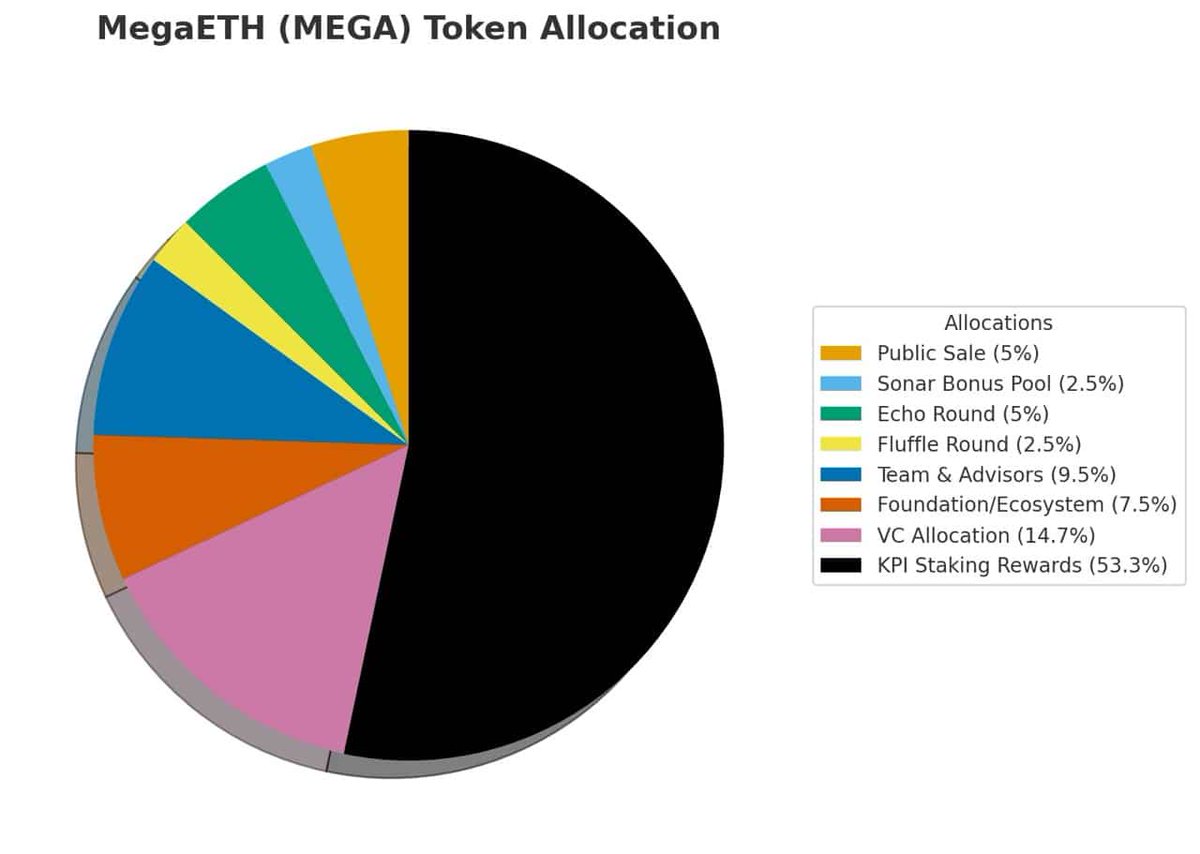
Pie chart showing MEGA token allocation for MegaETH
This MEGA launch follows a classic low-circulating-supply, high-FDV issuance model—mirroring early onchain project launches. However, the project features two major token unlock milestones—at 6 months and 12 months—after which large-scale unlocks will exert continuous selling pressure, significantly amplifying short-term market volatility.
Two Core Drivers Behind MegaETH’s Growth
Driver #1: MEGA Token Launch Brings Fresh Capital into the Ecosystem
Early MegaETH ecosystem participants will receive token unlocks: Echo holders will unlock 20%; Fluffle holders, 50%. Unstaked, non-U.S.-based Sonar A program participants will receive substantial airdrops—including the author of this article.
Market expectations point to concentrated sell-offs, especially from early Sonar investors. These participants originally anticipated rapid token listing and liquidity realization but were forced into extended holding periods—resulting in exceptionally strong sell intent upon TGE.
Even amid concentrated profit-taking, most of the proceeds are unlikely to exit the chain entirely. Instead, funds will rotate within the ecosystem—for example, purchasing memecoins, providing liquidity to protocols, trading cultural tokens on Kumbaya, acquiring Fluffle-series NFTs, or chasing trending narrative assets.
The higher MEGA’s Day-One price, the stronger the wealth effect—and consequently, the more pronounced the overall ecosystem’s empowerment and catalytic impact. Conversely, a sharp post-launch price decline would directly erode speculative confidence and hinder long-term ecosystem development.
The author plans to sell a small portion of holdings and allocate proceeds across already-launched ecosystem applications, trending narrative sectors, and memecoins. Most Fluffle and Echo holders are expected to adopt similar asset-rotation strategies. With thousands of onchain speculators rebalancing simultaneously, MegaETH as a whole will experience a massive surge in onchain activity and capital flow.
Driver #2: 2.5% Mainnet Airdrop Program Amplifies Growth Momentum
The team has confirmed a mainnet incentive airdrop program allocating 2.5% of the total token supply. Project leaders state they will carefully time and design these incentives—rejecting inefficient blanket subsidies—and instead implement multi-tiered, interactive mechanics that support user-combination strategies and compounding yield, avoiding simple mining-and-dump models.
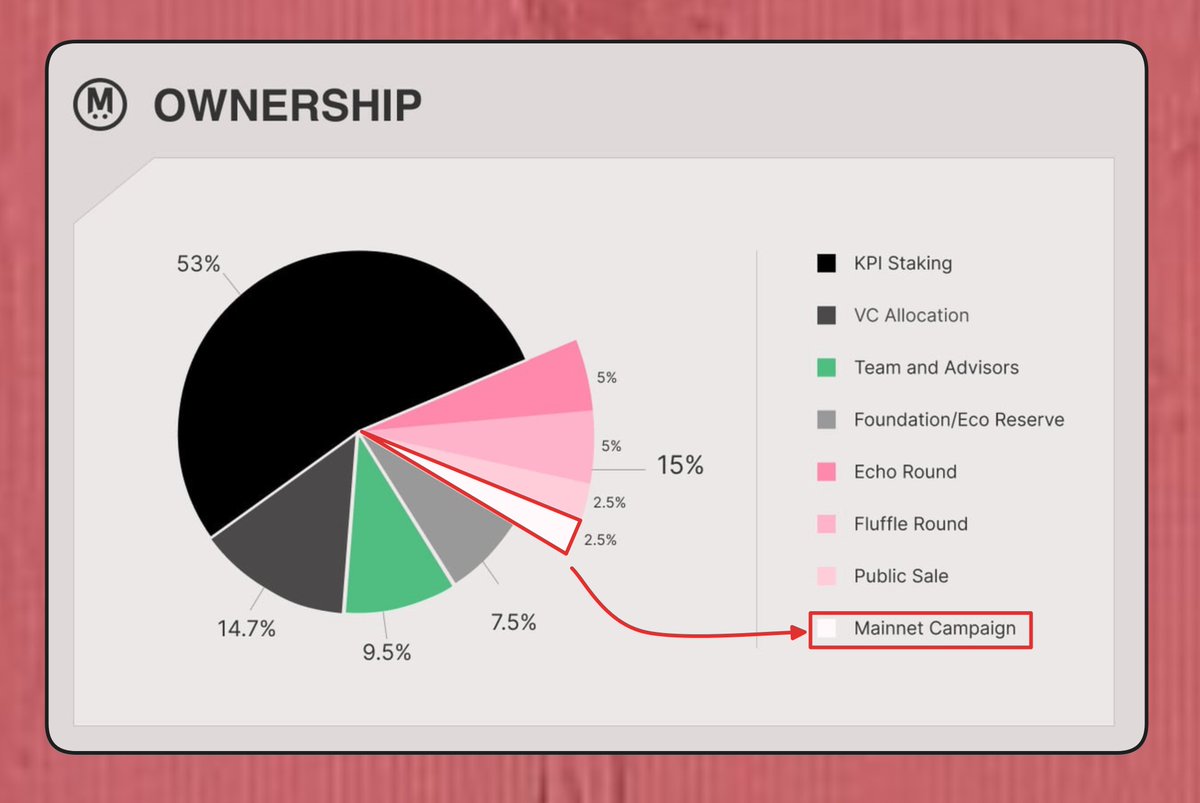
MegaETH ranks among the few crypto projects in the industry operating with mature commercial logic—precisely calculating user lifetime value (LTV) and customer acquisition cost (CAC), thereby overcoming the blunt, inefficient operational patterns common among most onchain projects.
Incentive resources will be precisely directed toward attracting *new* liquidity—not distributed universally. Existing liquidity of $50 million already yields organic mining returns, eliminating the need for redundant subsidies and improving capital efficiency.
Thanks to strategic strengthening of core team members, MegaETH’s long-term value outlook has further improved. Previously announced modular “Lego-style” composability—now realized via integrated deployments of Aave (paired with Ethena’s USDe) and Brix—has come to fruition. As infrastructure matures, detailed airdrop rules are highly likely to be announced shortly after TGE (mid-to-late May), drawing significant mining participation.
Positive flywheel logic:
Miners increase Total Value Locked (TVL) → Aave+Ethena combo expands USDM scale → USDM’s U.S. Treasury yield funds ongoing MEGA buybacks by the foundation → Regularized buybacks create floor demand and stabilize token price.
Whether this full growth loop materializes hinges entirely on MEGA’s TGE performance. Should the FDV fall below $10 billion and remain weak, ecosystem热度 and participant enthusiasm will rapidly cool.
Divergent Market Valuation Expectations
Industry institutions and analysts have offered varying forecasts for MEGA’s TGE valuation:
- Eli5defi applied five valuation models, arriving at a weighted FDV of $12 billion;
- Pre-TGE market optimism priced MEGA near $16.4 billion;
- Prediction market Polymarket reflects broad consensus around a $10 billion FDV.
Fundamentally, a reasonable valuation likely falls within the mid-range—and leans toward the lower end. Historical L2 sector patterns show all major Layer-2 tokens experienced post-listing valuation declines over their first 12–18 months: ZKsync fell 75%, Starknet plunged 90%.
These divergent expectations reveal a clear contradiction: either current pre-TGE pricing reflects excessive KPI-narrative hype—followed by valuation correction—or prediction markets underestimate MegaETH’s genuine demand.
Additional data indicates MEGA’s actual initial circulating supply is merely 3.86%, implying a ~$66.9 million market cap—highly scarce circulating supply:
- VC, team & advisor allocations (24.2%): Fully locked—1-year cliff + 3-year linear vesting;
- KPI staking allocations (53%): Permanently locked unless KPI targets are met;
- Ecosystem reserve (7.5%): Technically unlocked but controlled by the team—no malicious dumping expected;
- Mainnet airdrop (2.5%): Locked for 6–8 months with gradual release.
If accurate, MEGA’s initial market cap falls well below $70 million—far beneath the widely cited $180 million estimate. Extreme scarcity in circulating supply will amplify price volatility—both upside and downside—aligning with the high-consensus, low-circulation dynamics seen in top-performing HYPE tokens.
Unlike traditional Layer-2 networks, MegaETH features a unique revenue model: it avoids extracting value from users via sequencer fees, instead monetizing through USDM stablecoin yield. Backed by BlackRock’s compliant U.S. Treasury product reserves, USDM generates stable yield—100% allocated to secondary-market MEGA buybacks.
Price Expectations
- Bullish case: Combined with stablecoin yield, ecosystem incentives, and new app launches, MEGA could reach $0.5–$1.0 short-term—representing 3–6x upside;
- Institutional view: 6th Man Ventures partner believes MegaETH will evolve into a “super-app ecosystem”—distinct from neutral chains like Ethereum or Solana—driven primarily by application-level revenues and pursuing vertical integration.
MegaETH’s Core Differentiating Advantages
Most Layer-2 tokens serve only singular functions—fee payment and governance—with no intrinsic, real-world demand. By contrast, MEGA rests on three robust value pillars:
- Blazing-fast transaction speed: Block confirmation latency as low as 10 ms—vastly outperforming Arbitrum (250 ms), Base/Optimism (2 sec), and Ethereum (12 sec). Ideal for orderbook exchanges and HFT use cases—making MegaETH the sole low-latency EVM-compatible chain.
- Proximity-based sequencer auction: Introduces a MEGA-denominated priority access auction, granting millisecond-level transaction front-running rights. HFT teams and market makers must continuously bid MEGA to secure priority block inclusion—creating sustained, structural demand.
- Stablecoin-yield buyback loop: Rapid USDM scale-up via circular lending targets a $500 million KPI milestone. Augmented by trading fees, ultra-low-latency service premiums, and U.S. Treasury yield, multiple narratives converge to reinforce token value.
Existing Ecosystem Risks & Concerns
- Macroeconomic headwinds: Broader crypto markets remain bearish—dragging down even high-quality ecosystems;
- Unlock pressure: Fluffle unlocks 50% at launch plus phased releases over six months; team & VC unlocks concentrate at one year;
- Centralization risk: Single-sequencer architecture introduces operational centralization concerns;
- Extremely high KPI bar: Phase 3 requires three apps to sustain $50k/day in fees for 30 consecutive days—any interruption resets the counter;
- Narrative fatigue: L2 hype has waned—user and capital attention is declining;
- Structural imbalance: Top DEX Kumbaya commands 57% of total TVL—volatility in a single app can destabilize the entire chain;
- App attrition: Innovative app Avon has officially exited MegaETH; leading lending protocol Aave faces trust challenges.
Historical precedent shows many once-popular narrative-driven projects ultimately collapsed—even with robust infrastructure, neither market weakness nor narrative collapse can be fully insulated against.
That said, current onchain mining costs remain low, stablecoin swaps and circular lending are straightforward, and ecosystem app airdrop expectations still fuel broad anticipation for a smooth MEGA launch—and sustained ecosystem momentum.
Practical Guide to Top 10 Ecosystem Applications
Key Takeaways:
- Stake stcUSD to earn yield;
- Provide liquidity to USDe/USDm pools on Kumbaya + allocate modestly to cultural tokens;
- On World Markets: arbitrage ETH funding rates (long spot + short perpetual using same collateral), or engage in leveraged high-risk trades; alternatively, hold ETH on hit.one and await sync rewards;
- On Brix: allocate modestly to iTRY for uncorrelated hedging;
- Use Euphoria for trading/gambling.
Cap (@CapApp)
- Adaptive-yield stablecoin. Users mint cUSD 1:1 against USDC/USDT, then stake it as stcUSD to earn yield from authorized strategy providers.
- Largest onchain fee source—averaging ~$21k daily—publicly designated as the core KPI-3 project.
- Raised $12.9M across three rounds: seed round led by Franklin Templeton; Norinchukin’s Laser Digital and Kraken Ventures participated.
- High probability of being the first Mafia app to launch its own token post-MEGA (accelerated by traditional finance backers).
- Action item: Stake stcUSD for yield; use cUSD as MegaETH’s native settlement stablecoin.
Kumbaya (@kumbaya_xyz)
- Top-ranked DEX on MegaETH, with ~$59M TVL.
- Cultural-token issuance platform is natively embedded in the DEX—avoiding the “graduation-and-decoupling” phenomenon seen on Solana (e.g., pump.fun → Raydium).
- USDe/USDm pool (~$6M) serves as the critical routing node for Aavethena’s circular lending.
- Averages ~$2k daily fees; no public fundraising disclosed—though DEX airdrops generally underperform today.
- Action item: Provide liquidity to USDe/USDm pool for fee yield; ride Aavethena’s expansion wave. For high-risk exposure, explore memecoins.
World Markets (@worldmarketsinc)
- Unified-margin orderbook system supporting spot, perpetuals, and lending—all backed by a single collateral deposit.
- $11.6M TVL; ~$4k daily fees (second-highest onchain); no public fundraising disclosed.
- Team claims capital efficiency up to 100x vs. fragmented DeFi.
- Cross-margin trading demands margin updates and liquidations occur within the same block—only MegaETH’s speed enables this.
- Action item: ETH funding-rate arbitrage (long spot + short perpetual, same collateral); or hold ETH for lending yield while hedging with perpetuals.
Honestly, I find its UI somewhat clunky.
Brix (@brix_money)
- Tokenized emerging-market yield products. iTRY represents a tokenized Turkish lira money-market product (~20% local APY), custodied by licensed institutions.
- Raised $5.5M in April 2026, led by FRWRD and Is Asset Management, with Circle Ventures, ConsenSys, and Borderless Capital participating.
- The only non-native crypto yield product in the Mafia ecosystem—ideal for uncorrelated hedges during macro weakness.
- Plans to launch additional emerging-market currencies (BRL, INR prioritized).
- Action item: Small allocation to iTRY for uncorrelated hedge; dollar delta-neutral strategies may prove popular.
Euphoria (@Euphoria_fi)
- Click-to-trade gameplay: users click grid squares to predict short-term price direction.
- Raised $7.5M ($2.5M pre-seed + $5M seed), led by Karatage, with >100 investors.
- Most anticipated consumer-facing app among Tier-2 projects.
- Currently whitelisted on mainnet (AMA participants + early testers); full public launch expected mid-May.
- Notcoin on TON brought over 30M wallets to an unknown chain—Euphoria is the closest Mafia equivalent.
- Action item: Join waitlist; closely monitor mid-May launch.
Showdown (@Showdown_TCG)
- 1v1 Texas Hold’em poker game.
- Action item: Poker players can join cash games; ranked tournament airdrop weightings favor active players.
Stomp (@stompdotgg)
- Fully onchain PvP monster-battling game (Pokémon + Super Smash Bros. inspired), built by Owen Shen of 0xmons.
- First chain to fully execute a game loop: every attack triggers an onchain transaction.
- Action item: Collect monsters and battle; airdrops reward active engagement.
Hit.One (@hitdotone)
- Mobile-click mini-game packaging 666x+ leverage perpetuals.
- Fully live on MegaETH; no public fundraising disclosed.
- Designed to test whether gamified ultra-leveraged trading can onboard mainstream retail users.
- Action item: Participate only with minimal capital—this is gambling, not investing.
Pump Party (@pumpparty)
- Weekly live-streamed crypto game show from Manhattan (EST Mondays, Wednesdays, Fridays at 9 PM).
- Each 15-minute episode features skill-based mini-games (burger-building, Zyn tossing) with prize-pool distribution.
- Payouts settle instantly on MegaETH.
- Core objective isn’t the app itself—but testing whether native streaming/crypto products can onboard everyday users ontochain.
- Action item: Tune in live and play; track concurrent viewership—consistent >10k viewers signals product-market fit.
Ubitel (@getubitel)
- Decentralized eSIM covering prepaid data in 200+ countries, payable in ETH or UBI. Has its own native token—distinct from tokenless Mafia apps.
- Action item: Purchase data packages if traveling frequently.
Side note: I genuinely enjoy these types of apps. Gnosis is also building non-financial stacks like VPNs.
Nectar AI (@TryNectarAI)
- AI companion and roleplay platform; characters minted as NFTs (adult-oriented). A Web2 category leader (like Character.ai, Replika)—no successful onchain version yet exists.
- Action item: Don’t tell your mom or girlfriend.
The ecosystem extends far beyond these 11 apps. Bread reports ~120 apps are live or deploying via rabbithole.megaeth.com. Chefgoose’s beginner guide lists 50 key projects: Prism (super-app), SectorOne (DLMM DEX), Tulpea (RWA lending), Huntertales (idle GameFi, CROWN token), TopStrike (soccer cards), Aqua (liquid staking), Blackhaven, Blitzo—as well as non-native integrations like Aave, GMX, and gTrade. Worth bookmarking.
Conclusion
MEGA’s TGE launches April 30; mainnet airdrop incentives follow soon after. Short-term logic centers on wealth effect—retaining ecosystem capital and preventing cross-chain leakage.
Leveraging ultra-low latency, exclusive sequencer auctions, and stablecoin-yield buybacks, MegaETH has carved out a distinct commercial path separate from traditional L2 public chains—with a clear long-term narrative.
Yet risks—including unlock pressure, structural imbalance, macro bearishness, and stringent KPI requirements—must be acknowledged. Onchain speculation demands disciplined position sizing and cautious participation. This article provides ecosystem analysis only—not investment advice.
Join TechFlow official community to stay tuned
Telegram:https://t.me/TechFlowDaily
X (Twitter):https://x.com/TechFlowPost
X (Twitter) EN:https://x.com/BlockFlow_News
 Ignas | DeFi Research















