The Blockchain Triumvirate: Who Will Lead the Future—MegaETH, Hyperliquid, or Monad?
TechFlow Selected TechFlow Selected
The Blockchain Triumvirate: Who Will Lead the Future—MegaETH, Hyperliquid, or Monad?
MegaETH, Hyperliquid, and Monad each have their own strengths— which one will stand out in speed, decentralization, and focus area?
 Navigating Web3 tides with focused insights
Author: threesigmaxyz, blockchain engineering and auditing firm
Translation: zhouzhou, BlockBeats
Editor's Note: This article provides an in-depth analysis of the features and competitive advantages of three major blockchain platforms—MegaETH, Hyperliquid, and Monad—examining their performance in low latency, high throughput, and decentralization. Each platform demonstrates unique value in specific application scenarios, offering diverse options for developers and enterprises. As blockchain technology continues to evolve, these platforms are driving industry innovation and may enable further breakthroughs through cross-ecosystem integration.
Below is the original content (slightly edited for readability):
The next big act in blockchain has already begun—MegaETH, Hyperliquid, or Monad?
In the fast-evolving blockchain space, instant transactions are transitioning from a luxury to a necessity. As decentralized finance applications, payments, gaming, and high-frequency trading continue to push the limits of traditional blockchains, the demand for real-time performance has never been more urgent. In this race, MegaETH, Hyperliquid, and Monad are competing to redefine transaction speed and scalability.
As we mentioned in our previous article, MegaETH is an emerging Layer 2 solution centered on real-time performance, drawing significant attention for its near-instant block times and high transaction throughput.
However, Hyperliquid and Monad also present strong competition with their distinct approaches to optimizing blockchain performance. This article will delve into the strengths, architectures, and trade-offs of these solutions to understand who might take the lead in the race for instant blockchain transactions.

MegaETH Overview
Megaeth Labs is a Layer 2 scaling solution designed specifically for Ethereum. What sets MegaETH apart is its focus on real-time blockchain performance, delivering ultra-low latency and high scalability for applications requiring immediate responsiveness.
Latency and Speed: MegaETH achieves block times between 1 and 10 milliseconds and can process up to 100,000 transactions per second (TPS).
Dedicated Nodes: It employs a sequencer-centric model, dividing nodes into sequencers, provers, and full nodes to optimize execution and reduce redundancy.
Integration with EigenDA: Leverages EigenDA for data availability, achieving scalability while maintaining reliability and performance.
Advantages
MegaETH’s architecture is purpose-built for speed and efficiency, standing out in the competitive Layer 2 landscape:
-
Low Latency: Its near-instant transaction processing makes it ideal for high-frequency trading, gaming, and payment systems.
-
High Scalability: Millisecond-level block processing avoids congestion common during peak periods in other L2 solutions.
-
EVM Compatibility: Fully compatible with the Ethereum ecosystem, enabling seamless integration of existing dApps while ensuring security.
Despite MegaETH’s focus on real-time performance, it faces intense competition from Hyperliquid and Monad—two platforms taking radically different approaches to optimizing blockchain transactions.
Hyperliquid Overview
HyperliquidX is a fully on-chain perpetual contract trading protocol running on its own custom Layer 1 blockchain, optimized for low latency and high throughput. By integrating spot, derivatives, and pre-listing markets, Hyperliquid introduces the high-performance consensus mechanism HyperBFT and plans to launch HyperEVM to expand its ecosystem via efficient liquidity aggregation.
Hyperliquid aims to redefine the trading experience through high-speed, decentralized market infrastructure, making it highly attractive to financial institutions and high-volume traders. The unique combination of spot and perpetual markets enables seamless liquidity pooling and rapid settlement.
Technical Advantages:
Hyperliquid’s tech stack encompasses broader financial primitives such as lending, governance, and a native stablecoin.
Leveraging the HyperBFT consensus mechanism, it achieves 0.2-second block times and maintains unified state across all components, ensuring performance, liquidity, and programmability.
With over 262,000 users and handling 200,000 transactions per second, Hyperliquid has established itself as a leader in decentralized market infrastructure.
To further expand its reach, Hyperliquid offers Builder Codes—a feature allowing other dApps and centralized exchanges (CEXs) to seamlessly integrate its liquidity by paying fees per transaction. Builder Codes not only broaden Hyperliquid’s accessibility but also incentivize external platforms to leverage its high-performance trading infrastructure, enhancing liquidity and network effects.

Monad Overview
Monad xyz has re-engineered the EVM architecture, achieving unprecedented throughput through parallel execution. By overcoming Ethereum’s limitations in sequential transaction processing, Monad enhances both efficiency and scalability.
Monad aims to deliver cutting-edge blockchain performance while preserving decentralization, setting a new standard for Layer 1 scalability. Its architecture supports parallel transaction processing across multiple EVM instances, seamlessly integrating with existing user and developer workflows. Monad maintains full bytecode compatibility with Ethereum while boosting performance through advanced internal optimizations—without altering the developer experience.
Technical Highlights:
-
Pipelined Optimization: Optimizes transaction execution, consensus, and state synchronization to maximize hardware efficiency and reduce latency.
-
MonadBFT Consensus: A customized HotStuff-based consensus mechanism supporting a decentralized validator set and enabling fast finality.
-
MonadDB: A database specifically designed for Ethereum state access, combined with optimistic parallel execution to achieve high throughput at minimal overhead.
-
Separation of Consensus and Execution: Enhances scalability and supports development of high-performance, low-latency applications.
Monad delivers enterprise-grade support, providing developers with the tools to build high-throughput, Ethereum-compatible decentralized applications.
Comprehensive Comparison

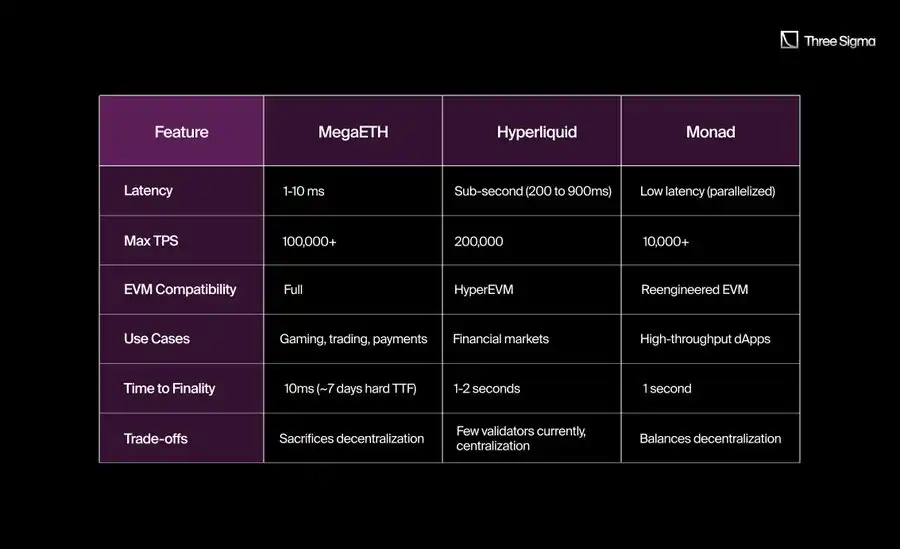
Evaluating MegaETH, Hyperliquid, and Monad across key metrics offers a comprehensive understanding of their unique strengths and trade-offs. This comparison focuses on the following criteria: latency, throughput (TPS), EVM compatibility, use cases, time to finality (TTF), and decentralization trade-offs. These characteristics highlight the fundamental requirements for scaling blockchain infrastructure while ensuring practical applicability and performance.
Latency
MegaETH: Excels in Layer 2 transactions with ultra-low latency (1–10 ms), ideal for applications requiring near-real-time response, such as high-frequency trading or competitive gaming.
Hyperliquid: Optimized for sub-second latency, designed specifically for financial markets to provide rapid order execution and seamless trading experiences.
Monad: Achieves low-latency execution through parallelization, maintaining consistent performance even under heavy network load, supporting a wide range of decentralized applications (dApps). The team has not yet disclosed specific latency figures.
Throughput (TPS)
MegaETH: Throughput exceeds 100,000 TPS, emphasizing scalability for large-scale applications.
Hyperliquid: Reaches 200,000 TPS through its proprietary HyperBFT consensus and Layer 1 optimization.
Monad: Maximum throughput of 10,000 TPS, prioritizing balance between high performance and decentralization.
EVM Compatibility
MegaETH: Fully EVM-compatible, ensuring seamless migration for developers and existing dApps.
Hyperliquid: Integrates a custom HyperEVM tailored for financial markets.
Monad: Redesigned EVM enables high-performance execution while maintaining compatibility with Ethereum tools and standards.
Use Cases
MegaETH: Focused on real-time interaction and high scalability, targeting gaming, trading, and payment systems.
Hyperliquid: Specializes in financial markets, providing robust infrastructure for derivatives, spot trading, and market making.
Monad: Supports diverse dApps requiring high throughput and low latency, demonstrating broad adaptability.
Time to Finality (TTF)
MegaETH: Layer 2 transactions are confirmed almost instantly (~10 ms), but full settlement on Ethereum Layer 1 takes approximately seven days.
Hyperliquid: Achieves 1–2 second TTF, balancing low latency with strong consensus security.
Monad: Confirms transactions within one second, offering a practical blend of speed and security.
Decentralization Trade-offs:
MegaETH: The centralized sequencer design sacrifices some degree of decentralization at the Layer 2 level to achieve real-time performance.
Hyperliquid: Its market-focused architecture prioritizes low latency and high throughput over decentralization.
Monad: Strives to balance performance and decentralization through parallel execution and delayed state updates.
Conclusion
MegaETH, Hyperliquid, and Monad each bring unique innovations to the blockchain ecosystem, addressing different needs:
MegaETH: Excels in latency and TPS, ideal for real-time applications, though its centralized sequencer raises concerns about decentralization.
Hyperliquid: Stands out in financial markets with its HyperEVM and liquidity integration, but lacks the general-purpose versatility of MegaETH for broader dApp use cases.
Monad: Balances decentralization and performance through parallel execution, increases TPS, and supports a wide variety of applications.
Who Is Ahead?
It depends on the specific use case:
For trading and liquidity needs, Hyperliquid performs strongly due to its specialization in financial markets.
For general-purpose dApp scalability, MegaETH leads with its real-time performance and broad applicability.
For decentralized high-throughput applications, Monad’s parallel EVM is a compelling choice for developers prioritizing decentralization.
Key Observations
1. MegaETH’s Trade-off
MegaETH achieves unparalleled speed by sacrificing decentralization, making it well-suited for real-time systems like trading and gaming. While it relies on Ethereum Layer 1 for settlement—ensuring trust and security—it inherits Ethereum’s long finality period. In contrast, Monad and Hyperliquid achieve faster local finality through independent consensus mechanisms, prioritizing immediate performance but forgoing Ethereum’s shared security guarantees.
2. Hyperliquid’s Focus
Hyperliquid excels in financial markets with exceptional speed, liquidity aggregation, and seamless trading infrastructure. However, its narrow focus on trading limits its general-purpose utility in broader dApp ecosystems, reducing its appeal for generalized applications. Additionally, its centralized HyperBFT consensus raises concerns about decentralization and trust, while its performance and ecosystem growth remain heavily dependent on external liquidity.
3. Monad’s Balance
Monad strikes a balance between scalability and decentralization through parallel execution, delivering high throughput to developers while maintaining EVM compatibility. However, its reliance on high-performance hardware (e.g., 32 GB RAM, high bandwidth) restricts accessibility for smaller operators, potentially leading to network centralization. Its independent Layer 1 consensus grants autonomy but sacrifices Ethereum’s security assurances, which may deter developers who prioritize trust and shared security.

The competition among MegaETH, Hyperliquid, and Monad highlights a critical aspect of blockchain development: currently, no single solution dominates all use cases. Each platform excels in its domain, offering distinct value propositions that meet different needs. For developers and enterprises, the decision often hinges on specific application requirements—be it unmatched speed, market liquidity, or decentralized scalability.
These projects also underscore the importance of continuous innovation in blockchain infrastructure. As adoption grows, the industry must balance the scalability trilemma against user expectations for low fees, high performance, and strong security. Integration across different ecosystems may drive the next wave of blockchain breakthroughs. As blockchain technology advances, these platforms are pushing the boundaries of what’s possible, paving the way for faster, more scalable, and efficient decentralized systems.
In the end, the choice comes down to the priorities of developers and users: speed, decentralization, or specialization.
Join TechFlow official community to stay tuned
Telegram:https://t.me/TechFlowDaily
X (Twitter):https://x.com/TechFlowPost
X (Twitter) EN:https://x.com/BlockFlow_News
 @threesigmaxyz