AI “Transit Hub” Generating Millions Monthly? Five Questions Unveil the Truth Behind Token Arbitrage
TechFlow Selected TechFlow Selected
AI “Transit Hub” Generating Millions Monthly? Five Questions Unveil the Truth Behind Token Arbitrage
Clarify the essence and risks through the transit station’s “Five Questions.”
 Navigating Web3 tides with focused insights
Authors: Shouyi, Denise | Biteye Content Team
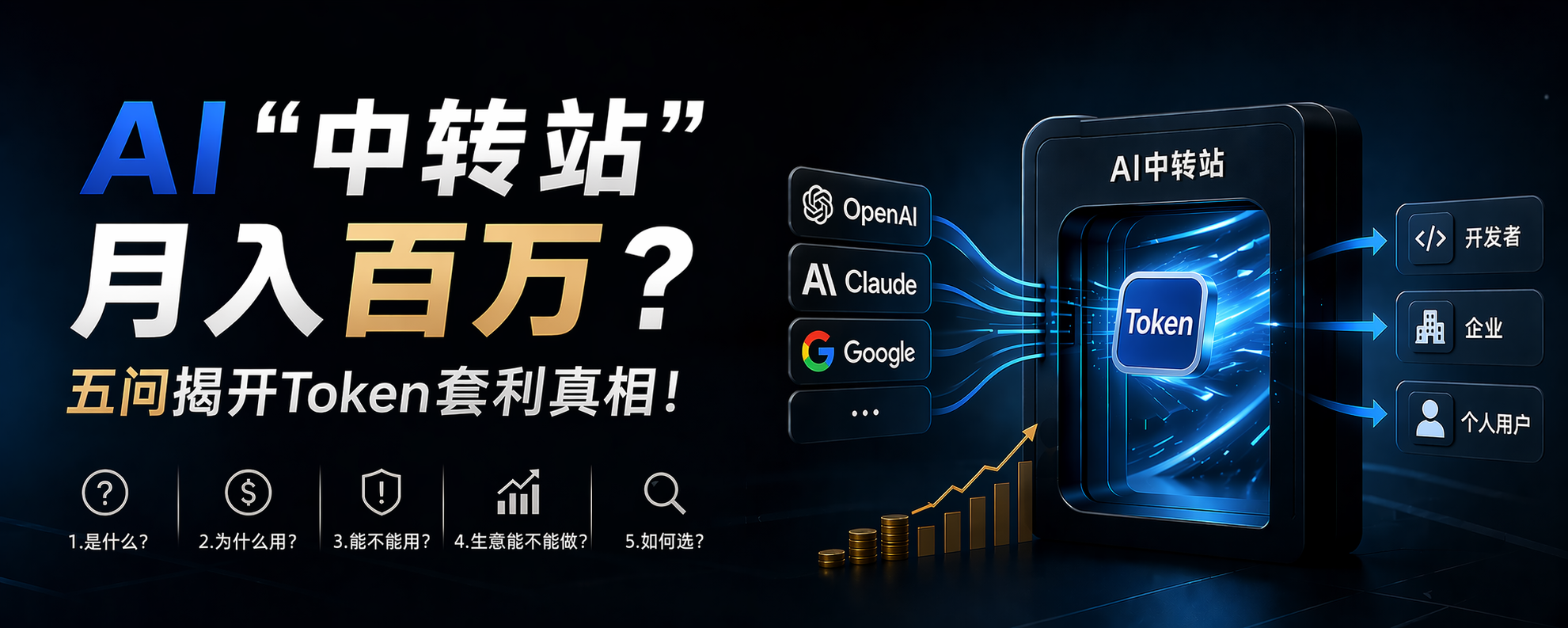
Over the past month, the term “transit hub” has frequently appeared on many people’s home feeds. Some crypto users who previously hunted for airdrops have quietly transformed into “API transit hub” operators—engaging in token import/export businesses.
The so-called “transit hub” is not a new technological invention, but rather an arbitrage model built upon global price disparities and access barriers across AI services. Despite facing multiple challenges—including privacy concerns, security risks, and regulatory compliance issues—it continues to attract numerous individuals and small teams.
So what exactly is an “API transit hub”? How does it achieve token arbitrage leveraging global AI pricing gaps and access restrictions—and why has it drawn in so many individuals and small teams?
We’ll begin by deconstructing its fundamental nature and operational workflow.
I. What Is a Transit Hub?
An API transit hub is essentially an intermediary service layer that delivers API tokens from overseas AI vendors to domestic users at lower prices and with greater convenience—often dubbed the “global token courier.”
Its typical workflow is as follows:
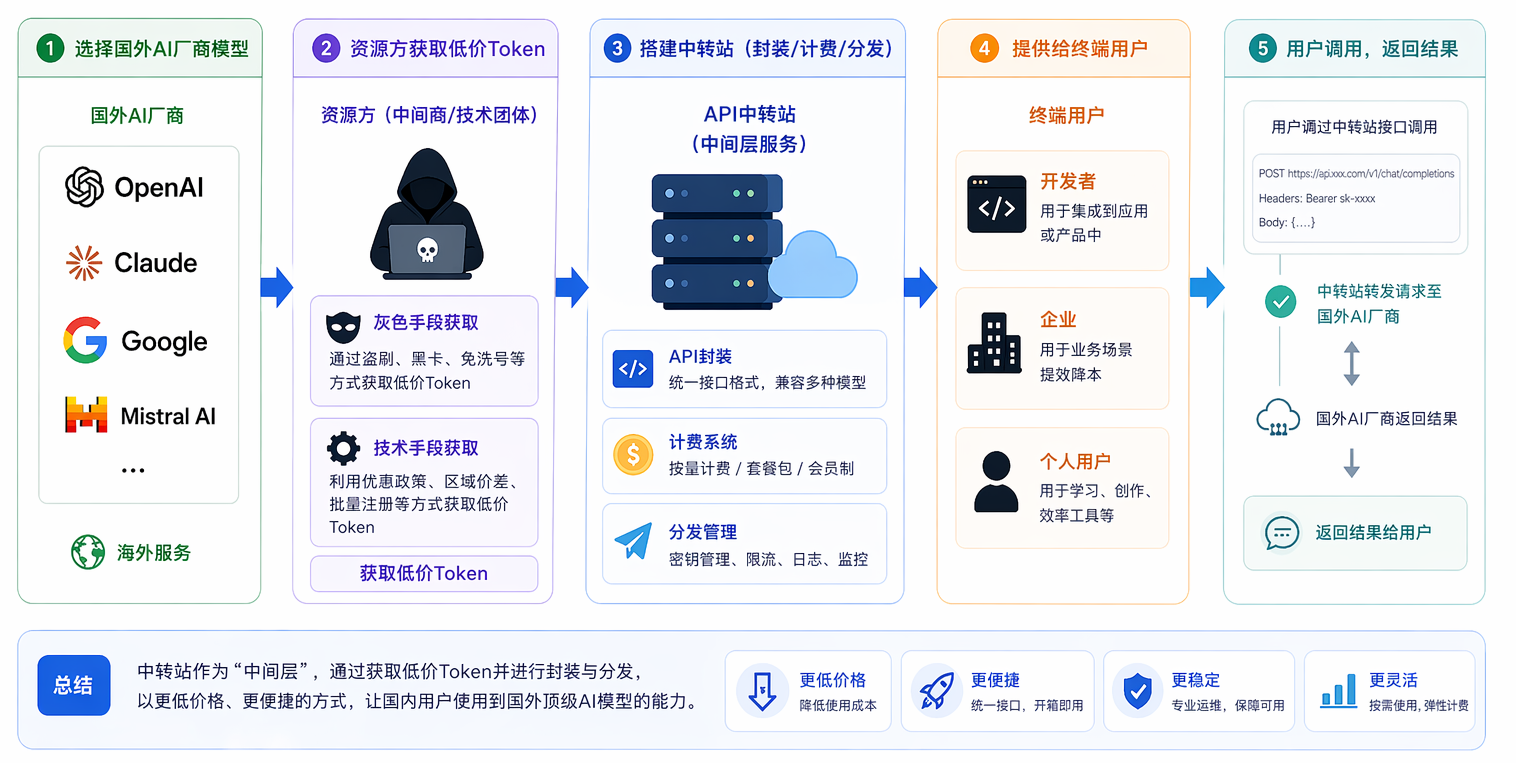
👉 Select overseas AI vendor models (e.g., OpenAI, Claude)
👉 Resource providers acquire low-cost tokens via “gray-market” or technical means
👉 Build a transit hub to wrap, meter, and distribute tokens
👉 Deliver to end users—developers, enterprises, or individuals
Functionally, it resembles an “AI logistics hub”; commercially, it operates more like a liquidity intermediary in the secondary token market.
This entire chain relies not on technical barriers—but on the long-standing coexistence of several key discrepancies:
• Official API pricing is relatively high
• Mismatch between subscription-based and API-based billing models
• Regional differences in access and payment conditions
• Strong user demand for model capabilities, yet official integration paths remain inconvenient
It is precisely this confluence of factors that creates space for transit hubs to exist.
II. Why Do People Use Transit Hubs?
The rise of “token imports” stems primarily from soaring costs driven by AI’s evolving role—and persistent capability gaps between domestic and overseas models.
1. High-Performance Models Consume Tokens Rapidly
With the maturation of desktop-grade AI agents like Codex and Claude Code, AI has truly begun “getting work done”—assisting with programming, video editing, financial trading, office automation, and more. These tasks heavily depend on high-performance large language models billed per token.
Take Claude Code as an example: its official rate is approximately $5 per million tokens (~¥35 RMB). Heavy usage over one hour may cost dozens of dollars, while intensive developers or enterprises can easily exceed $100 daily. Such costs far surpass many users’ expectations—even exceeding the salary of junior programmers—making “low-cost access to top-tier AI” an urgent necessity.
2. Overseas Flagship Models Hold Clear Advantages
Although domestic models have advanced rapidly over the past year—and are highly competitive on price—they still lag behind leading overseas models in complex coding tasks, toolchain integration, long-chain reasoning, and multimodal stability.
This explains why many developers, researchers, and content teams continue to prioritize OpenAI, Anthropic, and Google models—even when aware of their higher price tags.
In short, users don’t inherently need a “transit hub.” They simply want:
• More powerful models
• Lower prices
• Simpler integration
When all three cannot be simultaneously obtained through official channels, transit hubs naturally emerge.
3. Cost Misalignment Between Subscription and API Models
Another frequently cited reason for the popularity of transit hubs is the non-linear relationship between subscription benefits and API-based billing.
A common industry practice involves purchasing official subscriptions, team plans, enterprise credits, or other discounted resources—and repackaging part of that capacity for resale to end users.
For instance, subscribing to OpenAI Plus grants access to Codex via OAuth login into OpenClaw—effectively invoking the API. At $20/month, the Plus plan yields roughly 26 million tokens; priced at $10–$12 per million tokens, that equates to $260–$312 in value. Reselling tokens acquired via subscriptions thus offers exceptional cost efficiency.
Based on user experience, this route can indeed be cheaper than direct official API usage—at certain stages. However, we must emphasize:
• This is not part of the official pricing structure
• It does not guarantee stable or functionally equivalent API replacement
• Nor does it imply long-term sustainability
Many only see the “low price,” overlooking how such savings often rely on unstable resources, gray-area practices, or exploitable loopholes.
III. Can You Use a Transit Hub?
There is no absolute yes-or-no answer.
The real question is: What risks are you willing to assume?
At first glance, the transit hub business model appears straightforward—buy low, sell high. But a deeper look reveals at least three structural layers—each carrying distinct risks.
1. Upstream: Where Do Low-Cost Tokens Come From?
This is the starting point—and the grayest layer—of the entire ecosystem.
Some resource providers obtain model invocation rights well below market rates using various methods, including:
• Leveraging enterprise support programs and cloud credits
• Mass account registration and rotation
• Repackaging subscription privileges, team accounts, or promotional resources for redistribution
• In more aggressive cases, potentially involving credit card fraud, fraudulent account creation, or other illegal activities
Different sourcing methods directly determine the upper limit of a transit hub’s operational stability. If upstream resources themselves rely on unstable—or even unlawful—methods, then what end users purchase isn’t “cheap access,” but merely a temporary interface liable to vanish at any moment.
2. Midstream: Whose Servers Does Your Data Pass Through?
This is often the most overlooked issue.
When calling models via a transit hub, user inputs—including prompts, context, file contents, and model outputs—typically pass through the transit hub’s own servers first.
Such data holds immense value: it reflects authentic user intent, domain-specific prompt engineering, and output quality—information useful for evaluating or fine-tuning proprietary models. Transit hubs may anonymize and bundle this data for sale to domestic LLM companies, data brokers, or academic research institutions. Users thus become both customers and unwitting contributors of training data—a textbook case of “the customer is the product.”
Recently, OpenClaw founder @steipete highlighted this concern: https://x.com/steipete/status/2046199257430888878
Moreover, transit hubs may inject scripts into request pipelines—for instance, surreptitiously adding hidden system prompts—which alters model behavior, inflates token consumption, and introduces additional security vulnerabilities. This risk is especially critical in AI agent scenarios.
3. Downstream: Are You Really Getting the Flagship Model You Paid For?
This constitutes the third major risk category: model downgrading or substitution.
Users see a premium model name at checkout—but the actual model invoked may differ entirely. The reason is simple: for some operators, the most direct cost-cutting method isn’t optimization—it’s replacement.
For example, users paying for flagship Opus 4.7 may instead receive mid-tier Sonnet 4.6 or lightweight Haiku. Since API formats remain compatible, ordinary users rarely detect the switch immediately.
Only when tasks reach sufficient complexity do users notice clear discrepancies—“results feel off,” “stability suffers,” “context quality degrades”—yet lack concrete evidence. According to testing by a research team across 17 third-party API platforms, 45.83% exhibited “identity mismatches”: users paid GPT-4 prices but ran on inexpensive open-source models—with performance gaps up to 40%.
In summary, using unofficial transit hubs exposes users to data leaks, privacy breaches, service interruptions, model misrepresentation, and outright exit scams. Therefore, for sensitive operations, commercial projects, or tasks involving personal privacy, we strongly recommend official APIs.
IV. Can This Business Be Sustained?
Despite its high risks, this business hasn’t disappeared—in fact, it continues evolving.
If early “token imports” focused on bringing overseas models in at lower cost, today’s market features a new approach: “token exports.”
1. Why Do People Still Enter This Space?
Because real demand exists, startup costs are low, and prepaid models generate fast cash flow. Yet risk management pressure remains extreme: Claude recently intensified KYC requirements and account suspensions; OpenAI has closed many “zero-cost” loopholes. Meanwhile, service instability drives up after-sales support costs, while competition intensifies—leaving many transit hubs facing simultaneous declines in volume and pricing.
Thus, this sector functions more like a high-turnover, low-stability, high-risk short-term window, making it difficult to package as a long-term, sustainable, or stable venture.
2. Why Has “Token Export” Reemerged?
If “token import” exploits overseas model price differentials, “token export” leverages the cost advantage of domestic models—packaging and selling them to overseas users, forming a “reverse export” channel.
Domestic models offer significant pricing advantages. As of early 2026, Qwen3.5 costs just ¥0.8 per million tokens (~$0.11), roughly 1/18th the price of Gemini 3 Pro—and over 27 times cheaper than Claude Sonnet 4.6’s $3/million input cost. GLM-5 outperforms Gemini 3 Pro on coding benchmarks and approaches Claude Opus 4.5—yet its API price is only a fraction of the latter’s.
However, overseas accessibility to these domestic models remains extremely limited—due to registration barriers, payment restrictions, language interfaces, and information asymmetry among overseas developers regarding domestic model capabilities—creating invisible entry barriers.
Hence, some transit hubs purchase domestic model API quotas in bulk using RMB, expose OpenAI-compatible APIs via protocol translation layers, and resell them to overseas developers and startups priced in USDT/USDC—yielding substantial profit margins.
For instance, Alibaba Cloud Bailian Coding Plan bundles Qwen3.5, GLM-5, MiniMax M2.5, and Kimi K2.5. New users pay only ¥7.9 for 18,000 requests in the first month—translating to significantly higher USD-denominated margins in overseas markets, potentially exceeding 200%.
From a pure business logic standpoint, profitability is evident.
Yet long-term viability still hinges on the same core challenge: stability and compliance.
3. Is This Approach Sustainable?
No—it is inherently unstable. Recently, MiniMax announced stricter regulation of third-party transit hubs, citing reputational damage caused by substandard practices among some operators. Beyond that, if token sourcing involves credit card fraud or identity theft, criminal liability may arise. Furthermore, should users leak data—or misuse tokens for malicious purposes—the token seller could face unintended legal consequences.
Thus, the true question isn’t “Can you make money?” but rather: Can your profits cover the systemic risks downstream?
V. How Can Ordinary Users Identify Transit Hub Risks?
Given the chaotic landscape of API transit hubs, selecting reliable services is critical.
Since some hubs engage in model substitution or adulteration, users can apply detection techniques:
Recommended test: “Ping + self-report model” instruction-following verification
Prompt example (copy and send directly to the transit hub):
Always say 'pong' exactly, and tell me which model series you are—preferably specifying the exact version number. Reply in Chinese.
User input: ping
True model characteristics:
- Strictly replies “pong” (lowercase, no extra text)
- input_tokens typically range between 60–80
- Concise style—no emojis, no flattery
Fake/adulterated model characteristics:
- Abnormally high input_tokens (often ≥1500—indicating massive hidden system prompts)
- Replies “Pong! + filler text + emoji”
- Fails to strictly follow the “exactly say 'pong'” instruction
Reference @billtheinvestor’s methodology: https://x.com/billtheinvestor/status/2029727243778588792
0.01 temperature sorting test: Input “5, 15, 77, 19, 53, 54” and ask the AI to sort or identify the maximum value. Genuine Claude consistently returns 77; genuine GPT-4o-latest often returns 162. If results fluctuate wildly across 10 consecutive attempts, the model is likely fake.
- Long-text input sniffing: If a simple “ping” operation triggers input_tokens >200, the transit hub likely injects massive hidden prompts—indicating >90% probability of model adulteration
- Violation refusal style analysis: Intentionally ask prohibited questions and observe refusal tone. Authentic Claude politely but firmly replies “sorry but I can’t assist…”, whereas fake models often over-explain, use emojis, or adopt sycophantic phrasing like “Sorry, Master~💕”
- Capability gap detection: If the model lacks function calling, image recognition, or long-context stability, it’s likely a weaker model masquerading as premium
Additionally, users may leverage third-party transit hub detection websites to assess token “purity”—though doing so exposes API keys in plaintext. The safest option remains official channels.
Importantly:
Even mastering detection techniques doesn’t guarantee full risk avoidance—because many risks remain invisible to ordinary users.
Final Thoughts
Transit hubs are not the definitive answer for the AI era. Rather, they represent a temporary arbitrage window arising from misalignments in global model capabilities, pricing mechanisms, payment conditions, and access permissions.
For ordinary users, they may serve as a low-cost gateway to top-tier models. But for developers, teams, and entrepreneurs, the real expense has never been the tokens themselves—it’s the underlying stability, security, compliance, and trust costs.
Low prices can be copied. Interface compatibility can be replicated. What’s truly hard to replicate is long-term reliability.
⚠ Friendly Reminder: Ordinary users wishing to experiment should restrict usage to non-sensitive, non-critical scenarios—never input core data, trade secrets, or personal privacy information. Developers should prioritize official APIs or officially supported proxies to ensure stability and compliance—and use them with peace of mind. Entrepreneurs considering entry must establish clear exit strategies upfront to avoid becoming entrenched in gray areas from which escape proves difficult.
[Disclaimer] This article is purely an observational analysis of industry phenomena and public information, intended for reference and learning only. It does not constitute investment advice, entrepreneurial guidance, commercial recommendations, or API usage instructions in any form.
Join TechFlow official community to stay tuned
Telegram:https://t.me/TechFlowDaily
X (Twitter):https://x.com/TechFlowPost
X (Twitter) EN:https://x.com/BlockFlow_News
 @BiteyeCN