Co-founder of MetaMask departs, leaving behind a little fox stuffed into the IPO prospectus
TechFlow Selected TechFlow Selected
Co-founder of MetaMask departs, leaving behind a little fox stuffed into the IPO prospectus
Are you still using that little fox? 🦊
 Navigating Web3 tides with focused insights
Author: Kuli, TechFlow
The person who built this little fox no longer wants to build it.
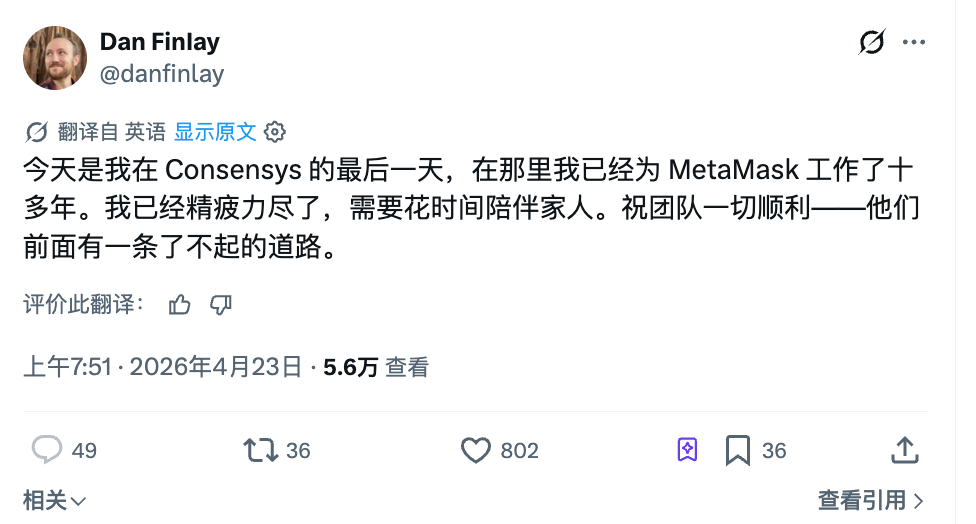
On April 23, Dan Finlay, co-founder of MetaMask, officially announced his departure from Consensys, concluding a decade-long development career—citing professional burnout and a desire to spend more time with his family.
MetaMask is arguably the most recognizable application in the crypto world. That orange fox logo is familiar to nearly everyone who has ever installed a crypto wallet. In 2016, Finlay and fellow co-founder Aaron Davis built this browser extension internally at Consensys, enabling ordinary users to interact with Ethereum without running a full node.
Over the past decade, third-party platforms estimate MetaMask’s global installations have surpassed 100 million, with approximately 30 million monthly active users—and its swap functionality has generated over $325 million in cumulative transaction fees.
A quick review of publicly available information reveals Finlay has rarely given interviews over the past ten years. Having previously written code at Apple, he is, at heart, an engineer—not someone who cultivates a public persona.
When people like him say they’re burnt out, they usually mean it. Yet the timing of his departure invites speculation.
Just months earlier, Consensys engaged JPMorgan Chase and Goldman Sachs as IPO advisors, with reports from Axios indicating a target for going public as early as this year.
The company’s last funding round was in 2022, when it was valued at $7 billion. Since then, it has undergone at least two rounds of layoffs. Meanwhile, the $MASK token—which has been rumored since 2021—has remained conspicuously absent for five years.
Issuing a wallet token may not be essential; what’s more concerning is that the little fox itself seems increasingly unnecessary to users.
Default, Not Mandatory
In the past, many dApp developer documents began with step one: “Please install MetaMask first.” It was the industry’s default wallet—akin to the blue Internet Explorer icon on your desktop after installing Windows a decade ago.
The problem is, “default” and “preferred option” are no longer synonymous.
Phantom initially focused solely on Solana wallets before expanding to Ethereum and Bitcoin. In January 2025, it raised $150 million in a Series C round, valuing the company at $3 billion.
According to chain data cited by whales.market, Phantom’s annualized revenue stands at roughly $108 million—more than double MetaMask’s estimated $46 million. And Phantom launched five years after MetaMask.
Phantom launched on Solana in 2021, capturing Solana’s entire arc—from recovery to explosive growth. Helius data shows Solana’s DEX trading volume surpassed Ethereum’s in 2024; in 2025, Solana’s onchain application revenue reached $2.39 billion, up 46% year-on-year. A total of 725 million new wallets completed their first Solana transaction in 2025—many encountering Phantom right at the door.
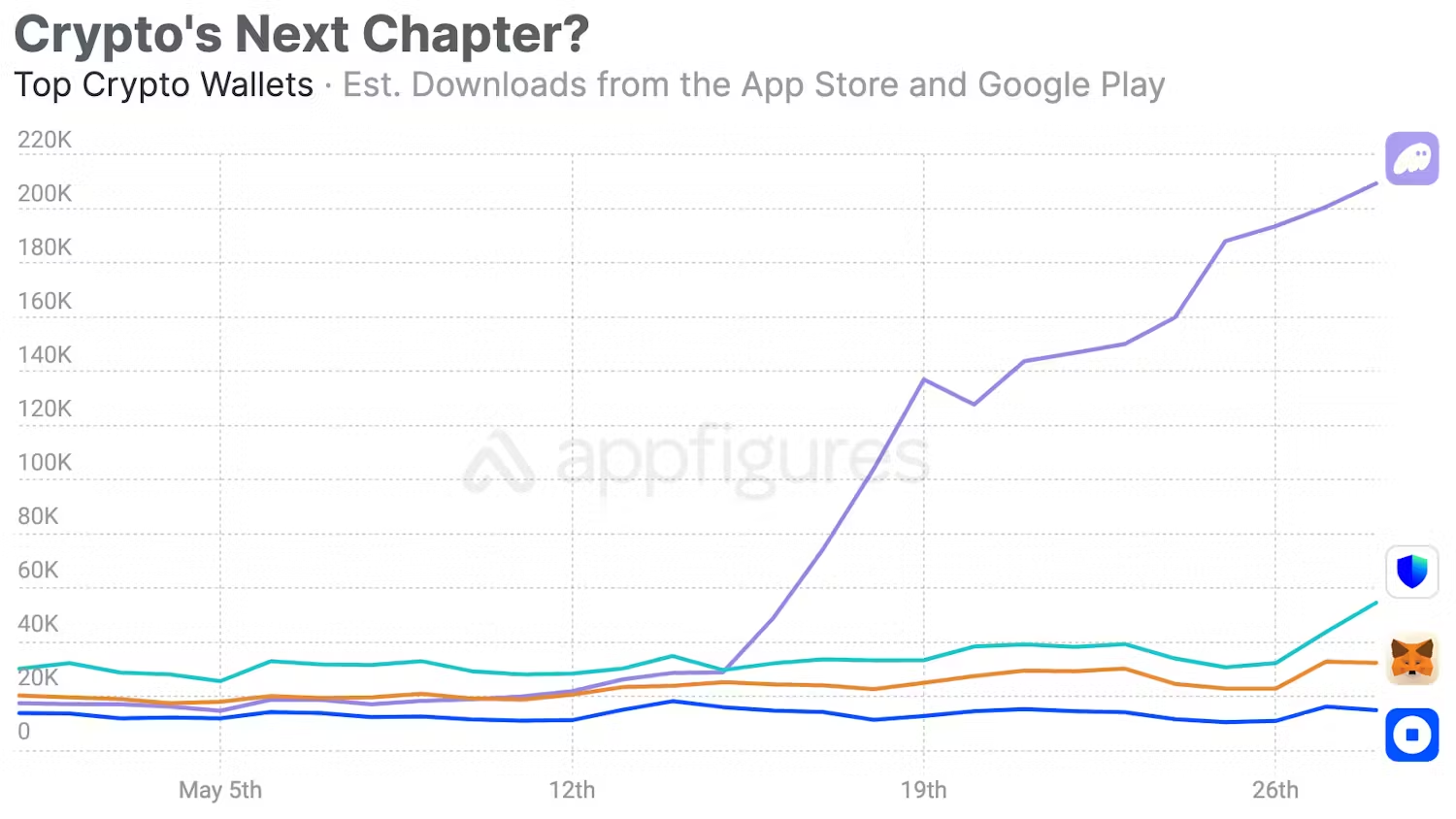
What about MetaMask? Native Solana support only arrived in May 2025. Before that, users wanting to access Solana via MetaMask had to install a third-party plugin called Snaps—an experience akin to installing a Chrome rendering engine inside Internet Explorer…
Over those five years, Solana evolved from a chain nearly killed by the FTX collapse into the highest-volume blockchain. Phantom rode that wave upward, securing its $150 million Series C round in early 2025 at a $3 billion valuation.
We believe MetaMask’s slowness isn’t due to technical limitations—it also reflects an identity dilemma. MetaMask is Ethereum’s “child,” and Consensys—the parent company—is co-founded by Ethereum co-creator Joe Lubin.
Supporting Solana represents expansion for Phantom—but betrayal for MetaMask. By the time Ethereum’s ecosystem growth genuinely slowed and cross-chain adoption became unavoidable, the window had already closed.
Of course, MetaMask remains the most compatible wallet within the Ethereum ecosystem: nearly all EVM-based dApps test against it as the default option, and its 30 million MAUs are real.
Yet this stickiness stems not from product strength, but from migration costs—and migration costs can only deter existing users from leaving, not prevent new users from arriving elsewhere.
A user entering the onchain space in 2025 is unlikely to receive MetaMask as their friend’s top wallet recommendation.
The Little Fox Awaits Its Price
The product is falling behind. Its creator is leaving. Yet Consensys is pursuing an IPO.
Per Axios, in October 2025 Consensys engaged JPMorgan Chase and Goldman Sachs as IPO advisors, targeting a listing as early as this year. If successful, it would become the first company deeply tied to Ethereum’s core infrastructure to list on U.S. markets.
Yet in the same year it hired investment banks, Consensys underwent at least two rounds of layoffs.
In October 2024, it cut 20% of its workforce—about 160 people—with CEO Joe Lubin citing macroeconomic pressures and regulatory uncertainty. Another round occurred mid-2025, now justified as “driving profitability.”
On Glassdoor—the prominent overseas job-search community—employee reviews are even more damning than the layoffs themselves.
One employee wrote that the company lays off staff at least twice yearly—always targeting frontline contributors, never management. Another recounted sharing career advancement aspirations with their manager—only to appear on the next layoff list.
We cannot gauge how much of these reviews reflect raw emotion versus objective fact. But a company slashing headcount aggressively while morale plummets—right before an IPO push—is itself a telling signal.
Then there’s the $MASK token story.
In 2021, Lubin tweeted “Wen $MASK?”—prompting brief community euphoria. In 2022, he elaborated plans to launch a token alongside a DAO, advancing “progressive decentralization.” In May 2025, during an interview with The Block, Finlay was asked when the token would launch. His answer? Maybe.
For users, the $MASK token functions as a carrot—dangling ahead to incentivize continued usage, interaction, and onchain data contributions to MetaMask. For Consensys, it’s an undealt card ahead of the IPO.
Issuing too early dilutes the valuation narrative; issuing too late risks losing community patience. Now, with a co-founder departed and no token yet launched, the IPO looms.
MetaMask’s product competitiveness is declining—a trend unlikely to reverse in the near term. Yet its brand recognition remains intact: that orange fox logo remains the world’s most recognizable crypto symbol.
Brand value and product value decay at different rates—brand value decays slower.
For crypto companies, IPOs rarely sell products—they sell brands plus narratives: “Ethereum infrastructure,” “Web3 onramp,” “world’s largest self-custodial wallet”—these labels still resonate in investor pitch decks. And Lubin himself, as an Ethereum co-creator, carries inherent credibility with traditional investors.
Hence Consensys’ strategy: monetize the brand while it still holds value, while regulatory windows remain open, while Wall Street retains enthusiasm for crypto infrastructure—by packaging MetaMask into a publicly listed shell and letting the secondary market assign its price.
Silence Isn’t Golden
Finlay’s departure triggered muted reactions across crypto Twitter. No farewell essays went viral; no “end of an era” reflections circulated. Most people didn’t even notice the news.
The departure of a MetaMask co-founder generated less buzz than a KOL complaining about shrinking conference swag at a Hong Kong event.
This silence itself speaks volumes.
MetaMask is a rare case in crypto: it commands the industry’s largest brand—but its founders possess virtually no personal brand.
In an industry where founders are often the primary marketing asset, MetaMask’s co-founders chose invisibility. The product spoke for them—until it could no longer speak at all.
We see MetaMask’s story, fundamentally, as a story about “default.”
In tech, becoming the default option is both the strongest competitive advantage—and the most dangerous anesthetic. When you’re the default, user growth arrives unbidden.
But such growth masks underlying product stagnation. By the time you realize users are leaving, the exodus has likely been underway for some time.
Internet Explorer was the default browser—until it lost to Chrome. Nokia was the default phone—until it lost to the iPhone. Windows Media Player was the default media player—until it lost to everyone.
When these products fell, their market share and brand recognition remained high—but new users simply stopped choosing them.
MetaMask now stands precisely here: its existing users remain, its brand still resonates—but new users are heading elsewhere. Consensys’ IPO plan, ultimately, is about monetizing that existing base.
Selling while brand value exceeds product value is, objectively, a rational decision.
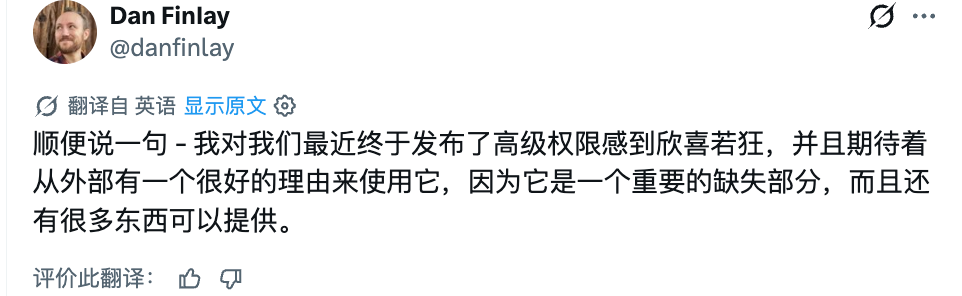
On the day Finlay left, MetaMask launched an advanced permissions feature called ERC-7715. He said he looked forward to experiencing it—as an ordinary user.
When a product’s creator becomes just another user—that may be the quietest, most understated farewell in crypto.
But for MetaMask, how many ordinary users will still open that little fox daily next year? Are you still using it?
Join TechFlow official community to stay tuned
Telegram:https://t.me/TechFlowDaily
X (Twitter):https://x.com/TechFlowPost
X (Twitter) EN:https://x.com/BlockFlow_News
 深潮TechFlow