

Crypto Morning Brief: Ethereum Foundation Sells 5,000 ETH to BitMine; Major Token Unlocks This Week for ZRO, BARD, ARB, and More
TechFlow Selected TechFlow Selected
Crypto Morning Brief: Ethereum Foundation Sells 5,000 ETH to BitMine; Major Token Unlocks This Week for ZRO, BARD, ARB, and More
WLFI launches the “Super Node” program, offering participants direct access to the team upon staking $5 million worth of tokens.
 Navigating Web3 tides with focused insights
Author: TechFlow
Yesterday’s Market Highlights
Trump says U.S. will not reach ceasefire agreement with Iran for now
According to Caixin Global, U.S. President Donald Trump stated on March 14 (local time) that Iran has expressed willingness to negotiate a ceasefire, but the terms it has proposed “are not good enough,” and therefore the U.S. will not conclude a war-ending agreement with Iran at this time. In an interview, Trump said: “Iran wants a deal, but I don’t want one right now because the terms aren’t good enough.” He did not specify the negotiation conditions but emphasized any agreement must be “very solid” and hinted Iran must fully abandon its nuclear program. On military action, Trump claimed U.S. and Israeli strikes have severely weakened Iran’s military capabilities. He stated U.S. forces have destroyed most of Iran’s missiles, drones, and related production facilities, adding such capabilities “will be completely eliminated within two days.” Trump also confirmed U.S. forces struck Kharg Island—the hub of Iran’s oil exports—saying the U.S. had “almost completely destroyed the island,” while deliberately avoiding damage to critical energy pipelines to prevent reconstruction from taking years.
Israeli military spokesperson: Military operation against Iran to continue for at least three more weeks
According to CNN, the Israel Defense Forces (IDF) military spokesperson stated the military operation against Iran will continue for at least another three weeks, with thousands of targets still pending. IDF spokesperson Defrin said: “We still have thousands of targets ahead of us. We are prepared and coordinating with our U.S. allies; our operational plan extends at least through Passover (in about three weeks). Beyond that, we have an even deeper plan lasting over three additional weeks.” Defrin added the IDF does not operate on a fixed timetable but pursues objectives methodically. He stressed Israel’s goal is to “severely weaken the Iranian regime.”
IEA: Oil from emergency reserves to soon enter global markets
According to JIN10, the International Energy Agency (IEA) stated oil from emergency reserves will soon begin entering global markets. Stocks from Asian and Oceanian countries will be immediately available, while those from Europe and the Americas will become available by the end of March. Governments have pledged to release 271.7 million barrels of crude oil from strategic petroleum reserves and 116.6 million barrels from mandatory industry reserves. Member countries in the Americas will supply 172.2 million barrels. Of the oil scheduled for release, 72% is crude oil and 28% is petroleum products.
Analysis: Address receiving 7,400 ETH from Tornado主导s CAKE and THE liquidation events tonight
According to on-chain analyst Yu Jin, an address that received 7,400 ETH from Tornado (possibly a hacker)主导ed tonight’s CAKE and THE collateral liquidation events, causing Venus to incur approximately $2.15 million in liquidation shortfall ($1.18M CAKE + $1.84M THE), while the hacker withdrew around $5.07 million from Venus ($2,172 BNB + 1.516M CAKE + 20 BTC):
1. The address first received 7,400 ETH via address 0x7a7...234 from Tornado, then deposited them into Aave to borrow $9.92M in stablecoins (including USDT, DAI, and USDC), subsequently transferring funds across multiple wallets to purchase THE.
2. Around 8 p.m. tonight, the actor likely pumped THE’s price on centralized exchanges (CEX) (having possibly established long positions beforehand). Then, using two wallets, they deposited 36.1 million THE into Venus to borrow BTC, BNB, CAKE, and other assets.
3. Forty minutes later, THE’s price crashed (likely triggered by closing longs and opening shorts), triggering liquidations of their collateral on Venus and further driving down THE’s price. Ultimately, both wallets’ collateral was fully liquidated, yet approximately $2.15 million ($1.18M CAKE + $1.84M THE) in borrowed funds remained unpaid—becoming Venus’s shortfall.
In summary, the actor borrowed $9.92M, but the assets withdrawn from Venus were worth only ~$5.07M. While unprofitable on-chain alone, it is speculated they profited off-chain by orchestrating THE’s price decline on CEX via on-chain liquidations.
Ethereum Foundation sells 5,000 ETH to BitMine for operational and event funding
The Ethereum Foundation announced it sold 5,000 ETH via over-the-counter (OTC) transaction at an average price of $2,042.96, totaling ~$10.38 million. The counterparty was BitMine. Proceeds fund core operations and activities, including protocol R&D, ecosystem development, and community grants.
WLFI launches “Super Node” program: Locking $5M in tokens grants “direct access opportunity” to team
According to Reuters, World Liberty Financial—a crypto project linked to the Trump family—has introduced a tiered staking mechanism. Investors locking $5 million worth of WLFI tokens (50 million WLFI) for 180 days qualify as “Super Nodes,” granting priority access to business development and executive teams for partnership discussions.
The proposal passed voting last Thursday. Per World Liberty’s official website, 99% of votes (1,786 total) supported it. Reuters could not independently verify these figures. World Liberty spokesperson David Wachsman clarified that “Super Nodes” receive “priority access rights,” not the previously mentioned “guaranteed direct access rights,” and such access is limited to business development and compliance teams—not founders.
Aave publishes analysis of “$50M loss buying AAVE”: Root cause is illiquidity—not slippage
Aave published a post-event analysis of the swap incident: “On March 12, 2026, a user executed a token swap via CoW Swap router integrated into Aave’s interface, attempting to exchange 50,432,688 aEthUSDT (~$50.43M) for aEthAAVE. Due to the unusually large order size relative to market liquidity, CoW Swap’s quote was extremely poor—and the user confirmed acceptance. Importantly, the Aave protocol itself was never at risk, as this swap occurred externally via a third-party swap protocol—not within Aave’s protocol. To date, the affected user has not contacted the Aave team.
The core issue was market illiquidity—not slippage. Illiquidity means insufficient assets are available at a given price to fulfill large orders, causing severe price deviation. The user’s order vastly exceeded available market liquidity; CoW Swap’s quote was 99.9% worse than the expected market clearing price. The adverse outcome stemmed from the user confirming the quote—not price movement during execution.
The fundamental cause was routing a large trade through an illiquid market, resulting in extreme price impact. The user executed the trade after acknowledging explicit warnings in the interface. To prevent recurrence, Aave Shield will be rolled out in the Swap widget: it will default-block swaps with price impact exceeding 25%, requiring manual override for high-risk trades. This trade incurred ~$110,368 in fees, which will be refunded upon user verification.”
Polymarket adds DOGE, BNB, HYPE price prediction markets to crypto section
Per the official interface, Polymarket’s crypto section now includes price prediction markets for DOGE, BNB, and HYPE.
Coinbase and Bybit negotiating investment cooperation agreement
According to Wu Shuo, Coinbase—the largest U.S. cryptocurrency exchange—and Bybit—the world’s second-largest offshore exchange—are negotiating an investment cooperation agreement. Bybit aims to enter the U.S. regulated market through this arrangement. Three sources familiar with the matter confirmed the news to Wu Shuo. Earlier, ICE invested in offshore exchange OKX at a $25 billion valuation; Bybit’s valuation is expected to be similar.
Michael Saylor re-posts Bitcoin Tracker info—hinting at possible new BTC accumulation
Michael Saylor, founder of Strategy, re-posted Bitcoin Tracker-related information.
Based on historical patterns, Strategy consistently discloses Bitcoin purchases the day after publishing related announcements.
ZRO, BARD, ARB, and others face major token unlocks this week
Token Unlocks data shows ZRO, BARD, ARB, and others face significant token unlocks this week:
ARB unlocks on March 16, valued at ~$9.65M (1.78% of circulating supply);
ZK unlocks on March 17, valued at ~$3.4M (2.97% of circulating supply);
BARD unlocks on March 17, valued at ~$32.43M (11.09% of circulating supply);
ZRO unlocks on March 20, valued at ~$55.53M (5.64% of circulating supply);
YZY unlocks on March 19, valued at ~$6.8M (4.90% of circulating supply);
BR unlocks on March 19, valued at ~$4.15M (68.45% of circulating supply);
LISTA unlocks on March 20, valued at ~$2.9M (6.17% of circulating supply);
PIXEL unlocks on March 19, valued at ~$1.05M (3.57% of circulating supply);
KAITO unlocks ~18 million tokens on March 20, valued at ~$6.3M (5.19% of circulating supply).
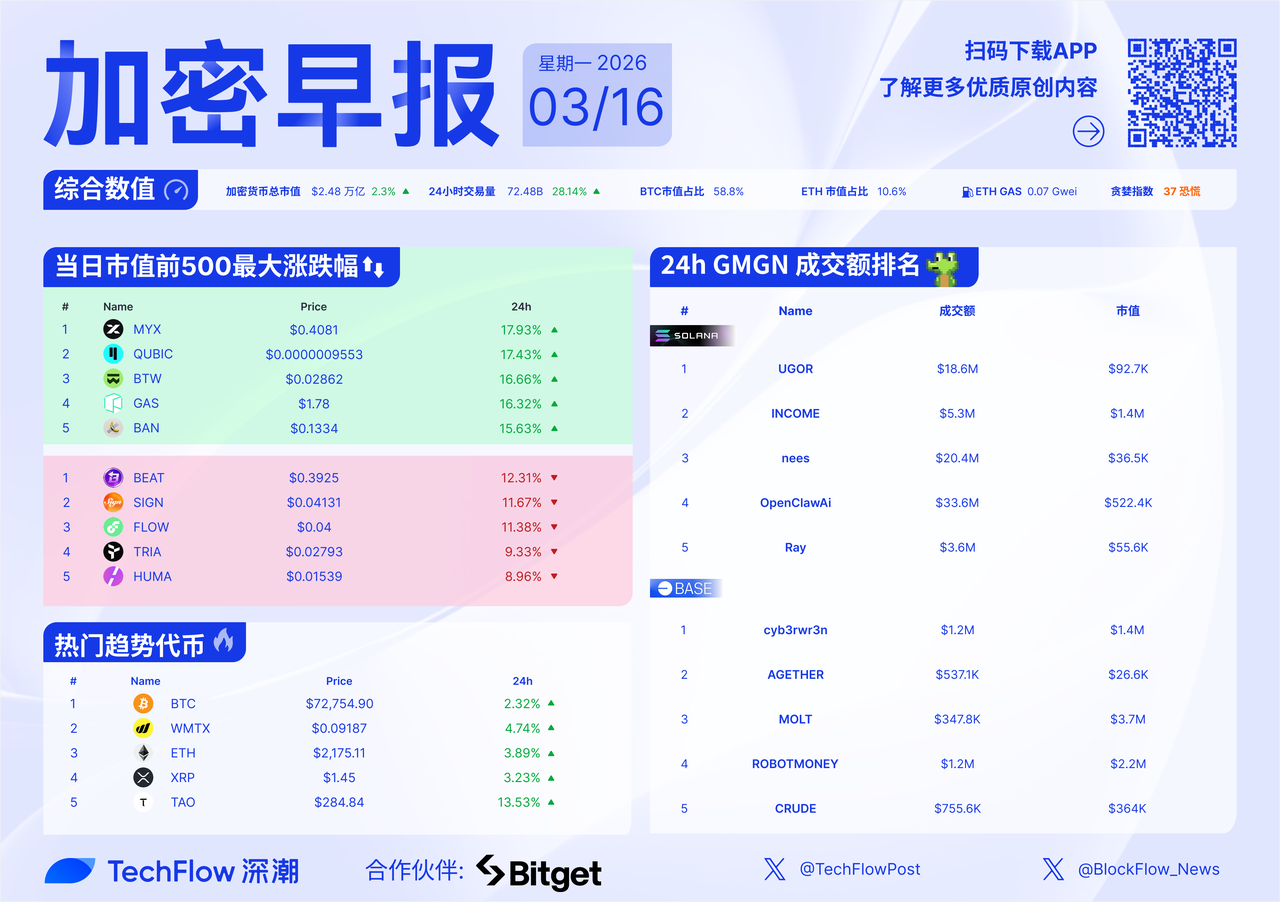
Market Data
Recommended Reading
The Person Who Exited at the NFT Peak Is Now the Most Secret Winner Behind OpenClaw
This article traces Alex Atallah’s entrepreneurial journey. Capitalizing on market fragmentation in NFTs and AI, he founded two successful aggregation platforms—OpenSea and OpenRouter—which dominate their respective fields (NFTs and AI models). His success stems from foresight and strategic positioning at critical market nodes.
Vitalik Proposes a Way to Use Large AI Models Anonymously
This article covers Vitalik’s proposal titled “ZK API Usage Credits,” leveraging zero-knowledge proofs to enable anonymous large AI model calls without exposing user identity. It remains in the research phase and has not been implemented.
This article discusses crypto’s shift from defense to offense: ETF inflows continued for two weeks straight; on-chain gold holdings surged; HIP-3 open interest hit an all-time high—indicating renewed investor interest in hard assets and crypto. Macro uncertainty, geopolitical tensions, and rising oil prices drove capital toward crypto and tokenized assets. Meanwhile, mainstream financial institutions are accelerating integration with the crypto industry.
Hormuz Strait Blockade: Which of the World’s Top 7 Economies Will Crumble First?
This article analyzes the impact of a 14-day Hormuz Strait blockade on global energy markets and major economies. It ranks nations by vulnerability under energy shortages, security vacuums, and diplomatic pressure—and examines the IEA’s strategic reserve releases, Saudi Arabia’s pipeline bypass capacity, and the feasibility—and cost—of U.S. efforts to reopen the strait.
80% of Tokens Underperform; IPO Funding Soars 48x—The Crypto Capital Shift Has Begun
This article explores major crypto trends: current token issuance dynamics, the rise of IPOs, equity vs. token comparisons, and accelerating M&A activity. Though token markets face challenges, capital hasn’t left crypto—it’s shifting toward equity and IPOs. The industry is undergoing a structural migration from token-centric to equity-centric models, prioritizing fundamentals and sustainability.
Join TechFlow official community to stay tuned
Telegram:https://t.me/TechFlowDaily
X (Twitter):https://x.com/TechFlowPost
X (Twitter) EN:https://x.com/BlockFlow_News
 深潮TechFlow















