Crypto Morning Brief: Bitcoin Drops Below $80,000; Major Token Unlocks This Week for HYPE, BERA, XDC, and More
TechFlow Selected TechFlow Selected
Crypto Morning Brief: Bitcoin Drops Below $80,000; Major Token Unlocks This Week for HYPE, BERA, XDC, and More
Federal Reserve Chair nominee Walsh implicated in Epstein case.
 Navigating Web3 tides with focused insights
Author: TechFlow
Yesterday’s Market Updates
U.S. Government Partial Shutdown Officially Begins
According to JIN10 Data, the U.S. government officially entered a partial shutdown in the early hours of January 31 (local time). Earlier, the U.S. Senate passed an appropriations bill funding most federal agencies and forwarded it to the House of Representatives for consideration. However, as House members were not in Washington and were scheduled to return only on Monday, February 2, the Senate’s vote could not prevent the partial government shutdown.
Fed Chair Nominee Kevin Warsh Linked to Epstein Case
According to Yahoo Finance, Kevin Warsh—the Federal Reserve chair nominee announced by U.S. President Donald Trump—was named in newly unsealed U.S. government documents related to the Jeffrey Epstein case released on Friday. The documents list Warsh’s name on the guest email list for an event titled “Christmas 2010 in St. Barth,” which also included Russian oligarch Roman Abramovich. Additionally, Warsh reportedly attended a dinner hosted by British aristocrat William Astor. The disclosure coincided with the day of his nomination as Fed chair. Previously, Warsh’s main controversy centered on his ties to Republican donor Ronald Lauder, who was alleged to have influenced Trump’s interest in Greenland during his first term and holds commercial interests there. Warsh may now need to address questions regarding his connection to Epstein and his whereabouts during the 2010 Christmas period. Observers are also examining whether Trump’s nomination reflects shared social circles.
Binance Releases Detailed Investigation Report on October 11 Crypto Flash Crash: Platform-Specific Issues Were Not the Cause
Binance has published a detailed investigation report on the October 11 crypto flash crash. Key findings include:
- The primary drivers of market turbulence on October 11, 2025, included macroeconomic shocks, market makers’ risk-control mechanisms, and Ethereum network congestion.
- During the market volatility, Binance’s core systems remained fully operational; no platform-wide outages occurred. Core order-matching, risk verification, and liquidation functions continued running stably and without interruption.
- Binance remains committed to transparency and user protection, having proactively implemented multiple measures to support users impacted by extreme market fluctuations.
Binance emphasized that isolated platform issues were not the root cause of this flash crash. The three widely cited stablecoin depegs (USDe, BNSOL, WBETH) occurred at 05:36 (Beijing Time), later than the peak volatility window (05:10–05:20 Beijing Time). Moreover, approximately 75% of all liquidations on that day took place before these depegs. This chronological sequence confirms that most deleveraging occurred during the initial macro shock at around 04:50 (Beijing Time), when rapidly thinning order-book liquidity accelerated price declines through forced liquidations.
This further affirms that the event’s primary drivers were broad-based risk-aversion sentiment and a cascade of liquidations—not isolated platform anomalies. Throughout the episode, Binance’s core matching engine, risk verification, and liquidation systems operated continuously and without disruption.
Below are findings from two specific incidents:
Incident One: Temporary Performance Degradation in Asset Transfer Subsystem (05:18–05:51 Beijing Time)
During the peak sell-off, our internal asset transfer subsystem experienced approximately 33 minutes of slowed performance, affecting fund transfers between users’ spot, wealth management, and futures accounts. Core order-matching, risk verification, and liquidation functions remained fully functional throughout. The impact was limited exclusively to the fund-transfer pathway and its dependent services. A very small number of users briefly saw their interface balances display “0” upon backend API failures—a display issue, not an actual loss of assets.
Incident Two: Index Deviations for USDe, WBETH, and BNSOL (05:36–06:15 Beijing Time)
Against a backdrop of broadly diminished order-book depth and on-chain congestion hindering cross-platform arbitrage, USDe’s index deviated first, followed by similar deviations for WBETH and BNSOL. Localized liquidity shortages, accelerated liquidations, and slower inter-market capital flows amplified short-term price fluctuations within the index calculation methodology.
OKX CEO Star: October 11 Flash Crash Caused by Binance’s Reckless USDe Yield Program
Star, CEO of OKX, posted on X: “The events of October 10 were triggered by irresponsible marketing campaigns launched by certain firms. Hundreds of billions of dollars were liquidated. Many industry participants believe the damage exceeded that of the FTX collapse. The root cause is not difficult to identify.
What Actually Happened:
- Binance launched a temporary user yield program offering a 12% annualized return on USDe, while permitting USDe to be used as collateral on equal footing with USDT and USDC—and without effective limits.
- Binance encouraged users to convert USDT and USDC into USDe to earn attractive yields, but underemphasized associated risks. From the user perspective, trading with USDe appeared indistinguishable from using traditional stablecoins—while the actual risk profile was significantly higher.
- Risk escalated further as users engaged in the following actions: • Converting USDT/USDC into USDe • Borrowing USDT using USDe as collateral • Converting borrowed USDT back into USDe • Repeating this cycle
- This leverage loop generated artificial annualized yields of 24%, 36%, or even over 70%—widely perceived as “low-risk” solely because they were offered by a major platform. Systemic risk accumulated rapidly across global crypto markets.
- At that point, even a minor market shock was sufficient to trigger collapse. When volatility hit, USDe quickly depegged. This triggered cascading liquidations, and weaknesses in risk management surrounding assets like WETH and BNSOL further amplified the crash. Some tokens traded near zero. Global users and institutions—including OKX customers—suffered severe losses, requiring significant time for recovery.”
Wintermute Founder: The October 11 Flash Crash Was Clearly Not a “Software Failure”; Blaming a Single Exchange Is Illogical
Evgeny Gaevoy, Founder and CEO of Wintermute, posted on social media urging public figures to exercise greater caution in their language. He stated that the October 10 crash was clearly not a “software failure,” but rather a flash crash in a large, leveraged market suffering from insufficient liquidity—triggered by macroeconomic news late Friday evening.
Since we’re on the subject, I understand no one enjoys being stuck in a bear market while watching every other asset class rally—except crypto. Finding a scapegoat may feel comforting, but assigning full responsibility to a single exchange is logically dishonest.
Dragonfly Partner: Attributing the October 11 Crash Solely to Binance’s USDe Yield Program Is Unreasonable
Haseeb Qureshi, Managing Partner at Dragonfly, offered his own analysis of the October 11 crypto market crash. He argued that OKX CEO Star’s claim—that the crash resulted from excessive leverage driven by Binance’s Ethena yield program—is unreasonable.
Qureshi pointed out that Bitcoin’s price bottomed 30 minutes before USDe’s price began deviating, and USDe’s deviation occurred only on Binance—yet the liquidation storm swept across all exchanges. Qureshi attributes the October 11 crash to a confluence of factors: Trump’s tariff threat triggering market panic; a Binance API outage causing price misalignment and massive liquidations; market makers’ inability to rebalance inventories across exchanges; and the lack of self-stabilizing mechanisms in crypto liquidation protocols.
Tom Lee: Current Bear Market Triggered by a CEX Pricing Glitch Last October That Sparked Cascading Liquidations
Tom Lee stated on Friday’s episode of the podcast The Compound that the current bear market stems from last October’s largest-ever crypto deleveraging event—larger than the FTX collapse. A pricing glitch on a centralized exchange triggered automatic cascading liquidations, wiping out over 2 million accounts globally, destroying one-third of market makers, and severely damaging exchange balance sheets—leaving the entire ecosystem “lame.”
Additionally, he maintains a bullish stance, forecasting that 2026 will mirror 2025: strong growth in the first half, a ~20% correction around mid-year, followed by a rebound of at least 10%.
Trend Research Repays Loan by Depositing 30,000 ETH ($70.18M) to Binance
According to Onchain Lens (@OnchainLens), Trend Research deposited an additional 30,000 ETH (~$70.18 million) to Binance, subsequently sold the ETH, and repaid its loan. Within the past 18 hours, Trend Research has deposited a total of 40,000 ETH (~$94.53 million) to Binance.
Market Rumor: UAE Royal Family Member Secretly Acquired 49% Stake in World Liberty Financial for $500M
Market sources report that a senior member of the UAE royal family secretly purchased a 49% stake in Trump’s cryptocurrency project, World Liberty Financial, for $500 million.
Michael Saylor Posts Again on Bitcoin Tracker; New BTC Acquisition Data Likely Next Week
Michael Saylor, founder of Strategy, posted new information about the Bitcoin Tracker, writing: “More Orange.”
Per historical precedent, Strategy always discloses its Bitcoin acquisition data the day after such announcements.
Major Token Unlocks This Week Across HYPE, BERA, XDC, and Others Exceed $300M
Token Unlocks data shows multiple crypto projects face significant token unlocks this week, totaling over $300 million in value.
- HYPE: 9.92 million tokens unlock on February 6, valued at ~$296.91 million (2.79% of circulating supply);
- BERA: 63.75 million tokens unlock on February 6, valued at ~$29.47 million (41.70% of circulating supply);
- XDC: 841.18 million tokens unlock on February 5, valued at ~$29.00 million (5.00% of circulating supply);
- ENA: 40.63 million tokens unlock on February 2, valued at ~$5.55 million (0.55% of circulating supply);
- KMNO: 100 million tokens unlock on February 8, valued at ~$3.34 million (1.55% of circulating supply);
- W: 50.41 million tokens unlock on February 6, valued at ~$1.15 million (0.95% of circulating supply);
- RED: 5.54 million tokens unlock on February 6, valued at ~$1.15 million (2.24% of circulating supply);
- AXS: 652,500 tokens unlock on February 6, valued at ~$1.12 million (0.24% of circulating supply);
- BB: 29.93 million tokens unlock on February 7, valued at ~$1.07 million (2.97% of circulating supply);
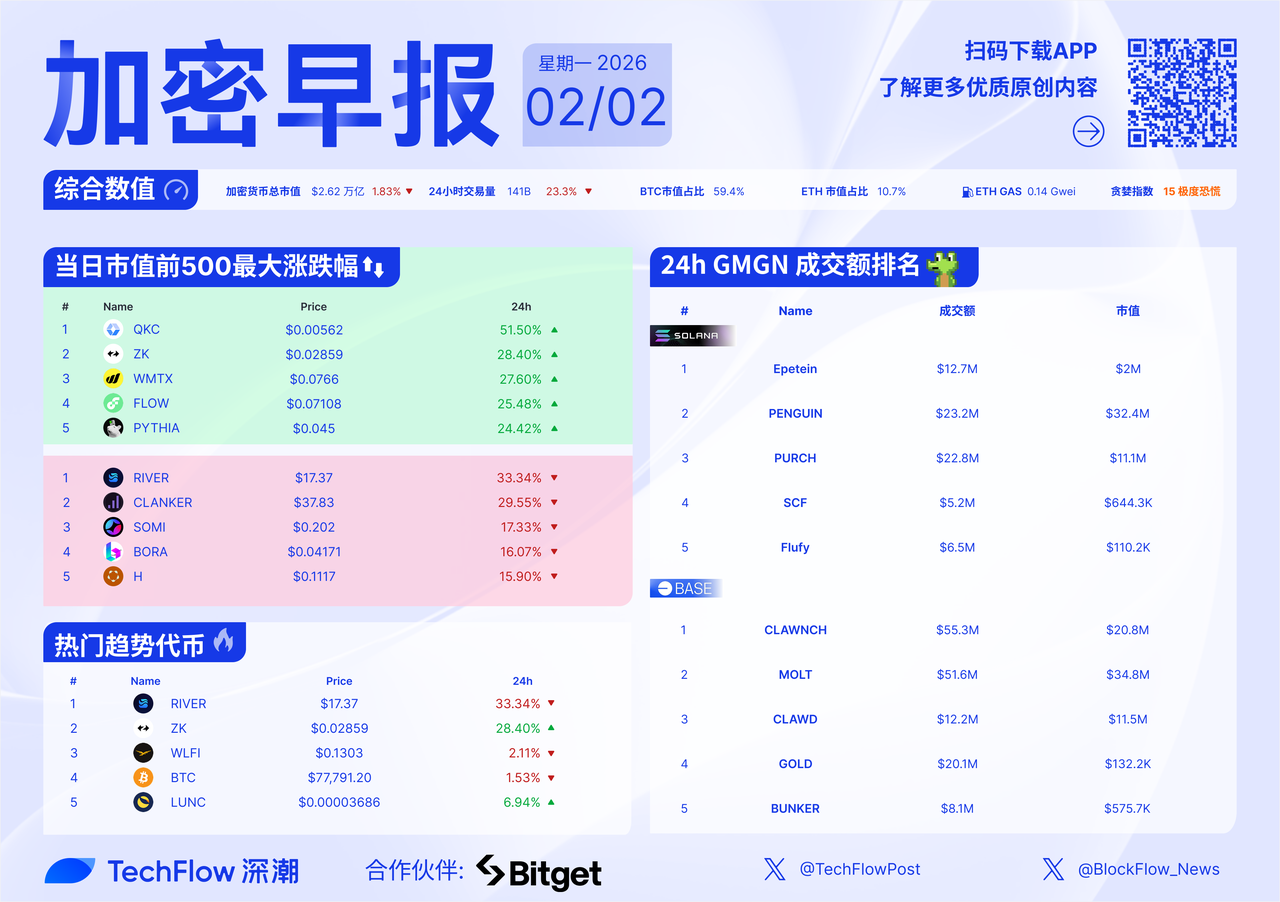
Market Data
Recommended Reading
Left Hand to Right? Unmasking the Financial Leverage Loop Behind the AI Boom and Wall Street’s Ultimate Bet
https://www.techflowpost.com/zh-CN/article/30180
This article examines the current investment frenzy around artificial intelligence (AI) and its underlying risks. It notes that while AI’s rapid advancement offers immense economic potential, it also brings cyclical investment patterns, profitability challenges, and infrastructure strain. The piece draws parallels between today’s AI boom and the 2000 dot-com bubble, analyzing possible risks and future outlooks.
Understanding Premium Rates: Gain a 24-Hour Edge Over ETF Data
https://www.techflowpost.com/zh-CN/article/30175
This article explains the concept of ETF premium rates and their application in crypto markets. It explores the relationship between premium rates and capital flows, how premium rates can forecast market trends, and recommends combining multi-dimensional indicators for comprehensive analysis.
Market Recap: January 30 – Gold & Silver Plunge Overnight; Trump Upends Fed Personnel
https://www.techflowpost.com/zh-CN/article/30170
This article analyzes recent market turbulence—including sharp fluctuations in precious metals prices, the impact of Fed personnel changes on markets, Microsoft’s earnings report and controversies surrounding AI investments, and the ongoing decline in crypto markets. It argues that market uncertainty stems primarily from geopolitical risks, the Fed’s policy trajectory, and crypto’s speculative nature.
Gold & Silver Suffer Historic Collapse! What Happened?
https://www.techflowpost.com/zh-CN/article/30183
This article details the historic collapse in precious metals markets, where gold and silver prices plunged sharply—posting their largest single-day declines in decades. Market consensus points to President Trump’s nomination of hawkish candidate Kevin Warsh as Fed chair as the catalyst, while technical factors and excessive market leverage further exacerbated the drop. Nonetheless, analysts suggest this correction may benefit long-term market health.
Three Key Shifts: Analyzing New Fed Chair Kevin Warsh’s Impact on Crypto Markets
https://www.techflowpost.com/zh-CN/article/30185
This article provides an in-depth analysis of newly appointed Fed Chair Kevin Warsh’s professional background, policy stance, complex relationship with Trump, and potential implications for crypto markets. It explores Warsh’s “concurrent rate cuts and balance sheet reduction” framework, assessing its impact on crypto liquidity, regulatory environment, and capital flows—and offers a forward-looking view of the crypto landscape under Warsh’s leadership.
Join TechFlow official community to stay tuned
Telegram:https://t.me/TechFlowDaily
X (Twitter):https://x.com/TechFlowPost
X (Twitter) EN:https://x.com/BlockFlow_News
 深潮TechFlow