








The Next Bitcoin Bull Run May Begin with a Private Credit Crisis
TechFlow Selected TechFlow Selected
The Next Bitcoin Bull Run May Begin with a Private Credit Crisis
The moment of truth for private credit—Bitcoin emerges as the ultimate winner.
 Navigating Web3 tides with focused insights
By Jordi Visser
Translated by Luffy, Foresight News
Bitcoin’s next major bull run may begin in the most unexpected place: the private credit market.
This isn’t because a private credit collapse would immediately benefit Bitcoin. During genuine liquidity crises, highly liquid assets like Bitcoin are typically among the first to be sold off alongside other assets. The crisis’s first phase is not redemption—it’s liquidation. Yet the core logic emerges only in the second phase.
In a system burdened by excessive debt, hyper-financialization, and political intolerance for prolonged credit cleansing, liquidity “ebbs” rarely last long. And when governments re-inject liquidity, Bitcoin tends to grasp the significance of that move faster than almost any other asset.
Warren Buffett described this scenario plainly: “Only when the tide goes out do you learn who’s been swimming naked.” He also mocked private equity’s “highly regarded fee structure and obsession with leverage,” warning later that, at certain rare moments, “credit vanishes overnight, and debt becomes a fatal financial trap.”
Buffett wasn’t talking about Bitcoin—he was diagnosing a financial system built on leverage, opacity, and confidence. That diagnosis fits today’s private credit market perfectly. When the tide recedes, hidden fragility ceases to be theoretical risk—and becomes the market’s entire reality.
That’s precisely why private credit matters so much right now. According to Morgan Stanley, the market stood at roughly $3 trillion in early 2025 and could approach $5 trillion by 2029—yet warning signs are already flashing.
This week, Morgan Stanley imposed redemption restrictions on one of its private credit funds after investor redemption requests neared 11% of the fund’s total size. Meanwhile, JPMorgan Chase wrote down loans extended to certain private credit funds, as market concerns over software-sector exposure continue to intensify.
The key point isn’t that the entire market has entered crisis—but that pressure is no longer hypothetical. It’s manifesting concretely in redemption limits, asset write-downs, and shifts in lender behavior.
AI Is the Catalyst
The core risk isn’t leverage alone—it’s leverage tied to an industry undergoing real-time AI-driven repricing.
Morgan Stanley noted in March that roughly 25% of commercial development company portfolios were allocated to software. Given AI’s disruptive impact on the software industry’s business model, that ratio is alarmingly high.
For years, software financing logic rested on assumptions that recurring revenue equaled stable cash flow, customer stickiness was strong, margins were high, and exit paths were reliable. AI is overturning all of that: pricing power is eroding, products rapidly commoditize into functional modules, competitive moats are narrowing, and compute and R&D investment have become non-negotiable fixed costs.
In other words, much of today’s private credit was extended based on a software business model that may already be obsolete.
Bitcoin Is Also in the Storm
All discussions around software valuations and private credit ultimately converge on Bitcoin. Overlaying Bitcoin’s price chart with those of software stocks and private equity equities reveals an unmistakable correlation:
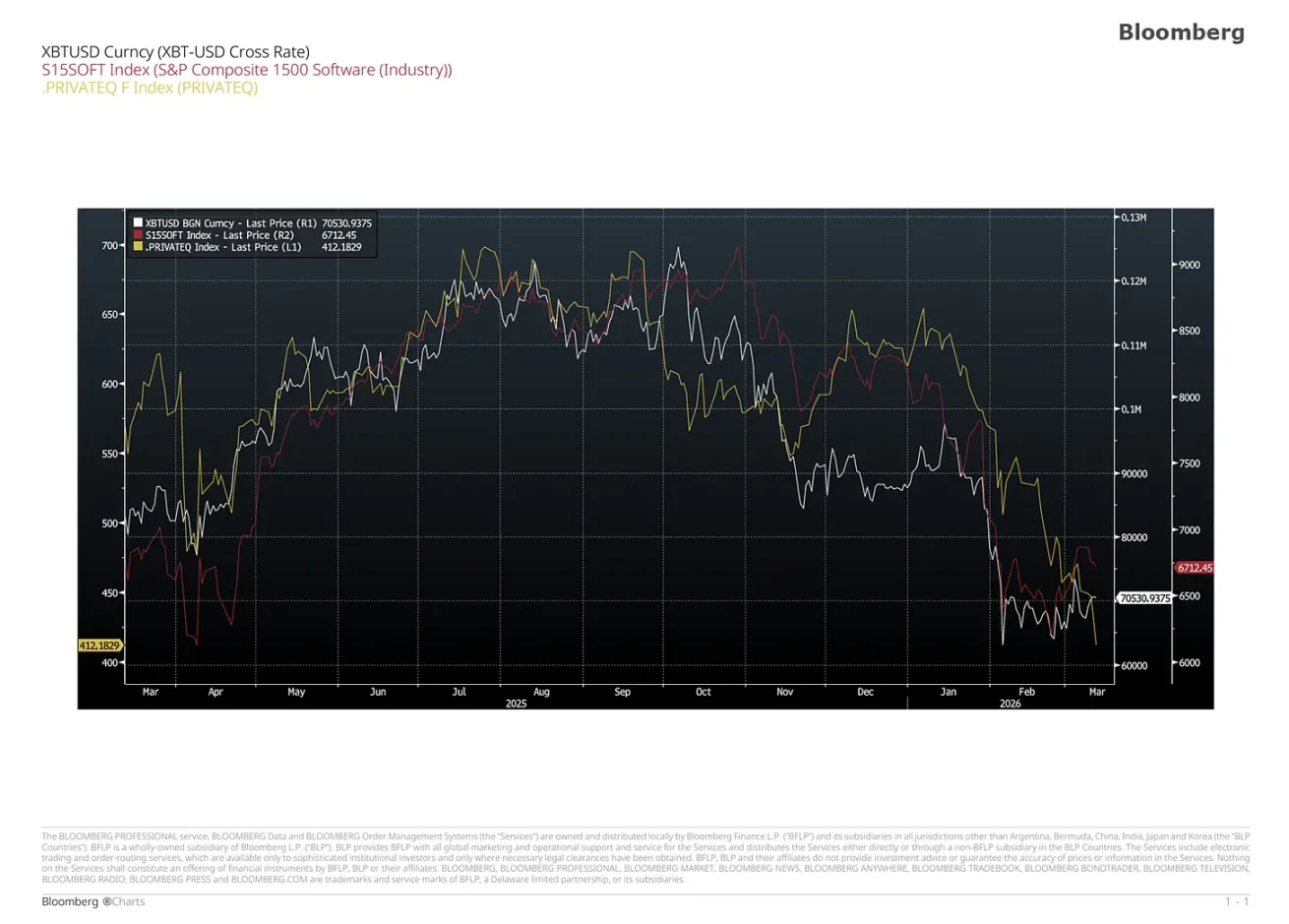
Bitcoin exhibits both software-sector beta and liquidity beta—and both forces are currently weighing it down.
In 2025, I anticipated a strong Bitcoin rally, driven by increased government support and the rise of AI agents—factors expected to reinforce crypto network effects, prompting a joint re-rating with the software sector and elevating Bitcoin into the high-growth asset class. Though stablecoin transaction volumes and market cap rose, that optimistic Bitcoin thesis ultimately failed to materialize.
Instead, with the rollout of technologies like Opus 4.5 and OpenClaw, market attention shifted toward AI’s disruption of the software industry itself. Investors reassessed the sustainability of traditional software models, driving rapid valuation multiple compression—which in turn hit private credit, a critical funding source for the software ecosystem.
AI is forcing a disruptive repricing of the software industry—and with it, one of Bitcoin’s key macro-pricing logics is under pressure. Simultaneously, the global liquidity cycle is tightening, undermining Bitcoin’s other defining trait: its acute sensitivity to global liquidity conditions.
That’s why cracks in private credit don’t instantly benefit Bitcoin: short-term effects often run counter. Bitcoin’s high liquidity, broad ownership dispersion, and ease of selling make it a prime candidate for early liquidation—its liquidity priority outweighing long-term value logic during Phase One of market stress.
Bitcoin Falls First in Panic—Rallies First in Rescue
History confirms this rhythm.
During the “cash is king” panic of March 2020, Reuters reported Bitcoin plunged over 20% in a single day and more than 30% over five days, as investors dumped nearly every asset. Policy easing then began—and by January 2021, Bitcoin had surged over 900% from its March lows. Governments expanded spending to offset pandemic fallout; investors feared inflation and currency debasement—and Bitcoin fully priced in those expectations.
Bitcoin doesn’t fear panic—it simply reflects the subsequent policy-driven upside earlier and more forcefully than other assets.
The same script played out during the 2023 U.S. regional banking crisis: Silicon Valley Bank faced $42 billion in withdrawals in a single day, with another $100 billion in withdrawal requests queued for the next day. Authorities then guaranteed all deposits, and the Fed launched the Bank Term Funding Program (BTFP), offering loans at par against eligible collateral. In the wake of that turmoil, Bitcoin climbed to its highest level in nine months—and more than doubled by year-end.
The core pattern remains consistent: Bitcoin suffers during cash grabs—then swiftly captures the upside from policy rescue measures.
Why Redemption Is Inevitable
This dynamic is especially critical today, because the U.S. financial system cannot withstand prolonged liquidity tightening.
The Congressional Budget Office (CBO) projected in February 2026 that the federal deficit for FY2026 would reach $1.9 trillion, with publicly held debt already at 101% of GDP. Meanwhile, the Buffett Indicator (U.S. stock market capitalization / GDP) stood at approximately 219% in early March.
This is the reality of financialization: sovereign debt is sky-high, and asset markets vastly outsize the real economy. Under such conditions, policymakers lack room for fully organic, unassisted deleveraging. Modern economies and asset prices are too tightly coupled—and nations are too dependent on economic growth and market functioning—for pure cleansing to persist.
The Fed has already signaled this reflexive response: slowing quantitative tightening in March 2025, deciding in October to halt securities sales on December 1, and launching reserve management purchases in December to maintain ample reserves. Even without a full-blown crisis, the system is already pivoting back toward easing.
Once it becomes clear the financial system itself requires a liquidity reboot, it’s easy to conclude: policymakers will almost certainly not stand idly by during the next private credit crisis.
The political dimension reinforces this. The SEC’s Investor Advisory Committee noted in September 2025 that although registered products have broadened retail access, private markets remain less transparent and riskier. Morningstar reported that net assets in semi-liquid funds reached $493 billion in Q3 2025.
When retail capital and wealth-channel funds are packaged into illiquid credit exposures, private credit ceases to be a niche institutional issue—and becomes a public concern. When opaque risks escalate into public issues, government intervention is inevitable.
Bitcoin Returns to Its Foundational Logic
Bitcoin’s whitepaper introduced a peer-to-peer electronic cash system enabling direct transfers between parties—without intermediaries. And the famous inscription on the genesis block—“Chancellor on brink of second bailout for banks”—reveals its political DNA.
The whitepaper delivers the technical architecture; the genesis block carries the political metaphor. Bitcoin was born from resistance to bailouts, intermediary dependence, and arbitrary rescue interventions.
Thus, each time governments step in to save fragile, leveraged systems, Bitcoin’s foundational logic grows stronger.
Meanwhile, financial infrastructure is moving toward 24/7 operation. In October 2025, the Fed announced plans for Fedwire and the National Settlement System to operate on Sundays and holidays by 2028 or 2029. This isn’t official Bitcoin adoption—but it signals acknowledgment of a crucial fact: the economy is growing increasingly digital and continuous, and its compatibility with traditional banking hours is steadily eroding.
If AI agents become genuine economic participants, capital and collateral must flow at software speed. That doesn’t mean every transaction must settle in Bitcoin—but it does mean scarce, neutral, digital collateral will grow more essential.
The “tide” Buffett spoke of is receding from the private credit market. AI is exposing the most vulnerable lending assets first—especially those misclassifying software revenue as permanent cash flow. Bitcoin suffers in the first wave—not because it’s weak, but because it embodies dual beta: software and liquidity.
Yet U.S. debt is too high, financialization too deep, and retail capital too tightly interwoven with private assets for policymakers to tolerate prolonged, disorderly deleveraging. Liquidity will return. And whenever liquidity restarts, Bitcoin is typically among the very first assets to respond.
That’s why private credit is so critical in today’s environment.
Ironically, Bitcoin was designed for precisely this moment: a world rife with shadow banking, implicit leverage, soaring government debt—and crisis responses reliant solely on monetary easing. Private credit isn’t just another risky segment—it’s the collision point where rigid valuations, embedded leverage, AI disruption, retail participation, and policy reflexes all converge.
Recent private credit redemption restrictions and asset write-downs suggest the adjustment process may already be underway. If private credit becomes the epicenter of the next liquidity ebb, Bitcoin’s next bull run won’t begin with halving narratives or perfect macro conditions—it will begin with risk exposure, policy rescue, and the market’s eventual realization: the financial system still depends on liquidity injections.
Join TechFlow official community to stay tuned
Telegram:https://t.me/TechFlowDaily
X (Twitter):https://x.com/TechFlowPost
X (Twitter) EN:https://x.com/BlockFlow_News
 @jvisserlabs


