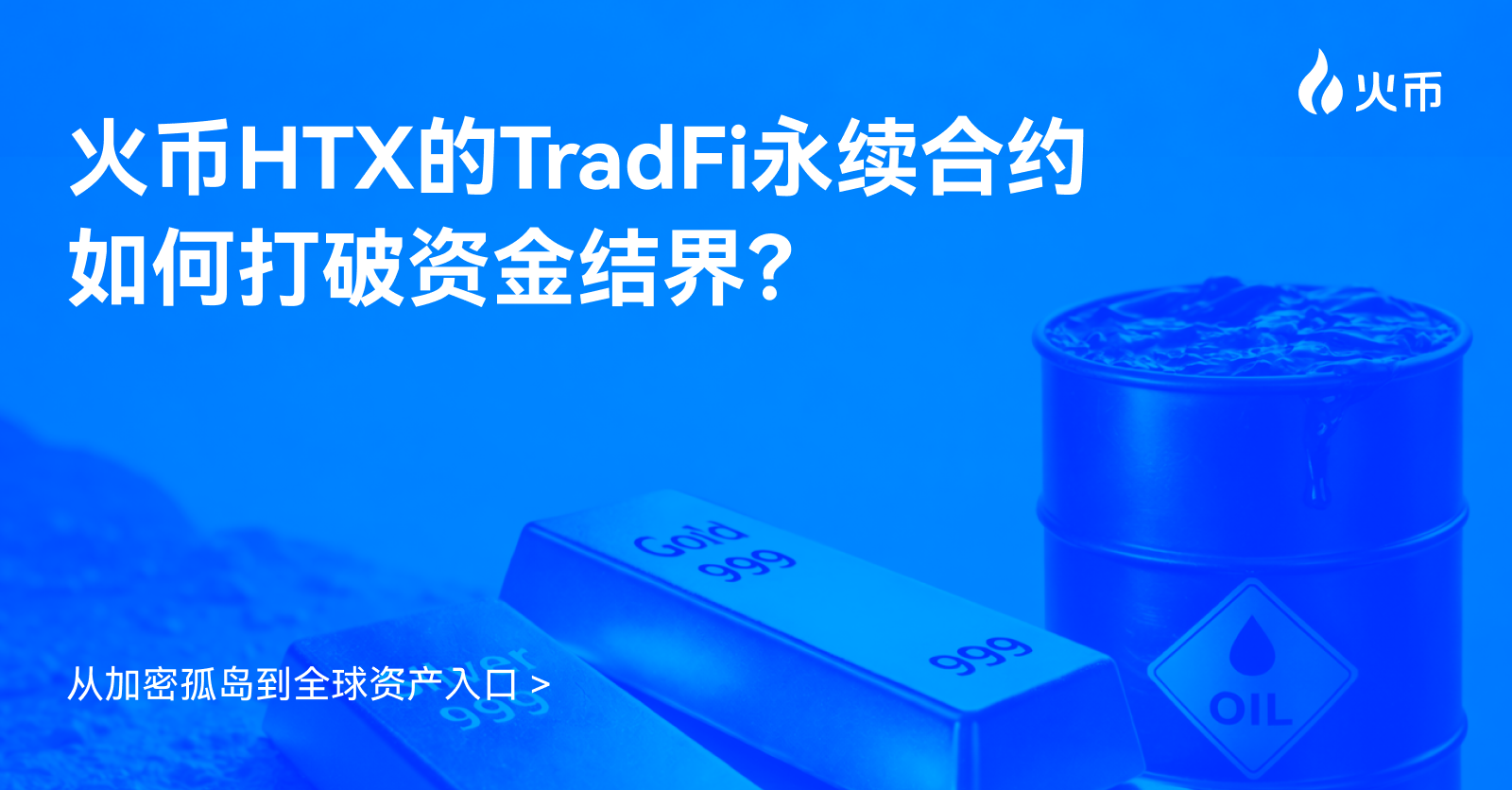
From Crypto Silos to Global Asset Gateway: How HTX’s TradFi Perpetual Contracts Break Down Capital Barriers
TechFlow Selected TechFlow Selected
From Crypto Silos to Global Asset Gateway: How HTX’s TradFi Perpetual Contracts Break Down Capital Barriers
HTX is not only a cryptocurrency asset trading platform but also aims to serve as a bridge connecting traditional financial markets with the crypto ecosystem, ultimately building a truly one-stop, comprehensive financial trading platform for global investors.
 Navigating Web3 tides with focused insights
The global financial markets in 2026 are entering a long-absent “high-volatility era.”
On one hand, the Federal Reserve’s wavering interest-rate policy continues to influence global asset pricing; on the other, safe-haven assets remain in high demand—gold prices repeatedly hit record highs—while energy and precious metals markets experience sharp swings, amplifying volatility across traditional financial assets. Meanwhile, the correlation between crypto-asset markets and global macroeconomic cycles is intensifying.
Against this backdrop, a new investment trend is rapidly taking shape among crypto users: shifting from single-asset crypto investing toward “global asset allocation” covering gold, silver, crude oil, and other asset classes. Hedging, risk diversification, and cross-market arbitrage—strategies once reserved for traditional financial institutions—are now becoming “core competencies” for crypto investors.
But here lies the problem: infrastructure has not kept pace.
Trapped Liquidity
For years, an invisible wall has separated crypto markets from traditional financial markets.
Under conventional pathways, crypto users seeking exposure to traditional financial assets still face significant structural friction. In most cases, investors must transfer funds from crypto exchanges to traditional brokers or forex platforms—a process involving complex account systems and compliance procedures, along with delays in fund transfers, foreign exchange costs, and efficiency losses from operating across multiple platforms.
High frictional costs, time lags, and fragmented cross-platform fund management mean vast amounts of capital remain trapped in a “crypto island,” endlessly circulating without accessing broader markets. Investors are forced to choose between “missing out on alpha returns from traditional markets” and “bearing prohibitively high cross-border friction costs.”
This is precisely the core issue that the RWA (Real World Assets) narrative seeks to resolve.
Over the past few years, RWA has largely been understood as on-chain issuance of assets: tokenized government bonds, tokenized real estate, and on-chain mutual fund shares. Yet another path is now being reexamined: rather than moving assets onto the blockchain, what if we instead bridge trading venues?
TradFi Perpetual Contracts: An Alternative Integration Path Beyond the RWA Narrative
Driven by this market demand, cryptocurrency exchanges are attempting to break down the barriers separating traditional finance and crypto markets.
Recently, HTX launched its TradFi Perpetual Contracts section, integrating traditional financial assets—including gold (XAU, XAUT, PAXG), silver (XAG), platinum (XPT), palladium (XPD), and crude oil (USOIL, BRENTOIL)—into the crypto derivatives trading ecosystem. Users can go long or short on global macro assets using USDT-denominated perpetual contracts—without ever leaving the crypto trading environment.
TradFi perpetual contracts align closely with the currently booming RWA narrative. The key distinction, however, lies in their emphasis on integrating trading venues: users can directly use crypto assets as margin to trade and hedge against price movements of traditional financial assets—enabling truly “cross-market trading.” In today’s increasingly volatile market environment, this mechanism provides investors with more flexible asset allocation tools while further expanding the functional boundaries of crypto exchanges.
In terms of product design, TradFi perpetual contracts function as a cross-market derivatives bridge. The familiar perpetual contract mechanism used by crypto users has been extended to traditional asset underlyings. For crypto traders accustomed to high-frequency trading and derivatives strategies, this model entails virtually zero learning curve.
Alongside the product launch, HTX also rolled out its “TradFi Super Cashback Program”, with a total prize pool of $500,000. From March 5 at 18:00 to March 19 at 18:00 (UTC+8), users who complete registration receive an airdrop of one “free position” on the TradFi section. Completing any trade—of any size—on a designated trading pair for the first time grants eligibility for a lucky draw. New users of TradFi perpetual contracts who execute their first trade totaling at least $100 USDT will receive additional $HTX token rewards. Moreover, users participating in designated TradFi perpetual contract trades can earn tiered fee rebates based on cumulative trading volume—with a maximum rebate rate of 120% and a total prize pool of $500,000.
Through this product structure, HTX is seamlessly injecting Web3’s liquidity and efficiency into the value system of traditional finance.
From “Exchange” to “Integrated Trading Platform”
As the convergence trend across global financial markets deepens, the role of crypto exchanges is also evolving.
Over the past decade, the core competitiveness of crypto exchanges has centered on three pillars: liquidity, breadth of tradable assets, and depth of derivatives offerings. But as the crypto market matures, a new competitive dimension is emerging: which platform delivers the most comprehensive asset allocation experience. In other words, the fundamental positioning of exchanges is undergoing a structural shift—from “crypto-asset trading platforms” toward “gateways to global asset trading.”
In this evolution, platforms capable of bridging traditional finance and the crypto world may become pivotal nodes in the future digital financial ecosystem.
HTX clearly aims to secure first-mover advantage in this space. By launching TradFi perpetual contracts alongside complementary incentive programs, its strategic intent has grown increasingly clear: it seeks not only to operate as a crypto-asset trading platform but also to serve as a bridge connecting traditional financial markets and the crypto ecosystem—ultimately building a truly one-stop, integrated financial trading platform for global investors.
About HTX
Founded in 2013, HTX has evolved over 12 years from a cryptocurrency exchange into a comprehensive blockchain business ecosystem, spanning digital asset trading, financial derivatives, research, investment, incubation, and other services.
As a leading global Web3 gateway, HTX adheres to a development strategy centered on global expansion, ecosystem prosperity, wealth creation, and security & compliance—delivering comprehensive, secure, and reliable value and services to cryptocurrency enthusiasts worldwide.
To learn more about HTX, please visit https://www.htx.com/ or HTX Square, and follow us on X, Telegram, and Discord. For further inquiries, please contact [email protected].
Join TechFlow official community to stay tuned
Telegram:https://t.me/TechFlowDaily
X (Twitter):https://x.com/TechFlowPost
X (Twitter) EN:https://x.com/BlockFlow_News