February 2026 Crypto Market Recap: BTC’s $60K Extreme Rebound and Market Reaction on the Day of U.S. Military Airstrikes
TechFlow Selected TechFlow Selected
February 2026 Crypto Market Recap: BTC’s $60K Extreme Rebound and Market Reaction on the Day of U.S. Military Airstrikes
Information-dense, suitable as background material for understanding the current market structure.
 Navigating Web3 tides with focused insights
Author: CryptoNarratives (Viktor)
Translation & Editing: TechFlow
TechFlow Intro: This monthly recap comprehensively reviews key developments in the crypto market for February: BTC’s sharp rebound from the $60k level, panic and rapid recovery following the strike on Iran, the expectation-driven narrative around the ZRO conference, and the prevalence of manipulated “pump-and-dump” tokens amid bearish conditions. Packed with information, it serves as valuable background material for understanding the current market structure.
Full Text Below:
BTC Timeline
Below is the main timeline for February:
Gold peaked at the end of January and then corrected sharply, falling from $5,600 to $4,400. The bottom occurred on February 2, followed by a rapid rebound to ~$5,100 within two days. Silver also experienced a collapse from its peak, plunging nearly 50% from $121 to $64 on February 6.
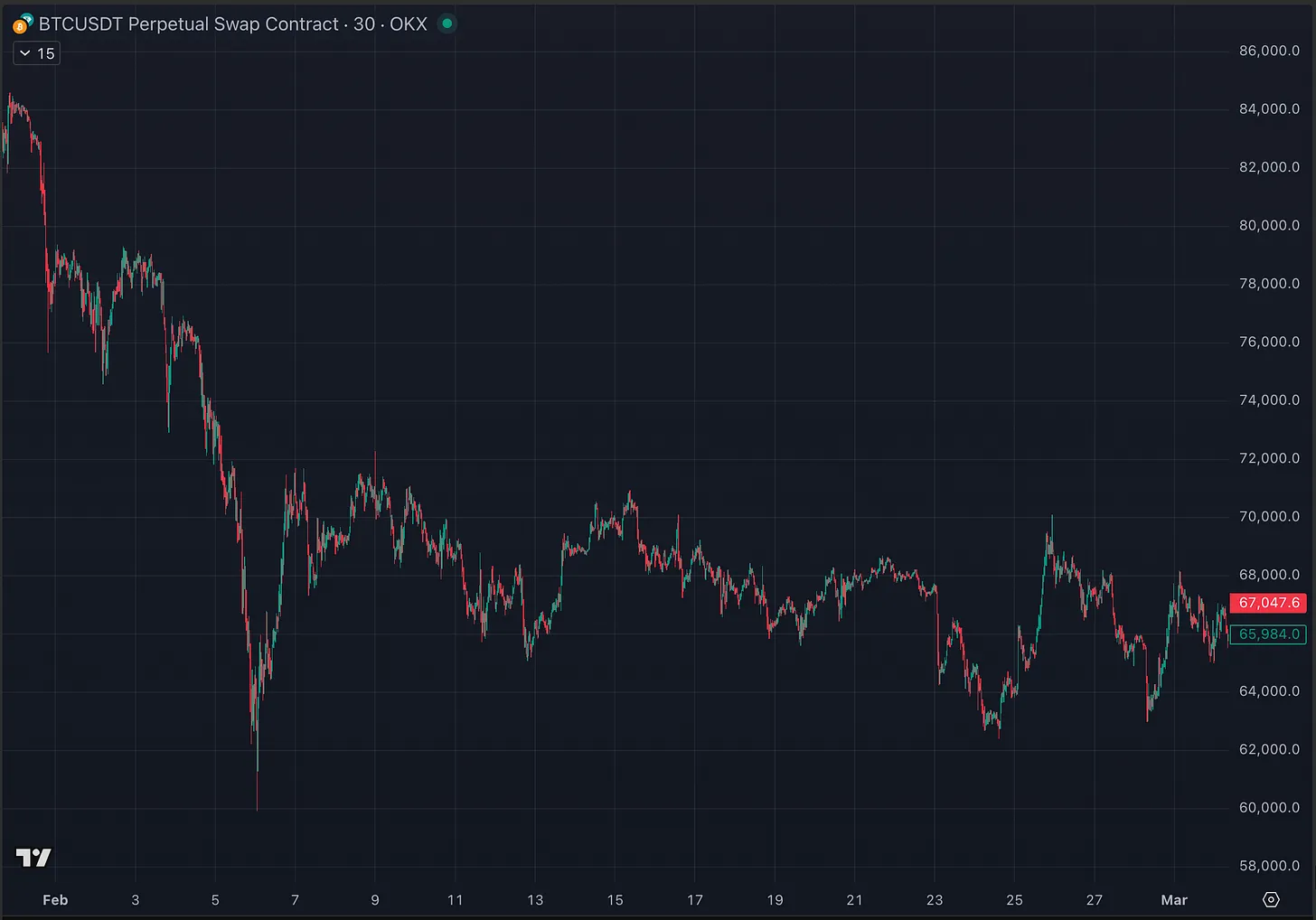
BTC entered February in extremely weak form—having reached a high of $98k in January but opening the month at $78k. It fell to $70k within four days, then crashed further—from $70k to $60k—in a single day on February 5.
BTC staged a strong rebound from the $60k level, recovering to nearly $72k in under one day. This full swing effectively defined the trading range for the remainder of the month—mostly confined between $60k and $70k.
After the first week, BTC traded sideways near $68k for most of the month, with only two clear periods of strength: February 13–14 and February 25—both marked by notable altcoin rallies.
On February 27, rumors of an imminent U.S. airstrike on Iran sent BTC down from $68k to $65k. The actual strike occurred the next day. Upon confirmation, BTC dropped further to $62k—but was consistently supported by buying pressure throughout the day, ultimately closing near $68k—the same price at which it ended the month. On the same day, news broke of Ayatollah Khamenei’s death, widely interpreted by the market as a bullish signal (as it implied the U.S. would likely avoid committing substantial resources to this conflict).
ZRO Conference
Almost the only coherent narrative among altcoins in February centered on the LayerZero conference on February 10. $ZRO had been steadily strengthening since the start of the year, largely driven by anticipation of this event. I originally anticipated a classic “sell-the-news” scenario—but reality played out somewhat differently.
That day, a video announcing the launch of LayerZero’s own L1 blockchain leaked early, triggering a sell-off that sent the token down ~20% within an hour—marking the intraday low. Later that day, the official announcement confirmed the launch of the “Zero” chain—and, crucially, came bundled with a series of high-profile partnership announcements, including Citadel Securities, Cathie Wood/ARK, DTCC, and ICE.
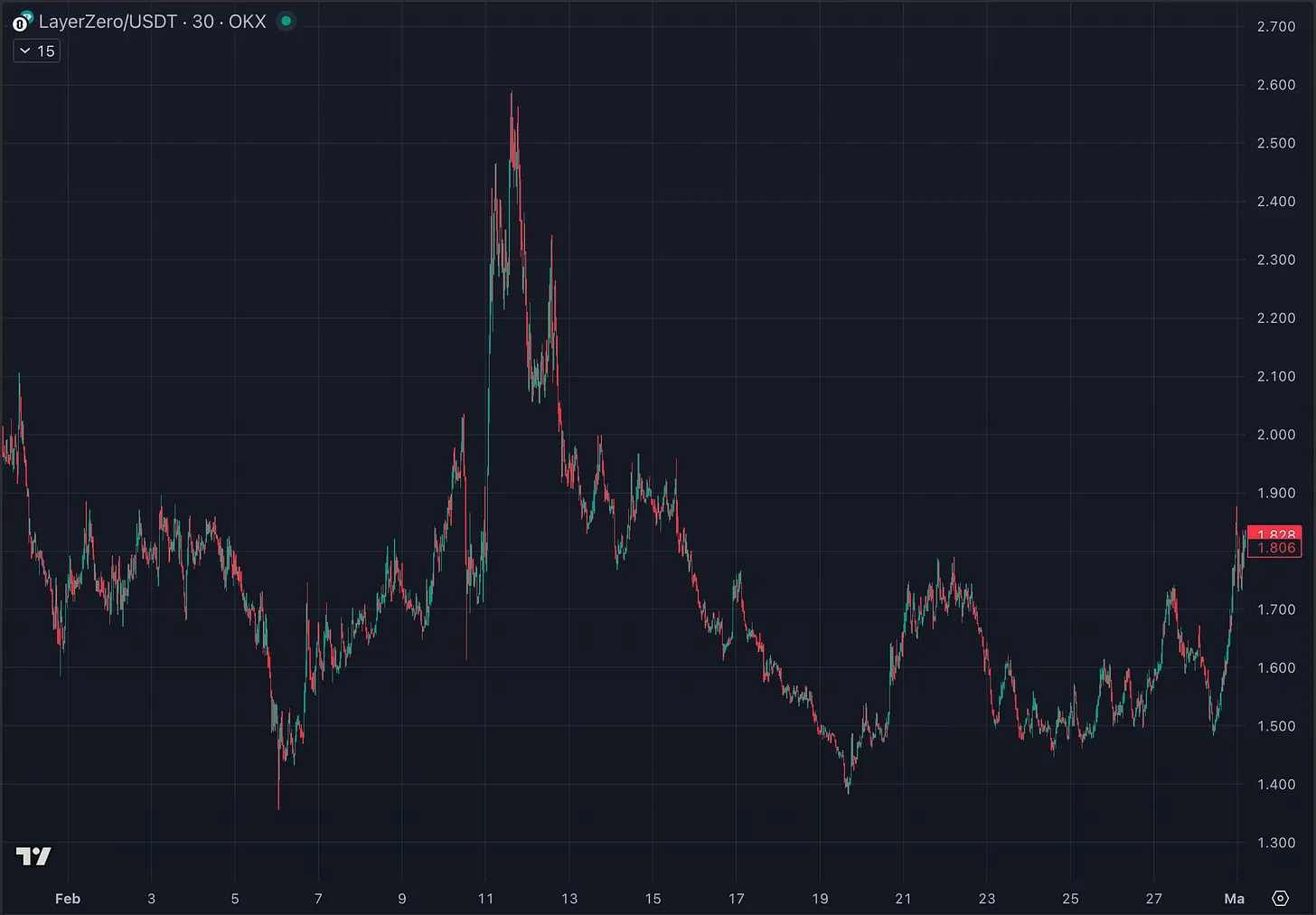
The result was a powerful post-conference rally: $ZRO surged ~45% within 12 hours—catching many “sell-the-news” traders off guard. However, the gains were subsequently fully erased, with the token sliding down to $1.5—a level that currently appears to be forming strong support.
Unusual Strength of $VVV
$VVV was the best-performing non-scam token in February, rising from a low of $1.65 to $5.5 by month-end (and further squeezed to $8 on March 2). One catalyst was its status as a legitimate project at the intersection of AI, privacy, and cryptography—with a sub-$100M market cap at its bottom. It also benefited from the momentum generated by OpenClaw, which listed Venice as a recommended model provider in its documentation until just yesterday.
(I suspect its peak occurred at the $8.4 squeeze in early March—but I could be wrong.)
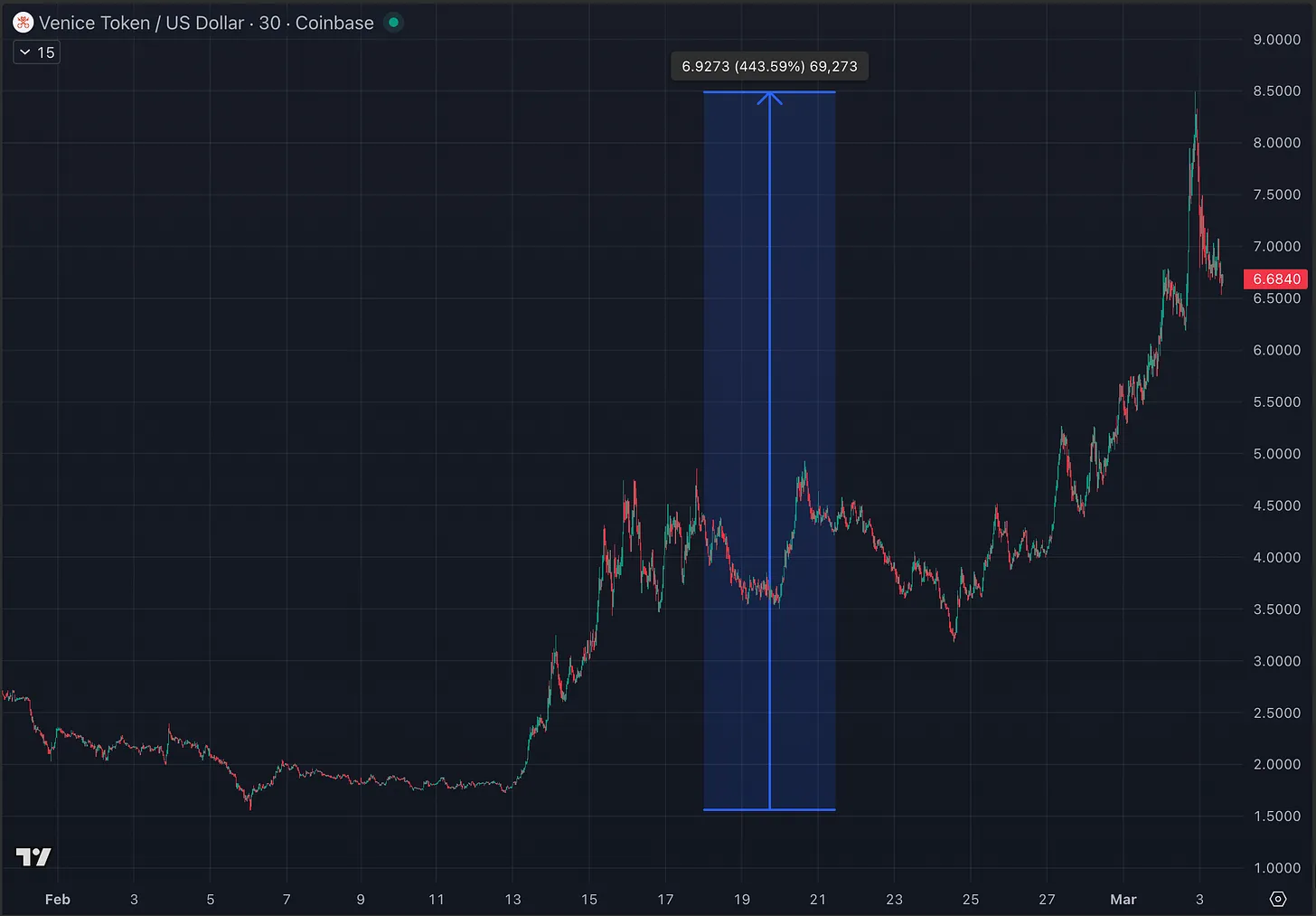
A few other AI tokens briefly awakened toward month-end: $SAHARA surged +70% in one day, while $GRASS rose +70% over four days.
A Banner Month for Scam Coins: $PIPPIN, $SIREN, $POWER
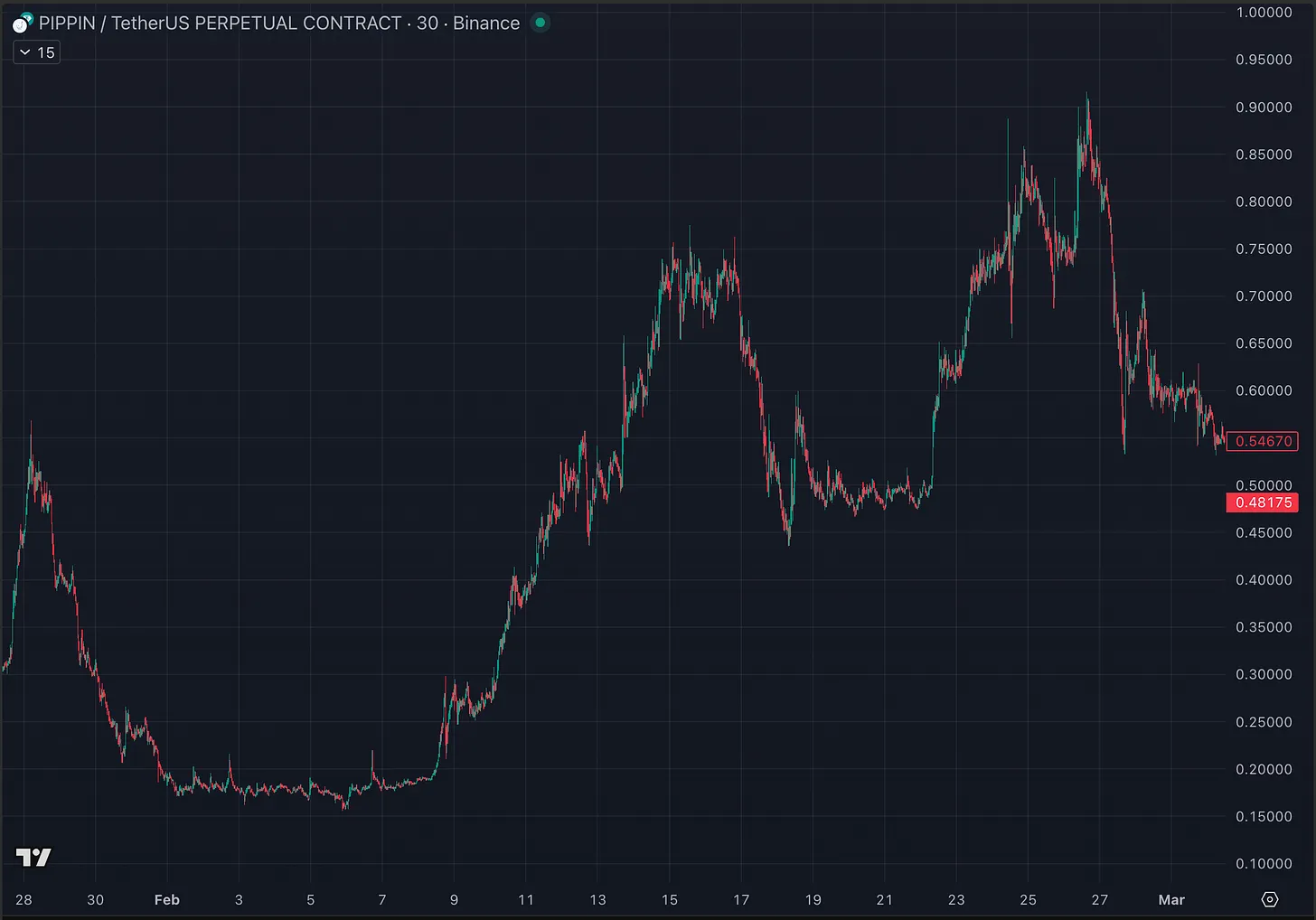
Bear markets seem to provide ideal breeding grounds for scam coins. In February, the veteran AI meme coin $PIPPIN made a comeback—its supply fully locked by a single entity, making its price action textbook manipulation. At the start of the month, $PIPPIN held steady at a $180M market cap, having already endured a 70% crash over four days. From February 8 onward, it launched a strong rally—up +315% over seven days—to a new all-time high market cap of $750M, pulled back to $500M, then surged again to a fresh high of $900M. Strangely, its funding rate turned positive—making it a relatively lower-risk short target among scam coins. Even so, I wouldn’t be surprised if it breaks $1B in market cap.
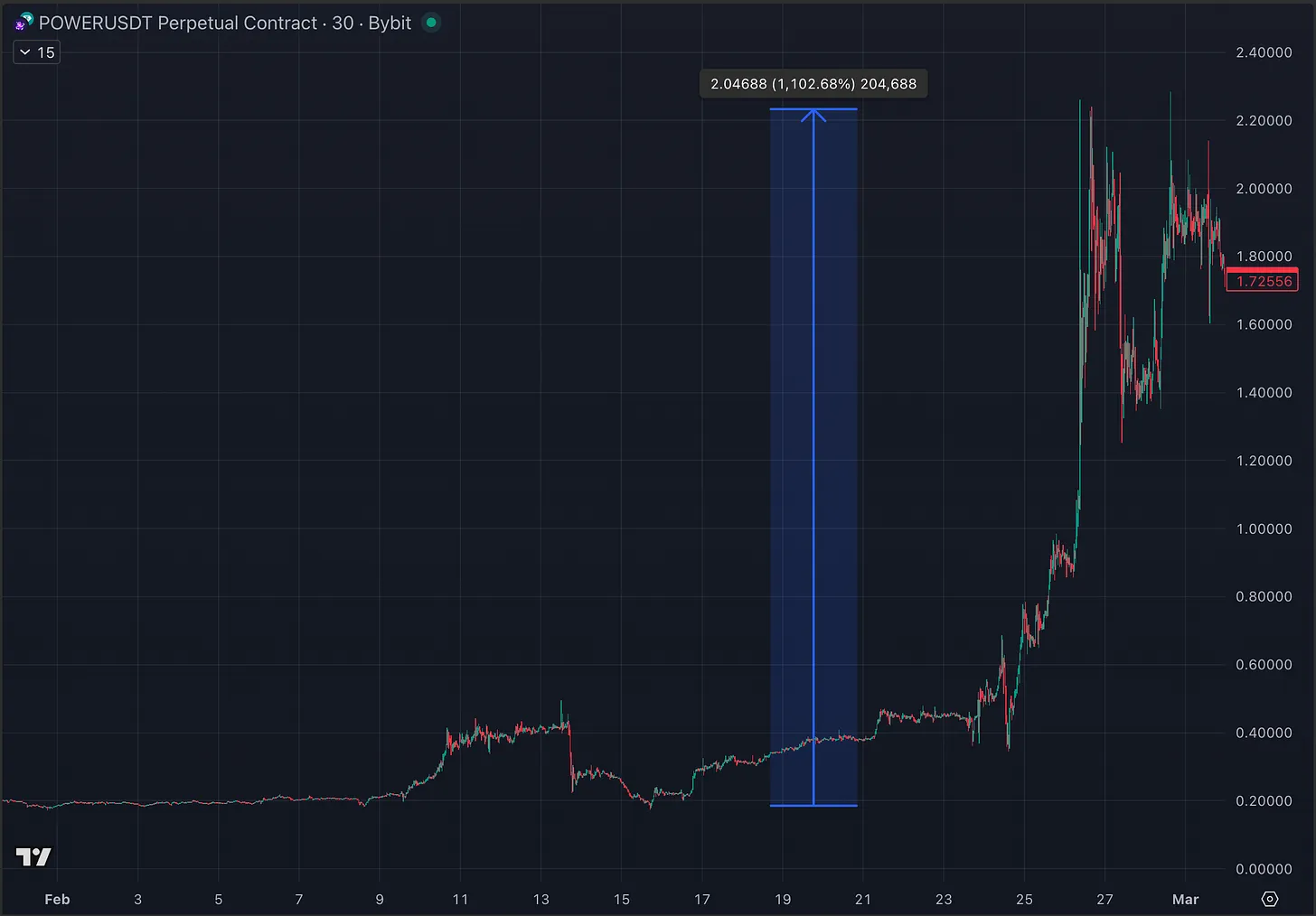
$POWER emerged in February as another manipulated token—rising 12x from its bottom, squeezing to a $2.3B FDV, with an extremely negative funding rate. Shorting this token requires extreme caution.
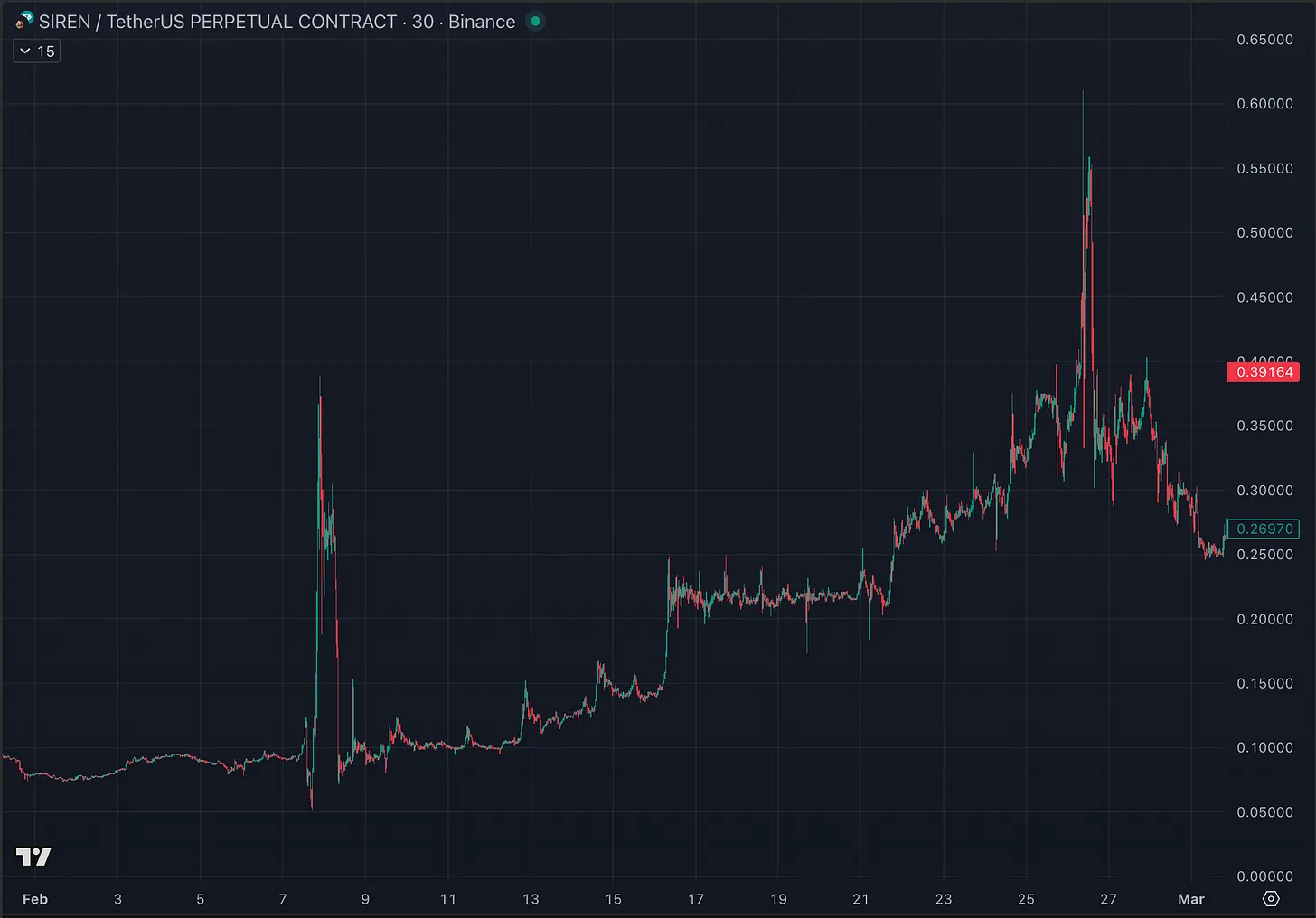
Another noteworthy move came from $SIREN, a BSC-based scam meme coin that executed a classic “pump-and-dump” on February 8—spiking from a $100M market cap to $400M before collapsing back to $100M. It then gradually climbed throughout the rest of February to reach a new high, culminating in a major squeeze ending at a $600M market cap.
Also worth mentioning: $BULLA surged 13x at the end of January, then plunged 95% in a single day on February 1—from a $450M FDV down to $25M FDV. $ARC rose from $40M to $130M before collapsing 80%.
Bear Market Characteristics
We are operating in a bear market environment: most altcoin rallies are short-lived squeezes followed by swift reversals. Tokens exhibiting this behavior in February included: ZK, ZIL, LA, NIL, SONIC, DYM, ME, MOVE, 0G, INIT, RPL, ESP, AZTEC, BIO, AGLD, and SAHARA. These moves typically involved +50% to +100% intraday gains accompanied by deeply negative funding rates (making shorts difficult to hold), followed by renewed weakness over the next several days.
Apart from bounce-backs after crashes, altcoins had only two brief rallies. The first ran February 13–15, led by meme coins (USELESS +50%, PEPE +35%) and AI tokens ($TAO +35%, $VVV +150%, VIRTUAL +25%). The second occurred on February 25—extremely brief, and purely a short squeeze targeting large-cap “dead” tokens, which rallied +25% to +30% that day (DOT, NEAR, UNI, APT, FIL, TIA…).
$HYPE and Perpetual DEX Sector
$HYPE ended January strongly—surging from $22 to $34 in a single day—and carried that momentum into early February. It peaked at $38 on February 3, emerging as the strongest performer during the market-wide crash and cascade of liquidations on February 5. Its resilience was striking—on February 6, it nearly touched $37, as if the broader market collapse hadn’t happened at all. Yet this also marked its relative top versus the broader altcoin market. Over the next 20 days, it slightly underperformed, falling back to $26.
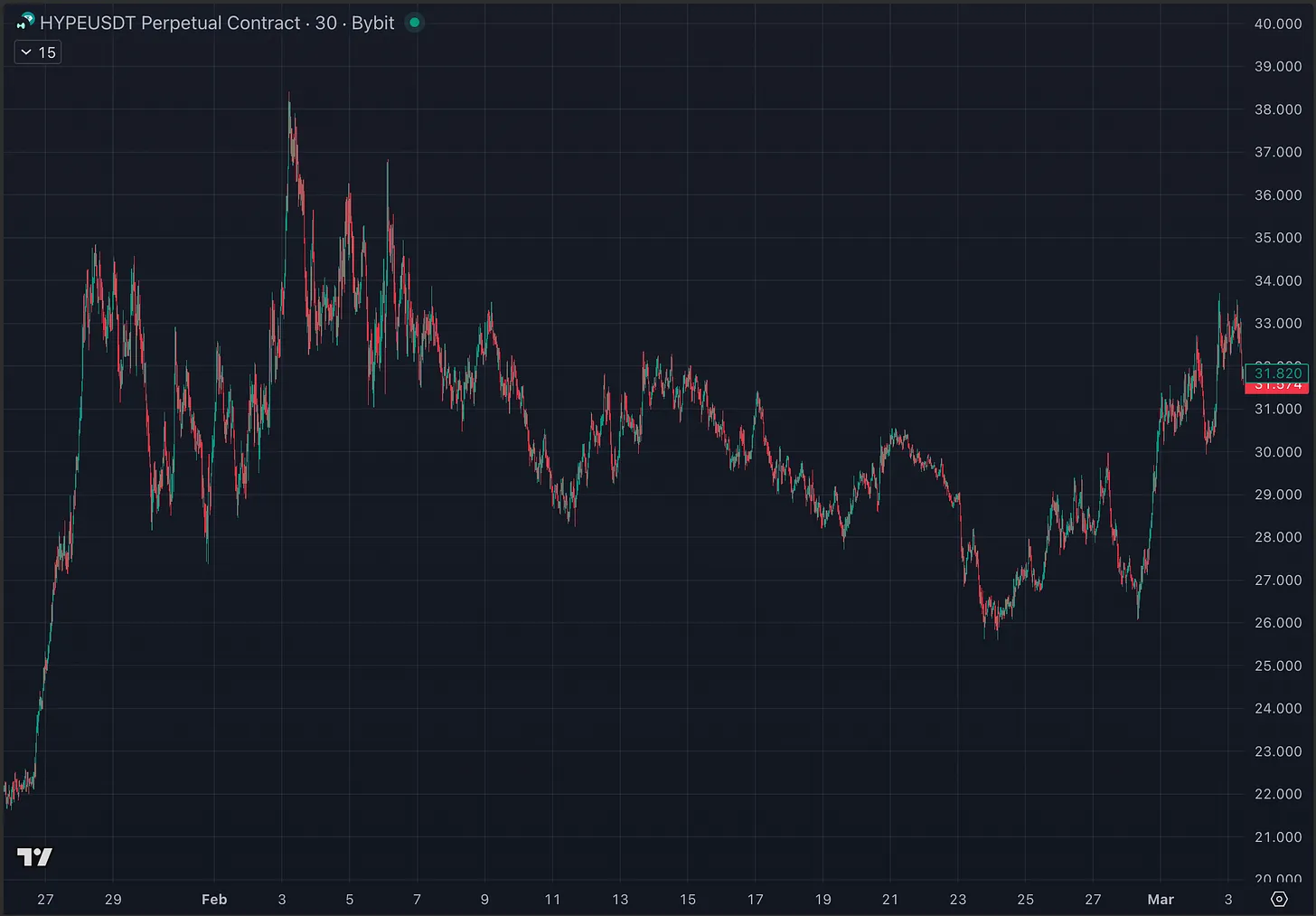
One reason for $HYPE’s strength in early February was heavy accumulation by Multicoin over several days, alongside sustained buying by HSI/PURR (HYPE’s DAT).
In the perpetual DEX sector, $LIT remained extremely weak in February—holding support at $1.3, having tested that level four or five times.
$ASTER staged a strong rebound after its February 5 crash—rising from a bottom near $0.4 to $0.7—and then oddly held flat at $0.7 for the remainder of the month. A bullish catalyst looms: its own L1 blockchain is set to launch in March.
Uniswap x BlackRock
On February 11, Uniswap announced a collaboration with BlackRock to provide liquidity for BlackRock’s BUIDL product—and simultaneously revealed that BlackRock had directly invested in $UNI (amount undisclosed). Market reaction was explosive: $UNI surged +40% in 10 minutes—an extraordinary move for a token with a $3B+ FDV. But those gains were fully erased within the next 10 hours—a classic bear-market pump-and-dump.
Aave faced reputational turbulence in February. On February 20, BGD Labs announced its exit from the Aave DAO due to strategic disagreements over V4—triggering an 8% drop in $AAVE. At month-end, prominent Aave ecosystem figure Marc Zeller published a critical article branding Aave Labs as essentially a value-extraction entity—further weakening the token.
Making matters worse for Aave, its main competitor $MORPHO performed strongly in 2026, posting a near +75% gain in February. The FDVs of both tokens are now roughly equal—around $2B each.
Other Key Events in February
On February 18, Base announced its shift away from the Optimism tech stack toward building its own stack. This was devastating for $OP, which plunged 40% over four days. $ARB was dragged down by correlation, now sitting at a “mere” $1B FDV—down 96% from its all-time high ($OP is down 97%).
On February 11, $BERA experienced an intense short squeeze—up +160% in eight hours—with spot-futures basis widening to an extreme 15%. It’s a bizarre token: usually severely underperforming the market, yet occasionally delivering wild, random squeezes—as seen last month when it doubled in five days.
On February 18, $WLFI spiked +30% for no apparent reason—while open interest (OI) surged nearly $100M. This suggests a single entity may have pushed the price up by going long $100M worth of $WLFI. Price topped there and has since fallen ~20%, with no further news. The operator’s behavior is highly unusual—I expect $WLFI to fall significantly lower over the coming months.
At the end of February 2026, Terraform Labs’ bankruptcy estate filed suit against Jane Street in Manhattan federal court, accusing it of trading on nonpublic information ahead of critical UST liquidity events during the 2022 Terra collapse. Within days of the filing, $LUNC rose +35%.
$ZEC continues digesting its massive Q4 2025 rally—broadly underperforming—but still delivers occasional powerful squeezes, such as the +45% move on February 13–14. I believe it’s quite possible it falls to $150—or even $100—in the coming months.
$HNT posted a strong 2x move in February. Is this merely a “dead cat bounce” for an asset suffering from excessive token emissions—or has this DePIN token finally become cheap enough to be a compelling buy?
As last month, $STABLE continued trading with its supply locked—rising +144% from a local FDV bottom of $1.6B to a new high near $4B. DegenSpartan publicly endorsed it in an article—a notably bullish signal, given DegenSpartan’s recent silence.
$BCH is a strange token: it outperformed BTC continuously for 22 days (by ~40%), then abruptly reversed—giving back all excess gains in under a week. Fueled by the “quantum-resistant” narrative and overall strength since early 2025, many became bullish on BCH—but it now appears a large holder decided to dump, executing continuous TWAP sales.
Robinhood listed two altcoins in February: $SNX (February 19) and $CC. $CC showed almost no reaction, but $SNX rose +42% over several days. Listings on Upbit remain powerful catalysts: $AZTEC (+70%), $ESP (+100%), and $SKR (+40%) all surged post-listing, with deeply negative funding rates in the hours immediately afterward. $BIRB, listed on Bithumb on February 3, also doubled.
Two notable TGEs in February were $AZTEC and $ESP (Espresso). Both launched at remarkably low valuations (FDVs below $500M—whereas similar projects easily commanded $1B+ FDVs just months earlier), signaling a slow repricing downward of the altcoin premium. Still, $ESP performed strongly—up +280% from its February bottom to peak.
Polymarket announced a partnership with Kaito to launch an attention market. Upon announcement, $KAITO jumped +13% in three minutes—then gave back all gains within an hour.
Join TechFlow official community to stay tuned
Telegram:https://t.me/TechFlowDaily
X (Twitter):https://x.com/TechFlowPost
X (Twitter) EN:https://x.com/BlockFlow_News
 @thedefivillain