Giants Enter the Market and Asset Restructuring: On-Chain Investment Logic Amid Volatile Gold and Silver Prices
TechFlow Selected TechFlow Selected
Giants Enter the Market and Asset Restructuring: On-Chain Investment Logic Amid Volatile Gold and Silver Prices
The callback period presents an opportunity for upgrading the asset architecture.
 Navigating Web3 tides with focused insights
When HSBC launched its distributed ledger-based gold platform, and J.P. Morgan achieved cross-border collateralized settlement of tokenized gold bars via its Onyx network, the foundational restructuring of underlying assets—spearheaded by traditional financial giants—had already begun. This trend has found its most direct validation in capital markets: Ondo Finance’s SLVon received substantial backing from Peter Thiel’s Founders Fund and Coinbase Ventures; meanwhile, PAXG leveraged deep, compliant partnerships with PayPal and Mastercard to directly import the trustworthiness of traditional payment systems into the digital asset space.
This article uses recent gold and silver market movements as a case study to explain why institutions are increasingly favoring tokenized assets.
As of February 2026, global gold and silver markets are undergoing a stress test. After spot gold hit a peak of $5,600 at the end of January, markets experienced brutal long-position liquidation amid successive hawkish signals from Federal Reserve officials. As of yesterday (February 5), spot gold—having rebounded briefly—has once again entered high-range consolidation, currently trading near $4,980 and failing to hold above the $5,000 threshold; silver, likewise volatile, is trading at $86.50.
This pattern—sharp vertical declines followed by price corrections—has become the ideal real-world proving ground for RWA (Real World Assets). It not only tests investors’ holding endurance but also vividly demonstrates how on-chain investment, backed by industry titans, fundamentally enhances capital control—granting professional investors superior operational efficacy over traditional physical assets during extreme market conditions.
1. Liquidity Premium During Price Volatility
In traditional physical or paper-gold trading, price corrections are often accompanied by severe liquidity lag. First, trading is doubly constrained by time and geography: physical gold buybacks are limited by business hours and physical location—even gold ETFs cannot respond to macro-driven sell-offs (e.g., triggered by Kevin Warsh’s nomination for Fed Chair) over weekends or outside trading hours.
Second, bidirectional cost erosion intensifies during volatility. During price declines, physical buyback premiums often asymmetrically widen—forcing investors to absorb both paper losses and higher realized spreads. Coupled with the traditional financial system’s T+n settlement framework, this severely restricts rapid capital rotation across asset classes. By contrast, Web3-native gold and silver assets offer 24/7 instant settlement—a liquidity advantage carrying exceptionally high risk-mitigation value during correctionary phases.
2. Three Strategic Positionings and Deep Advantages of On-Chain Assets
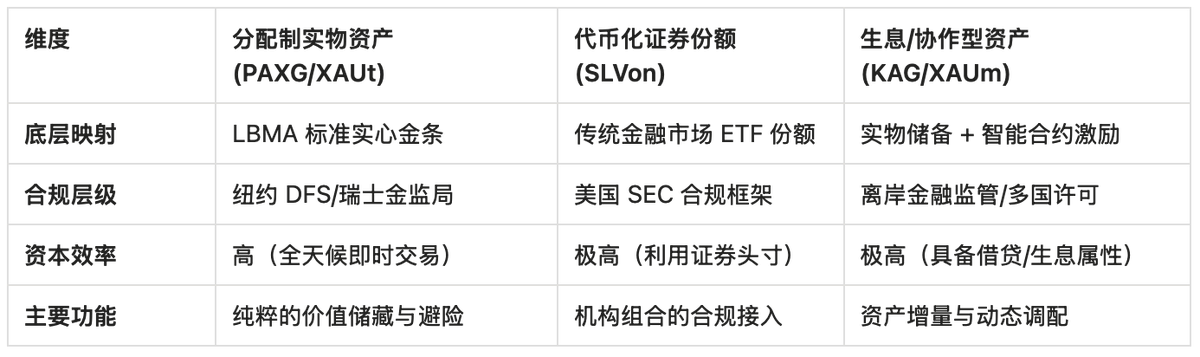
Based on our research into leading RWA projects, we classify on-chain precious metals into three complementary investment categories—defined by their underlying architecture and functional attributes—and examine their generational advantages over traditional models.
Category A: Digitized Form of Physical Holding (PAXG, XAUt, CGO)
This category centers on securitizing physical ownership through blockchain technology. Its primary advantage lies in extremely low operational barriers and enhanced asset flexibility. Compared to the typical 3%–5% premium and high shipping/insurance fees associated with physical gold transactions, on-chain assets dramatically reduce frictional costs.
- Quantitative Support: Comtech Gold (CGO), for example, enables investments starting at just 1 gram (~$160), whereas institutional vaults typically require a minimum of 12.4 kg (delivery-grade gold bars). According to data from January 2026, PAXG’s 24-hour trading volume surged to $1.2 billion during gold price turbulence—demonstrating institutional demand for “second-level rebalancing” using on-chain assets amid extreme volatility.
- Audit Premium: On-chain proof-of-reserve transforms traditional finance’s quarterly sampling audits into per-minute logical verification. By integrating Chainlink oracles for real-time reserve data, PAXG maintains secondary-market premiums/discounts consistently within ±0.1%—far outperforming physical markets, where bid-ask spreads can swing up to 2% during panic periods.
Category B: Tokenized Securities (SLVon)
As an on-chain mirror of traditional regulated financial products, SLVon (launched by Ondo Finance) exemplifies cross-market arbitrage and risk-hedging capabilities that dominate conventional frameworks. Its strategic value lies in embedding the stability of traditional securities into 24/7 crypto trading logic.
- Quantitative Support: In early February 2026, when silver prices unexpectedly plunged during U.S. equity market closures, SLVon’s on-chain turnover rate reached 45% of its total supply—whereas holders of the traditional iShares Silver Trust (SLV) could only wait passively for U.S. markets to reopen.
- Efficiency Comparison: Traditional ETFs settle on a T+1 or T+2 basis, while SLVon—built on Solana or Ethereum—enables instantaneous settlement. This means investors selling silver shares can immediately deploy proceeds into DeFi protocols to capture short-term volatility opportunities offering >15% returns—achieving capital turnover efficiency over 50× higher than traditional brokerage accounts.
Category C: Yield-Bearing & High-Efficiency Collaborative Assets (KAG, XAUm)
This category definitively ends the historical zero-yield era for precious metals—transforming them into income-generating productive assets. During correctionary phases, this positive yield serves as a buffer against falling token prices.
- Quantitative Support: Kinesis Silver (KAG), employing a fee-sharing model, delivered average annual yields of 1.8%–3.2% to holders in 2025—covering gold’s holding costs and delivering net asset appreciation.
- Capital Reuse Rate: Matrixdock (XAUm) shows even more striking performance. During this episode of violent gold price swings, XAUm maintained a robust loan-to-value (LTV) ratio of 85%. This allows holders to borrow stablecoins against their gold positions—without selling—then deploy those funds into liquidity mining strategies yielding >10%. Such strategies sustain positive internal rates of return (IRR) for portfolios even during price corrections, revealing the profound collaborative depth of RWA assets under extreme market stress.
3. Integrated Analysis of the Three Strategic Pathways
4. Conclusion: Corrections Are Opportunities for Architectural Upgrades
The market correction at the start of 2026 reaffirms that asset disposal rights are equally critical as ownership rights. The true value of on-chain assets lies in providing instantaneous risk-hedging tools during price declines, generating asset productivity during sideways consolidation, and enabling seamless profit-taking channels during rallies.
For operators building professional market analytics platforms, emphasizing asset liquidity efficiency—not merely price forecasting—will be the core logic for establishing a durable competitive moat. The current price pullback offers a timely window to observe how different on-chain metal projects perform under extreme liquidity stress—a vital reference for constructing long-term, resilient asset allocation frameworks.
Join TechFlow official community to stay tuned
Telegram:https://t.me/TechFlowDaily
X (Twitter):https://x.com/TechFlowPost
X (Twitter) EN:https://x.com/BlockFlow_News
 @Tiramisu_AI