The First "Crypto Fiscal Nation" Emerges: Sanctioned Venezuela Becomes a Stablecoin Testing Ground
TechFlow Selected TechFlow Selected
The First "Crypto Fiscal Nation" Emerges: Sanctioned Venezuela Becomes a Stablecoin Testing Ground
The sanctions on Venezuela serve as a validation of the stablecoin concept.
 Navigating Web3 tides with focused insights
Author: Byron Gilliam
Translation: Saoirse, Foresight News
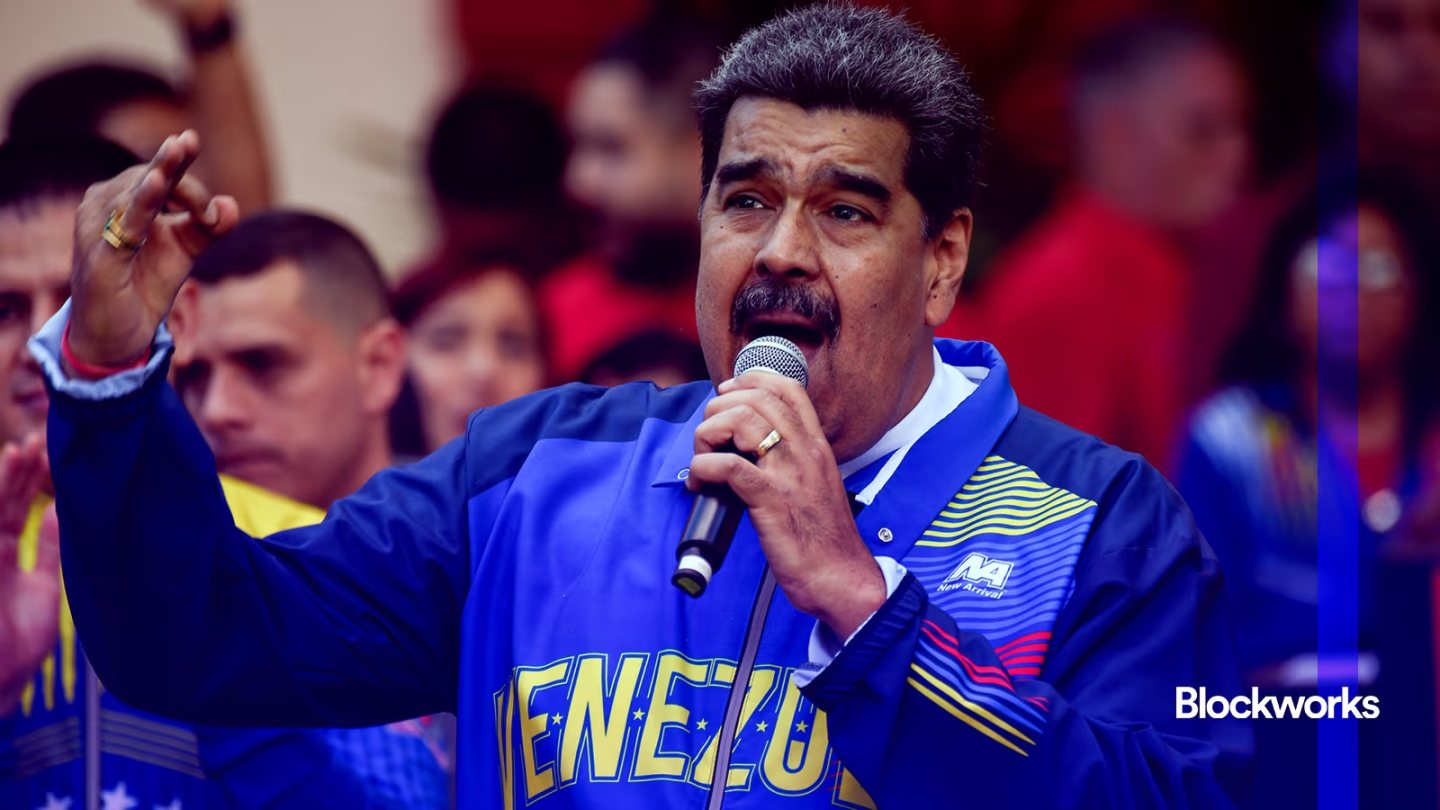
Venezuelan President Nicolás Maduro | Image source: StringerAL/Shutterstock and Adobe, modified by Blockworks
“I don’t think the so-called ‘dollarization’ process is bad… Thank God this process exists.” — Nicolás Maduro, President of Venezuela
A recent report by The New York Times stated that Venezuela has become “the first country to entrust a significant portion of its financial operations to cryptocurrencies.”
But this was not by choice.
Around half of Venezuela’s fiscal revenue comes from oil sales priced in U.S. dollars. However, as a sanctioned nation, it cannot legally send or receive dollar-denominated transactions.
In the past, governments under sanctions would settle oil trades using intricate networks of shell companies and offshore banking systems, or barter oil for goods or infrastructure investments.
Today, they have a simpler option: accepting stablecoin payments. Economist Asdrúbal Oliveros estimates that Tether’s USDT stablecoin has become the medium of exchange in approximately 80% of Venezuela’s oil sales.
The Venezuelan government once banned stablecoin transactions, viewing them as a threat to its national currency, the bolívar. But the severe impact of U.S. sanctions left the country with no alternative but to embrace stablecoins.
Delcy Rodriguez, Venezuela’s current vice president, recognized last August that crypto-driven dollarization was inevitable. At the time, she told business leaders the government was implementing “non-traditional management mechanisms” to better regulate the bolívar’s exchange rate.
Shortly afterward, Reuters reported: “Since June this year, the Venezuelan government has allowed expanded use of USDT.” With state approval, banks now sell USDT earned from oil sales to domestic businesses, which then use the tokens to pay both domestic and foreign suppliers.
The Venezuelan government also hopes stablecoins will circulate in retail: The head of the country's national supermarket association recently told state television that grocery stores are upgrading their systems to accept USDT payments.
In other words, the Venezuelan government is encouraging its citizens to use the “dollar” issued by Tether—not the bolívar issued by the state.
Therefore, as a supporter of stablecoins, I am disappointed that in the U.S. government’s indictment against Nicolás Maduro, cryptocurrencies—including stablecoins—are not mentioned at all.
Instead, the indictment describes traditional methods of illicit financial flows: planes returning from Mexico “loaded with drug proceeds,” exchanging cocaine for grenades and rocket launchers, using portions of drug shipments as “protection fees,” and a $2.5 million cash bribe.
Why no mention of cryptocurrency?
There may be two reasons: 1) The U.S. government has become more cautious about criticizing cryptocurrencies and thus prosecutors deliberately avoid the topic; or 2) The scale of funds handled by cryptocurrencies (and stablecoins) is still insufficient to meet the needs of Maduro and his associates.
While the first explanation is more intriguing, the second seems far more likely.
Asdrúbal Oliveros explains: “The Venezuelan government struggles to quickly liquidate these (crypto) assets because transferring crypto funds requires passing through multiple control processes, which currently do not meet the necessary requirements.”
A report from TRM Labs reached a similar conclusion: “Large trafficking organizations still heavily rely on physical cash, trade-based money laundering, and state or quasi-state protection when moving core illicit proceeds; cryptocurrencies typically play only an auxiliary or supplementary role and cannot replace these traditional methods.”
National security analysts at Lawfare agree: “Compared to traditional illicit financial channels, the scale of sanctions evasion via cryptocurrency remains negligible.”
However, some hold a more optimistic view of stablecoins and cryptocurrencies in international payments.
For example, InSight Crime reported that Mexican drug cartels are relying on an “industrial-scale cryptocurrency money laundering network” to operate—using digital channels to transfer illicit funds to Chinese chemical suppliers.
The report details how stablecoins have found a specific use case connecting two groups: Chinese currency brokers who need to sell dollars to clients circumventing China’s capital controls, and Mexican drug cartels needing to procure fentanyl precursors from China.
This may not be the “product-market fit” that crypto advocates envisioned, but real-world applications show stablecoins are highly effective in such scenarios. For instance, the U.S. Drug Enforcement Administration (DEA) says that due to criminal groups “favoring cryptocurrencies over traditional cash-based money laundering,” the amount of illegal cash seized has dropped significantly.
Conversely, seizures of “virtual currency” have risen sharply: Between 2020 and 2024, the DEA confiscated $2.5 billion in cryptocurrency, exceeding the $2.2 billion in cash seized during the same period.
This might explain why Maduro and his associates continue to rely on traditional payment methods—traceable cryptocurrencies and freezeable stablecoins still cannot meet the demands of large-scale money laundering.
Nonetheless, Venezuela’s adoption of digital dollars remains groundbreaking. As Lawfare summarized: “America’s adversaries have built a practical proof-of-concept, and emerging financial technologies could further solidify this model.”
If so, this may also further entrench the dominance of the U.S. dollar.
Being barred from using traditional dollars did not lead Venezuela to settle oil trades in currencies like the Chinese yuan—it simply switched to digital dollars instead.
Join TechFlow official community to stay tuned
Telegram:https://t.me/TechFlowDaily
X (Twitter):https://x.com/TechFlowPost
X (Twitter) EN:https://x.com/BlockFlow_News
 Blockworks