Strategy: Direct Confrontation with MSCI: DAT's Ultimate Defense
TechFlow Selected TechFlow Selected
Strategy: Direct Confrontation with MSCI: DAT's Ultimate Defense
The letter stated bluntly: "This proposal is seriously misleading and will have profound, damaging consequences for global investor interests and the development of the digital asset industry. We strongly urge MSCI to completely withdraw this plan."
 Navigating Web3 tides with focused insights
By KarenZ, Foresight News
The battle over the future of digital asset treasury (DAT) companies continues to unfold.
In October, global index provider MSCI proposed excluding from its investable market indices any company holding 50% or more of its assets in digital assets. This move directly threatens the market standing of firms like Strategy and could reshape capital flows across the entire DAT sector.
According to data compiled by Bitcoin for Corporations, 39 companies could be excluded from MSCI’s Global Investable Market Index. JPMorgan analysts previously warned that removing just Strategy could trigger nearly $2.8 billion in passive outflows; if other index providers follow suit, total outflows might reach as high as $8.8 billion.
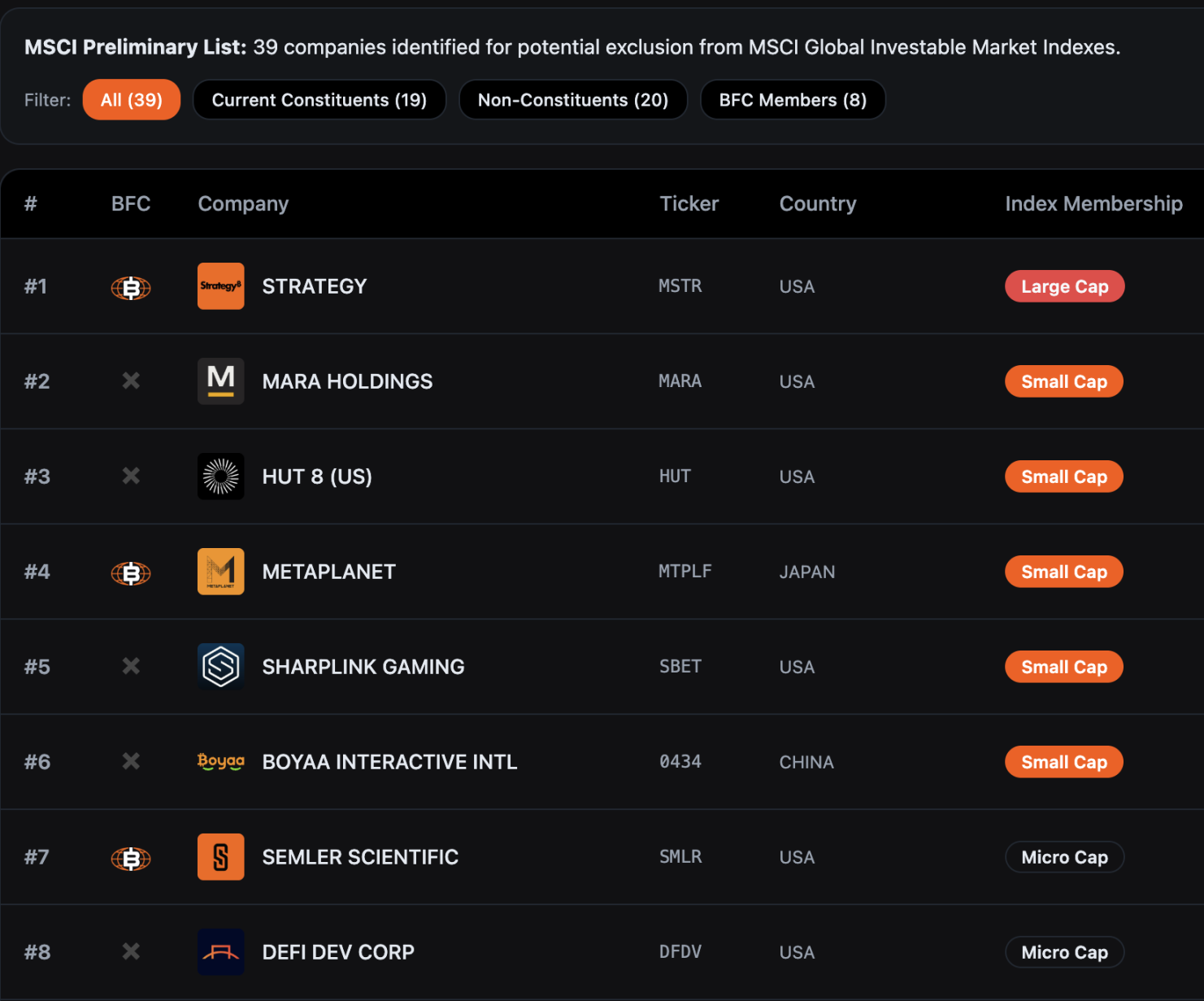
MSCI's consultation period on the proposal runs through December 31, 2025, with final decisions expected by January 15, 2026. Any changes would be formally implemented during the February 2026 index review.
Facing this urgent threat, Strategy submitted a 12-page strongly worded open letter to MSCI's Equity Index Committee on December 10, jointly signed by Executive Chairman and Founder Michael Saylor and President and CEO Phong Le, firmly opposing the proposal. The letter states: "This proposal is profoundly misleading and will have deeply damaging consequences for global investors and the development of the digital asset industry. We strongly urge MSCI to fully withdraw this plan."
Strategy’s Four Core Arguments
Digital Assets Are Revolutionary Foundational Technology Reshaping the Financial System
Strategy argues that MSCI’s proposal underestimates the strategic importance of Bitcoin and other digital assets. Since Satoshi Nakamoto introduced Bitcoin 16 years ago, it has evolved into a key component of the global economy, now representing approximately $1.85 trillion in market value.
To Strategy, digital assets are not mere financial instruments but fundamental technological innovations capable of reshaping the global financial system — companies investing in Bitcoin-related infrastructure are building a new financial ecosystem, much like pioneering firms in past technological revolutions.
Just as Standard Oil dominated oil extraction in the 19th century and AT&T built the telephone network in the 20th century, these companies laid the groundwork for economic transformation through forward-looking investments in core infrastructure, eventually becoming industry leaders. Strategy contends that today’s digital asset-focused firms are following the same “technology pioneer” path and should not be dismissed under outdated index rules.
DATs Are Operating Businesses, Not Passive Funds
This is Strategy’s central argument — digital asset treasury companies (DATs) are fully operational businesses with sustainable business models, not passive Bitcoin-holding investment funds. While Strategy holds over 600,000 Bitcoins, its value proposition does not rely solely on Bitcoin price appreciation. Instead, it designs and issues unique “digital credit” instruments to generate consistent returns for shareholders.
Specifically, Strategy offers various forms of digital credit, including preferred shares with fixed and floating dividend rates, different priority levels, and credit protection terms. Proceeds from selling these instruments are used to acquire additional Bitcoin. As long as Bitcoin’s long-term return exceeds Strategy’s dollar-denominated financing costs, both shareholders and clients benefit. Strategy emphasizes that this model of “active operations + asset appreciation” fundamentally differs from the passive management approach of traditional funds or ETFs and should therefore be recognized as legitimate corporate activity.
Moreover, Strategy questions why energy giants, real estate investment trusts (REITs), timber companies, and power infrastructure firms can hold concentrated single-asset portfolios without being classified as investment funds or excluded from indices. Imposing special restrictions exclusively on digital asset companies clearly violates principles of industry fairness.
The 50% Digital Asset Threshold Is Arbitrary, Discriminatory, and Impractical
Strategy asserts that MSCI’s standard applies discriminatory criteria. Many large traditional companies maintain highly concentrated holdings in single asset classes—such as oil and gas producers, REITs, timber firms, and utility infrastructure operators. Yet MSCI singles out only digital asset companies for exclusionary treatment, creating an obvious double standard.
From a practical standpoint, the proposal also poses serious implementation challenges. Due to extreme volatility in digital asset prices, a single company could repeatedly enter and exit the MSCI index within days based purely on valuation swings, causing market instability. Furthermore, differences between accounting standards—U.S. GAAP versus IFRS—in how digital assets are reported mean identical business models could face unequal treatment depending on jurisdiction.
Violates Index Neutrality by Introducing Policy Bias
Strategy argues that MSCI’s proposal amounts to making a value judgment about a specific asset class, contradicting the fundamental principle that index providers must remain neutral. MSCI claims its indices offer “comprehensive” coverage designed to reflect “the evolution of underlying equity markets,” explicitly avoiding judgments about “the merits or suitability of any market, company, strategy, or investment.”
By selectively excluding digital asset companies, MSCI effectively makes policy decisions on behalf of the market—an action index providers should avoid.
Contradicts U.S. Digital Asset Strategy
Strategy particularly emphasizes that the proposal conflicts with the Trump administration’s goal of advancing U.S. leadership in digital assets. Within its first week in office, the Trump administration issued an executive order promoting digital financial innovation and established a strategic Bitcoin reserve aimed at positioning America as the global leader in digital assets.
However, if MSCI’s proposal takes effect, it would block long-term capital such as U.S. pension funds and 401(k) plans from investing in digital asset companies, triggering billions in capital outflows. This would not only hinder the growth of American innovators in the space but also weaken U.S. competitiveness in a strategically vital sector, running counter to established government policy.
Citing analyst estimates, Strategy notes that it alone could face up to $2.8 billion in passive stock liquidation due to MSCI’s proposal. Such an outcome would harm not only Strategy but create a chilling effect across the entire digital asset ecosystem—for example, forcing Bitcoin mining firms to sell assets prematurely to restructure their balance sheets, thereby distorting normal supply-demand dynamics in the market.
Strategy’s Final Demands
In its open letter, Strategy makes two key requests:
First, it calls on MSCI to completely withdraw the exclusion proposal, allowing the market to freely assess the value of digital asset treasury companies (DATs) so indices can neutrally and accurately reflect the trajectory of next-generation fintech innovation;
Second, if MSCI insists on treating digital asset firms differently, it must expand industry consultation, extend the comment period, and provide stronger justification for the rule’s rationale.
Strategy Is Not Alone
Strategy is not fighting this battle alone. According to BitcoinTreasuries.NET, as of December 11, 208 publicly traded companies worldwide hold over 1.07 million Bitcoins—more than 5% of the total supply—worth approximately $100 billion at current prices.
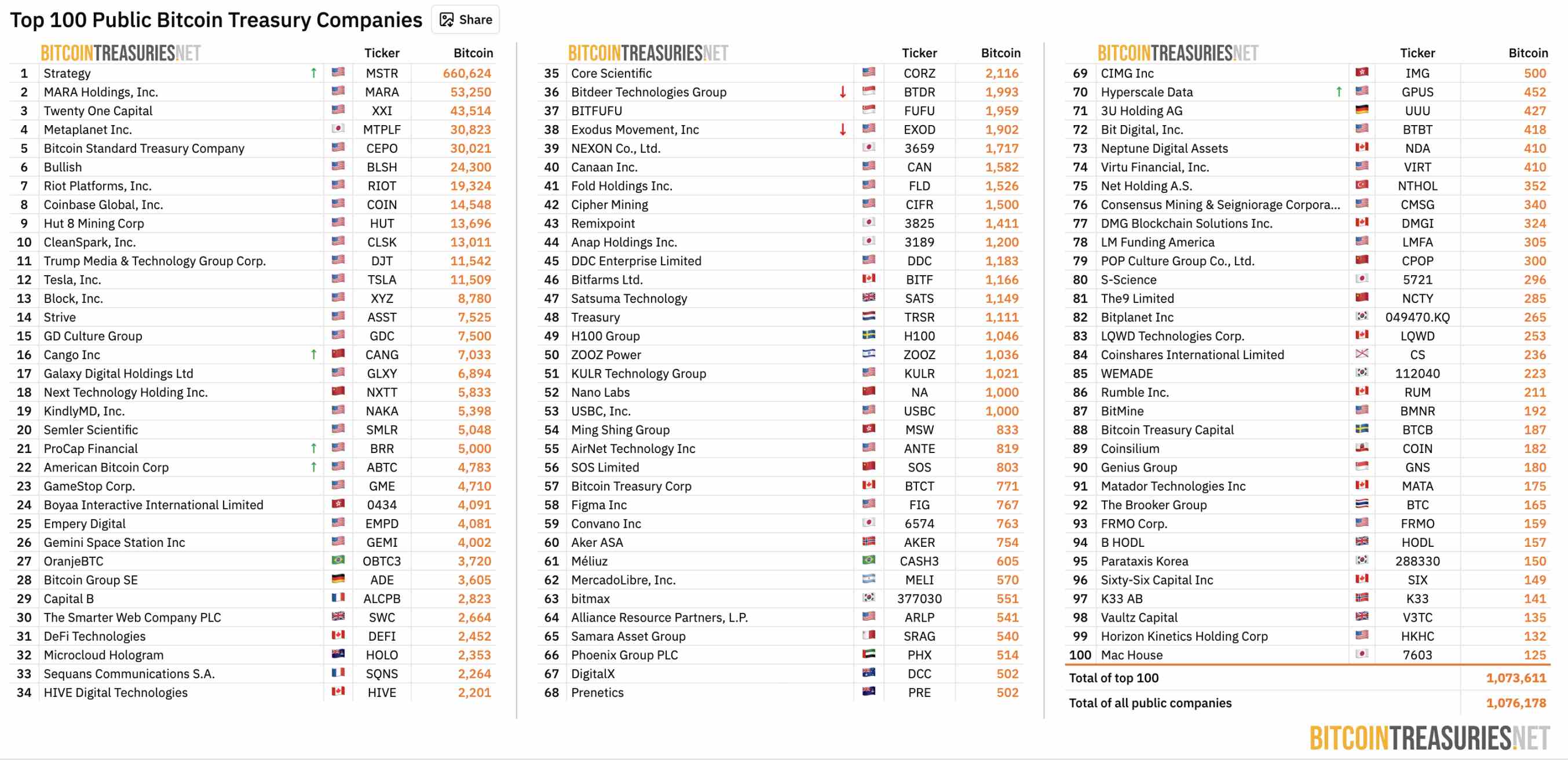
Source: BitcoinTreasuries.NET
These digital asset treasury companies serve as crucial bridges for institutional adoption of cryptocurrency, offering compliant indirect exposure for pension funds, endowments, and other traditional financial institutions.
Prior to this, Strive, another public company holding Bitcoin, suggested that MSCI should leave the “choice” to the market. A simple solution would be creating ex-DAT versions of existing indices, such as the MSCI USA ex Digital Asset Treasuries Index and the MSCI ACWI ex Digital Asset Treasuries Index. With transparent screening mechanisms, investors could choose their own benchmark, preserving index integrity while meeting diverse investor needs.
In addition, the industry group Bitcoin for Corporations has launched a joint initiative calling on MSCI to withdraw the digital asset proposal, advocating classification based on actual business models, financial performance, and operational characteristics rather than simplistic asset thresholds. According to its website, 309 companies or investors have already signed the petition, including executives from Strive, BitGo, Redwood Digital Group, 21MIL, Btc inc, DeFi Development Corp, along with numerous individual developers and investors.
Summary
The standoff between Strategy and MSCI represents a fundamental debate over how emerging financial innovations integrate into traditional systems. Digital asset treasury companies (DATs), as cross-border entities between conventional finance and crypto, are neither pure tech firms nor simple investment funds, but rather a new business model built around digital assets.
MSCI’s attempt to categorize these complex entities as “investment funds” using a rigid “50% asset threshold” and exclude them from indices is challenged by Strategy as a gross misrepresentation of their true nature and a violation of index neutrality. As the January 15, 2026 decision deadline approaches, the outcome will not only determine whether Bitcoin-holding public companies retain access to major indices but also define the critical “survival boundary” for the digital asset industry within the global traditional financial system.
Join TechFlow official community to stay tuned
Telegram:https://t.me/TechFlowDaily
X (Twitter):https://x.com/TechFlowPost
X (Twitter) EN:https://x.com/BlockFlow_News
 Foresight News