

Vitalik Donated 256 ETH to Two Chat Apps You've Never Heard Of—What's He Betting On?
TechFlow Selected TechFlow Selected
Vitalik Donated 256 ETH to Two Chat Apps You've Never Heard Of—What's He Betting On?
He clearly pointed out: neither of these apps is perfect, and there is still a long way to go to achieve true user experience and security.
 Navigating Web3 tides with focused insights
Author: David, TechFlow
When you truly support something, the most direct way is to fund it.
On November 26, Vitalik Buterin donated 128 ETH each to two private messaging apps, Session and SimpleX, totaling approximately $760,000.
In a tweet, he wrote: Encrypted communication is crucial for protecting digital privacy. The next critical step is achieving permissionless account creation and metadata privacy.
$760,000 is no small amount, but what’s even more intriguing are the two recipients.
Session and SimpleX are virtually unknown outside the crypto community. Why did Vitalik choose to fund them instead of more established privacy messaging tools?
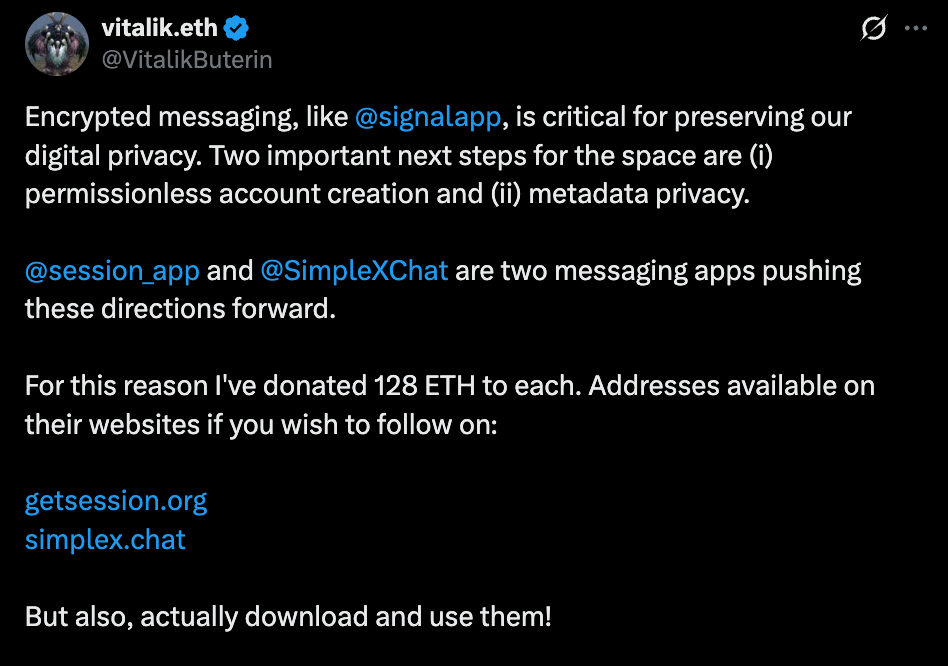
The donation amount itself is also interesting.
128 isn’t a convenient number for humans, but in binary it's 2 to the power of 7. Some community members interpret this as Vitalik’s symbolic gesture—this is a structural investment in privacy, not a casual tip.
Just one day before the donation, the Council of the European Union reached an agreement on the "Chat Control" proposal. This legislation would require messaging platforms to scan users’ private messages, which privacy advocates see as a direct threat to end-to-end encryption.
Vitalik’s public donation at this moment sends a clear message: existing privacy communication solutions aren’t enough, and more radical alternatives need support.
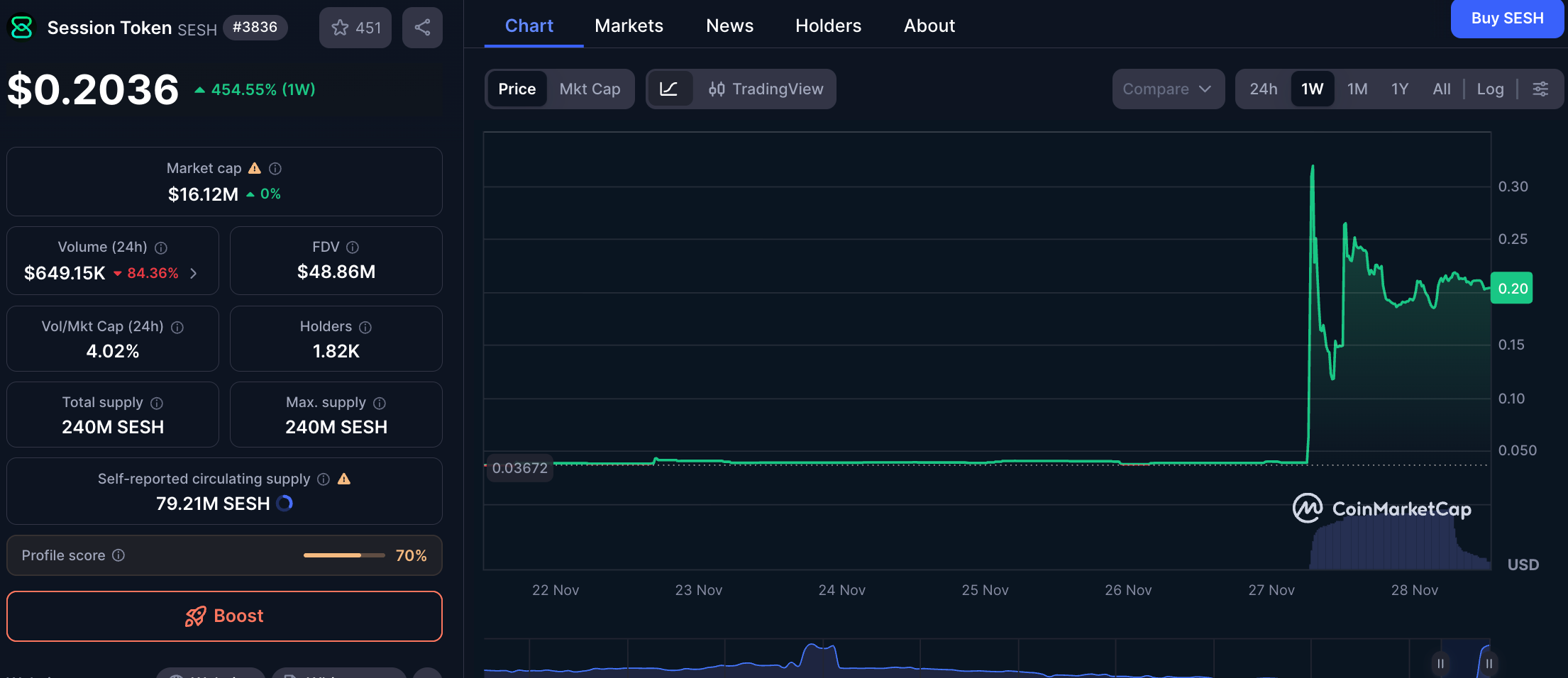
The market seems to have picked up on the signal. Session’s token SESH surged from under $0.04 to around $0.40 after the news broke, a weekly gain of over 450%.
Let’s take a quick look at what these two apps actually are, and why they’re worth Vitalik’s bet.
Session: Privacy Communication via DePIN
Session is a decentralized, end-to-end encrypted messaging app launched in 2020, currently with nearly 1 million users.
It was initially developed by Australia’s Oxen Privacy Tech Foundation. In 2024, due to tightening privacy laws in Australia, the team relocated operations to Switzerland, forming the Session Technology Foundation.
The app’s core selling point is “no phone number required.”
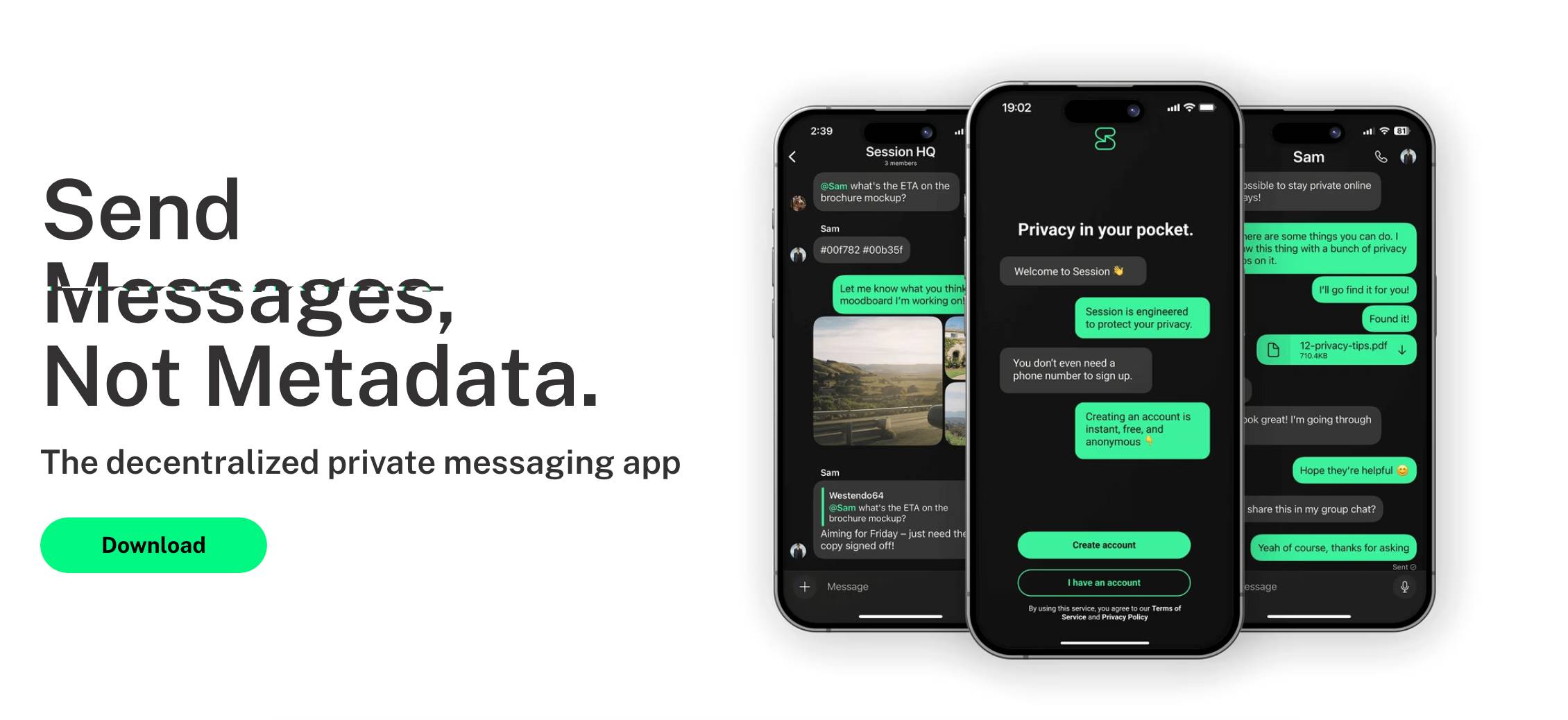
Upon registration, Session generates a 66-character random string as your Session ID and provides a set of recovery mnemonics. There’s no phone number binding, no email verification, and no information linking back to your real identity.
Technically, Session uses an architecture similar to onion routing to ensure privacy.
Every message you send is triple-encrypted and routed through three randomly selected nodes. Each node can only decrypt its own layer and cannot see the full message path. This means no single node can know both the sender and receiver simultaneously.
These nodes aren’t servers operated by Session—they come from the community. Currently, there are over 1,500 Session Nodes across more than 50 countries. Anyone can run a node, provided they stake 25,000 SESH tokens.
In May 2025, Session completed a major upgrade, migrating from the previously used Oxen Network to its own Session Network. The new network is based on proof-of-stake consensus, where node operators participate in network maintenance by staking SESH and earn rewards in return.

In practice, Session’s interface is similar to mainstream messaging apps, supporting text, voice messages, images, file transfers, and encrypted group chats of up to 100 people. Voice and video calls are still in testing.
A notable downside is notification delay—since messages go through multi-hop routing, delivery can be slower than centralized apps, sometimes by several seconds or more. Multi-device syncing is also less smooth, a common drawback of decentralized architectures.
SimpleX: Extreme Privacy That Doesn’t Even Require an ID
If Session’s advantage is “no phone number,” SimpleX goes further:
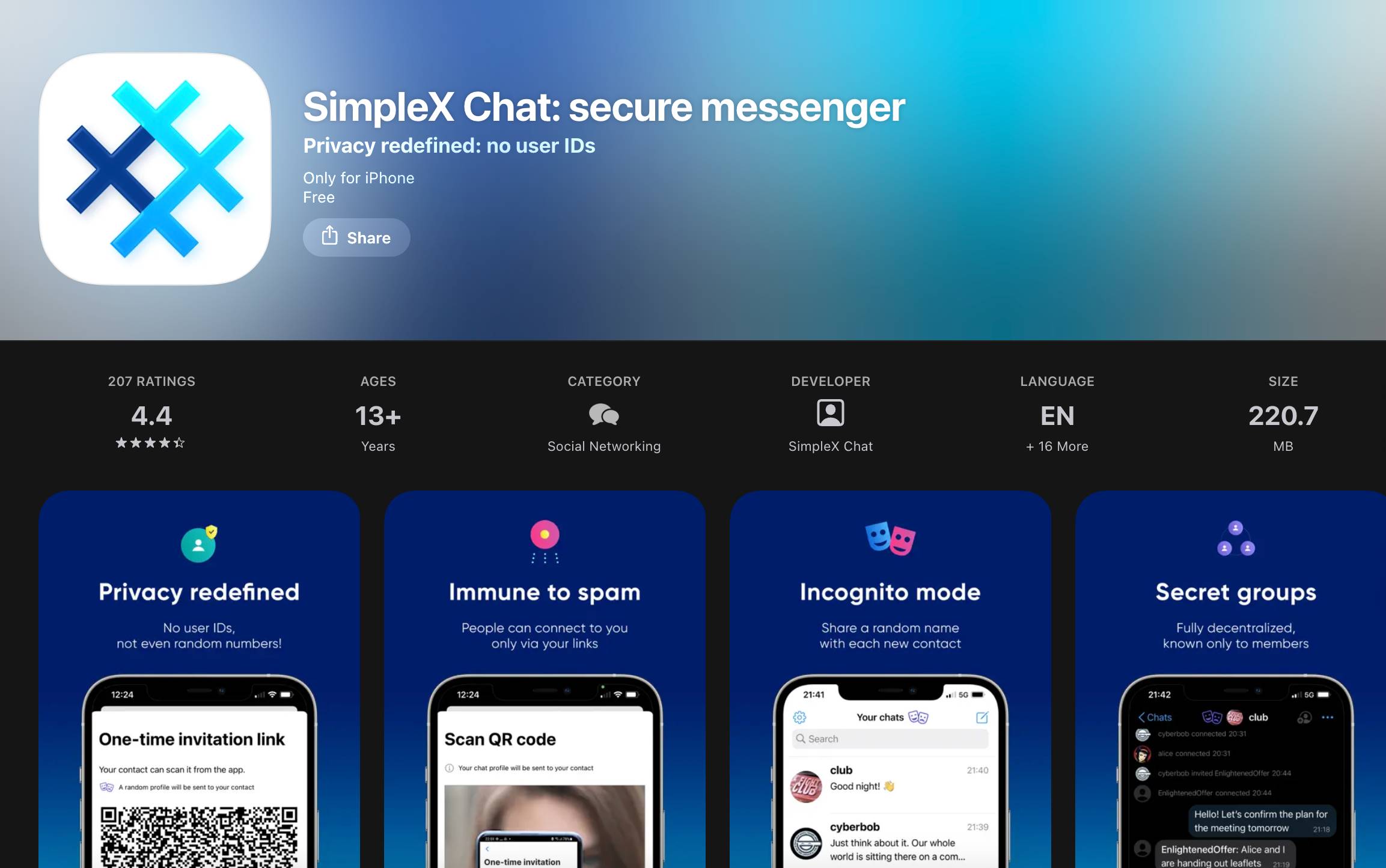
It doesn’t even have user IDs.
Virtually all messaging apps, no matter how privacy-focused, assign users some form of identifier. Telegram uses phone numbers, Signal uses phone numbers, Session uses randomly generated Session IDs.
Even if these identifiers don’t link to real identities, they leave traces: if you chat with two people using the same account, those two individuals could theoretically confirm they’re communicating with the same person.
SimpleX eliminates this identifier entirely. Each time you connect with a new contact, the system generates a unique, one-time message queue address. The address used for chatting with A is completely different from the one used with B—there’s no shared metadata at all.
Even if someone monitors both conversations simultaneously, they cannot prove they originate from the same person.
Even if someone monitors both conversations simultaneously, they cannot prove they originate from the same person.
As a result, the registration experience with SimpleX is different. Upon opening the app, you simply enter a display name—no phone number, no email, not even a password. Your profile is stored entirely on your local device; SimpleX’s servers hold no account information about you.
Adding contacts works differently too. You must generate a one-time invitation link or QR code and send it to the other person. Only after they click it can a connection be established. There’s no “search username to add friend” function because there are no usernames to search.
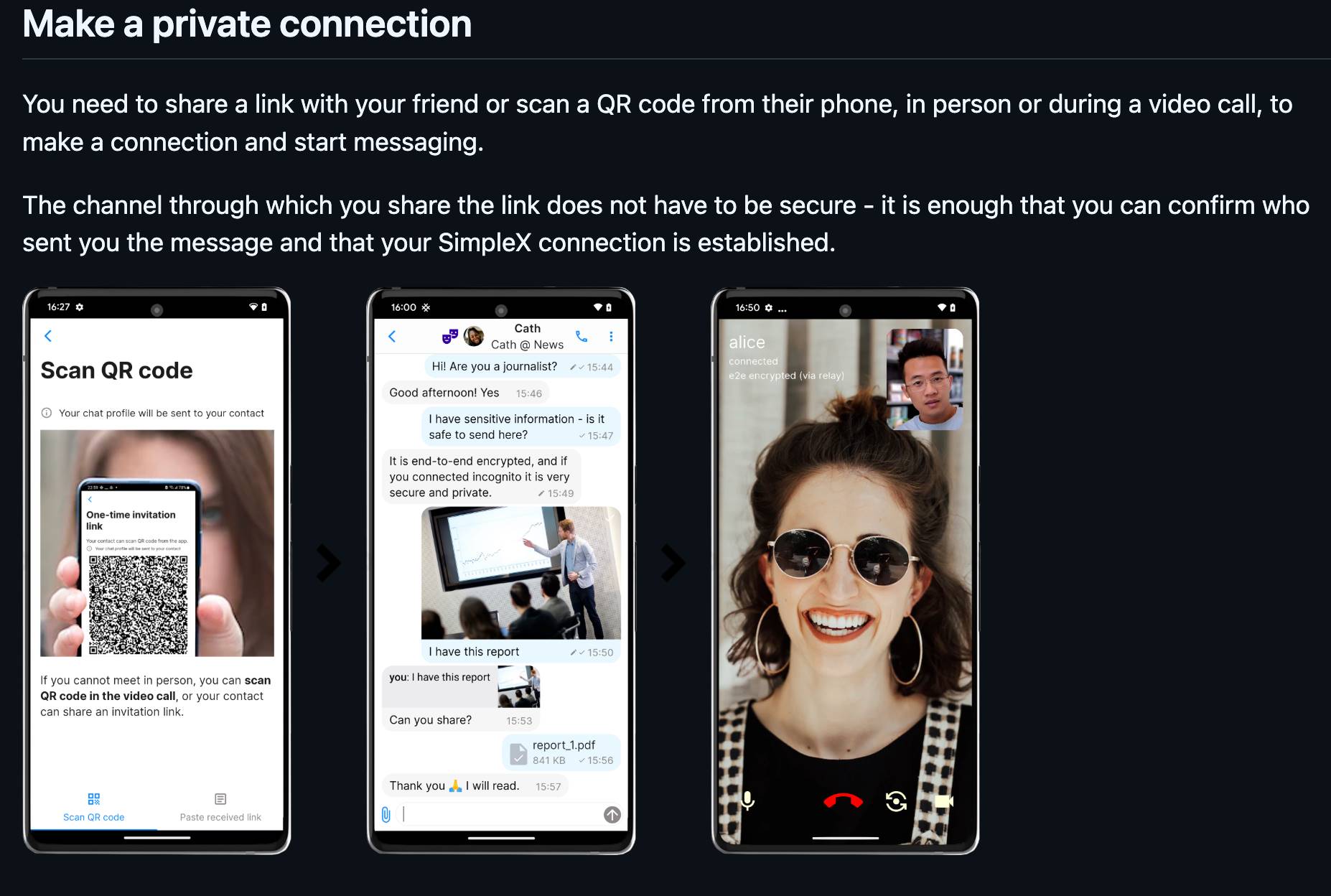
Technically, SimpleX uses its own SimpleX Messaging Protocol. Messages are relayed through servers that temporarily store encrypted messages without keeping user records or communicating with each other. Messages are deleted once delivered. Servers cannot see who you are or whom you’re chatting with.
This design is extremely privacy-centric, prioritizing protection above all else.
By the way, the app is open-source on GitHub. More information can be found here.
SimpleX was founded in 2021 in London by Evgeny Poberezkin. In 2022, it secured pre-seed funding led by Village Global, and Jack Dorsey has publicly expressed support for the project. The app is fully open-source and has passed a security audit by Trail of Bits.
In practice, SimpleX has a clean interface supporting text, voice messages, images, files, and self-destructing messages. Group chat is available, but due to the lack of centralized member list management, large groups don’t perform as well as traditional apps. Voice calls work, though video calls still face stability issues.
A notable limitation: since there’s no unified user ID, if you switch devices or lose local data, you must re-establish connections with every contact individually. There’s no “log in to restore all chat history” option.
This is the trade-off of extreme privacy design.
Business Model Comparison: Token Incentives vs. Deliberate De-Financialization
Both apps focus on private messaging, but their business models are fundamentally different.
Session follows a typical Web3 approach, using tokens to align incentives among network participants. SESH is the native token of the Session Network, serving three main purposes:
-
Running a node requires staking 25,000 SESH as collateral;
-
Node operators earn SESH rewards for providing message routing and storage services;
-
Future paid features like Session Pro memberships and Session Name Service will use SESH for payments.
The logic behind this model: node operators have economic incentives to maintain network stability, staking raises the cost of malicious behavior, and token circulation provides sustainable funding. Currently, about 79 million SESH are in circulation, with a maximum supply of 240 million. Over 62 million SESH are locked in the Staking Reward Pool as reserves for node rewards.
After Vitalik’s donation, SESH rose from under $0.04 to over $0.20 within hours, briefly pushing the market cap beyond $16 million. While part of this surge was speculative, it also shows the market pricing in the narrative of “privacy infrastructure.”
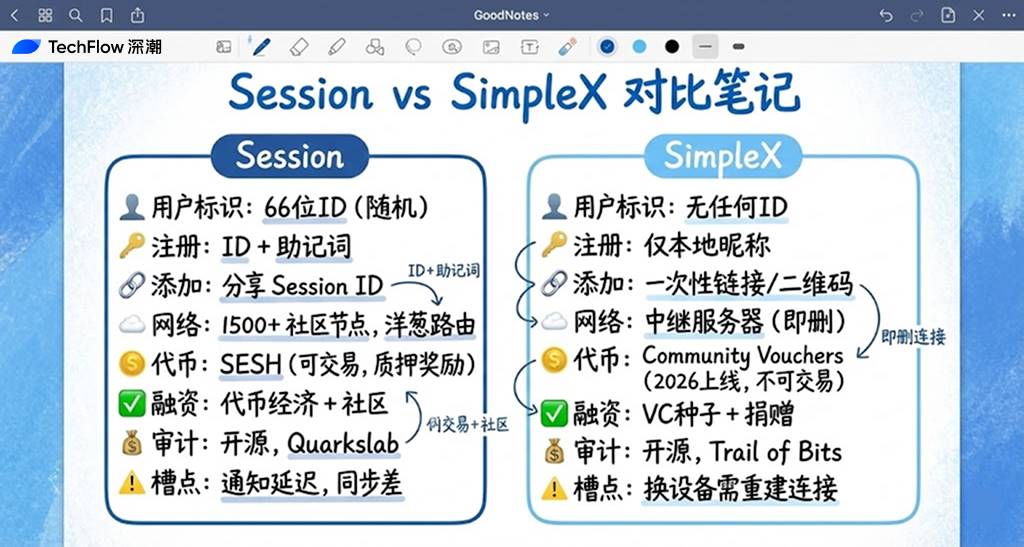
SimpleX takes the opposite route. Founder Evgeny Poberezkin has clearly stated he won’t issue tradable tokens, believing that token speculation would distract the project from its mission.
SimpleX is currently funded through VC investments and user donations. Its 2022 pre-seed round raised about $370,000, and user donations have totaled over $25,000. The team plans to launch Community Vouchers in 2026 for sustainable operations.
Community Vouchers are restricted utility tokens—essentially prepaid server usage vouchers. Users purchase Vouchers to cover server costs for their communities, with funds distributed to server operators and the SimpleX network. Crucially, these Vouchers are non-transferable, have no pre-mine, no public sale, and are sold at a fixed price.
Clearly, SimpleX deliberately shuts down any possibility of financial speculation.
Each approach has pros and cons. Session’s token model quickly attracts node operators and capital attention, but exposes the project to volatility and regulatory risks. SimpleX’s de-financialized design preserves purity but limits funding sources and slows growth.
This isn’t just a difference in business strategy—it reflects divergent views on how privacy should be funded.
Shared Challenges in Private Messaging
Vitalik didn’t offer blind praise in his donation tweet. He explicitly noted:
Neither app is perfect. Achieving true usability and security still has a long way to go. The challenges he mentioned reflect structural issues across the entire private messaging sector.
The first is the inherent cost of decentralization. Centralized apps deliver fast, stable, and seamless experiences because all data passes through a unified server infrastructure with ample optimization opportunities. Once you move to decentralization, messages must hop between multiple independent nodes, making latency inevitable.
The second is multi-device synchronization. With Telegram or WhatsApp, switching phones and logging in restores your chat history instantly. But in decentralized systems, without a central server storing your data, syncing across devices relies on complex end-to-end key synchronization mechanisms.
The third is Sybil attack and DoS protection. Centralized platforms use phone number registration as a natural barrier against spam accounts and malicious attacks. Without phone number binding, how do you prevent mass creation of fake accounts for harassment or network attacks?
Decentralization requires sacrificing some user experience. Permissionless registration demands alternative abuse prevention methods. Multi-device sync forces trade-offs between privacy and convenience.
Vitalik’s decision to fund these projects now is, in a sense, a statement: these problems are worth solving, and solving them requires funding and attention.
For average users, switching to Session or SimpleX may still be premature—the experiential shortcomings are real. But if you care about your digital privacy, it’s at least worth downloading and trying them to understand how far “true privacy” can go.
After all, when Vitalik is willing to put real money behind something, it’s probably more than just geek enthusiasm.
Join TechFlow official community to stay tuned
Telegram:https://t.me/TechFlowDaily
X (Twitter):https://x.com/TechFlowPost
X (Twitter) EN:https://x.com/BlockFlow_News
 深潮TechFlow















