

Pantera Partner: The Era of Privacy Renaissance—These Technologies Are Changing the Game
TechFlow Selected TechFlow Selected
Pantera Partner: The Era of Privacy Renaissance—These Technologies Are Changing the Game
A new reality is emerging: privacy protection is key to driving blockchain into the mainstream, and demand for privacy is accelerating across cultural, institutional, and technological levels.
 Navigating Web3 tides with focused insights
Author: Paul Veradittakit, Partner at Pantera Capital
Translation: Saoirse, Foresight News
Since the inception of Bitcoin, the core principle of the blockchain industry has always been rooted in "transparency" — an open and immutable ledger accessible to all, where trust stems from "verification" rather than institutional reputation. It is precisely this transparency that enables decentralized systems to function with integrity and accountability.
However, as blockchain technology matures and its applications expand, transparency alone is no longer sufficient. A new reality is emerging: privacy protection is key to driving blockchain into the mainstream, and demand for privacy is accelerating across cultural, institutional, and technological domains. At Pantera Capital, we have long held this belief — as early as 2015, we invested in Zcash, one of the first projects attempting to introduce privacy protections to an immutable ledger.
We believe the industry is entering a "privacy renaissance" era — one that deeply integrates the principles of open blockchains with the practical needs of global finance. In this context, privacy protocols built around confidentiality, such as Zama (which is即将 launching its mainnet), are poised for growth. Zama’s fully homomorphic encryption (FHE) technology serves as an "absolute fortress" enabling blockchain's mainstream adoption and will also defend against quantum computing threats in the coming years. Blockchain applications are just one use case for Zama’s FHE technology, which can extend to other verticals such as artificial intelligence (e.g., Zama’s Concrete platform) and cloud computing.
Another notable investment is StarkWare — the creator of zk-STARKs zero-knowledge proof technology and the Validium solution, offering a "hybrid approach" to blockchain privacy and scalability. StarkWare’s cryptographic techniques are also quantum-resistant and focused on blockchain use cases, particularly with its newly launched "S-Two prover," which further enhances technical practicality.
Cultural Shift: From Surveillance Fatigue to Digital Sovereignty
Globally, perceptions of data have fundamentally shifted. Years of mass surveillance, algorithmic tracking, and data breaches have made "privacy" one of the central cultural issues of the past decade. Users now increasingly recognize that not only their information and transaction records but even metadata can expose sensitive details about identity, wealth, location, and personal relationships.
"Privacy protection + user ownership of sensitive data" has become the new industry standard — a direction Pantera Capital strongly supports, leading us to invest in projects like Zama, StarkWare, Transcrypts, and World. As public awareness of privacy grows, the blockchain industry must confront a reality: digital currencies need "confidentiality," not "full traceability." In this environment, privacy is no longer a niche demand but a critical component in advancing "digital sovereignty."
Institutional Shift: Transparent Systems Without Privacy Cannot Scale
An increasing number of institutions are entering the blockchain ecosystem: banks, remittance platforms, payment processors, enterprises, and fintech companies are piloting initiatives and preparing to handle real transaction volumes in tokenized assets, cross-border settlements, and multi-jurisdictional payment networks.
Yet these institutions cannot operate on "fully transparent public ledgers" — corporate cash flows, supplier networks, foreign exchange exposures, contract terms, and customer transaction histories must not be exposed to competitors or the public. What enterprises need is "selective transparency with confidentiality," not full exposure.
This was the foundation laid by early pioneers like Zcash. When Pantera Capital invested in Zcash in 2015, we recognized that privacy is not merely an ideological preference but a necessity for real economic activity. Zcash’s key insight was that privacy protection cannot be "added later" to a system — especially when using zero-knowledge proofs — but must be embedded at the protocol level; otherwise, implementation becomes extremely difficult, fragile, and inefficient.
Zcash launched in 2016 as a Bitcoin fork, introducing zk-SNARKs technology that hides transaction details while preserving full verifiability. Additionally, the mixing protocol Tornado Cash marked a significant milestone in on-chain privacy development: as users sought ways to break transaction linkages on public chains, the protocol saw substantial real-world usage.
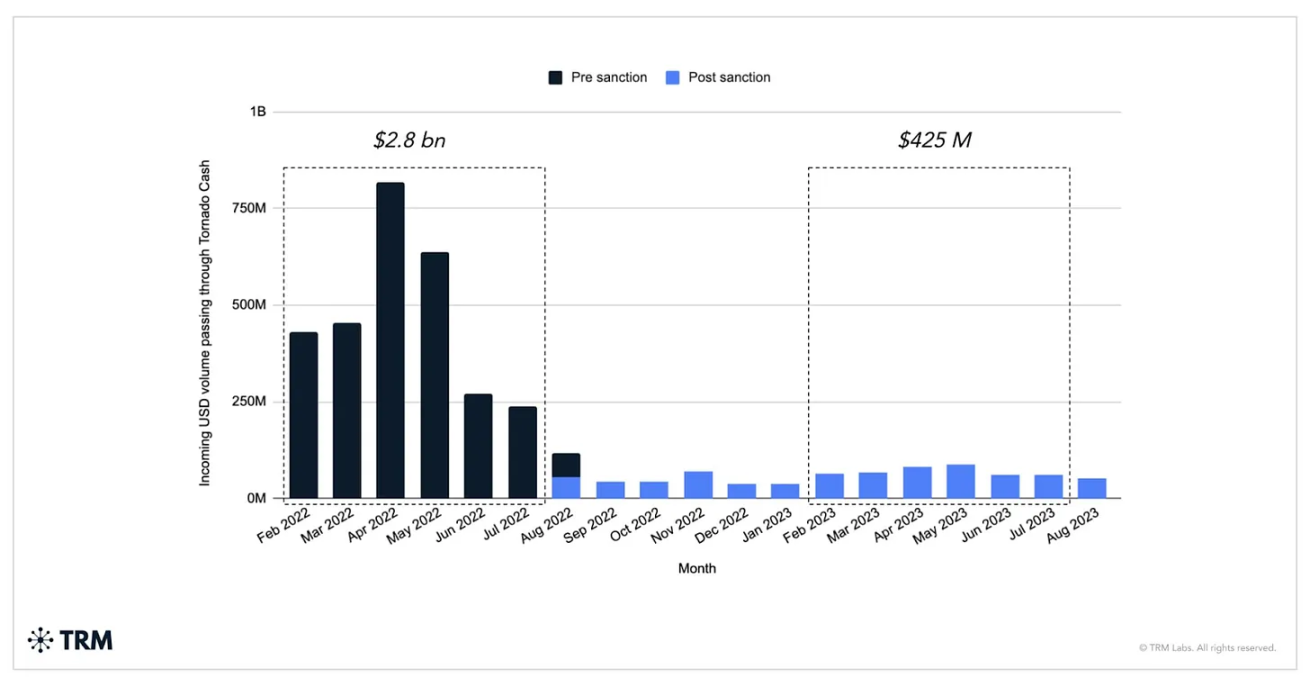
USD inflows to Tornado Cash before and after sanctions (Source: TRM Labs)
However, Tornado Cash had a critical flaw: it emphasized strong privacy but lacked a "selective disclosure mechanism," ultimately resulting in high-profile legal actions by regulators — despite being autonomous code, the project was effectively forced to pause. This outcome confirmed a crucial lesson: privacy protection must not come at the expense of auditability or compliance pathways.
This is precisely where Zama’s fully homomorphic encryption (FHE) technology delivers core value: FHE allows computation directly on encrypted data while preserving the ability to selectively verify and disclose information — a functionality absent from mixing protocols like Tornado Cash from the outset.
The importance of FHE is evident in strategic moves by tech giants: companies like Apple and Microsoft are investing heavily in building FHE frameworks. Their involvement signals a clear consensus: for both consumers and institutions, "scalable, compliant, end-to-end encrypted technologies" represent the future of digital privacy.
Demand for Privacy Is Accelerating Rapidly
Data confirms this trend: privacy-focused crypto assets are gaining increased attention from users and investors. But the true shift is not driven by retail speculation, but by real-world applications requiring both privacy and transparency:
-
Cross-border payments are becoming more reliant on blockchain, yet enterprises and banks cannot disclose every payment path;
-
RWA requires confidentiality regarding "ownership" and "investor identities";
-
In global supply chain finance, counterparties need to verify events (e.g., shipments, invoices, settlements) without revealing trade secrets;
-
Enterprise transaction networks require models where auditors and regulators can see data, but the public cannot.
At the same time, retail users are growing increasingly dissatisfied with highly surveillable public chains — where simple tools can reconstruct entire transaction graphs. Today, "privacy protection" has become one of the core expectations users have for digital currencies.
In short, the market is gradually recognizing a fundamental truth: blockchains that cannot provide confidentiality face structural limitations in institutional-scale applications.
Canton, Zama, StarkWare, and the New Generation of Privacy Architecture
With the arrival of the privacy renaissance, a new generation of protocols is emerging to meet institutional demands.
Take the Canton blockchain as an example — it highlights the growing need for "private transaction execution on a shared settlement layer." Such systems allow participants to conduct private transactions while benefiting from "global state synchronization" and "shared infrastructure." Canton’s development clearly shows that enterprises want the advantages of blockchain without exposing their business data publicly.
Yet the most transformative breakthrough in private computation may come from Zama — occupying a unique and more scalable position within the privacy technology stack. Zama is building a "confidentiality layer" based on fully homomorphic encryption (FHE), enabling direct computation on encrypted data. This means entire smart contracts — including inputs, states, and outputs — can remain encrypted while still being publicly verifiable on a blockchain.
Unlike "privacy-first Layer 1 blockchains," Zama is compatible with existing ecosystems — especially the Ethereum Virtual Machine (EVM) — meaning developers and institutions do not need to migrate to a new chain but can simply integrate privacy features into their current development environments.
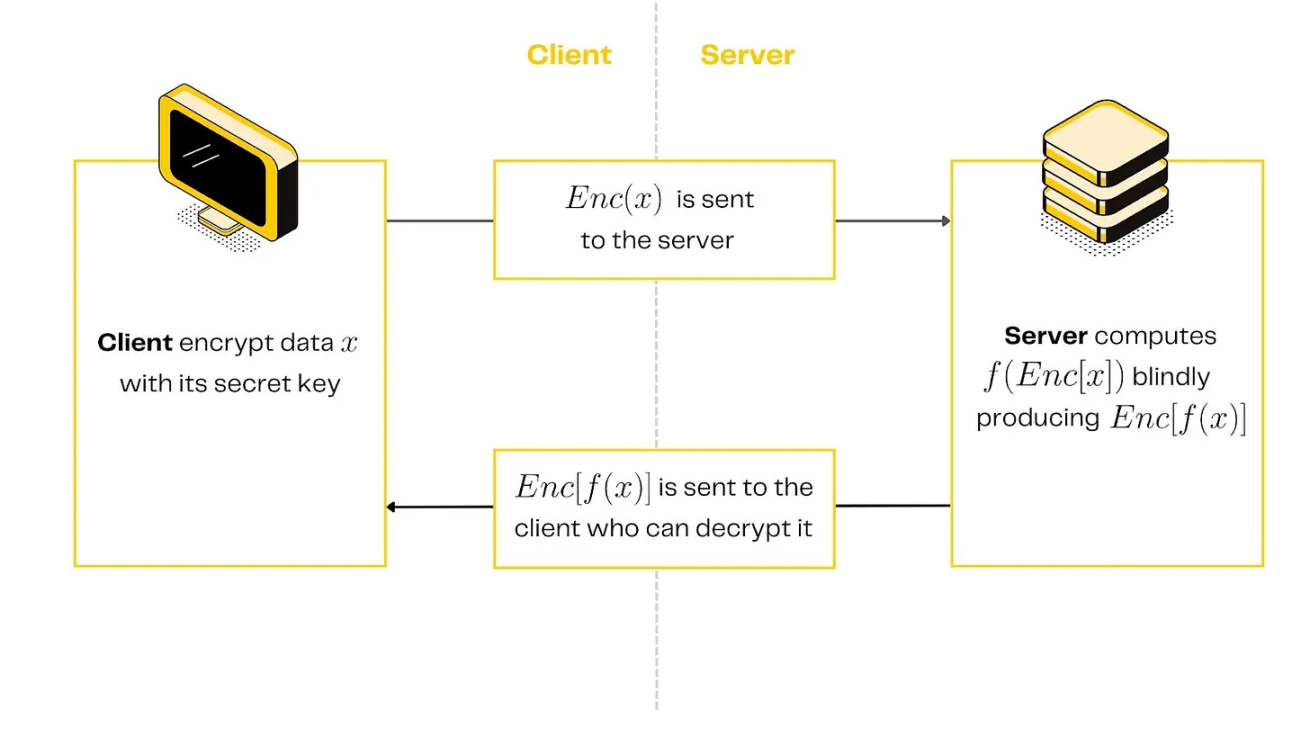
Private smart contracts using fully homomorphic encryption (FHE) (Source: Zama)
Zama’s architecture represents the next evolution in blockchain privacy: moving beyond simply hiding transactions toward enabling "scalable private smart contracts." This unlocks entirely new use cases — including private DeFi, encrypted order books, confidential issuance of real-world assets, institutional-grade settlement and clearing processes, and secure multi-party business logic — all without sacrificing decentralization, with some applications likely deployable in the near term.
Currently, privacy assets are attracting greater attention: institutions are actively evaluating confidentiality layer technologies, developers seek privacy-preserving computation without off-chain latency and complexity, and regulators are beginning to establish frameworks distinguishing "legitimate privacy tools" from "illicit obfuscation methods."
Looking Ahead
The narrative around privacy in the blockchain industry is no longer framed as "transparency versus confidentiality," but rather recognizes that both are essential for the next era of DeFi. The convergence of cultural attitudes, institutional demands, and cryptographic breakthroughs is reshaping the trajectory of blockchain over the next decade.
Zcash demonstrated at the protocol level the necessity of privacy; protocols like Canton reflect institutional demand for "confidential transaction networks"; and Zama is building the infrastructure to unify these needs into a "cross-chain, universal, scalable privacy layer."
Pantera Capital’s early investment in Zcash stemmed from a simple conviction: privacy is not an "optional feature." Nearly a decade later, this view has grown even more relevant — from tokenized assets and cross-border payments to enterprise settlements, the key to the next wave of blockchain adoption lies in delivering "secure, seamless, and private" user experiences.
As privacy becomes a central theme in this market cycle, protocols that offer "practical, scalable, and compliant confidentiality solutions" will define the future landscape of the industry. Among them, Zama stands out as a timely and highly promising leader in the emerging "privacy supercycle."
Join TechFlow official community to stay tuned
Telegram:https://t.me/TechFlowDaily
X (Twitter):https://x.com/TechFlowPost
X (Twitter) EN:https://x.com/BlockFlow_News
 Pantera Capital















