Danny Ryan: Wall Street needs decentralization more than you think, and Ethereum is the only answer
TechFlow Selected TechFlow Selected
Danny Ryan: Wall Street needs decentralization more than you think, and Ethereum is the only answer
Former Ethereum Foundation researcher deep dives at Devconnect ARG 2025: How to support $120 trillion in global assets by eliminating counterparty risk and building L2s.
 Navigating Web3 tides with focused insights
Compilation: Pan Zhixiong
The most surprising discovery for me is this: Wall Street actually has a strong demand for decentralization.
This sounds counterintuitive. We, the cypherpunks and crypto natives, care about decentralization, but the general public seems more interested in trading stablecoins or rushing into meme coins on-chain. It appears no one else cares? But Wall Street does.
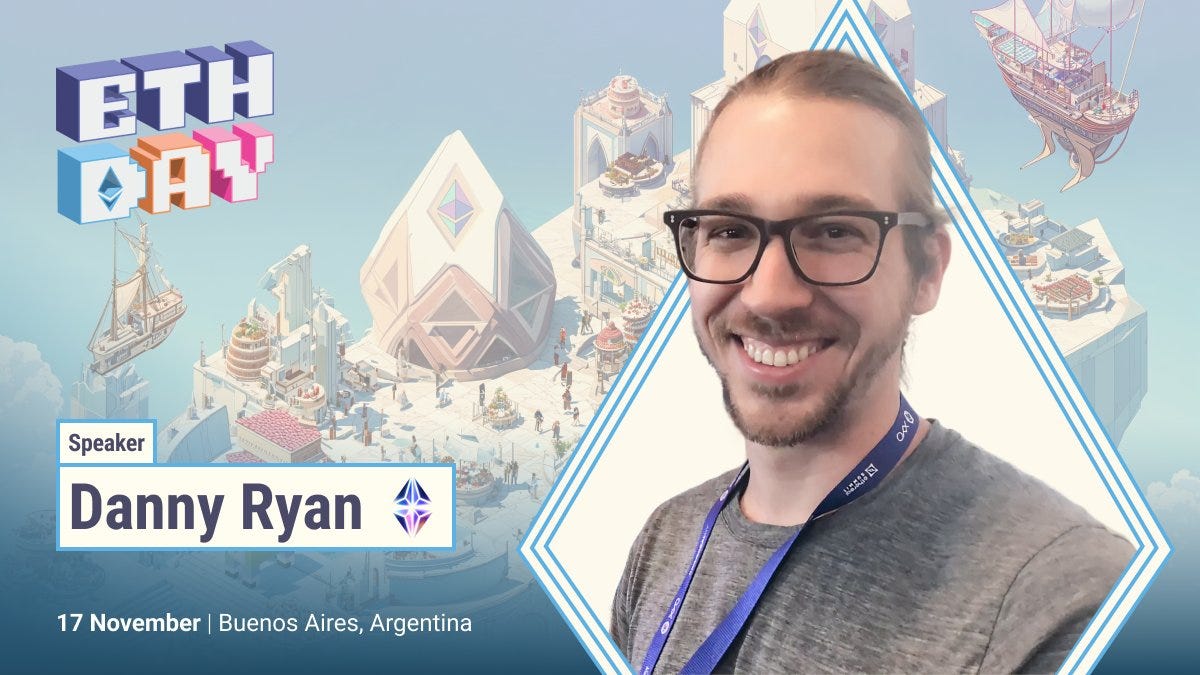
Danny Ryan is co-founder of Etherealize and former core researcher at the Ethereum Foundation. At Devconnect ARG 2025, he shared profound insights gained after shifting from protocol development to institutional applications.
Introduction: From Protocol Research to Viewing the World Through a "Banker's Lens"
Long time no see. I missed the last Devcon—that was all I could say about Ethereum at the time.
I've worked in decentralized systems for several years, building Ethereum, researching mechanism design, decentralization, security, and resilience. Now, I interact with banks every day. It feels odd, yet incredibly interesting. I’ve learned a lot, and they’ve learned from us too. For instance, I was surprised to find that business cards are still in use, and everyone relies on LinkedIn—even though I personally haven’t registered (much to my colleagues’ likely dismay). Wall Street still depends on these tools.
Speaking of Wall Street, “Wall Street” isn't really on Wall Street anymore. Aside from the New York Stock Exchange, most institutions have relocated to Midtown Manhattan.
Status Quo: Traditional Financial Markets Are Extremely Inefficient
We often assume institutional markets are highly efficient. You might think instant online trading is straightforward, but even the most efficient equity trades take one day to settle (T+1)—and that’s considered optimal. Look deeper, and you’ll find institutional markets riddled with inefficiencies and manual processes.
Technologically, everything is extremely fragmented. An asset manager might use one software to manage positions, another for trading, and a third for compliance—each requiring complex integrations. It’s like a Frankenstein-like disaster of stitched-together software queues. Some institutions still exchange faxes. Settlement and other critical operations take far too long. Settlement takes two days, which was hailed as a “huge victory” a decade ago when upgraded from T+3 to T+2.
In contrast, on Ethereum, transaction and settlement happen simultaneously—this is our inherent advantage.
Traditional systems are filled with systemic counterparty risk. The architecture is over a century old, with legal layers piled atop layers, effectively adding more intermediaries. Anthropologically speaking, it’s a miracle they built such a system at all. But now we have better technology—it’s time to fix it.
Core Insight: Institutions Genuinely and Strongly Desire Decentralization
The most surprising discovery for me is: Wall Street (as a proxy for institutions) actually has a strong demand for decentralization.
It sounds counterintuitive. We, the cypherpunks and crypto natives, obsess over decentralization, while the broader public seems focused on trading stablecoins or chasing meme coins (memecoins) on-chain. Does anyone else care? But Wall Street does. Let me translate the reasons through their lens:
-
Eliminate Counterparty Risk: A key institutional concern is “Who will screw me over?” Risks exist at every level—from counterparties to affiliated banks to infrastructure. Decentralized and credibly neutral infrastructure can drastically reduce, if not eliminate, this risk.
-
Uptime: This is crucial. They require 100% uptime. Ethereum achieves this because dozens of clients and thousands of nodes run the network. This isn’t accidental—it’s by deliberate design.
-
Scarce Cryptoeconomic Security: Very few decentralized systems in the world can provide security suitable for “trillion-dollar” asset classes. I’m not talking about retail investors’ hundreds of dollars, but national-level assets worth hundreds of billions globally. You can’t just spin up a new system tomorrow and instantly have that level of security. Ethereum possesses this scarce resource.
-
Mature Application Layer: Ethereum has been running for ten years. If you talk to a bank and they know anything about blockchain internally, they mean EVM and Solidity. They need mature security standards and application frameworks—not the latest trendy software that appeared yesterday.
-
Privacy: This is something I deeply value. Building privacy for institutions acts as a “Trojan horse” to advance overall blockchain privacy. For institutions, privacy isn’t a nice-to-have feature—it’s table stakes. Without solving privacy, market upgrades are impossible. When Institution A trades with Institution B, they cannot publicly disclose positions; it violates market norms. Fortunately, Ethereum’s investment in applied cryptography—especially zero-knowledge (ZK)—is currently in the hundreds of millions. Our work on scalability (compressing computation) has serendipitously delivered privacy benefits.
-
Network Effects and Liquidity: Capital flows where capital already exists. With the widespread adoption of stablecoins, Ethereum is far ahead in this regard.
-
Mid-layer Infrastructure (Layer 2): This is extremely important. When I explain Layer 2 to institutions, they’re eager to buy in. Banks want to build customizable, scalable systems that can still connect to Ethereum—the internet of value.
When you truly engage with institutions and bridge the knowledge gap, you realize: Wall Street needs Ethereum.
Real World vs. Speculative World
As developers, we sometimes feel frustrated. You build unstoppable, decentralized systems, only to see people flock to meme tokens issued by multisig wallets controlled by “three guys in a basement.” You worry no one values decentralization.
But institutional demand for decentralization is actually a window into the real world. If it’s just speculation, sure—people may not care. But when it comes to putting pensions or property deeds on-chain, the real world demands decentralization. In these cases, the system must offer security equal to—or better than—what currently exists.
Strategic Shift: From "Simple Explanation" to "Building Better Products"
The Ethereum community excels at building infrastructure and mechanism design, but we must move beyond the mindset of “if we build it, they will come.”
We can’t simply explain to institutions why they need decentralization. We must assume global assets will go on-chain. How? Not through simple tokenization, but by building systems so superior that global assets must migrate on-chain.
Value collaboration can be divided into two phases:
-
Straightforwardly Better: Faster, cheaper, trust-minimized, user-friendly interfaces.
-
Extended Ecosystem: Asset simplification, DeFi composability, etc.
We often focus too much on point 2, but we need to invest more in point 1. Current institutional products may look elegant on the surface with powerful reporting features, but their underlying infrastructure remains in the Stone Age. By leveraging blockchain properties like atomic settlement, we can make products fundamentally better in time. Only by mastering point 1 can we attract long-tail assets into the innovation space of point 2.
Redefining Success: Trillions in Assets and Market Growth
We should measure success in “trillions.” Currently, so-called RWA (real-world assets) on Ethereum amount to roughly $18 billion. By the way, when you talk to institutions, they don’t call it RWA—they just call it “assets.” Global asset management is estimated at $120 trillion. If we want to bring the global economy on-chain, we must mobilize institutional capital.
Another measure of success is impact and market evolution.
This includes two stages:
-
Rewire: Use Ethereum and Layer 2 to programmatically define settlement rules, eliminating manual checks. For institutional markets, Ethereum is already “fast” compared to T+1 settlement.
-
Evolving: Expand market access. Today’s markets are highly exclusive—sometimes due to regulations, sometimes purely to maintain closed clubs. But through on-chain products and DeFi, we can include more participants. This is a positive-sum game. Institutions want to manage more assets; the public wants access to financial products.
Conclusion: The Most Important Work
I love working on the most important problems. Right now, I spend my days advancing institutional adoption on Ethereum. This includes bridging knowledge gaps, explaining why they shouldn’t use those strange, closed “privacy chains” without DeFi, but instead build on Ethereum.
We need to genuinely build, design native environments, understand asset flows, legal complexities, and compliance. If we don’t do this, we’ll hand the global economy over to others. If you want to change the world, it’s time to bring the world onto Ethereum.
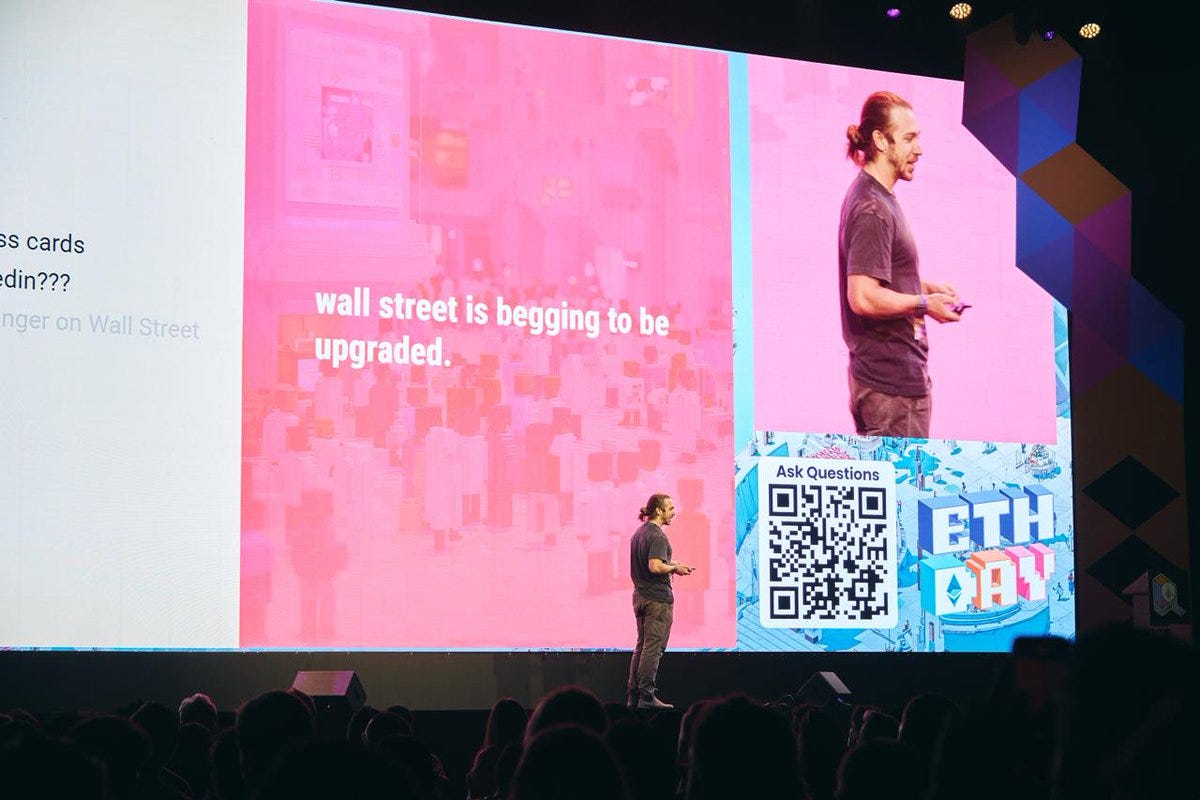
Live Q&A
Q1: What is the biggest misconception institutions have about Ethereum’s decentralization?
Danny: Institutions are becoming increasingly aware. There’s a growing FOMO—they fear fintech will eat their lunch. The main misconception might be that “decentralization” means “lawless” or “no access control.” In reality, on-chain environments are highly governed—you can set rules. This fear is turning into concern over falling behind, which presents a great opportunity for builders.
Q2: What advice do you have for developers wanting to enter the institutional space?
Danny: Just as understanding the Ethereum tech stack takes effort, so does understanding Wall Street—it’s a complex beast. My advice: find a partner. Pair up with someone on Wall Street who trades daily but wants to learn about decentralization. Combine strengths.
Q3: As adoption grows, is there a risk Ethereum could be co-opted by institutions?
Danny: Absolutely. We need to bring in global assets while preserving Ethereum’s core values of global inclusivity and diversity. As long as we retain the ability to fork, we won’t lose control. I’m not an ossificationist—I believe there’s still much work to do—but we must proceed carefully during asset integration.
Q4: How can we ensure the right narrative is conveyed to institutions?
Danny: Together. The Ethereum Foundation forming an enterprise group is a good first step. But with hundreds of key companies and tens of trillions in assets involved, we can’t go it alone. We must unite on narrative and education, ensuring our voices are present at negotiation tables worldwide.
Q5: What’s something you know now that you wish you’d known at the start?
Danny: Translation of language. For example, when I spoke with a former head of oil trading at JPMorgan about “RWA,” he had no idea what I meant—because to him, it’s just “assets.” Or “atomic settlement”—they don’t have this concept, since in traditional finance, asset delivery and payment are often separate (even to earn interest on float). We need to learn their language and provide accurate “translations.”
Q6: What excites institutions the most?
Danny: Layer 2 (L2). This truly resonates. Compared to swimming in a single public pool, institutions love the idea of having sovereignty (building their own L2 with partners) while still connecting to the Ethereum ecosystem.
Q7: How do you view ecosystem collaboration?
Danny: Over the past year, I’ve focused too much on heads-down work, leading to less collaboration—something I need to reflect on. As global assets go on-chain, it’s not just about infrastructure. DeFi, on-chain lending, capital, compliance stacks—every part of the ecosystem must be fully utilized. Everything we’ve built over these years is for this moment.
Join TechFlow official community to stay tuned
Telegram:https://t.me/TechFlowDaily
X (Twitter):https://x.com/TechFlowPost
X (Twitter) EN:https://x.com/BlockFlow_News
 @ChainFeedsxyz