Wall Street legend Ron Baron doubles down on Musk: after making $12 billion, he's betting for another 10 years
TechFlow Selected TechFlow Selected
Wall Street legend Ron Baron doubles down on Musk: after making $12 billion, he's betting for another 10 years
He's betting on the very few people in this era who can build infrastructure from scratch.
 Navigating Web3 tides with focused insights
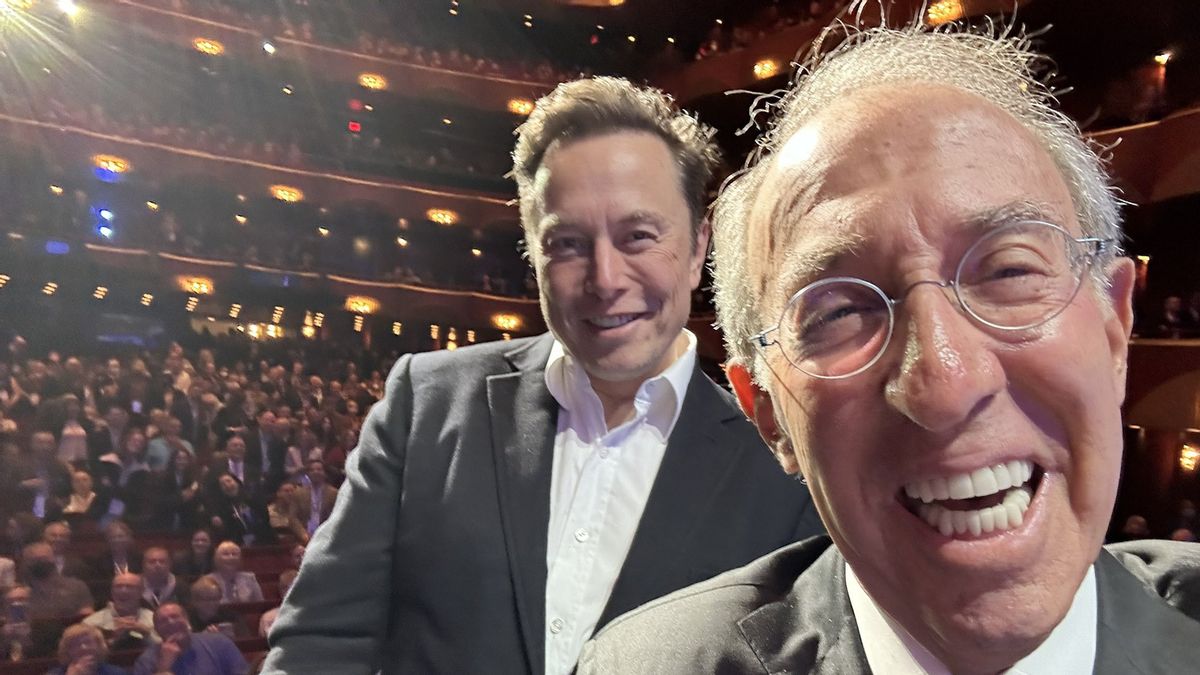
November 14, 2025, Lincoln Center, New York City.
The opening theme of the 32nd Baron Investment Conference: just four words—Changing Lives.
The most anticipated segment that day was a dialogue.
On one side: Ron Baron, the 82-year-old legendary investor. He has allocated about 40% of his personal assets to Tesla, 25% to SpaceX, and also invested in xAI—nearly 65% of his net worth tied to Elon Musk.
On the other end of the screen: Elon Musk himself, the very figure Baron has heavily bet on for over a decade.
In an interview with CNBC, Baron estimated that since purchasing Tesla shares in 2014, his investments linked to Musk have generated over $12 billion in profits for him and his clients. $8 billion came from Tesla, $4 billion from SpaceX, while returns from newer ventures like xAI are still in early stages.
But the most surprising part wasn't the profit—it was what he said next:
I believe we can make five times more on this investment in the next ten years.
In his eyes, Musk’s business empire extends far beyond electric cars and rockets—it's a fully integrated system combining automotive, aerospace, AI factories, humanoid robots, chips, and space-based power stations.
What he values isn’t that Musk builds specific products, but that Musk is personally constructing the infrastructure of the AI era.
Section I|What Exactly Is Baron Betting On?
At this New York conference, Baron had one core message:
I don't bet on companies—I bet on people.
This is the foundation of his entire investment philosophy.
There’s a well-known story: Baron first met Musk in 2009, shortly after Tesla faced a severe cash crunch. Baron asked Musk:
"Will you keep going?"
Musk replied simply: Yes. It’s worth it.
Baron later said that moment revealed something crucial—he realized this wasn’t just about building a company; Musk was investing his entire being into the mission.
1. He bets on execution capability
Baron isn’t a tech expert—he admits it openly: I don’t understand EVs, rockets, or AI. What I do understand is who can actually get incredibly hard things done.
What he sees is Musk’s relentless determination to push forward no matter the odds:
-
When Tesla nearly collapsed, Musk mortgaged his house to pay employees
-
After three failed rocket launches at SpaceX, he said one more failure would mean bankruptcy
-
Within 18 months of founding xAI, he released a roadmap for Grok 5
-
While others say robotics is premature, he already has Optimus working in factory tests
Every single thing Musk does is so difficult that most people wouldn’t even attempt it—but he persists.
He bets on someone who can endure and overcome such immense challenges.
2. He bets on long-term strategic vision
Baron’s approach is patience. He openly says: My investments often span over a decade.
He gives an example: In 2012, Tesla had only one model, the Model S, selling fewer than 30,000 units annually. Many investors doubted whether the company could survive, yet Baron kept increasing his position.
His reasoning? Musk isn’t just making cars—he’s building the future.
In 2012, these moves looked irrational. But by 2025, their strategic coherence became clear.
Baron says: You can’t think in annual terms—you must think in decades. His rhythm isn’t about making money tomorrow, but turning the future into reality.
3. He bets on integration capability
Baron said during the conference: Musk’s projects may seem unrelated, but he’s making each one strengthen the others.
Fifteen years ago, Musk told Baron: “The machines that build machines” are what truly matter. While most investors focused on car sales, Musk was already thinking about cross-business synergy.
Baron says: Others build businesses. He builds ecosystems.
He doesn’t invest in product lines—he invests in integration capability.
4. He bets on resilience under pressure
Baron once said on CNBC: I love when he gets criticized—because then the stock gets cheaper.
When others panic, he’s more inclined to buy.
But his greatest signal of confidence came in the form of a promise. Around 2020, Tesla’s stock surged from $10–15 to $220, and clients grew nervous about overweight exposure. Baron reduced client holdings by 25–30%.
But he didn’t sell a single share himself. To his board, he pledged: I will be the last seller. I won’t sell a single share until every client has fully exited. He said: Within my lifetime, I will never sell Tesla or SpaceX.
His reasoning: Most people retreat when facing hardship—Musk doesn’t. Every time he falls, he climbs back up stronger.
He found someone who turns vision into reality—who pushes harder the tougher it gets.
In his own words: In him, I see a future I can’t see in anyone else.
Section II|Why Does He Say: Grok Is the Most Important Step?
When Ron Baron invested in Tesla, he was waiting for a car to become an opportunity;
When he backed SpaceX, he was waiting for a launch to become an industry;
Now, by betting on xAI, he’s waiting to see who ultimately controls AI.
1. He sees Musk mastering the three pillars of AI success
Musk clearly stated in the dialogue: An AI company’s success hinges on three things:
-
The ability to attract top-tier talent
-
The capacity to deploy massive AI hardware and bring GPUs online rapidly
-
Access to unique data sources
xAI excels in all three—and builds them from the ground up: training data comes from the X platform, the world’s best real-time data source; computing power runs on SpaceX-built data centers and chip clusters; deployment happens through its own apps, vehicles, and robots.
On the hardware front, Jensen Huang himself said: I’m stunned by how fast they built their data centers. Only one person on Earth could do this.
Others use AI—Musk is building AI himself.
More importantly: The stronger AI becomes, the more critical it is who controls it. Musk holds a complete technology stack—fully independent and self-reliant.
2. He sees Musk redefining how AI is used
Today, we rely on search engines, web pages, browsers—these are old entry points. Musk wants to create an assistant that directly understands, analyzes, and acts on your behalf.
Grok is the first version of this new interface:
-
Can read PDFs, code, edit images, generate videos
-
Has tone, attitude, sarcasm, questions, emotion
-
Doesn’t just chat—it helps you complete tasks like writing copy, reviewing contracts, planning driving routes
To investors, this means AI shifts from conversation to execution.
And the upcoming Grok 5, which Musk is currently training, will scale parameters from Grok 4’s 3 trillion to 6 trillion, adding video understanding, image recognition, tool usage, and real-time multimodal processing. Musk described it as: like having a study group meeting inside your brain.
Even more significant is his assessment: Grok 5 is the first time I feel we might actually achieve Artificial General Intelligence (AGI). There’s only a 10% chance—but it’s a feeling I’ve never had before.
3. He trusts Musk’s foresight in AI
He didn’t jump onto the AI bandwagon late. Long before ChatGPT emerged, he was already laying the groundwork.
Musk founded OpenAI after a conversation with Google co-founder Larry Page. Page told him he was a "speciesist" who favored computers over humans.
Musk responded:
"Which side are you on? I must join Team Human."
So he created OpenAI—the word “Open” meaning open-source. He provided all initial funding, recruited key figures like Ilya Sutskever, and helped OpenAI partner with Microsoft. Yet he refused stock options: taking equity in a nonprofit is wrong.
But when OpenAI turned closed, he launched xAI.
He isn’t riding the AI wave—he helped start it.
Baron bets on xAI not because it’s strong today, but because Musk isn’t chasing trends—he’s defining them.
Section III|The Parts No One Else Understands—He Bets Everything On Them
If Ron Baron backed Tesla because it could go faster and earn more, his bets on robotics, chips, and satellites stem from his belief that Musk can build the foundations of the future.
To most people, these projects seem too distant or too costly. But to Baron, they are precisely the infrastructure needed for AI to become real.
1. Optimus isn’t a robot—it’s accessible labor for everyone
Musk made it clear: We’re not building a dancing robot—we’re building a working robot.
This reflects a fundamental shift in how Optimus is positioned:
-
From lab prototype to mass-producible product
-
From showpiece to tool replacing basic human labor
Optimus V3 can now perform the following actions:
-
Walk autonomously, avoid obstacles, self-charge
-
Replicate human hand movements—tightening screws, gripping circuit boards
-
Hand with 50 actuators capable of fine manipulation
-
Crucially, the cost target is under $20,000
Musk believes that in the future, everyone will want their own Optimus—to help care for family, cook, clean, and provide companionship.
His envisioned applications go far beyond household chores: Imagine a world where everyone has access to the best surgeons. Optimus will offer superhuman precision, performing highly complex medical procedures—even surgeries beyond human capability.
Even more striking: Combined with Neuralink’s brain-computer interface, amputees could use Optimus legs as replacements. Neuralink reads signals from the motor cortex and sends them to Optimus’ legs—at a cost of around $60,000.
This isn’t just building a product—it’s rebuilding the supply of labor. From housework to surgery, from companionship to healthcare—all can be handled by robots.
And Musk has the ability to drive costs down to $20,000, enabling true mass adoption.
2. Chips aren’t tech demos—they’re affordable brains
Musk repeatedly emphasizes:
The vast majority of our AI computing tasks and resources will focus on video processing—not text.
What does this mean?
He’s not building an AI to write papers, but one that sees, interprets, and understands human actions. This requires:
-
Ultra-efficient chips
-
Fast compression capabilities
-
Not server-dependent, but embeddable in cars, robots, even spacecraft
That’s why he personally leads the latest chip project, AI5.
Musk admitted at the conference:
"This chip project hit problems. The design was too advanced—progress has been bumpy."
So he merged AI5 with Dojo, consolidating all efforts on AI5 and stepping in personally.
He said: I spent the entire weekend studying the chip design, analyzing data, tracing current flows… Now I have the full layout in my mind—I can visualize every detail.
NVIDIA’s chips aren’t optimized for low-power AI inference in robots and vehicles. His chips must deliver ultra-low power consumption, extreme performance, and cost just one-tenth of NVIDIA’s.
What would that mean? If successful, using AI wouldn’t cost tens of thousands per month—but just hundreds.
Musk isn’t competing on AI capability—he’s slashing AI cost.
3. Starlink isn’t internet—it’s an orbital computing power station
Most know Starlink as Musk’s satellite internet. But in this dialogue, he revealed a bolder plan:
We’ll use solar power to launch the entire AI data center into space.
This is their actual plan. Musk aims to:
-
Deploy data centers in orbit
-
Power them entirely by solar energy—no ground facilities needed
-
Use Starlink for transmission, creating a globally distributed “brain”
-
Deliver 100 gigawatts of AI power annually
Consider this: The U.S. average electricity output is 160 gigawatts. Musk’s orbital data centers would produce roughly 1/4 of total U.S. power generation.
Musk says: Earth’s electricity will only get more expensive. For AI to scale, it must go to space.
This solves AI’s ultimate bottleneck: power.
Baron heavily invests in these seemingly incomprehensible areas because he knows Musk doesn’t live on ideas—he delivers through production lines and physical execution.
Section IV|Why Will Baron Keep Betting for Another 10 Years?
Baron claims he can make five times more in the next decade. Many call this madness. Yet he believes it deeply—because the AI era has only just begun.
1. He sees the timing: AI infrastructure isn’t built yet
Baron noted: Today’s AI companies are all working on the application layer.
What is the application layer? Products like ChatGPT and Claude—visible, accessible to users.
Musk is building the infrastructure layer: his own chips, data centers, computing networks—free from external suppliers. And this infrastructure serves physical endpoints: cars and robots.
Applications evolve constantly, but infrastructure value grows exponentially over time. Like building highways—initially undervalued, but once traffic increases, tolls become cash machines.
Others optimize existing products. He’s reconstructing how AI operates altogether.
2. He sees AI becoming infrastructure—like electricity
Musk’s goal is clear: Make AI so cheap that everyone can afford it.
Baron understands the weight of that statement.
Today, using AI means subscriptions or enterprise purchases—costs remain high. But if Musk can drive AI costs low enough, what happens?
AI becomes ubiquitous, like electricity:
-
Every car has AI to drive for you
-
Every home has robots doing chores
-
Every phone has AI managing your information
This is why he dares to predict another fivefold return.
Baron’s $12 billion wasn’t won by gambling—it was earned by waiting.
Now he’s willing to wait another 10 years—because the AI era has just started, and Musk controls its foundational infrastructure.
Conclusion|Baron’s Bet Is About Who Controls AI Infrastructure
Ron Baron doesn’t need to make five times more.
At 82, he’s already made $12 billion from Musk, achieving every financial goal imaginable.
Musk doesn’t need it either.
As Baron said on CNBC: Why does Musk do this? When you’re worth $400 billion, what’s the difference between $400 billion and $1 trillion? He’s not saving up for beachfront villas.
He thinks about how the future will remember him, what he created, and how he helped humanity survive.
Baron asked Musk: Are you fighting for your legacy?
Musk replied: Yes, absolutely. I am a rational pro-humanist.
That’s why Baron chooses to keep betting. He sees one truth clearly: The infrastructure of the AI era will determine the rules of the coming decades.
He’s betting on one of the few people alive who can build that infrastructure from nothing.
Baron’s answer: I’ve seen many. Only he can do it.
Join TechFlow official community to stay tuned
Telegram:https://t.me/TechFlowDaily
X (Twitter):https://x.com/TechFlowPost
X (Twitter) EN:https://x.com/BlockFlow_News