a16z: How Has It Become a Key Force Behind U.S. AI Policy?
TechFlow Selected TechFlow Selected
a16z: How Has It Become a Key Force Behind U.S. AI Policy?
Silicon Valley’s wealthiest venture capital firm has become a “lobbying powerhouse,” seeking to minimize AI regulation.
 Navigating Web3 tides with focused insights
By Emily Birnbaum and Oma Seddiq, Bloomberg
Translated by Saoirse, Foresight News
One of Silicon Valley’s most prestigious venture capital firms has become a behind-the-scenes force shaping artificial intelligence (AI) policy in Washington. Its influence has grown increasingly pivotal as Donald Trump throws his full support behind the industry’s ambitions in this emerging technology.
According to current and former White House and congressional aides, senior White House officials and top Republican congressional staffers now routinely call Andreessen Horowitz (a16z) first when considering measures that could impact tech companies’ AI initiatives.
Their primary point of contact is Collin McCune, the firm’s chief lobbyist in the nation’s capital. A former White House official described the firm—commonly known by its shorthand “a16z”—as possessing near-veto power over virtually all AI-related legislative proposals.
“They are an absolutely formidable lobbying force—perhaps the most powerful single entity I’ve seen in recent years,” said Doug Calidas, chief lobbyist for Americans for Responsible Innovation, an organization opposing a16z’s efforts to weaken state-level AI laws.
The firm’s rise in Washington stems from massive investments in influence, co-founder Marc Andreessen’s close ties with Trump, and a network of partners who previously worked at a16z and now hold key government positions. It has also skillfully branded its portfolio startups as exemplars of free-market innovation favored by the Republican-led capital.
a16z’s bold, aggressive stance—and its enthusiasm for deregulation—has reinforced the administration’s view that most regulatory constraints on AI would jeopardize U.S. competitiveness in this rapidly advancing field, which has recently powered American economic growth. The firm has also been a key driver behind the Trump administration’s efforts to block states from enacting AI regulations.
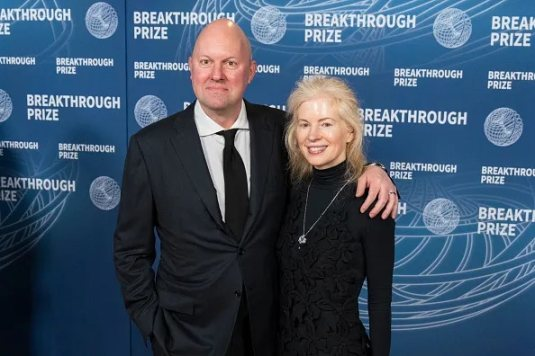
Marc Andreessen and his wife Laura Arrillaga-Andreessen, a prominent U.S. philanthropist, photographed in April. Photographer: Craig T Fruchtman/Getty Images
White House spokesperson Kush Desai stated in a written declaration that Trump and his advisors “are always open to hearing from business and technology leaders,” but “the only special interest guiding this administration’s decisions is the greatest interest of the American people; only President Trump holds veto power over government policy.”
Collin McCune likewise stated in a declaration that Trump is “the sole architect of AI policy in this administration.”
As of January, a16z managed $90 billion in assets—the largest among Silicon Valley’s pure venture capital firms. The firm recently closed the largest VC fundraise in history, raising $15 billion, and has invested billions of dollars into AI startups such as Cursor and LM Arena. These companies—as well as a16z’s stakes in major tech firms including OpenAI and Meta—stand to benefit directly from the firm’s push for lighter regulation in Washington.
The firm’s uncompromising position has made compromise on AI legislation more difficult—and at times frustrated even fellow tech-industry lobbyists who are otherwise Washington policy allies. According to insiders, while tech giants like Microsoft and Amazon have signaled willingness to compromise on federal AI standards, a16z has outright rejected proposals that would impose significant new regulatory burdens on AI development.
Jai Ramaswamy, a16z’s Chief Legal and Policy Officer, said: “The end result is that big companies begin making trade-offs.” Large enterprises can draw on legal teams and compliance budgets, whereas “a small startup run by a few people out of a garage simply lacks the capacity to make those compromises.”
Many AI skeptics argue the technology may harm users, replicate real-world biases against marginalized groups, and displace workers across industries—making regulation essential. Some AI developers even warn that unchecked AI could pose existential risks.
Last December, an attempt to insert language blocking state AI safety laws into a must-pass defense bill illustrated a16z’s influence. Just months earlier, tech-industry allies in Congress had tried—and failed—to include similar provisions in Trump’s signature tax bill, stymied by a coalition of Republican governors, MAGA influencers, and child safety advocates.
According to a senior Republican aide, when weighing options related to the defense bill, Collin McCune—the firm’s lead lobbyist—was the first outside contact the administration reached out to. McCune offered unequivocal support and acted swiftly, coordinating with White House AI lead David Sacks, House Majority Leader Steve Scalise, and Senate Commerce Committee Chairman Ted Cruz to advance the effort.
That legislative maneuver ultimately failed—but Trump soon achieved the same goal via executive action: signing an executive order prohibiting states from enacting regulations designed to mitigate AI-related harms. According to a source close to the White House, a16z also assisted in drafting the order. The directive echoes a novel legal argument promoted by a16z—that under the Constitution’s dormant Commerce Clause, states lack authority to regulate the national AI market.
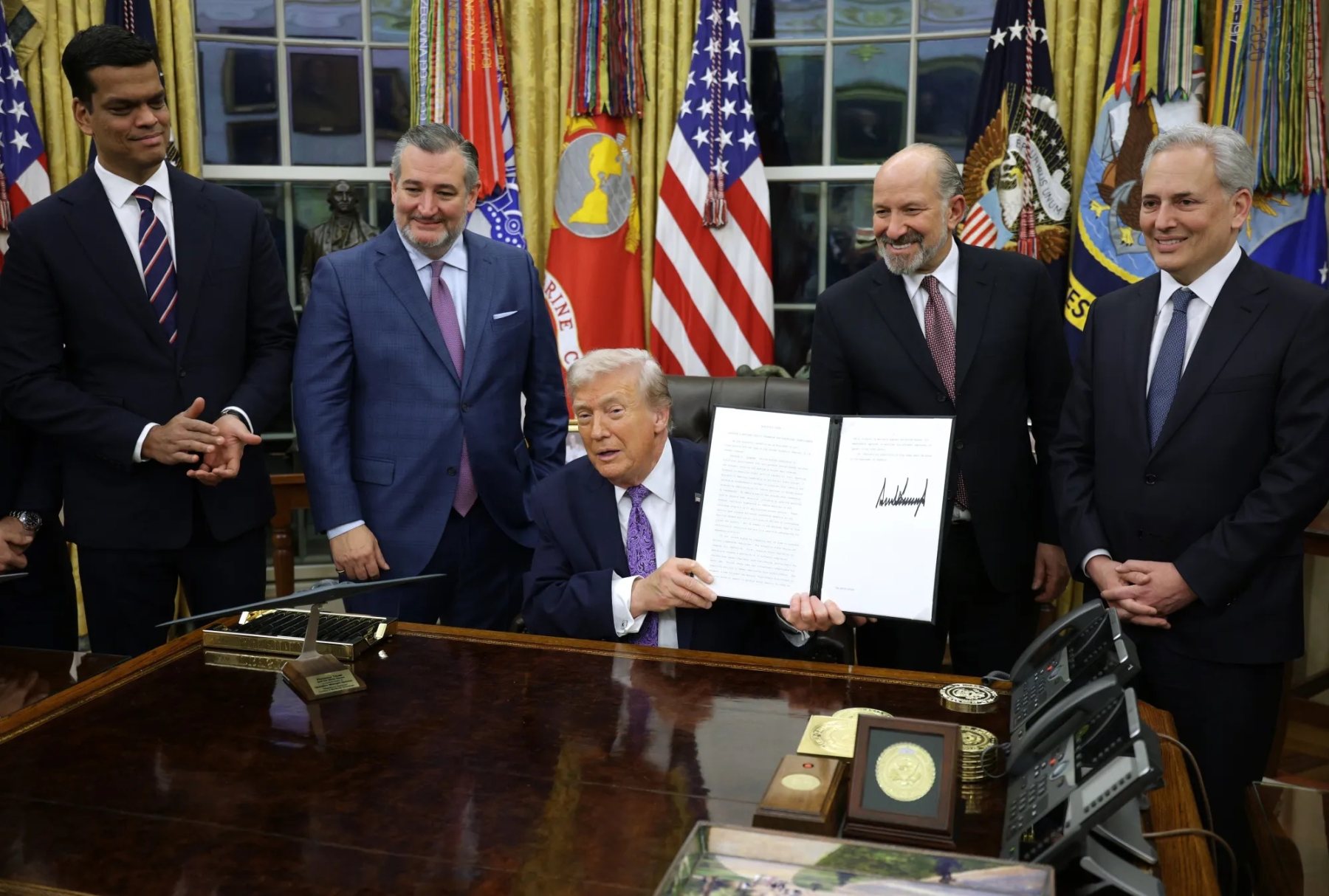
In December last year, Trump signed an executive order limiting states’ authority to regulate AI—a long-standing objective of the tech industry. Photographer: Alex Wong/Getty Images
Marc Andreessen, the firm’s outspoken co-founder, sits at the apex of this influence operation. At 54, he co-founded Netscape, helping launch the internet era. He and Ben Horowitz launched a16z shortly after the 2008 financial crisis. Standing nearly two meters tall and known for his flamboyant personality, Andreessen once joked to Fortune that his personal motto could be “frequently wrong, never in doubt.”
Andreessen was once a bipartisan donor—including contributions to Barack Obama’s first presidential campaign—but fully pivoted after the Biden administration pursued stricter tech regulation, especially around cryptocurrency and tech mergers and acquisitions. He subsequently became a top Republican donor and positioned himself as a thought leader of the “tech right.”
In 2024, after donating $2.5 million to Trump’s campaign, Andreessen met with the president multiple times for extended discussions at Mar-a-Lago. According to sources close to the White House, he frequently speaks with Trump about tech policy and maintains regular communication with White House Chief of Staff Susie Wiles.
He also deliberately cultivates relationships on Capitol Hill. In 2024, Andreessen headlined a Republican donor event hosted by House Speaker Mike Johnson in Jackson Hole, Wyoming. Since then, he has made frequent trips to Washington, gaining notoriety for hosting intimate dinners with lawmakers at popular restaurants. He enjoys philosophical conversation and hosts generously—yet rarely makes explicit policy requests.
According to an insider, during a two-hour dinner last fall with Republican Senators Eric Schmitt and Mike Lee, Andreessen spent most of the time discussing AI-related books and podcasts he found interesting.
The firm registered its lobbying operations for the first time in 2023, initially focusing on cryptocurrency legislation and defense procurement—both areas where it holds substantial tech investments.
“Traditional VCs typically assess political risk facing their investments,” said Adam Thierer, senior researcher at the center-right R Street Institute. “a16z, by contrast, proactively tackles those risks before they disrupt investments.”
Andreessen expresses no regret. “In theory, every VC and every tech company should be involved in these issues. But in reality, the vast majority aren’t,” he said on an a16z podcast in January. He and Horowitz “essentially concluded that the stakes here are just too high—if we want to be industry leaders, we must take responsibility for our own fate.”
a16z is also willing to pay the price. Public disclosures show the firm’s federal lobbying expenditures surged to $3.53 million in 2025—double its 2024 total—and far exceeding those of other VCs such as Sequoia Capital and Bessemer Venture Partners.
The firm also helped launch a new lobbying group, the American Innovators Network, which spent over $350,000 in New York State alone opposing AI safety legislation—and is targeting similar bills advancing in other states nationwide.
To build a more favorable Congress for its agenda, Andreessen and Horowitz jointly contributed $50 million to a super PAC named Leading the Future, part of a $100 million effort supporting industry-aligned candidates and opposing AI regulators. The group aims to replicate the success of Fairshake—the crypto-focused PAC backed by a16z—which spent tens of millions of dollars influencing key congressional races in 2024.
“Everyone I speak with understands there’s a $100 million ‘dragon’ sitting here, ready to breathe fire on them at any moment,” said Sunny Gandhi, Vice President of Political Affairs at AI safety group Encode.
The firm boasts additional connections across Washington. According to insiders, David Sacks regularly meets with a16z’s government affairs team. Sriram Krishnan, the White House’s Senior AI Policy Advisor, was formerly a partner at a16z. The firm’s close ties with Sacks and Krishnan, in turn, make congressional aides more inclined to engage with a16z’s lobbying team.
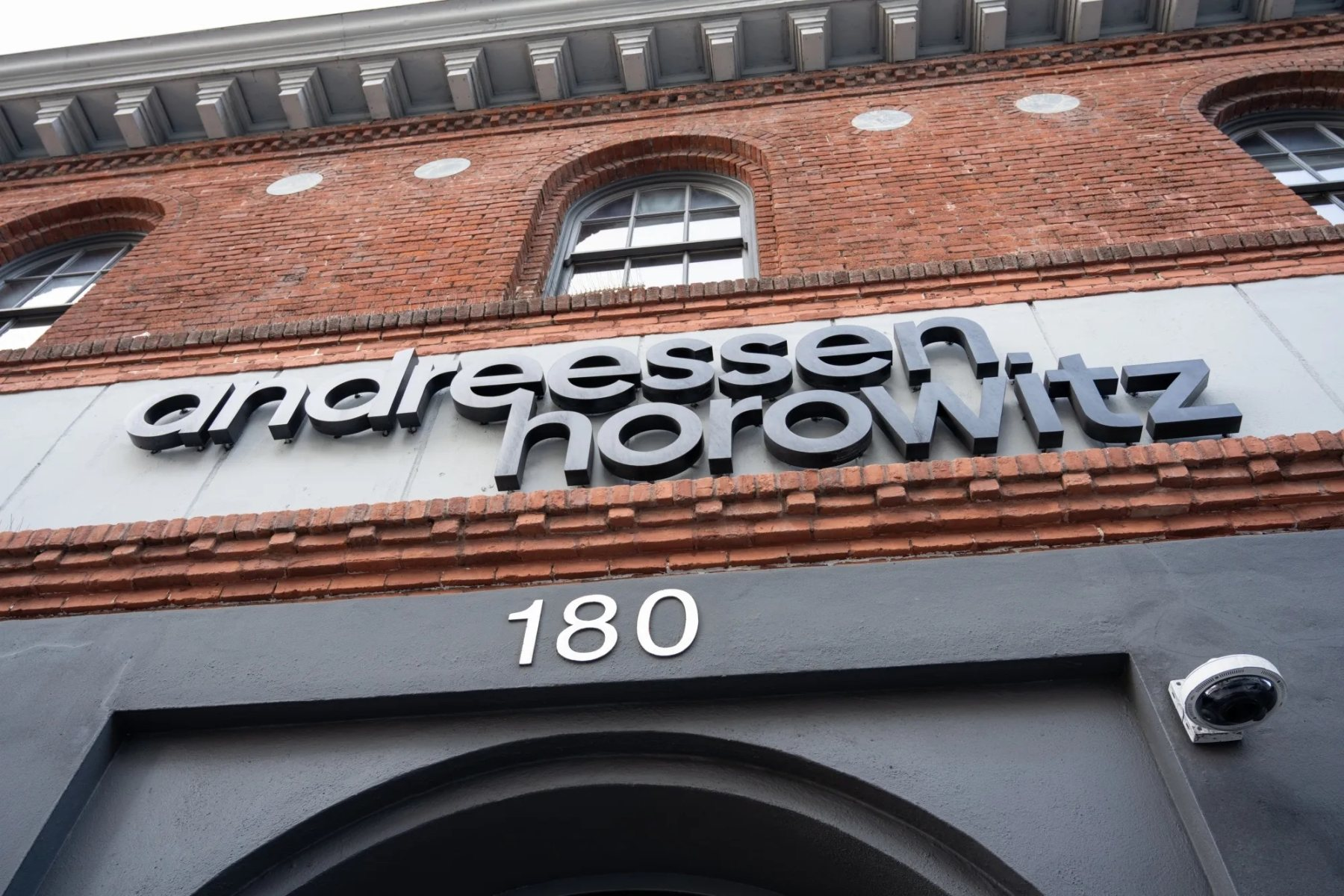
a16z’s office building in San Francisco, California. Photographer: Smith Collection/Getty Images
Yet the firm’s leadership is determined to build influence that extends beyond Trump’s term—and hedge against a Democratic return to power. According to one attendee, last spring Andreessen and a16z partner Chris Dixon accepted an invitation from moderate Democrats to host a policy forum focused on AI and cryptocurrency, attended by several Democratic House members.
“They’re trying to cultivate pro-innovation factions across both parties and across all levels of government,” said Adam Kovacevich, CEO of the Chamber of Progress—a group aligned with Democratic positions and of which a16z is a member.
Andreessen and Horowitz frame their deregulatory agenda as the “Small Tech Agenda,” positioning the VC firm as a defender of vulnerable startups. First published in 2024 amid widespread public frustration with Big Tech, the manifesto declares a16z’s mission to protect fledgling innovators. Collin McCune, the firm’s chief lobbyist, echoes this framing, stating his guiding principle is “protecting small-tech entrepreneurs so they can thrive.”
Critics dismiss the claim. “They think anyone who wants to offer some kind of protection to Americans is an idiot,” said New York State Assemblymember Alex Bores, who became a target of a16z’s lobbying after introducing AI safety legislation in his state.
The firm holds stakes in numerous large enterprises—including SpaceX, xAI, Airbnb, and Anduril Industries—whose early valuations have skyrocketed. According to PitchBook data, a16z has invested in 10 of the world’s 15 most highly valued privately held companies backed by venture capital. Its core business model hinges on betting on nascent companies poised to become the next tech giants—a strategy dependent on shielding startups from constraints that hinder rapid scaling. Another key revenue stream is large tech companies acquiring its portfolio startups.
Critics argue that these holdings in Big Tech undermine a16z’s professed commitment to “small tech.” Notably, a16z has not lobbied for using antitrust law to rein in the power of the largest tech companies.
Currently, a16z’s stance on AI policy largely aligns with that of the biggest tech firms. When Assemblymember Alex Bores was finalizing his AI safety bill in New York, he asked a16z’s policy team for guidance on defining “small,” “medium,” and “large” AI developers. Bores originally agreed that the bill’s strictest provisions should apply only to the largest firms, to safeguard startups.
a16z’s recommendation: “Small” developers should be defined as those generating less than $50 billion annually in AI product revenue.
“That basically excludes every company on Earth,” Bores said in an interview. Ultimately, after intense lobbying by a16z and other tech firms, the version of the bill signed into law by New York Governor Kathy Hochul—a Democrat—had been significantly weakened.
Now, the firm has set its sights on the next frontier: helping shape federal AI standards—a framework that could supersede state-level AI laws even after Trump leaves office. In mid-December, a16z released a federal AI legislative roadmap calling for provisions such as “model transparency”—requiring AI developers to disclose certain details about their models, including intended uses and safeguards for children using AI. Beyond that, a16z’s proposal focuses on punishing “bad actors” who misuse AI—not on regulating developers themselves.
Doug Calidas of Americans for Responsible Innovation countered that a16z’s broad proposal amounts to mere “baby steps,” lacking concrete solutions to mitigate AI threats. He added that its proposed transparency requirements only mandate disclosure of the “most basic” product information.
According to two congressional aides involved in the preparation, top Republican lawmakers have adopted a16z’s framework as a starting point for legislation. Yet federal AI legislation is evolving into a major battleground, drawing participation from numerous stakeholders—including safety organizations advocating for holding AI developers legally accountable for harms caused by their products.
“How much influence we’ll wield will be a hard-fought battle,” said Sunny Gandhi of Encode. “But they can’t just ram something through.”
Join TechFlow official community to stay tuned
Telegram:https://t.me/TechFlowDaily
X (Twitter):https://x.com/TechFlowPost
X (Twitter) EN:https://x.com/BlockFlow_News
 @Bloomberg