UAE's Cryptocurrency Strategy: Empire or Mirage?
TechFlow Selected TechFlow Selected
UAE's Cryptocurrency Strategy: Empire or Mirage?
The UAE has created the most sophisticated tax haven in the cryptocurrency space, cloaked in the legitimacy of regulation, and convinced the world to call it "digital leadership."
 Navigating Web3 tides with focused insights
Author: Thejaswini M A
Translation: Block unicorn
Introduction
Over the past five years, the United Arab Emirates (UAE) has built a compelling digital empire: processing $30 billion in cryptocurrency transactions annually, hosting over 700 blockchain companies, and attracting the world’s largest crypto exchanges to establish their headquarters in Dubai.
Empires are built on resources, and the UAE's digital empire relies on something more valuable than oil: other people's tax obligations.
Changpeng Zhao, founder of Binance with a net worth of $33 billion, resides in Dubai.
So do the executives of dozens of other major cryptocurrency firms, who have found a significant advantage in operating multibillion-dollar digital asset businesses in the UAE: they get to keep more of their wealth.
The UAE’s digital transformation story is a textbook case of economic strategy.
While other countries were still debating cryptocurrency regulation, the UAE began building infrastructure.
While competitors imposed restrictions, Dubai offered clear rules.
When traditional powers hesitated, Abu Dhabi invested billions of dollars.
Beneath the narrative of innovation lies a simpler truth: the UAE has created the most sophisticated tax haven in the crypto space, wrapped it in the legitimacy of regulation, and convinced the world to call it "digital leadership."
What does this mean for the future of global finance?
A Grand Entrance
Imagine: in 2020, most governments were still arguing whether cryptocurrency was a scam.
The UAE looked at its oil reserves, then looked at Bitcoin, and thought: “Why not both?”
Fast forward to 2025, and the UAE has executed the most successful national cryptocurrency strategy in history.
It has transformed from an oil-dependent economy into a powerhouse of digital assets.
-
As of 2024, 30% of the population holds cryptocurrency
-
Annual crypto transaction volume exceeds $30 billion
-
More than 700 blockchain companies in Dubai alone
-
Ranked among the top 40 globally by on-chain transaction value
-
Third-largest crypto economy in the Middle East and North Africa region
This isn’t just retail market enthusiasm.
The UAE’s sovereign wealth funds have collectively invested billions of dollars.
-
Mubadala: $408.5 million invested in Bitcoin ETFs
-
MGX Fund: $2 billion invested in Binance (using Trump’s stablecoin—because 2025 is a bit strange)
-
A $30 billion AI infrastructure fund established in partnership with Blackstone and Microsoft
When your government buys Bitcoin ETFs and your sovereign wealth fund makes massive investments in the world’s largest crypto exchange, you know fundamental change is underway.
Let’s Break It Down
Regulatory Innovation: In March 2022, Dubai launched the Virtual Assets Regulatory Authority (VARA)—the world’s first independent regulator specifically designed for virtual assets.
Not a committee, not a working group, not a bunch of suited officials learning as they go—but a real, empowered, dedicated crypto regulator.
VARA’s achievements in just three years:
-
Issued licenses to global giants like Binance, Bybit, OKX, Crypto.com, and Bitpanda
-
Created an activity-based regulatory framework (not one-size-fits-all rules)
-
Established clear guidelines for everything from staking to tokenization
-
Set compliance deadlines that companies actually follow (e.g., deadline for updated rules: June 19, 2025)
In parallel, Abu Dhabi created its own complementary framework through the Abu Dhabi Global Market (ADGM), focusing on institutional-grade digital assets.
The result? A dual-emirate model covering both retail and institutional markets.
Infrastructure Investment: The UAE didn’t just change regulations—they built physical infrastructure too:
-
Dubai AI and Web3 Campus: a physical ecosystem for blockchain innovation
-
Sigma Capital launched a $100 million blockchain startup fund
-
The campus hosts 977 blockchain companies, according to Tracxn
-
Largest AI campus outside the U.S. (located in Abu Dhabi)
Banking Integration: Zand Bank became the first digital-only bank to receive a VARA custodial license and now serves nearly all VARA-licensed virtual asset service providers.
They’re the bridge between traditional banking and digital assets.
Meanwhile, the central bank approved Coin AE—the first UAE dirham-backed stablecoin—proving serious national-level commitment to digital currencies.
Real-World Applications
Real Estate Tokenization: Dubai has just launched the first licensed real estate tokenization project in the Middle East and North Africa. For just 2,000 dirhams ($545), anyone can buy partial ownership in Dubai property. The Dubai Land Department even launched a program to tokenize RWA for real estate registration.
Government Crypto Payments: Dubai announced a partnership with Crypto.com to accept cryptocurrency payments for government services. Parking fees, utility bills, license renewals—all payable in crypto and automatically converted to dirhams.
Cross-Border Payments: In May 2025, Ripple launched cross-border blockchain payment services in the UAE through partnerships with Zand Bank and Mamo.
AI Integration: Abu Dhabi’s Bold Technologies recently announced a $2.5 billion AI-powered smart city platform called Aion Sentia Cognitive City.
The Math of Escape
The UAE’s appeal begins with a mathematical principle impossible to ignore.
No capital gains tax for corporations. No personal income tax on crypto gains. A flat 9% corporate tax for businesses earning over $102,000 annually. Crypto trading completely exempt from VAT.

By contrast, in the U.S., crypto gains face up to 37% capital gains tax, corporations pay 21% federal tax plus state taxes, and regulatory uncertainty adds millions in compliance costs annually for large exchanges.
For example, if Coinbase moved to Dubai tomorrow, based on its $1.3 billion net income in 2024, it could theoretically save over $250 million annually—just in taxes.
But this math only works if you can actually operate in Dubai.
This is where the UAE’s regulatory approach becomes relevant—not because it’s especially innovative, but because it provides legal certainty lacking in other jurisdictions.
Dubai’s Virtual Assets Regulatory Authority (VARA) has already licensed Binance, Bybit, OKX, Crypto.com, and Bitpanda. These companies can legally operate under clear rules—a rare occurrence in the crypto industry.
Regulatory Arbitrage
VARA represents a different approach to crypto regulation: collaboration instead of confrontation. Rather than treating crypto firms as potential criminals, VARA works with them to build compliant frameworks.
This stands in stark contrast to the U.S., where regulators often communicate through enforcement actions rather than guidance. The SEC has spent years litigating whether certain crypto assets qualify as securities, while VARA simply defines categories and licensing requirements.
The practical outcome? Major crypto firms gain legal certainty in Dubai while their competitors navigate regulatory uncertainty in larger markets.
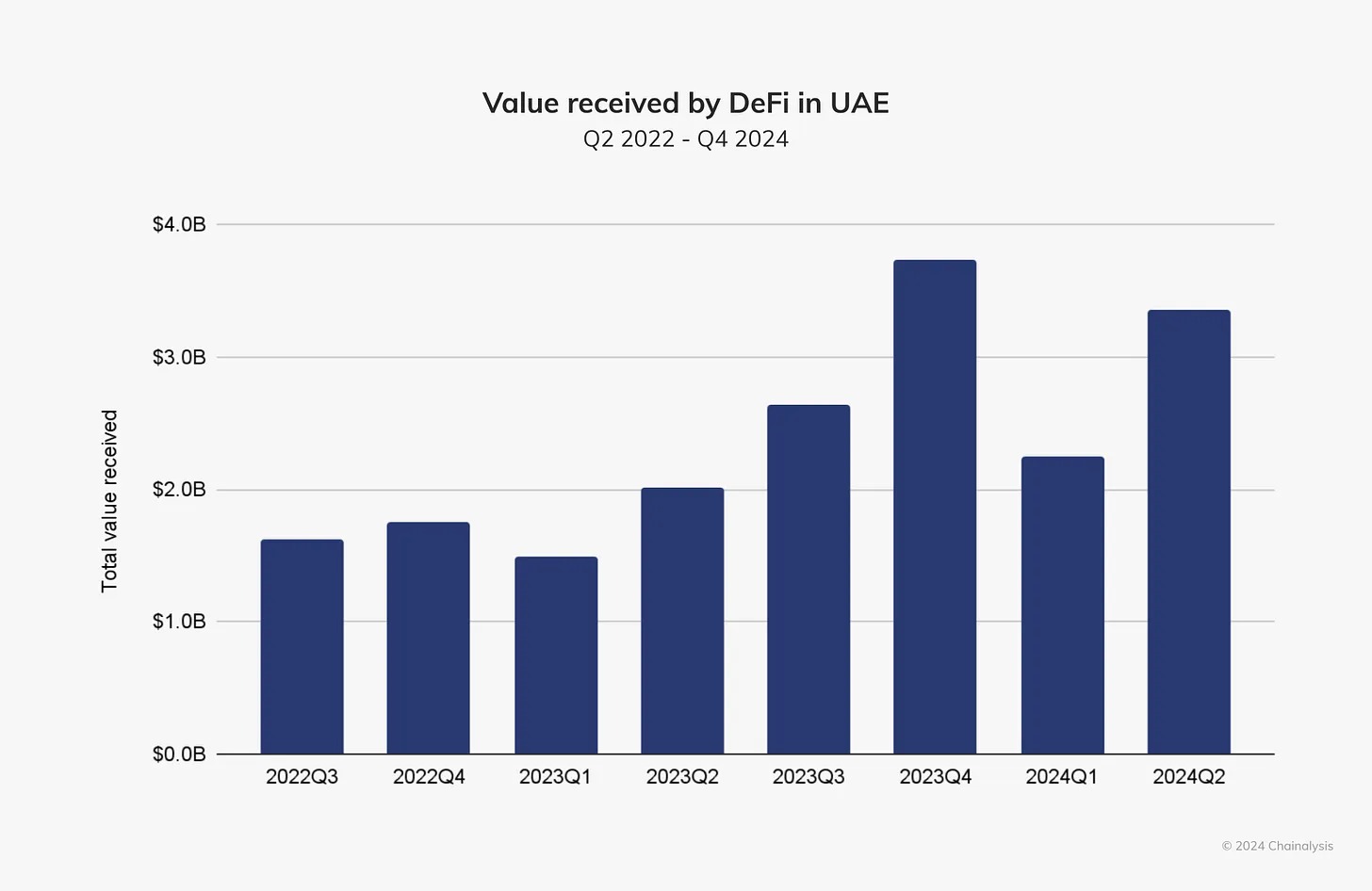
As of 2024, Dubai hosts over 700 blockchain companies. The UAE ranks third in the MENA region for crypto transaction volume, with DeFi activity growing 74% year-on-year.
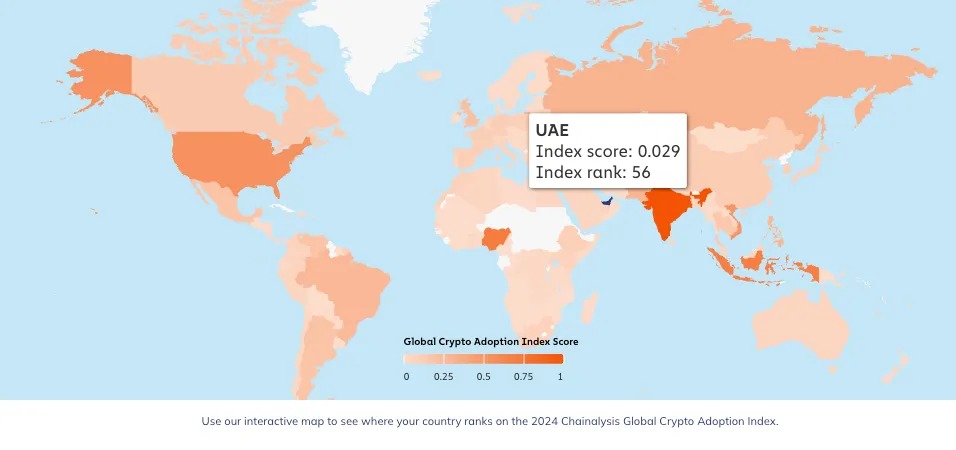
However, according to Chainalysis’ 2024 report, the UAE ranks only 56th globally in cryptocurrency adoption, compared to the U.S. at number 4.
The U.S. processes $1.3 trillion in annual crypto transactions—over 40 times the volume of the UAE.
U.S. companies dominate crypto development: 19% of global crypto developers are based in the U.S., while the UAE’s share is negligible.
Wealth concentration tells a similar story.
The combined wealth of the world’s 17 crypto billionaires totals $93 billion, most of whom are based in the U.S., including Chris Larsen (Ripple), Brian Armstrong (Coinbase), and Michael Saylor (MicroStrategy).
The UAE’s contribution comes largely from Changpeng Zhao.
Has the UAE built impressive infrastructure for crypto businesses—but left core innovation elsewhere?
The Stablecoin Sovereignty Experiment
The UAE’s stablecoin strategy reveals both opportunities and contradictions in its approach. The Central Bank of the UAE approved Coin AE, the first stablecoin backed by the UAE dirham (AED), creating a bridge between the national currency and the global crypto market.
More controversially, Abu Dhabi’s MGX fund used Donald Trump’s USD1 stablecoin for its $2 billion investment in Binance. This choice highlights the UAE’s strategy: maintaining neutrality by partnering with those in power.
This pragmatic move raises questions about the UAE’s long-term positioning. Building financial infrastructure around politically linked assets may yield short-term advantages but could create long-term dependencies.
The UAE’s so-called dominance in crypto stems largely from successfully hosting industry events. Dubai’s Token2049, numerous blockchain summits, and regular crypto conferences create the impression of vibrant local activity.
These events attract global participants and generate positive press, but don’t necessarily reflect underlying economic activity.
The UAE has become highly skilled at crypto marketing—but this shouldn’t be confused with actual crypto development.
Our Take
The UAE’s success in crypto is fundamentally about arbitrage—regulatory, tax, and geographic. They identified inefficiencies in how other nations handle digital assets and built systems to capture the resulting opportunities. But this approach has limits. As markets mature and inefficiencies are corrected, arbitrage opportunities will eventually vanish.
The UAE’s advantage depends on other countries maintaining suboptimal policies—an assumption unlikely to hold forever. What happens when tax advantages disappear, or other jurisdictions match Dubai’s regulatory clarity?
The model heavily relies on attracting foreign companies and talent rather than cultivating domestic capabilities. If global tax coordination efforts succeed, or major economies like the U.S. achieve regulatory clarity, the UAE’s competitive edge could rapidly erode.
That said, 25 years of political stability carries undeniable weight in the broader geopolitical landscape.
The UAE has also demonstrated something valuable: how quickly a jurisdiction can adapt to new technology when it chooses decisive action. While others spent years debating crypto policy, the UAE simply implemented frameworks and learned through experience.
They’ve built real infrastructure and expertise, offering some protection against these risks. VARA’s regulatory framework, the concentration of crypto firms, and a growing developer community create network effects beyond mere tax benefits.
The regulatory clarity and tax advantages driving UAE’s crypto growth aren’t sustainably permanent. Eventually, major economies will offer similar benefits to retain their own crypto firms. When that happens, the UAE will need to compete on innovation and infrastructure—not arbitrage.
The true test of the UAE’s crypto strategy isn’t whether it can attract companies fleeing unfavorable regulations, but whether it can retain them once those disadvantages disappear.
For now, mass migrations continue. Crypto executives are packing their bags for Dubai, drawn by clear rules and favorable taxes.
Whether they’re building the future of finance—or merely optimizing their tax bills—depends largely on what they do after they arrive.
Join TechFlow official community to stay tuned
Telegram:https://t.me/TechFlowDaily
X (Twitter):https://x.com/TechFlowPost
X (Twitter) EN:https://x.com/BlockFlow_News