

Virtuals Playbook for Project Teams: Raising a $2M–$20M Seed Round from the Community
TechFlow Selected TechFlow Selected
Virtuals Playbook for Project Teams: Raising a $2M–$20M Seed Round from the Community
If your product has PMF or even revenue, Virtuals is an excellent way to raise funds.
 Navigating Web3 tides with focused insights
Author: starzq.eth
There's already plenty of content introducing Virtuals from a retail investor's perspective, but very little from the project builder or developer standpoint. At its core, Virtuals is about asset issuance, so onboarding high-quality developers is key to maintaining competitiveness.
Thanks to the invitation from Felix, head of the Chinese-speaking region at Virtuals, I'll be joining as a Virtuals Partner to help identify and support promising projects. This article aims to clearly explain what Virtuals means for project teams and share practical playbooks—so more builders can understand Virtuals’ advantages and unique value proposition. Feel free to comment and discuss below.
If you think this model fits your project, please DM me. As a Virtuals Partner, I'm happy to advise and support strong dev teams in building compelling products and contributing to a healthy ecosystem.
I also believe this is currently the best fundraising and launch method for small product-driven teams—and project teams are still in a favorable window of opportunity.
AI has reduced startup labor costs, but not fundraising costs
AI has transformed how startups operate by drastically lowering the cost of coding and content creation, enabling small teams—or even solo founders—to build companies worth tens or hundreds of millions of dollars with annual recurring revenue (ARR) in the millions. For example, Arcads AI, an AI-powered video ad generator built by a 6-person team, has achieved $5 million in ARR. Another example is super-solo founder @levelsio, who built seven products generating $3.3 million in combined ARR.
However, AI hasn’t changed how startups raise funds. Founders still spend massive amounts of time pitching to VCs. Based on my own experience and that of peers in the industry, fundraising often becomes a full-time job—pitching takes months, and follow-ups through due diligence, legal reviews, contract signing, and disbursement take several more months. Then it’s time to start preparing for the next round. With increasing shareholders, managing investor relations also demands additional effort.
In the AI era, if someone with basic technical skills identifies a niche user pain point, they can quickly build a product, acquire users, and generate revenue. Often, these teams consist of just two people—one handling product and tech, the other marketing. If one person then goes full-time on fundraising, half the team’s capacity is diverted away from product development, which is highly inefficient.
Besides, not everyone is skilled at fundraising, and today’s VCs are especially cautious, rarely writing checks without extensive validation.
Some small teams choose not to fundraise at all, instead bootstrapping with personal savings. Occasionally, luck strikes—a first or second product hits product-market fit (PMF) and starts generating cash flow. But let’s be honest: this is extremely rare. Statistics show that 90% of such ventures fail within three years.
A major reason is psychological strain. Founders bear full financial risk, often surviving six to twelve months without income, which creates immense pressure—negatively impacting product iteration and overall success.
Is there a better way?
Virtuals Genesis Launch aims to offer exactly that: a path for teams to raise a seed round of $2–20 million from the community based on a product—or even just an idea—while aligning incentives between builders and users. Teams lock up tokens for 1–6 months tied to milestones, while users patiently hold, benefiting from long-term project growth.
Introducing Virtuals Genesis Launch
Raising funds from communities isn't new—it was the essence of the "creator economy" in the last cycle. In 2021, *Ethereum: The Infinite Garden* raised 1,035.96 ETH, nearly $5 million at peak prices, helping propel Mirror into the spotlight.
But the problem with such models is lack of accountability. While funding appears transparent, retail investors have no control over whether the team actually builds or simply spends it on yachts and influencers. Last cycle saw projects raising money to buy land or sports teams—most of which disappeared, leading to the decline of such models.
Virtuals designed a system to solve these issues—and incidentally provides go-to-market (GTM) support:
-
Through Genesis Launch, a team issues 1 billion tokens, valued at 224k (112k $Virtual), raising 42k $Virtual. 37.5% of tokens go to users, 12.5% to liquidity, and 50% to the team;
-
The 42k $Virtual raised from users doesn’t go directly to the team but into a liquidity pool, preventing immediate rug pulls;
-
Successfully launched projects typically open trading above $4M FDV, with records like Solace launching at $50M and settling around $36M. This means teams effectively raise a $2–20 million seed round upon launch;
-
To prevent teams from dumping or running insider accounts (“rat warehouses”), Virtuals partners with @tokentable to ensure clear token allocation and vesting schedules. Short lockups, fast vesting, or unclear distributions trigger community scrutiny;
-
To reduce early selling and price dumps, Genesis Launch uses a core mechanism: Points;
-
Users must accumulate Points before participating in a launch. The number of Points determines how much $Virtual they can contribute. If users sell immediately after launch (“paper hands”), they enter a cooldown period—unable to earn new Points for 10 days—risking missing future high-potential launches. Early on, most users don’t have many Points, so even hitting a 100x project may only yield ~$1,000 profit, reducing incentive to exit early. Additionally, staking earns Points, further discouraging dumping;
-
Since Genesis Launch involves very early-stage projects, token value grows as the project develops. For instance, @basisos launched at $1M FDV and peaked at $38M—selling early would miss out on 38x gains;
-
Early participants have been involved since last year and mostly profited, making them eager to engage in this PVE (player vs environment) game, helping bootstrap the entire system;
-
Additionally, no single address can purchase more than 0.5% of the tokens, reducing concentration risks and large-holder dumps;
-
The entire system creates a three-way dynamic between platform, project, and users. For Virtuals, continuously onboarding quality projects and supporting their growth ensures users keep earning, spending Points, and using $Virtual—creating a positive flywheel;
-
Project teams might wonder: if tokens are locked for at least one month, how do we cover daily expenses? Virtuals has another clever mechanism: 0.7% of daily trading volume (70% of the 1% fee) goes directly to the project team. Current projects see daily volumes between $20k–$2M, meaning $140–$10,500 per day, or $4,200–$315,000 monthly—enough to sustain a 2–3 person team at the lower end, and substantial at the higher end. This is something traditional VC funding cannot provide;
-
Another advantage over traditional VC: once in Genesis Launch, “angel investors” within the community conduct deep research and actively share insights on Twitter and in forums—providing organic marketing and GTM. Before Solace launched, I personally saw over ten threads discussing it. Partly because Yap rewards contributors with Virtuals Points, but also because Points are valuable—everyone wants to know which projects have real potential. Strong projects get massive organic exposure; I’ve posted multiple times, reaching hundreds of thousands. Conversely, questionable designs or shady histories are quickly uncovered by community DD.
For top-tier projects, Virtuals offers additional support:
-
Upon successful launch, the official team spends another 42k $Virtual buying project tokens. This increases snipe costs (pushing FDV above $10M post-buy), and the acquired tokens are airdropped to $Virtual stakers, boosting engagement;
-
Official marketing support: featured tweets from the main account, research threads from @Virgen_Alpha, Online Pitch Spaces. These Spaces allow teams deeper visibility and significant momentum. Launched projects are invited back to update progress. A fun example: during a recent Space, Holly’s project update was treated as alpha by the community, driving a 70% price surge live on stream;
-
Virtuals operates its own ecosystem fund, Virtuals Venture, investing in standout projects and facilitating OTC deals—addressing funding needs beyond the initial launch;
-
Virtuals Partner Network (VPN)—I’m part of it—comprising investors, domain experts, academics, and researchers providing holistic support to teams;
-
Opportunity to join the ACP protocol;
-
Various resource matchmaking opportunities.
In short: early-stage teams only need to focus on product and tech—the rest, including fundraising and marketing, is handled by Virtuals.
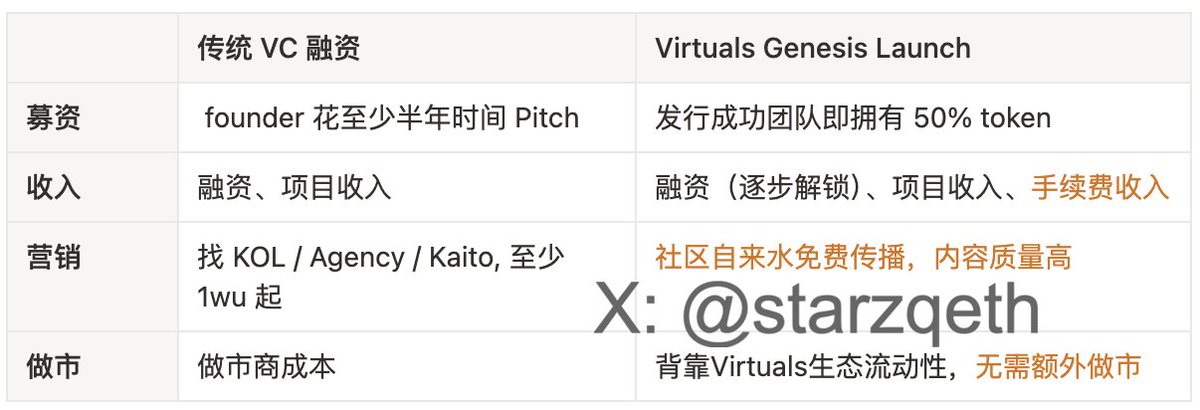
Clearly, Virtuals Genesis Launch is ideal for small product-tech teams lacking bandwidth or expertise to pitch VCs. Communicating directly with the community via product is the simplest route—especially now when VCs are hesitant to invest.
Of course, if you're a well-known founder with easy access to capital, you have more options.
Virtuals Genesis Launch grows organically from the community, whereas traditional VC fundraising is top-down and aggressive.
Examples of community research and marketing
Daily ecosystem reports are published in both Chinese and English communities covering various projects.
https://x.com/ZaggyGoKrazy/status/1930294077469405671
https://x.com/gkisokay/status/1930557747201974699
Project research and ratings:
https://x.com/starzqeth/status/1922460334289518725
https://x.com/bigwil2k3/status/1930785772103418053
https://x.com/kaylyn_0x/status/1930141738049687856
Inviting projects to Spaces (organized spontaneously in Chinese community; for Vader’s English Space, teams must airdrop 1% of tokens to $Vader holders):
https://x.com/ZaggyGoKrazy/status/1927696366148759798
Comparison: Virtuals Genesis Launch vs Pump.fun / DAOS.fun / Believe
Builders may ask: why not use platforms like Pump.fun, DAOS.fun, or Believe? They offer lower launch costs.
The biggest trade-off is that low launch barriers make long-term user support difficult. On those platforms, users dump quickly, destabilizing projects. Without lockup requirements, teams can also exit anytime—leading to prisoner’s dilemma dynamics where neither side trusts the other.
Pump.fun has long struggled with anti-sniping (some argue it's intentional), making it hard for teams to secure their own raised funds. No cap on individual holdings enables whale accumulation. DAOS.fun’s whitelist system is controversial and limits fair participation.
Among these, Believe is likely Virtuals’ strongest competitor: low entry barrier, returns 1% of fees to teams as revenue, and embraces the “internet capital markets” narrative aiming to become a full-fledged fundraising platform. However, due to low thresholds and no team lockups, most projects remain memes, with few achieving sustained community backing.
After comparing all these, one must acknowledge: Virtuals Genesis Launch is thoughtfully designed and execution-focused.
Moreover, the Virtuals team has survived two crashes with over 90% drawdowns and rebuilt each time—proving resilience and relentless iteration. Building alongside such a team multiplies impact.
Playbook: What kind of projects succeed on Virtuals Genesis Launch, and how to operate?
In my view, the ideal candidates for Virtuals Genesis Launch are small product-tech teams of five or fewer, capable of sustaining operations purely from trading fees, then scaling via PMF and smart token design. Prime examples include @niyoko_agent, @solacelaunch, and @BasisOS.
Some VC-backed projects have experimented by launching sub-tokens (e.g., @SamIsMoving, @Bizzy_agent), though they’ll later need to manage relationships with parent tokens.
Operating successfully on Virtuals Genesis Launch hinges on one principle: **Trust**
-
Product Trust: clear product definition, roadmap, and ideally a launched product with proven PMF;
-
Tokenomics Trust: lockups, transparent distribution, and vesting;
-
Community Trust: consistent and open communication;
-
Team Trust: doxxed (public identity) team members;
-
Official Endorsement: recognition from Virtuals Hackathon, support from Virtuals Venture, official retweets, or token purchases for airdrops.
I believe a solid project should meet at least the first three criteria. To achieve strong results, four or all five should be fulfilled.
Take @niyoko_agent, @solacelaunch, and @BasisOS as examples:
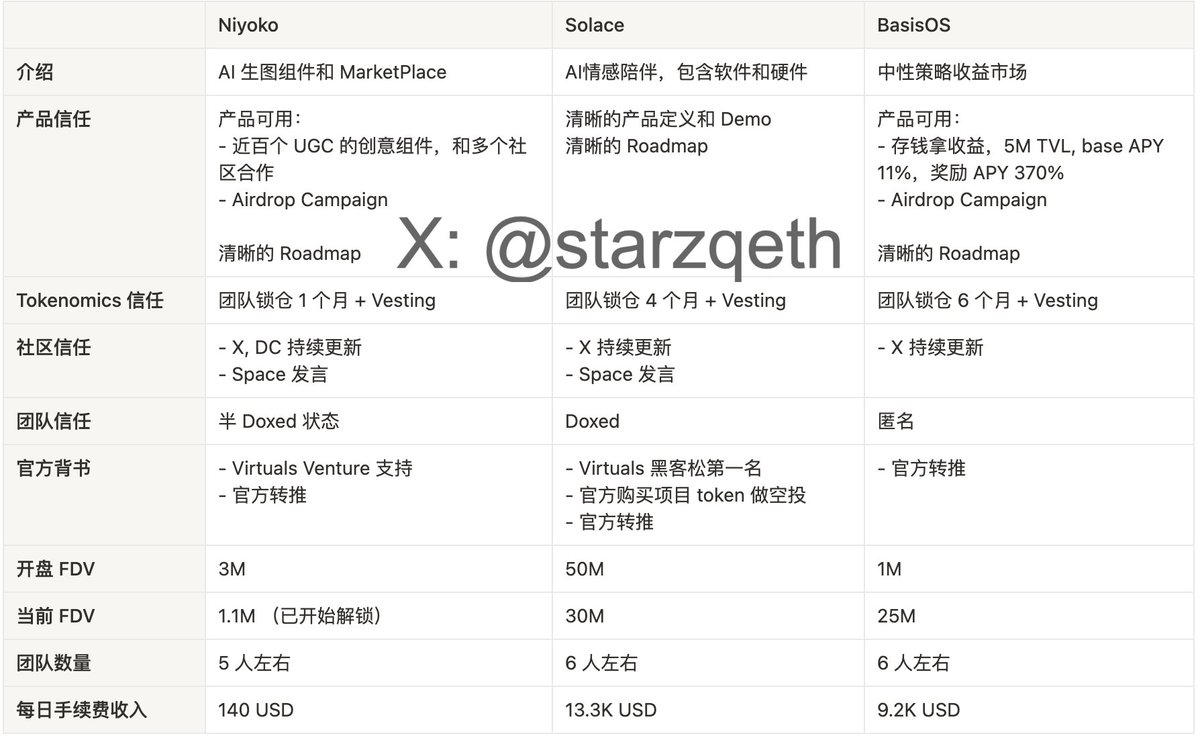
We observe:
-
Niyoko meets nearly all five criteria. After unlocking, FDV remained relatively stable, and according to official data, staking rate increased slightly from 20% to 22%;
-
Solace fulfills all five, and as winner of the Virtuals Hackathon, received maximum official backing. Their challenge: delivering a PMF product before team tokens unlock. Initially, lockup was too short, but they quickly adjusted to 4 months based on community feedback;
-
BasisOS, despite being anonymous, stands out due to high product utility and attractive yields. Its FDV surged from $1M at launch to $35M peak, currently holding at $25M—the highest post-launch appreciation among Virtuals projects;
-
All three generate sufficient daily fee revenue to fully fund operations—Solace and BasisOS even enjoy very comfortable margins.
This reinforces my earlier point: on Virtuals, usable products and the trust built around them are paramount. Grand visions work for VC pitches, but not here.
Also, projects don’t need to run exclusively on Base. For example, BasisOS deposits on Arbitrum, runs neutral arbitrage on Hyperliquid, and uses $BIOS primarily as liquidity and mindshare incentive—as long as the core logic holds, cross-chain operation works fine.
Welcome aboard
Over the past month, Virtuals has shown impressive metrics. Dozens of projects have raised $2–20 million seed rounds—simply by having a product. More users are joining the ecosystem every day, creating a powerful positive feedback loop.
I believe this model isn’t limited to crypto-native teams—it’s equally viable for Web2 startups. If you have a product with PMF or even existing revenue, Virtuals offers an excellent fundraising avenue to accelerate growth.
(If you agree, feel free to forward this to your Web2 friends!)
Now is also a golden window for Virtuals—projects with solid fundamentals are likely to receive official support, and users actively seek strong projects to back. Joining now offers amplified results.
Finally, I warmly welcome talented devs and builders to join. As mentioned, I’m excited to serve as a Virtuals Partner advising and supporting high-potential teams (though I’ll keep it selective due to limited bandwidth). Support includes product strategy, content, marketing, tokenomics, and more.
I've led AI products with over 100M DAU and raised tens of millions in venture funding—so I deeply understand the pain points discussed. If I were to do it again, I’d choose Virtuals over spending six months meeting investors, pitching slides, and sharing metrics. That shouldn’t be the norm in the AI era.
If you’re already building or about to start, please
fill out this form to streamline our conversation. If you’re not yet building but interested in this model, leave a comment below or DM me.
This week I joked with a friend that I hope to discover a sub-two-person team building a billion-dollar project. Could it be you?
Join TechFlow official community to stay tuned
Telegram:https://t.me/TechFlowDaily
X (Twitter):https://x.com/TechFlowPost
X (Twitter) EN:https://x.com/BlockFlow_News
 @starzqeth















