DeFi on Bitcoin: Finally Getting Interesting?
TechFlow Selected TechFlow Selected
DeFi on Bitcoin: Finally Getting Interesting?
Institutional investors are flocking to Bitcoin, drawn by its returns.
 Navigating Web3 tides with focused insights
Author: Chilla
Translator: Block unicorn
Introduction
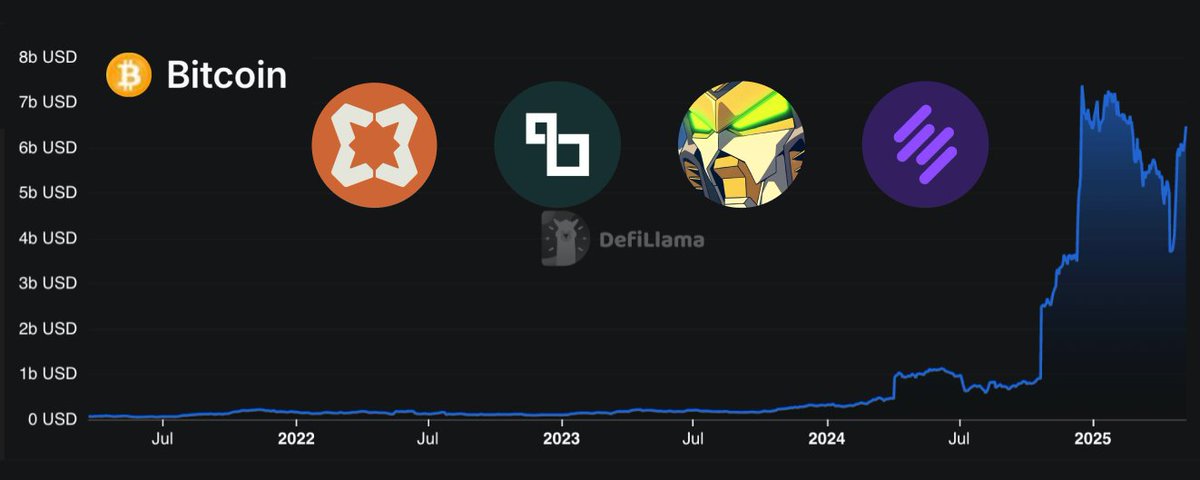
Decentralized finance (DeFi) on Bitcoin is no longer just theoretical. Despite some setbacks, momentum around unlocking Bitcoin's potential beyond digital gold is growing.
But let's be honest: nobody really cared—until recently, and understandably so, because things were messy.
While Ethereum built a massive DeFi economy, Bitcoin stayed on the sidelines, with over $1.5 trillion in liquidity locked in cold wallets. The lack of DeFi smart contracts, decentralized wrapping/bridging (wBTC), and Bitcoin’s identity as digital gold limited ecosystem development around this orange coin. But that’s changing.
With a wave of new protocols launching on and around Bitcoin, we’re seeing the foundation of a real native BTC DeFi stack. Projects like Babylon, Lombard, SatLayer, and Solv Protocol are leading the way in technology and total value locked (TVL), each solving different parts of the DeFi Lego set.
Babylon: Bitcoin’s Staking Layer
Babylon can be thought of as Bitcoin’s version of Ethereum’s Beacon Chain—but built specifically for Bitcoin. It’s a native Bitcoin staking protocol with over $5 billion in TVL, pioneering its category.
What makes Babylon special is that it allows users to stake BTC directly on the Bitcoin mainnet without bridging or wrapping. The coins remain on-chain, stored in a non-custodial manner.
But Babylon isn’t just about staking for staking’s sake. Its key innovation is extending Bitcoin’s security to other blockchains—whether EVM chains, rollups, or app chains.
Bitcoin holders can now help secure networks by locking up their coins and earn rewards from the chains they protect.
Lombard: Liquid Staking for Bitcoin
It’s Bitcoin’s Lido. Babylon handles staking; Lombard makes it composable.
Thus, Lombard, with $1.9 billion in Bitcoin-related TVL, is built atop Babylon. It enables users to stake BTC via Babylon and receive LBTC, a liquid staking token representing their staked position.
In fact, as previously mentioned, BTC staked through Babylon remains locked on the BTC network. Without validating consensus on other networks, these assets are essentially “useless”—they can’t be used in DeFi. That’s where Lombard comes in. Now, users can obtain liquid staked BTC (LBTC) and begin trading, lending, yield farming, and more.
Lombard earns yield by delegating BTC to Babylon validators, who in turn secure external networks and earn rewards, as explained earlier. These rewards are shared with LBTC holders. Simply put, the more chains Babylon secures, the higher the yield for stakers.
Lombard is active across multiple ecosystems including Sonic, Sui, and Base, and collaborates with protocols like Aave, Pendle, Ether.Fi, and Corn, showcasing its composability. It also played a key role in Boyco Berachain’s liquidity campaign, helping bootstrap early TVL.
SatLayer: Bitcoin’s EigenLayer
As the title suggests, SatLayer can be imagined as an EigenLayer built on top of Babylon.
Though it has the smallest TVL on the list at just $340 million, it introduces a novel restaking model. While Babylon locks BTC to secure external networks at the consensus layer, SatLayer allows users to restake LBTC to secure application layers.
This opens the door to yield markets directly from protected applications—for example, an oracle paying restakers to ensure data integrity, a rollup paying restakers to guarantee transaction validity, or a bridge paying to avoid slashing or fraud.
SatLayer supports restaking on both EVM and Sui networks.
Do You See the Full Picture Now?
-
Babylon acts as the base layer, providing consensus-level security;
-
Lombard provides liquid staking, unlocking otherwise idle Babylon-staked BTC;
-
SatLayer enables restaking, delivering economic security to the application layer.
Does the resemblance to Ethereum, Lido, and EigenLayer start to become clear?
That said, it’s important to note that Lombard and SatLayer currently depend on Babylon, but not vice versa.
SatLayer doesn’t necessarily rely on Lombard, though due to its decentralized nature, Lombard is currently its only utilized solution.
Solv Protocol: BTC Reserves and DeFi Vaults
Solv Protocol, with $524.27 million in TVL within the BTC ecosystem, takes a different approach.
Like Lombard, it offers liquid staking for BTC but does not rely on Babylon, instead focusing on building its own Bitcoin reserve strategy and other DeFi products.
In practice, the SolvBTC token is a liquid representation of its BTC reserve strategy. Users deposit wrapped versions of BTC, which Solv then largely converts into native BTC via institutional channels and stores through centralized custody.
While Solv does not depend on Babylon, it benefits from Babylon-linked assets like LBTC. In turn, thanks to its DeFi vaults, it offers greater composability.
Conclusion
DeFi on Bitcoin is no longer a pipe dream. With new protocols emerging and liquidity rising, we may be witnessing the dawn of a new era of decentralized yield on Bitcoin.
This is no longer just about wrapping BTC onto Ethereum—it’s about unlocking native BTC DeFi.
With more projects like Botanix launching EVM-compatible Bitcoin blockchains, the composability and potential value of these layers could soar. Billions of idle BTC may soon become active collateral, helping validate networks, secure applications, and earn real yield.
Join TechFlow official community to stay tuned
Telegram:https://t.me/TechFlowDaily
X (Twitter):https://x.com/TechFlowPost
X (Twitter) EN:https://x.com/BlockFlow_News
 @chilla_ct