Why does finance lead every production transformation?
TechFlow Selected TechFlow Selected
Why does finance lead every production transformation?
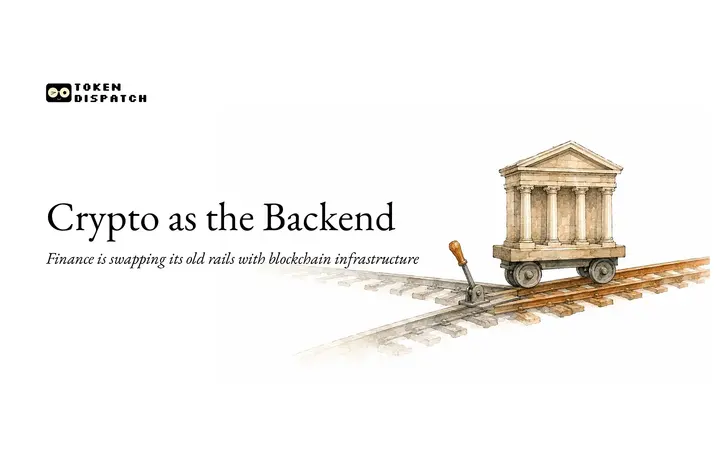
Finance plays an irreplaceable and critical role in the fourth industrial revolution, represented by blockchain, across multiple dimensions including transaction settlement, value transfer, innovation stimulation, transformation of production relationships, and industrial upgrading.
 Navigating Web3 tides with focused insights
Authors: far, Centreless
When discussing the significance and value of finance in the context of the Fourth Industrial Revolution represented by blockchain, what exactly does an industrial revolution entail? Historically, each industrial revolution has profoundly reshaped methods of production, economic models, and even social structures. The Fourth Industrial Revolution, ushered in by the convergence of emerging technologies such as information technology and blockchain, opens a new chapter. The role of finance in this process warrants deep analysis.
Why do traditional financial transaction settlements get bogged down in cumbersome processes and long cycles? This is because they rely on numerous intermediaries; from transaction confirmation to fund clearing, multiple institutions conduct layered reviews. In contrast, consider blockchain's distributed ledger technology, which operates on decentralization, allowing every participating node to hold a complete copy of the ledger. Imagine a cross-border payment scenario: under traditional models, funds must pass through several correspondent banks, with each step consuming time for verification and processing. With blockchain, transacting parties connect directly, and information is synchronously recorded across all nodes. It’s like replacing a multi-stop delivery route with direct shipping from sender to recipient—significantly reducing time and cost. Thus, we can clearly see that blockchain builds an efficient bridge for global economic exchange, establishing a solid foundation for transaction settlement in the globalized economic activities of the Fourth Industrial Revolution.
Looking deeper at value transfer, the essence of finance lies in enabling the movement of value across time and space—a capability constrained by spatial and temporal limitations in traditional finance. What changes does blockchain bring? By leveraging distributed accounting and cryptographic algorithms, blockchain breaks these constraints. Take decentralized finance (DeFi) as an example: in traditional financial systems, small businesses and individuals often struggle to access financial services due to lack of collateral or incomplete credit histories. Under the DeFi model, smart contracts enable direct connections between lenders and borrowers. The underlying logic is that blockchain ensures the authenticity and reliability of transaction data, eliminating the need for traditional intermediaries’ credit endorsement. As a result, more people can participate in financial activities, expanding the scope of value transfer and providing a reliable channel for value circulation in digital and intelligent innovations in production relations.
Examining the innovation catalyzed by the integration of finance and blockchain, why does this fusion give rise to new financial services and models? We know that the financial industry demands extremely high levels of security, stability, and efficiency. Blockchain offers new pathways to meet these demands. Consensus mechanisms, for instance, solve the problem of achieving agreement among nodes in a decentralized environment. In traditional finance, centralized institutions provide credit guarantees, but this introduces risks such as single points of failure. Blockchain’s consensus mechanisms allow nodes to mutually verify transactions, enhancing security. Such technological innovations not only satisfy financial transaction requirements but also offer insights for digital transformation in other industries. For example, in healthcare, blockchain can ensure secure sharing of patient medical records. Therefore, along this logical chain, the convergence of finance and blockchain stimulates innovation and drives societal digitalization.
Further considering how finance leverages blockchain to transform production relations, in resource allocation, capital flows within traditional financial systems are often affected by information asymmetry and human factors, leading to misallocation. How does a blockchain-based decentralized financial network improve this situation? Through blockchain, information from funding demanders and suppliers becomes more transparent, and smart contracts automatically execute fund distribution according to predefined rules. This is akin to a large marketplace where every stall clearly displays product details and prices, allowing buyers to directly locate the goods best suited to their needs. Resources are thus allocated more rationally, promoting productivity growth and shifting production relations toward greater efficiency and flexibility.
Analyzing from the perspective of trust mechanisms, traditional finance relies on centralized institutions and numerous intermediaries—resulting in high costs and low efficiency. Blockchain’s transparency and immutability enable transacting parties to establish trust directly. For example, in supply chain finance, suppliers and purchasers previously needed banks or other intermediaries to build trust. Now, by recording goods movement on blockchain, both parties can directly view the data without intermediary guarantees. This transformation in trust mechanisms naturally promotes cross-organizational and cross-industry collaboration, reshaping production relations.
Finally, consider how the integration of finance and blockchain drives industrial upgrading. Why do areas like supply chain finance and digital assets become key enablers of industrial digital transformation? In supply chain finance, blockchain enables coordination among capital flow, information flow, and logistics. Previously, small and medium enterprises struggled to obtain financing due to opaque information. Now, with verifiable transaction records on blockchain, financial institutions can confidently extend credit, facilitating supply chain integration and upgrading. In the digital asset domain, advancements in fintech promote digital asset circulation, providing financial support for emerging industries. The underlying logic is that digital assets, as a critical asset class for emerging sectors, require financial infrastructure for circulation, while blockchain ensures the security and credibility of digital asset transactions. Looking at cases where blockchain integrates with traditional industries—from energy and manufacturing to agriculture—the same logic applies: combining finance and blockchain optimizes industrial processes, enhances competitiveness, and propels industries toward digital and intelligent transformation.
In conclusion, through systematic reasoning and analysis, it becomes clear that finance plays an irreplaceable and pivotal role in the Fourth Industrial Revolution represented by blockchain—spanning transaction settlement, value transfer, innovation stimulation, transformation of production relations, and industrial upgrading—and serves as a core driving force behind the continued advancement of the Fourth Industrial Revolution.
Join TechFlow official community to stay tuned
Telegram:https://t.me/TechFlowDaily
X (Twitter):https://x.com/TechFlowPost
X (Twitter) EN:https://x.com/BlockFlow_News
 Centreless